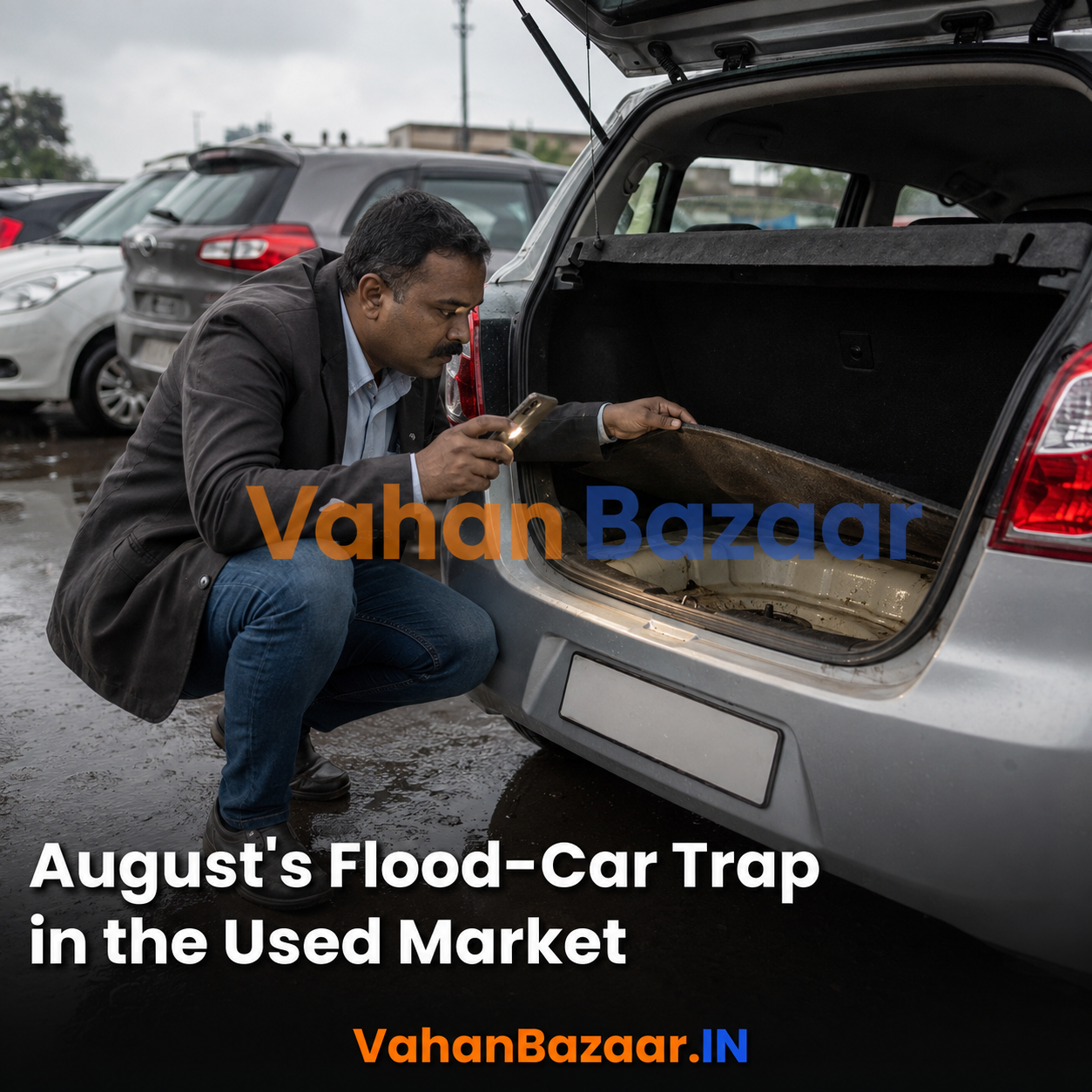
Every monsoon, the same quiet transaction plays out in the low-lying parts of Indian cities. Water rises through a basement car park or a flooded colony, submerges a row of cars for a few hours, and then recedes. The cars are towed away, and within weeks a large share of them reappear on the used market, deodorised, detailed and photographed to look like any other well-kept second-hand car. Submerged and waterlogged cars are recovered, cleaned and put back up for sale, often within weeks — and the buyer who cannot tell the difference is the one who ends up paying for someone else's flood.
This matters most right now because of the calendar. July and August see minimum demand and heightened buyer caution about flood damage, and it is also a pre-festive stock build-up period, when sellers list early ahead of the Navratri and Diwali rush. More inventory appears — including the risky inventory. Soft prices are real in these months, but so is the trap underneath them. This article covers the physical red flags of a cleaned-up flood car, why the damage is so expensive, and how to verify a car before you pay a single rupee of deposit.
A cleaned car hides the silt. A flood-damaged car can look showroom-fresh after a detailing job while its wiring and control units quietly corrode — so in the monsoon months, buy on verified evidence, never on appearance.
Why a Flooded Car Is Worse Than It Looks
A dent is honest. You can see it, price it, and decide. Flood damage is the opposite: the harm is invisible on the surface and it gets worse with time. When water sits inside a car, it does not simply dry out and disappear. It leaves moisture, salt and fine silt in exactly the places that matter most — the wiring harness, the connectors, the sensors and the electronic brain of the car.
Flood water damages the electronic control units, corrodes the wiring, and triggers unpredictable electrical failures months later. That last word — months — is what makes a flood car such a costly buy. The car may drive perfectly on the test drive and for several weeks after the sale. Then the corrosion, which has been spreading through the copper and the connector pins the whole time, starts to break circuits one by one. A power window stops responding. The instrument cluster flickers. The engine warning light comes on, clears itself, and returns. Each fault feels small; together they are a car that can never quite be fixed, because the root cause is spread across the entire electrical system rather than sitting in one replaceable part.
Because flood faults are intermittent and scattered across the electricals, the repair rarely arrives as one clean quote. It builds up over several workshop visits — which is why the true cost of a flood car is almost always far higher than the discount that lured the buyer in.
The Real Cost: Rs. 50,000 to Rs. 3 Lakh
Put a number on it and the trap becomes clear. Industry-cited hidden flood-damage repair exposure is in the Rs. 50,000 to Rs. 3 Lakh band for a typical compact or mid-size used car. A control unit replacement alone can run into tens of thousands of rupees; a full wiring harness on a mid-size car is a major job; and once the upholstery, carpets and electricals are added up across multiple visits, the total climbs steadily.
Set that against the discount that sold the car. A flood car is usually priced a little below the market to move quickly — attractive enough to tempt, not so cheap as to raise alarm. A buyer who saves, say, Rs. 40,000 on the sticker and then spends Rs. 1.5 Lakh chasing electrical faults over the following year has not found a bargain. They have bought the most expensive version of that car in the market. The monsoon months are when this exact arithmetic catches the most people, because that is when the supply of freshly cleaned-up flood cars is highest.
Cannot tell a cleaned flood car by eye? Let our AI engine read the photos and the record together first.
Run an AI Vahan InspectionThe Physical Red Flags to Check Yourself
Before any tool, there is your own inspection. A professional clean-up is thorough, but water leaves traces that are hard to erase completely if you know where to look. Go over a monsoon-season car in daylight and check every one of these:
- A musty or damp smell. Deodorisers and strong air fresheners are used to mask it, so be suspicious of a car that smells heavily perfumed. Sit inside with the doors shut for a minute; the damp note often returns.
- Silt in the crevices. Run your fingers under the carpets, along the seat runners, into the boot floor and the spare-wheel well, and inside the door pockets. Fine mud or a gritty residue where dust does not normally settle is a strong sign of standing water.
- Rust on seat rails and under-body bolts. Metal that has been submerged corrodes in places a normal car never rusts — the seat-mounting rails, the bolt heads under the seats, and the exposed metal under the dashboard.
- Foggy or water-marked headlights. Condensation or a tide line inside the headlamp and tail-lamp housings shows water sat inside the lenses.
- Mismatched interior trim. Carpets, door cards or seat fabric that look newer than the rest of the cabin, or do not quite match, often mean wet panels were swapped out during the clean-up.
- Electrical gremlins. Test every switch — windows, mirrors, central locking, the infotainment screen, all the lights, the fan speeds. Anything that hesitates, flickers or behaves oddly is a warning worth taking seriously.
None of these alone proves a flood, and a good clean-up can defeat a quick glance. That is the whole problem: the clean-up is designed to hide the silt and the smell, and a buyer often cannot tell a cleaned-up flood car from a genuine one by eye. Which is exactly where verification earns its keep.
Verify the Record, Then Read the Condition
Two checks turn a gut feeling into evidence. The first is cheap and fast; the second is the one that catches the flood car most buyers would miss.
Step one: the record check (Rs. 99)
Start with the paperwork. A Rs. 99 check on Vahan Verify reads the car's registration record from the VAHAN database and confirms the basics that a seller's story should match — the owner count, the registration status and the insurance validity. If a car that has supposedly led a quiet single-owner life shows a recent change of hands, or the insurance history looks disturbed, you have a reason to dig deeper before you spend a Saturday travelling to see it. It is the cheapest first step in any used-car purchase, and it takes minutes from your phone.
Step two: the AI Vahan Inspection (Rs. 249)
The record check tells you who owned the car and whether the papers are in order. It does not tell you whether the shiny car in the photographs is quietly a flood car. That is the gap the AI Vahan Inspection at Rs. 249 is built to close. Our AI engine reads the car's photographs and its VAHAN database record together and flags condition, mismatch and red-flag risks — before you pay a deposit.
This is the tool that fits the flood problem precisely. A cleaned car hides the silt from your eye, but it cannot make its photographs, its claimed history and its registration record all agree with each other when they should not. When the AI reads the images against the record, a car whose story does not line up is surfaced as a risk rather than slipping past a hurried buyer. It is not a replacement for a physical inspection or a trusted mechanic — it is the layer that catches the mismatches a single glance misses, and gives you an evidence-based reason to negotiate hard or walk away. For Rs. 249, before a deposit that could be tens of thousands, that is cheap insurance.
Why August Is the Riskiest Month to Buy on Price Alone
The seasonality is worth understanding, because it explains why the flood trap is at its worst just as prices look their most tempting. July and August are the deep monsoon lull: demand is at a minimum, sellers who want to be sold before the festive season are listing early, and buyer caution about flood damage is already high. That combination pushes soft prices — but it also floods the market with freshly recovered cars, because the same rains that keep buyers away are the rains that create the flood stock in the first place.
| Window | Market Condition | Flood-Car Risk | Buyer Verdict |
|---|---|---|---|
| July–August 2026 | Minimum demand; pre-festive stock build-up; soft prices | Highest | Buy only after verifying |
| September–October 2026 | Post-monsoon slump; roughly 4–7% negotiating room | Falling as problem cars surface | Often the better window |
| Festive peak (mid-Oct onward) | Navratri and Diwali demand; asking prices firm | Lower, but competition high | Least buyer leverage |
Directional view of typical monsoon and post-monsoon behaviour in most Indian cities; actual price movement and risk vary by city, segment and individual car.
Many experienced buyers conclude that September and October are the better buying window. The heaviest rains have passed, the worst of the freshly cleaned-up flood stock has started to reveal its faults, and the post-monsoon slump still leaves roughly 4 to 7 percent of negotiating room before the festive firming. You give up a little of August's softness and gain a market that has begun to sort the honest cars from the salvaged ones. If you do buy in the peak-risk August window, the rule is simple: never buy on price and appearance alone.
What This Means for Used Car Buyers
The flood trap is not a reason to avoid the used market in the monsoon — it is a reason to change how you buy in it. The single most dangerous habit at this time of year is trusting the shine: a well-detailed, sweet-smelling car with a confident seller is exactly the profile a cleaned-up flood car is engineered to present. The buyer who wins is the one who assumes nothing from appearance and insists on evidence.
The method is straightforward. Inspect the car yourself in daylight with the red-flag checklist above — the smell, the silt, the rust, the foggy lamps, the mismatched trim, the electrical gremlins. Confirm the paperwork with a Rs. 99 record check so the owner count, registration status and insurance validity match the seller's story. Then, because you cannot see silt through a clean interior, let the Rs. 249 AI Vahan Inspection read the photographs and the record together and flag the mismatches your eye would miss. And if the calendar allows, lean toward the September–October window, where the risk is lower and the negotiating room is still real. A flood car costs Rs. 50,000 to Rs. 3 Lakh to live with; the checks that keep you out of one cost a fraction of a single repair visit.
Don't Buy a Flood Car by Mistake
You cannot tell a cleaned-up flood car by eye. For Rs. 249, our AI engine reads the car's photos and its VAHAN database record together and flags condition, mismatch and red-flag risks before you pay a deposit. Start with a verified used car listing.
Run an AI Vahan InspectionFrequently Asked Questions
Look and smell before you trust the shine. The tell-tale physical red flags of a flood car are a musty or damp odour, silt or fine mud in crevices, under carpets and in the boot, rust on seat rails and under-body bolts, foggy or water-marked headlights, mismatched interior trim where wet panels were swapped, and electrical gremlins such as flickering lights or an infotainment screen that behaves oddly. A professional clean-up can hide the smell and the silt from a quick glance, so inspect in daylight, lift the carpets and check under the seats. Because a cleaned car hides the silt, the safest step is an AI Vahan Inspection at Rs. 249 that reads the car's photos alongside its VAHAN database record and flags condition and mismatch risks before you pay a deposit.
The monsoon does two things at once. It waterlogs and submerges cars in low-lying parts of Indian cities, and those cars are recovered, cleaned, deodorised and put back up for sale, often within weeks. At the same time, July and August are a pre-festive stock build-up period, so sellers list early ahead of the Navratri and Diwali rush and more inventory, including risky inventory, appears. Demand is at its minimum in these months and buyer caution about flood damage is high, which is exactly why a cleaned-up flood car may be priced attractively to move quickly.
Industry-cited hidden flood-damage repair exposure sits in the Rs. 50,000 to Rs. 3 Lakh band for a typical compact or mid-size used car. Flood water damages the electronic control units, corrodes the wiring harness and triggers unpredictable electrical failures that surface months after the sale, long after the seller is unreachable. Because the faults are intermittent and spread across the electricals, the repair bill builds up over several visits rather than arriving as one clean quote, which is what makes a flood car so expensive to own.
August has genuinely soft prices because demand is at its minimum, but the flood risk means you cannot buy on price and appearance alone. Many experienced buyers treat September and October as the better buying window, once the monsoon has passed and problem cars have started to reveal themselves, with roughly 4 to 7 percent of negotiating room in the post-monsoon slump. If you do buy in August, verify the record and inspect the condition first. A Rs. 99 record check confirms owner count, registration status and insurance validity, and a Rs. 249 AI Vahan Inspection reads the photos and the record together to flag red-flag risks before any money moves.
A buyer often cannot tell a cleaned-up flood car from a genuine one by eye, because the clean-up is designed to hide the silt and the smell. An AI Vahan Inspection at Rs. 249 does not rely on a single glance. Our AI engine reads the car's photos and its VAHAN database record together and flags condition, mismatch and red-flag risks, so a car whose photographs, claimed history and registration record do not line up is surfaced before you pay a deposit. It is not a substitute for a physical inspection, but it catches the mismatches a quick look misses and gives you an evidence-based reason to walk away or negotiate.
Related News
- Flood-Damaged Cars in the Monsoon Used Market
- The Invisible Chassis and Frame Damage in Flood Cars
- Flood Salvage and Total-Loss Cars: The Checks That Catch Them