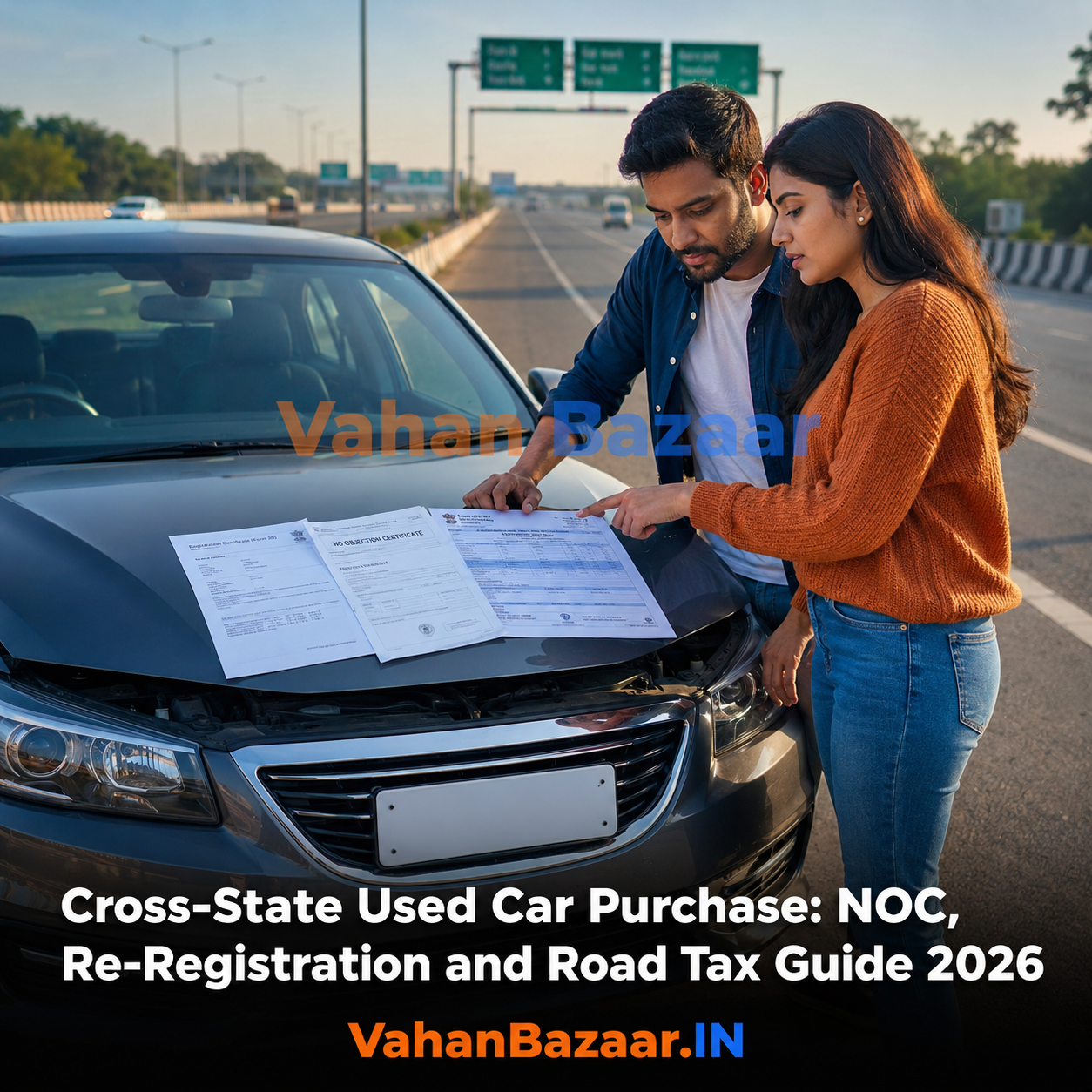
A cross-state used car purchase can save you significantly — prices in Tier 2 cities and neighbouring states are often 10–18% lower than metro markets. But the process carries hidden costs and procedural traps that catch buyers off guard. This guide covers every step from the Motor Vehicles Act 1988, CMVR 1989, and current RTO practice.
The most common shock: a surprise road tax bill of ₹30,000 to ₹80,000 after the car arrives in your state. The second most common trap: a deal collapsing because the seller has pending challans that the original RTO refuses to overlook when issuing the NOC. Both are entirely avoidable if you know the rules before you agree to buy.
The Legal Framework: What the Law Actually Says
Cross-state vehicle movement is governed by two primary statutes: the Motor Vehicles Act 1988 (MV Act) and the Central Motor Vehicles Rules 1989 (CMVR). Understanding the key provisions saves you from guessing.
Section 47 of the MV Act 1988: The 12-Month Grace Period
Under Section 47 of the MV Act 1988, a vehicle registered in one state may be kept or used in another state for a period of up to 12 months without re-registration. Once 12 months of use in the new state have elapsed, re-registration at the local RTO becomes mandatory.
This provision is important for buyers in two scenarios. First, if you are relocating temporarily, you have a year to sort out the paperwork without legal exposure. Second, after purchasing a cross-state vehicle, the 12-month window gives you time to complete the full NOC and re-registration process without driving an "illegal" vehicle.
Rule 54 of CMVR 1989: The NOC Procedure
Rule 54 of the Central Motor Vehicles Rules 1989 prescribes the procedure for obtaining a No Objection Certificate from the registering authority. The NOC is formally called Form 28 — "Application for grant of No Objection Certificate." The registering authority (original RTO) is required to verify that the vehicle has no outstanding financial liabilities, challans, or fitness violations before issuing the certificate.
Critically, the NOC process is required for cross-state transfers only. For a same-state transfer (both buyer and seller are in the same state), no NOC is required — you proceed directly with Form 29 (intimation of transfer) and Form 30 (application for transfer of ownership) at the local RTO. Some states have partially digitised this distinction, but the underlying legal requirement remains unchanged.
Understanding Road Tax: Where the Big Bill Comes From
This is the section most buyers skip — and the one that costs them the most.
Every state in India levies a lifetime road tax calculated as a percentage of the vehicle's ex-showroom price. When you purchase a car that was originally registered in another state, you are required to pay the road tax of your new state after re-registration. However, under Section 47 of the Motor Vehicles Act, 1988, and state-level motor vehicle taxation acts, you receive credit for the road tax already paid in the original state.
The net amount due = (New State Road Tax Rate − Original State Road Tax Rate) × Ex-Showroom Price.
A Worked Example
Consider a 2021 Maruti Swift VXi with an original ex-showroom price of ₹7.5 Lakh in Delhi. The seller paid Delhi road tax at 10% — that is, ₹75,000. You are buying this car to use in Maharashtra, where the lifetime road tax rate is 13%.
- Maharashtra road tax due: 13% of ₹7.5 Lakh = ₹97,500
- Credit for Delhi road tax already paid: ₹75,000
- Net additional road tax payable by buyer: ₹97,500 − ₹75,000 = ₹22,500
Now consider a more expensive SUV — say a 2020 Hyundai Creta with an ex-showroom price of ₹15 Lakh, originally registered in Haryana (5% road tax). Moving it to Karnataka (15%):
- Karnataka road tax due: 15% of ₹15 Lakh = ₹2.25 Lakh
- Credit for Haryana road tax: 5% of ₹15 Lakh = ₹75,000
- Net additional road tax: ₹1.5 Lakh
This is why cross-state purchases of higher-value vehicles coming from low road tax states (Haryana, Rajasthan, Madhya Pradesh) to high road tax states (Karnataka, Maharashtra, Tamil Nadu) carry the largest surprise bills. The differential can easily reach ₹80,000–₹1.5 Lakh on premium vehicles.
State-Wise Road Tax Rates: 2026 Reference
Road tax rates vary significantly by state. The following table covers the eight most relevant states for cross-state used car transactions in India. Note that some states have tiered rates based on vehicle cost or age — the figures below represent the standard rate for private passenger vehicles under ₹20 Lakh ex-showroom.
| State | Lifetime Road Tax Rate | On ₹10L Ex-Showroom | Notes |
|---|---|---|---|
| Maharashtra | 13% (varies by vehicle value) | ₹1,30,000 | Higher rate for vehicles above ₹20L ex-showroom |
| Karnataka | 15% (varies by vehicle value) | ₹1,50,000 | Highest among major states; tiered above ₹20L |
| Tamil Nadu | 10–20% (varies by vehicle value) | ~₹1,00,000–₹2,00,000 | Tiered: 10-12% up to ₹10L, ~13% up to ₹20L, 18-20% above ₹20L; additional green tax on older vehicles |
| Delhi | 10% | ₹1,00,000 | Additional surcharges may apply |
| Rajasthan | 8% | ₹80,000 | One of the lowest in north India |
| Madhya Pradesh | 8% | ₹80,000 | Low tax, common source state for buyers |
| Haryana | 5% | ₹50,000 | Very low — largest differential to south/west |
| Gujarat | 6–12% (varies by vehicle value) | ~₹80,000–₹1,20,000 | Tiered: ~6% up to ₹10L, ~8-9% up to ₹20L, ~12% above ₹20L ex-showroom |
The practical implication: a car registered in Haryana (5%) being re-registered in Karnataka (15%) carries a 10-percentage-point differential. On a ₹12 Lakh ex-showroom vehicle, that is ₹1.2 Lakh in additional road tax. Always factor this into your total cost before negotiating the purchase price.
The Full Process: Step-by-Step
Cross-state used car purchase involves coordinated action on both the seller's side (at the original RTO) and the buyer's side (at the new RTO). The two tracks run partially in parallel.
Seller's Responsibilities: Before Handover
-
1Clear all pending challans Check all outstanding challans through the state transport portal or VAHAN. Pay and obtain receipts. An unpaid challan blocks the NOC unconditionally.
-
2Ensure road tax is current Verify that all road tax dues in the original state have been paid and obtain the receipt. The RTO will cross-check this when processing the NOC.
-
3Obtain valid PUC and fitness certificate A valid Pollution Under Control (PUC) certificate is required. For vehicles above 15 years, a valid fitness certificate may also be needed at certain RTOs.
-
4Apply for NOC (Form 28) at original RTO Submit Form 28 with the original RC, valid insurance certificate, PUC certificate, road tax receipts, and identity proof. Some RTOs now accept this via the Parivahan portal (parivahan.gov.in). The RTO inspects and verifies all documents.
-
5File Form 29 (intimation of transfer) The seller must file Form 29 — "Notice of Transfer of Ownership" — with the original RTO within 14 days of the sale. This formally notifies the authority of the ownership change.
-
6Receive NOC The original RTO issues the NOC (Form 28) after verification. Timeline varies by RTO: 7 days to 30 days in practice. The NOC is typically valid for 6 months — the buyer must complete re-registration within this window.
Buyer's Responsibilities: After Receiving the Vehicle and NOC
-
1Verify NOC and all documents on receipt Before completing payment, verify that the NOC is genuine, the RC is original (not a duplicate), the chassis and engine numbers match, and insurance is valid.
-
2Calculate road tax differential Obtain the original ex-showroom price from the seller or from the manufacturer's website/brochure. Calculate the net road tax payable to the new state using the differential formula.
-
3Pay road tax at new state RTO Visit the new state RTO and pay the applicable road tax differential. In many states this can now be done via the Parivahan portal. Obtain the road tax payment receipt — this is a critical document.
-
4Submit Form 30 (transfer of ownership application) File Form 30 — "Application for Transfer of Ownership" — at the new state RTO. Attach the NOC (Form 28), Form 29, original RC, new insurance in buyer's name, road tax payment receipt, address proof, identity proof, and PUC certificate.
-
5Vehicle inspection at new RTO Many RTOs conduct a physical inspection of the vehicle to verify chassis and engine numbers. Bring the vehicle to the RTO on the scheduled date.
-
6Receive new RC in buyer's name and state After successful verification, the new RTO issues a fresh Registration Certificate in the buyer's name with the new state registration number. The old number plate must be replaced with a new high-security registration plate (HSRP) in the new state's format.
| Stage | Action | Who | Typical Timeline |
|---|---|---|---|
| Pre-purchase | Challan and RC status check | Buyer | Same day (online) |
| Pre-handover | Clear challans, get PUC, apply Form 28 NOC | Seller | 7–30 days |
| At sale | Form 29 filed by seller, sale deed / agreement signed | Seller + Buyer | Day of transaction |
| After handover | Road tax payment, Form 30 filing at new RTO | Buyer | Within NOC validity (typically 6 months) |
| New RTO | Vehicle inspection, document verification | Buyer + RTO | 15–45 days after Form 30 filing |
| Completion | New RC issued, new HSRP plates fitted | RTO | Total: 30–90 days from NOC application |
Check Challans and RC Status Before You Pay Any Advance
Pending challans block the NOC. A suspended RC means a blocked transfer. Run a Vahan Verify check on the registration number to confirm clean status before you commit to the purchase.
The Challan Problem: Why It Kills Deals
Outstanding traffic challans are the single most common reason a cross-state transfer falls apart. Under the Motor Vehicles (Amendment) Act 2019, electronic challans (e-challans) issued anywhere in India are linked to the vehicle's registration number in the central VAHAN database. The original RTO's NOC verification process includes a mandatory challan clearance check.
If the vehicle has unpaid challans — whether from camera-issued speed violations, signal jumping, lane discipline, or any other traffic infraction — the RTO will not issue Form 28 until they are paid in full. This is not a discretionary call; it is a procedural requirement.
The problem for buyers: challans may have been issued months or years before the sale, in cities the seller claims never to have visited. This is particularly common with inter-city driving and toll-plaza cameras. A seller in good faith may be unaware of a challan issued against their vehicle on the Delhi-Meerut Expressway three years ago.
For more on how e-challans can affect buyers, see our article on cross-state e-challan buyer liability in India.
Special Cases
Diesel Vehicles in Delhi NCR
If you are purchasing a used diesel vehicle from another state for use in Delhi, Gurugram, Noida, Faridabad, or Ghaziabad (the NCR), verify the vehicle's registration year before proceeding. The National Green Tribunal (NGT) and the Supreme Court of India have imposed restrictions on older diesel vehicles in the NCR. Diesel vehicles over 10 years old face restrictions on Delhi roads; those over 15 years are effectively unusable.
Buying a diesel car from another state for use in Delhi NCR carries a specific additional risk: the vehicle may clear all NOC and re-registration requirements yet still be operationally restricted by age-based diesel vehicle bans. Confirm the vehicle year against the current NGT order before committing to such a purchase.
Electric Vehicles
EV re-registration follows the same procedural path (Form 28 NOC, Form 29, Form 30), but the road tax burden is significantly lower. Most Indian states currently exempt or heavily discount lifetime road tax for electric vehicles as part of their EV adoption policies. In practice, the road tax differential on an EV cross-state transfer is often zero or nominal, making cross-state EV purchases considerably more financially straightforward than petrol or diesel equivalents.
Check the specific EV tax policy of your destination state at the time of purchase, as state-level EV incentives are subject to revision.
Vehicles Under Hypothecation (Loan)
If the vehicle you are purchasing still has an active loan and the hypothecation is noted on the RC, the process has an additional layer: you need a No Objection Certificate from the financier before the RTO will process the NOC. The bank or NBFC must issue a hypothecation clearance letter confirming the loan has been closed. This is not a quick step — many lenders take 15–30 working days to issue hypothecation removal documentation. For a full breakdown of this issue, see our article on the hypothecation trap in used car NOC transfers.
Documents Checklist
The following documents are required across both stages of the process. Organise these before initiating any step — missing documents are the most common cause of delays at RTOs.
Seller (for NOC application at original RTO)
- Form 28 — Application for NOC (available at parivahan.gov.in or RTO counter)
- Original Registration Certificate (RC)
- Valid insurance certificate
- Valid PUC certificate
- Road tax payment receipts for the original state
- Challan clearance proof (if applicable)
- Seller's identity proof and address proof
- Hypothecation clearance letter (if vehicle had a loan)
Buyer (for re-registration at new RTO)
- Original NOC (Form 28) issued by original RTO
- Form 29 — Intimation of Transfer (filed by seller)
- Form 30 — Application for Transfer of Ownership
- Original RC
- Valid insurance certificate in buyer's name
- Valid PUC certificate
- Road tax payment receipt for the new state
- Buyer's identity proof
- Buyer's address proof (new state)
- Sale agreement or purchase invoice
Price Arbitrage: Is the Saving Worth It?
Cross-state purchases are popular precisely because price gaps exist — and they are real. A 2022 Maruti Ertiga in a Tier 2 city in Rajasthan might be priced ₹80,000–₹1.2 Lakh cheaper than an equivalent car in Pune or Bengaluru. The question is whether the net saving, after accounting for all costs, still justifies the effort and risk.
Total cost of a cross-state purchase includes: the car price, road tax differential, NOC-related expenses (RTO fees, agent charges if any), new insurance premium, new HSRP plates, and your time and travel costs to manage the transaction. Our article on pincode-based price arbitrage and cross-state traps covers this calculation in detail.
The process also works in reverse: if you are a seller trying to sell a car originally registered in a high road-tax state to a buyer in a lower-tax state, the buyer's road tax cost is actually negative — the new state may owe them a partial refund of the differential. This scenario is uncommon but worth knowing.
For context on how the NOC landscape has evolved and which transfers have been streamlined, see our article on interstate NOC changes for RC transfer in India and our detailed analysis of the interstate RC NOC trap for used car buyers.
Know Before You Buy: Check the RC and Challans in 60 Seconds
Before finalising a cross-state purchase, run a Vahan Verify on the registration number to confirm zero pending challans and active RC status. A clean VAHAN report is the seller's strongest proof the NOC will come through — and your assurance that the deal will not collapse at the RTO.