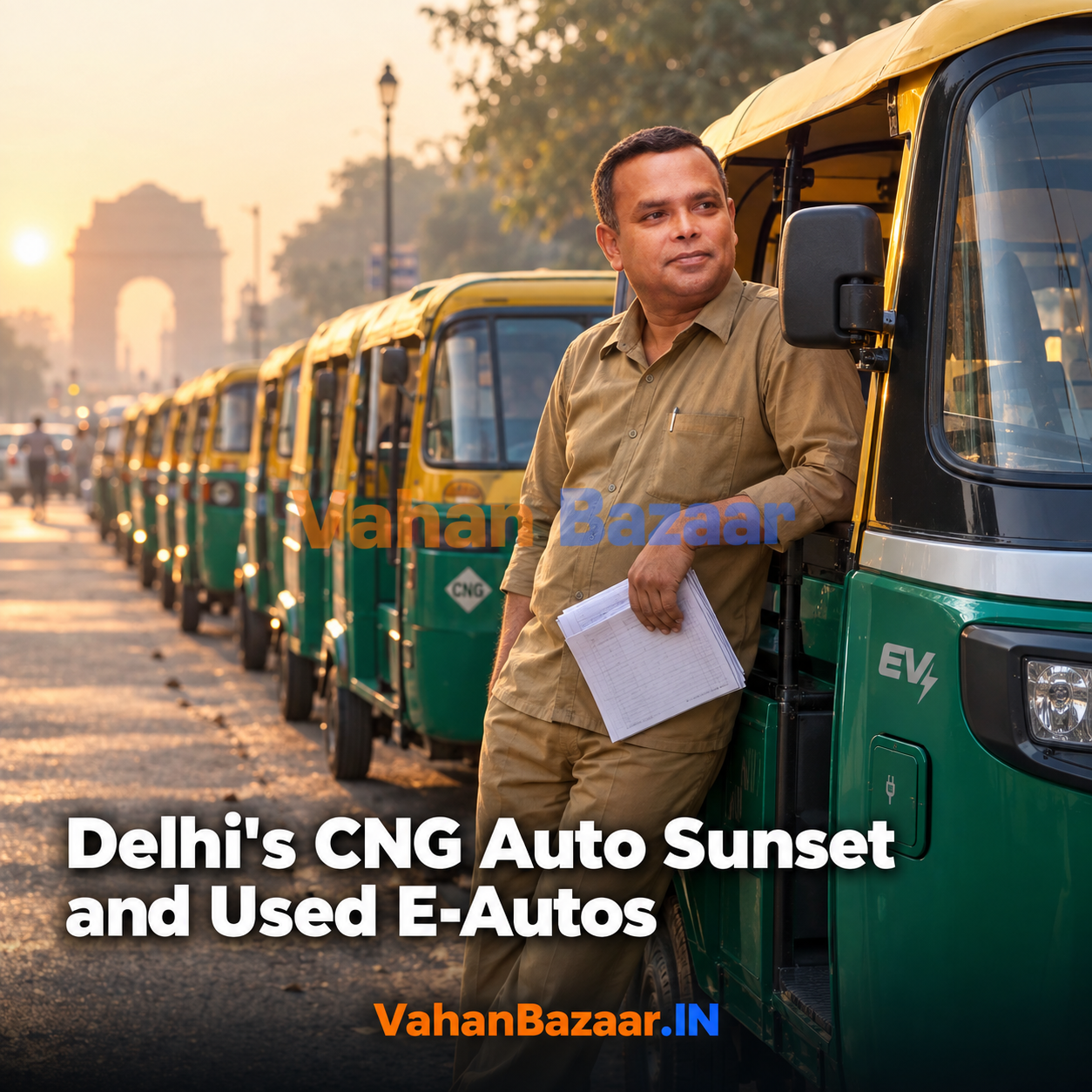
Most policy news does not reach the person it affects most. This one does, because the people it affects park outside metro stations at six in the morning and know exactly what their vehicle is worth, to the thousand rupee, at any moment. Delhi's notified EV Policy 2026 restricts fresh three-wheeler registrations to electric vehicles from 1 January 2027. After that date, a new petrol or CNG passenger auto cannot be registered in the capital. Only electric passenger three-wheelers and electric light goods carriers can.
That single sentence changes an arithmetic that thousands of drivers do in their heads every year. It does not, however, change it in the way most of the louder headlines suggested, and the gap between what was proposed and what was actually notified is where drivers are most likely to lose money.
What Delhi Has Notified, and What It Has Not
The policy that is now in force took effect from 1 July 2026 and runs to 31 March 2030. Its three-wheeler provision is clear and narrow: from 1 January 2027, only electric autorickshaws and electric light goods carriers will be permitted fresh registrations in Delhi. Alongside it sits a purchase incentive for electric three-wheelers of Rs. 50,000 in the first year, Rs. 40,000 in the second and Rs. 30,000 in the third, which is a real amount of money on a vehicle in this price band. Two-wheelers get a later cut-off, with new petrol and CNG registrations stopping from 1 April 2028, a change we covered when the petrol two-wheeler registration deadline was first reported.
Now the part that got lost. An earlier draft, reported everywhere as EV Policy 2.0, went considerably further. It proposed a much earlier halt on new CNG auto registrations, discussed not renewing CNG auto permits after a cut-off, and floated reissuing those permits as e-auto permits, alongside dates in August 2026 that were repeated in headline after headline. Those draft proposals were not carried into the notified policy. The August dates are not in force. Detailed rules for the existing CNG fleet, including anything about permit renewals, have not been released.
A proposal in a draft policy and a provision in a notified policy are not the same thing, and drivers have been quoted prices on the basis of the first. The fixed part is the 1 January 2027 fresh-registration cut-off. Everything about the existing fleet is still developing. If someone is pressing you to sell a working CNG auto cheaply this month because of a deadline they have read about, ask them to point to the notified rule. Very often they cannot.
The official position has been consistent through all of it: the restrictions apply to new registrations, and a vehicle already registered and running is not being taken off the road by this policy. That is worth reading twice if you own a CNG auto, because it is the difference between an asset that depreciates on a schedule and one that becomes worthless overnight. Nothing notified so far describes the second scenario.
What a Fresh-Registration Cut-off Actually Does to Resale Value
A registration cut-off does not destroy the value of the vehicles already registered. What it does is shut off the supply of new ones, and that has two opposite effects on a used CNG auto's price that arrive at different times.
In the near term, a working CNG auto with a valid registration and a valid permit is one of a fixed and no longer growing population. Anybody who wants to operate a CNG auto in Delhi after the cut-off has to buy an existing one, because no new one can be registered. That is a supply constraint, and supply constraints support prices rather than collapsing them.
Over the longer run the direction reverses. The fleet ages without replacement, the resale pool shrinks as vehicles reach the end of their service lives, and buyer demand steadily migrates towards electric because that is the only side of the market where a new vehicle can still be bought. A CNG auto's remaining earning life stops being about its condition alone and starts being about how many years of registration and permit validity it has left in it.
For a driver, that turns one question into the whole valuation: how much validity is left, and where can it be verified? Not how the engine sounds, not how the body looks. How many years the paperwork has left. And the paperwork is the one thing a seller's description is least reliable about, because it is the one thing a buyer historically could not check without asking.
An E-Rickshaw and an E-Auto Are Not the Same Vehicle
Here is where a lot of used three-wheeler money goes wrong, and it goes wrong in listing photographs that look almost identical.
An e-rickshaw is a low-speed battery vehicle. The definition caps it at 25 kilometres per hour and at not more than four passengers besides the driver. An e-auto is an L5M vehicle: a passenger three-wheeler that exceeds those speed and motor-power limits, seats a comparable number of passengers under a different rule set, and is the direct electric equivalent of the CNG auto a Delhi driver already knows. The notified Delhi provision is written around electric passenger autos and electric light goods carriers, which is the L5M and N1 side of the market.
These two categories earn differently, are regulated differently, are priced differently and hold their value differently. A buyer who thinks they are purchasing the electric replacement for a CNG auto, and who actually buys a low-speed e-rickshaw because the photograph looked right and the seller said auto, has bought a vehicle that cannot do the job they bought it for. The vehicle class field in the record is where that question is settled in about ten seconds, and it is settled by the government's own record rather than by anybody's description.
| What you are comparing | CNG auto (existing fleet) | E-rickshaw (low speed) | E-auto (L5M passenger) |
|---|---|---|---|
| Speed and capability | Full road speed, long shifts | Capped at 25 km/h by definition | Exceeds the low-speed limits |
| Fresh Delhi registration from 1 Jan 2027 | Not permitted for new registrations | Electric, so on the permitted side | Electric, so on the permitted side |
| Delhi purchase incentive on a new vehicle | Not applicable | Depends on the category the vehicle falls in | Rs. 50,000, then Rs. 40,000, then Rs. 30,000 by policy year |
| Vehicle class shown in the record | Yes, and it settles the fuel type too | Yes, if the vehicle is registered at all | Yes, and it separates it from an e-rickshaw |
| Permit position | Separate paperwork, must be seen | Rules vary by state, must be confirmed | Separate paperwork, must be seen |
| Biggest used-market risk | Remaining validity, not condition | Vehicle never registered in the first place | Wrong class sold as the right one |
Read the last row across. Three different vehicles, three different ways to lose money, and one field in the record that separates all three of them before you have handed over anything.
The Registration Gap Sitting Under the Cheapest Listings
There is a reason the vehicle class check matters more on three-wheelers than on almost anything else, and it is uncomfortable. The Electric Vehicle Manufacturers Society has estimated that roughly 4.75 Lakh electric rickshaws are operating across India without registration, fitness certification or insurance. That is not a rounding error at the edge of the market. It is a parallel fleet.
The consequences of that gap are now visible in the system. The Delhi High Court has taken up a public interest case seeking stricter enforcement of e-rickshaw regulations, and the Delhi government has been considering a one-month registration window for unregistered e-rickshaw operators to come into the system. Both of those point the same way: the tolerance for unregistered three-wheelers is narrowing, not widening.
For anybody buying second-hand, that produces a plain risk. An unregistered vehicle cannot be transferred to you, cannot be insured properly, cannot be financed, and is exposed the moment enforcement tightens. It also tends to be the cheapest thing in the market, which is exactly why it finds buyers. Our separate report on the 4.75 Lakh unregistered electric rickshaws works through that problem in detail, and the short version is that price and paperwork are related in a way that should make a suspiciously cheap listing slower to buy, not faster.
Registration is not only a compliance box either. Electric three-wheelers are overwhelmingly commercial vehicles bought to earn, and registration is what unlocks purchase subsidies, and in many cities priority parking, toll exemptions and access to charging corridors. An unregistered vehicle is cut off from all of it. The saving at purchase is repaid, with interest, over every month of operation.
The Fields That Carry the Policy Clock
The useful thing about a policy with dates in it is that the dates are read against the vehicle's own record, and the record is available against nothing more than a registration number. Five fields do most of the work on a three-wheeler.
1. Date of first registration
This is the true age, and on a commercial three-wheeler age is the single strongest predictor of how much earning life is left. It also settles disputes: the year in a listing and the year in the record are frequently different numbers, and only one of them is the government's. Every calculation about remaining validity starts here.
2. Vehicle class
The field that separates an e-rickshaw from an e-auto, and a passenger three-wheeler from a goods carrier. If you are buying to carry fare-paying passengers, this field decides whether the vehicle in front of you can legally do that at all. It is also the field that quietly tells you which side of Delhi's 1 January 2027 line the vehicle sits on.
3. Registration status
Active, suspended, cancelled or blacklisted. A vehicle with a status that is not what the seller implied is a conversation that ends there, and the status is not something a buyer can infer from the condition of the vehicle or the confidence of the person selling it.
4. Fitness validity
On a commercial three-wheeler this is not a formality. Fitness validity is a hard limit on the vehicle's ability to work, and buying one with fitness about to lapse means inheriting whatever it costs to bring the vehicle back into compliance. Read the date, and price the deal from that date rather than from the day you take delivery.
5. Hypothecation
If a lender still holds a charge on the vehicle, ownership cannot transfer to you until it is cleared, however sincerely the seller believes the loan is closed. On commercial three-wheelers, which are very often financed, this is one of the most common reasons a transfer stalls after money has moved. Checking it costs Rs. 99 and takes seconds.
The permit. A passenger three-wheeler earns its living on a permit, and that is separate paperwork which has to be seen, read and verified with the issuing authority in its own right. Our guide to the permit and registration checks on an auto or e-rickshaw covers what to ask for and in what order. Treat the record check as the fast filter that comes first, and the permit as the document you insist on seeing before any money changes hands.
Read the Clock Before You Pay for the Vehicle
Date of first registration and true age, month and year of manufacture, registration status, vehicle class, registered owner serial number, fuel type, hypothecation against a lender, insurance and fitness validity, and blacklist flags — pulled from the VAHAN database against any registration number, three-wheeler or car. RC check Rs. 99, challan check Rs. 99, or both together for Rs. 149.
What This Means for Buyers
If you are buying a used e-auto in Delhi to get ahead of the transition, your job is narrower than it looks. You are not trying to predict policy. You are trying to confirm that the specific vehicle in front of you is what it claims to be and has enough validity left to earn.
So do it in this order. Run the record check on the registration number first, before you travel and before you negotiate, because it needs nothing at all from the seller and it is the step most likely to end the conversation. Confirm the vehicle class is the category you actually want, confirm the registration status is active, read the date of first registration against the age claimed in the listing, read the fitness validity as a date you will inherit, and look for a hypothecation entry that has not been cleared. Then ask for the permit paperwork and verify it separately. Then look at the batteries, the tyres and the vehicle itself.
Two specific traps deserve naming. The first is the low-speed vehicle sold as an e-auto, which is a class problem the record solves outright. The second is the unregistered vehicle sold at a price that makes no sense, which is a problem the record also solves, because a vehicle with no record is telling you something extremely important by returning nothing at all. Our earlier piece on the permit a used e-auto needs to earn goes deeper into the operating side of that decision.
And do not price a used electric three-wheeler against a new one without accounting for the incentive on the new one. Rs. 50,000 in the first policy year, tapering to Rs. 40,000 and then Rs. 30,000, is money that applies to a new purchase and does not follow the vehicle into the second-hand market. A used e-auto has to be cheap enough to be worth buying against a new one that carries that support, and sellers do not always do that subtraction for you.
What This Means for Sellers
If you own a CNG auto in Delhi, the first thing to do is stop reacting to headlines. Your vehicle is not being taken off the road by this policy, and the notified provision is about new registrations. Panic selling into a market full of buyers who have read the same headlines is how a working asset gets sold for less than it is worth.
The second thing is to understand what a buyer is now actually paying for. Not condition, not paint, not seat covers. Remaining validity. A CNG auto with clean registration status, comfortable fitness validity, a permit in order and no hypothecation left on the record is worth materially more than an identical-looking one where any of those is uncertain, and the gap widens as the cut-off approaches. The paperwork is the product now.
Which means the seller who proves it up front wins the negotiation before it starts. Pull the record yourself, know exactly what it says, and be ready to put those dates in front of a buyer instead of asking them to take your word. A buyer who can see the fitness date and the clean hypothecation position does not need to discount for uncertainty, because there is none left to discount for. If you are selling a car alongside the three-wheeler, a verified listing at Rs. 99 cross-checks the vehicle against the official record and carries a Verified badge, which is the same principle applied to a listing page. Rs. 99 is.
Finally, watch the transport department's own circulars rather than the resale rumour mill. The existing-fleet rules are the part still being written, and when they are notified they will be notified properly. Until then, anybody quoting you a deadline for permits is quoting a draft.
The Short Version
Delhi's notified EV Policy 2026, in force from 1 July 2026 to 31 March 2030, restricts fresh three-wheeler registrations to electric vehicles from 1 January 2027. New electric three-wheelers carry a purchase incentive of Rs. 50,000, then Rs. 40,000, then Rs. 30,000 across the first three policy years. Two-wheelers follow later, from 1 April 2028.
The earlier draft's proposals about halting CNG auto registrations sooner and not renewing CNG auto permits were not carried into the notified policy, and detailed rules for the existing fleet have not been released. Restrictions apply to new registrations; vehicles already on the road are not being removed by this policy.
For a used three-wheeler buyer, the two expensive mistakes are buying a low-speed e-rickshaw believing it to be an L5M e-auto, and buying a vehicle that was never registered at all, in a national pool the Electric Vehicle Manufacturers Society has estimated at roughly 4.75 Lakh unregistered electric rickshaws. Both are visible in the record, or in its absence.
So run the Rs. 99 check on the registration number first. Date of first registration for true age, vehicle class for what it legally is, registration status, fitness validity as the date you inherit, and hypothecation for whether ownership can transfer at all. Verify the permit separately as its own document. Then inspect the vehicle. In that order, because that is the order that costs least and disqualifies fastest.
Frequently Asked Questions
No. What the notified Delhi EV Policy 2026 does is restrict fresh registrations. From 1 January 2027, only electric passenger three-wheelers and electric light goods carriers will be accepted for new registration in the capital. The government's stated position has been consistent: the restriction applies to new registrations, and vehicles already on the road are not being taken off it by this policy. An earlier draft, widely reported as EV Policy 2.0, had proposed a much earlier halt and other measures around the existing CNG fleet, but those proposals were not carried into the policy that was notified with effect from 1 July 2026. Treat the 1 January 2027 date as the fixed part and everything about the existing fleet as still developing.
Nothing in the notified policy states that existing CNG auto permits stop being renewed, and detailed rules for the existing fleet have not been released. The draft that preceded it did discuss ending renewals and reissuing permits as e-auto permits, and that proposal is what much of the reporting was based on, but a draft proposal is not a rule. The honest position for a driver in September 2026 is that the fresh-registration cut-off is settled and the permit question for the existing fleet is not. Do not buy or sell on the strength of a date that has not been notified, and check the transport department's own circulars before making a decision that costs you a vehicle.
They are related but they are not the same category of vehicle, and the difference matters to the price. An e-rickshaw is a low-speed battery vehicle limited to 25 kilometres per hour and built to carry not more than four passengers besides the driver. An e-auto is an L5M vehicle, a passenger three-wheeler that exceeds those limits on speed and motor power, and it is the direct electric equivalent of the CNG auto most Delhi drivers know. Two used three-wheelers can look similar in a listing photograph and belong to different classes with different rules, different earning ability and very different values. The vehicle class field in the record is where that question is settled, not the seller's description.
The same fields it shows on any registered motor vehicle: the date of first registration and therefore the true age, the month and year of manufacture, the registration status, the vehicle class, the registered owner serial number, the fuel type, whether a lender still holds a hypothecation charge, the insurance validity dates, the fitness validity and any blacklist entry. On a commercial three-wheeler bought to earn a living, four of those do most of the work, namely the date of first registration, the vehicle class, the fitness validity and the hypothecation entry. The RC check is Rs. 99, the challan check is Rs. 99, and both together are Rs. 149. All you need is the registration number.
No, and it is important not to assume otherwise. The record settles registration, vehicle class, fitness validity, hypothecation and the other fields listed above, which together tell you whether the vehicle legally exists as what the seller claims it is. The permit is separate paperwork that has to be seen, read and verified with the issuing transport authority in its own right, because a passenger three-wheeler without a valid permit cannot legally carry fare-paying passengers no matter how clean its registration looks. Run the record check first because it is cheap, fast and needs nothing from the seller, then treat the permit as a separate document you insist on seeing before any money changes hands.