Two stories are running in parallel in Indian motoring right now, and the gap between them is where used EV buyers will either save money or lose it.
The first story is the boom. Electric car sales are set to cross 3 Lakh units in calendar 2026 for the first time, up from just under 2 Lakh in 2025, as reported by IBEF. Registrations approached 1.5 Lakh units in the first half of the year, and the average monthly run rate has climbed to around 27,000 over the past four months.
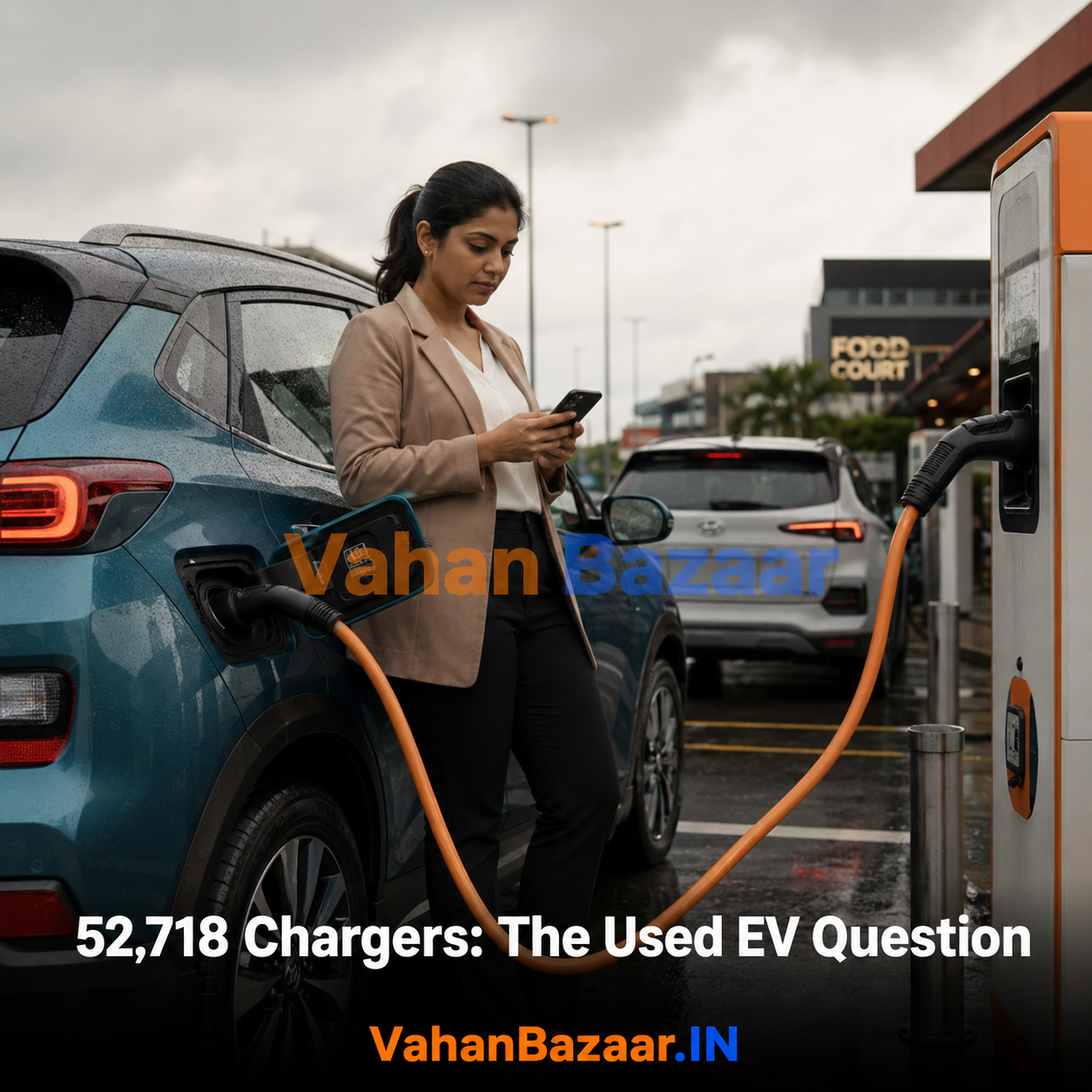
The second story is the infrastructure trying to keep up. As of July 2026, India had 52,718 public EV charging stations, of which 16,561 offer fast charging, per industry and ministry data reported by S&P Global Mobility. That means roughly two-thirds of the public network is made up of slow AC units, the kind that need hours, not minutes. Industry analysts now describe charging availability, not price or model choice, as the binding constraint on Indian EV adoption.
Between those two stories sits a third one that gets almost no coverage: the first substantial wave of used EVs is reaching the second-hand market, sold by early adopters upgrading, fleets rotating stock and owners who discovered their charging situation did not match the brochure. If you are considering one of these cars, the price tag is the least complicated part of the decision.
Considering a used EV? Pull its official VAHAN record first. Owner count, hypothecation, registration status and blacklist flags, in minutes.
The Boom Is Real: What the 2026 Numbers Say
Start with the demand side, because it explains why used EVs are suddenly a category rather than a curiosity. Quarterly electric car retails reached 82,011 units in Q2 2026, an 88.69 per cent jump from 43,464 units in the same quarter a year earlier. That is not a niche growing politely. That is a segment nearly doubling year on year.
The manufacturer numbers tell the same story. Tata Motors sold 31,604 electric cars in the first four months of 2026, up 65.2 per cent, according to company sales data. Mahindra recorded the highest growth among major players, at 18,153 units, up 170.4 per cent. When two of the country's biggest carmakers are posting EV growth of 65 and 170 per cent, the cars being registered today are the used inventory of 2028 and 2029, and the cars registered in 2022 and 2023 are the used inventory of right now.
Every one of those early cars was bought into a market with far fewer chargers than exist today. Some were bought by households with a garage and a 15-amp socket, and have led gentle lives. Others were bought by fleet and taxi operators, and have been fast-charged twice a day since the day they were registered. From the outside, on a listing photo, the two cars look identical.
52,718 Chargers, and Why Two-Thirds of Them Are Slow
The network number deserves a closer look, because the headline flatters the reality. Of the 52,718 public charging stations counted as of July 2026, only 16,561 offer fast charging. The remaining stations, roughly two out of every three, are slow AC units. A slow charger is perfectly useful if the car parks next to it for six hours. It is close to useless for a driver who needs 200 km of range added during a lunch stop on the highway.
The growth itself is genuinely rapid. As we covered earlier this year, India had roughly 27,700 public chargers as of March 2026, which means the network has expanded dramatically in a matter of months. But it is growing from a small base against a sales curve that is steepening at the same time: around 27,000 electric cars are now being registered every month, each one a new claim on the same public plugs. This is exactly why industry analysts have shifted from calling charging a convenience issue to calling it the binding constraint on adoption.
A used EV buyer in Coimbatore, Indore or Bhubaneswar does not charge on the national average. What matters is how many working chargers, and specifically fast chargers, exist on the routes that one household actually drives: home to office, home to the highway, the monthly run to a home town. The national count of 52,718 says the network is growing. It says nothing about your pin code.
Layer One: The Charging Reality Check
The first due-diligence layer has nothing to do with the specific car. It is about whether an EV, any EV, fits your life. Three questions settle it.
Can you charge where the car sleeps?
Home charging is what makes EV running costs attractive and ownership predictable. If you have a dedicated parking spot where a charger or even a reinforced 15-amp point can be installed, most of the public-network question stops mattering for daily use. If you park on the street or in a shared lot with no power access, you are betting your daily commute on public infrastructure where only one in three stations is fast. Our home EV charging setup cost guide walks through what an installation actually costs, and our comparison of home versus public charging costs shows how different the per-kilometre economics are between the two.
How dense are fast chargers on your actual routes?
Before negotiating on any used EV, open a charging map and trace your three most common journeys. Count the fast chargers, not the total pins, because a slow AC unit at a mall you never visit is not infrastructure, it is a statistic. Metros like Delhi, Mumbai, Bangalore and Pune are meaningfully better served than tier-2 cities, and highways between metros are better served than the roads that branch off them. If your routine regularly leaves the well-covered corridors, the car's rated range matters far more, and an older EV with a degraded battery has less of it.
What happens when you sell it?
This is the question buyers forget. A used EV in a city with thin fast-charging coverage will face exactly the same scepticism from the next buyer that you should be applying now. Resale liquidity for EVs in tier-2 and tier-3 markets depends on local charging density catching up. If it does, early buyers look smart. If it lags, the discount you are enjoying today gets passed on, larger, to you at resale time. Price that risk in, rather than discovering it in three years.
Layer Two: The Paper Trail Nobody Photographs
The second layer is specific to the car in front of you, and it lives in the official record, not in the listing photos.
Fleet and taxi history
A large share of India's early electric cars went to fleet and taxi operators, because predictable daily running made the economics work first for them. Fleet cars live hard lives: high daily kilometres, frequent fast charging, multiple drivers. On the VAHAN record, that history tends to surface as a corporate or company registration, a commercial category, or an owner count that does not match the "single owner, gently used" story in the advertisement. None of that is visible in photographs, and battery wear from years of daily fast-charging cycles is invisible until you own the replacement bill.
Hypothecation: the loan that becomes your problem
Many EVs on the used market are still under finance, and an active loan appears as a hypothecation entry on the RC. Buy a car with an undischarged hypothecation and the lender's claim on the vehicle survives the handshake. Until the seller closes the loan and removes the entry, you cannot cleanly transfer ownership, and in the worst case you are holding a car a financier can repossess. This is a thirty-second check against the VAHAN database, and it is astonishing how many buyers pay several Lakh without making it.
The warranty that does not follow the car
The battery is the single most expensive component in an EV, and the long battery warranties that headline every EV launch frequently apply to the first owner only. As we detailed in our piece on why lifetime battery warranties do not transfer to used EV buyers, the cover can lapse the day the RC moves to your name. Confirm the transfer terms with the manufacturer in writing before you pay, because a used EV with a live battery warranty and an identical one without it are not the same purchase at the same price.
With a used petrol car, a hidden history costs you in niggles and repairs spread over years. With a used EV, the downside is concentrated in one component: a heavily cycled fleet battery, out of warranty, in a car whose record you never pulled. The check that would have surfaced the corporate registration and the hypothecation flag costs Rs 99. The battery it warns you about costs several Lakh.
What This Means for Used EV Buyers
Put the two layers together and the used EV decision becomes clear, and clearer than most buyers make it.
First, the market context favours buyers who do their homework. Sales set to cross 3 Lakh units this year mean supply of used EVs will keep thickening, so there is no need to rush at the first car that fits the budget. At the same time, a public network of 52,718 stations, of which only 16,561 are fast, means charging convenience is unevenly distributed, and the value of any individual used EV is tied to the map around it. The same car is a better purchase in a fast-charger-dense metro corridor than in a district where the nearest fast plug is 40 km away.
Second, the cars arriving on the used market now are precisely the ones where history checks pay for themselves. The 2021-2023 cohort includes a meaningful proportion of fleet and taxi units, financed cars with live hypothecation entries, and vehicles whose headline battery warranty will not survive the ownership transfer. The seller knows which of these applies. The listing will not tell you. The official record will.
So before committing to any used EV, pull its VAHAN record. A Vahan Verify check on VahanBazaar costs Rs 99 and returns the car's official registration status, owner serial number, hypothecation flag, insurance validity and blacklist status straight from the VAHAN database, with a pending-challan check available for another Rs 99, or both together for Rs 149 instead of Rs 198. Owner count and ownership type expose the fleet story. The hypothecation flag exposes the loan. Registration status exposes a blacklisted or cancelled RC before it becomes your problem. For a purchase where the battery alone can cost several Lakh to replace, it is the cheapest component of the entire transaction.
The EV transition is happening, the numbers above put that beyond argument. But a transition this fast produces a used market full of cars with very different histories wearing very similar price tags. The buyers who come out ahead will be the ones who checked the map and the record before they checked the colour options.
Check the Record Before You Check the Car
A Vahan Verify check pulls a used EV's official record from the VAHAN database in minutes: owner count, registration status, hypothecation flag, insurance validity and blacklist status for Rs 99. Add a pending-challan check for Rs 99, or run both together for Rs 149 instead of Rs 198. Know the car's real history before you negotiate on it.
Frequently Asked Questions
As of July 2026, India had 52,718 public EV charging stations, of which 16,561 offer fast charging, according to industry and ministry data reported by S&P Global Mobility. That means roughly two-thirds of public chargers are slow AC units. The network is growing quickly from a small base: India had around 27,700 public chargers as of March 2026, so thousands of stations have been added in a few months, but density outside the big metros remains thin relative to how fast electric car sales are rising.
Be cautious. Home or workplace charging is what makes EV ownership cheap and predictable; relying entirely on public infrastructure means depending on a network where only 16,561 of 52,718 stations offer fast charging as of July 2026. Before committing, map the working chargers on the routes you actually drive, not the city-wide count. If you have no dedicated parking with a power point and no reliable fast charger within your routine, a used EV can turn from a bargain into a daily logistics problem, and resale in your city will face the same question from the next buyer.
Pull the vehicle's VAHAN record before you negotiate. A Vahan Verify check on VahanBazaar costs Rs 99 and shows the owner serial number, registration status and ownership type against the official VAHAN database. Fleet and taxi history typically shows up as a corporate or company registration, a commercial registration category, or a higher owner count than the seller's story suggests. Early electric cars were bought in large numbers by fleets, so this check matters more for used EVs than for most petrol cars.
Often not in full. Several manufacturers offer long or lifetime battery warranties that apply only to the first registered owner, so the cover can lapse the day the car is transferred to your name. Since the battery is the single most expensive component of an EV, confirm the warranty terms in writing with the manufacturer before you pay, and verify the car's registration and hypothecation status on its VAHAN record with a Rs 99 Vahan Verify check so there are no surprises on the RC either.