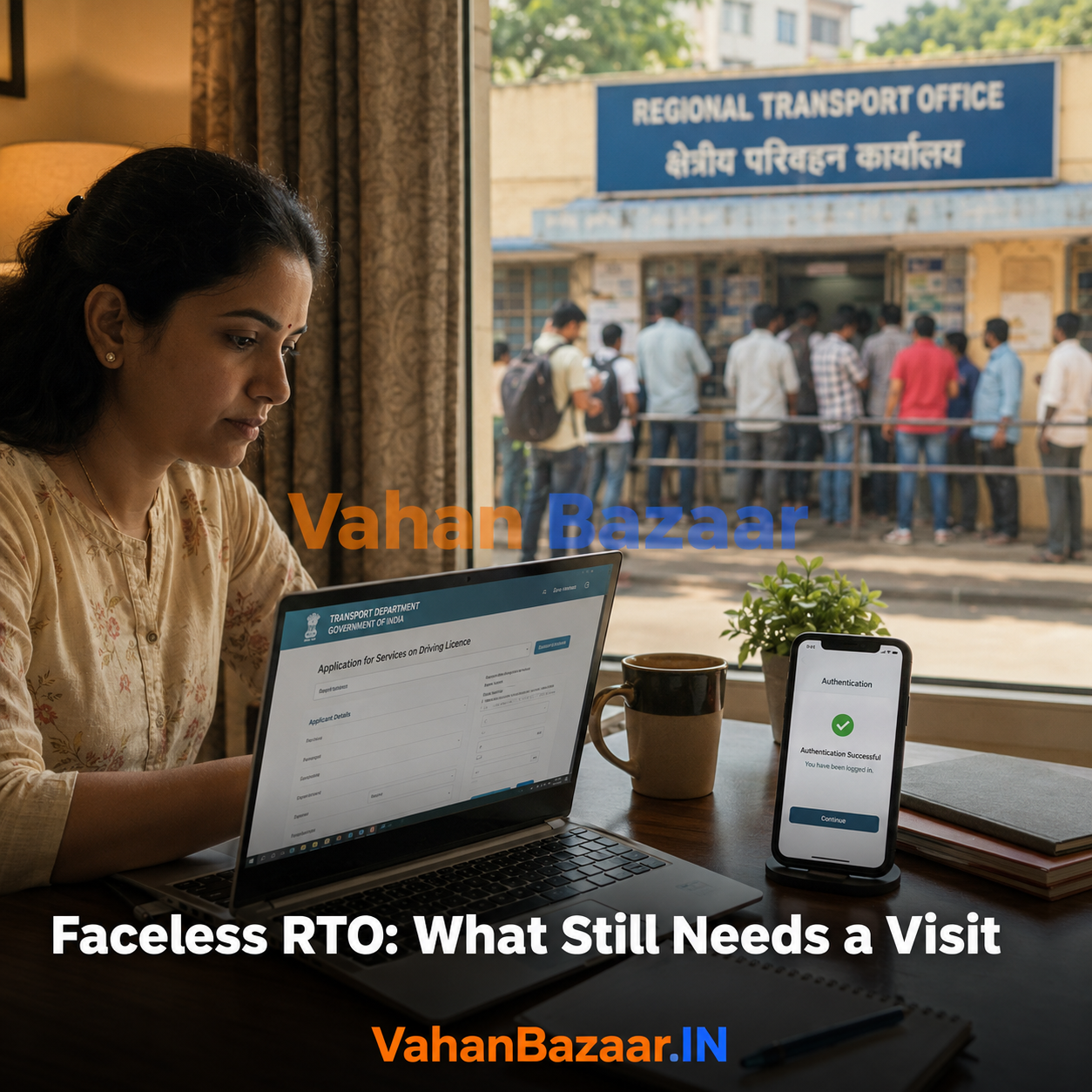
Someone tells you the RTO has gone faceless and you can do the whole thing from your phone. Someone else tells you they still had to take a day off work. Both of them are telling the truth, because they were doing different tasks.
The move to online transport services has been real and substantial. A broad set of services are now offered online in many states, and Aadhaar-based electronic KYC is available as an optional authentication route for several of them, which removes the in-person identity check that used to anchor everything else to a physical counter. That is a meaningful change, and the direction of travel is clearly towards more of it.
The problem is the word "online". It gets used to describe two very different situations, and a used-car buyer or seller who cannot tell them apart will plan a transfer around an assumption and discover the gap on the day.
"Online" Is Not One Thing
A service can be online in the sense that you submit the application from home, pay from home, and track it from home — and still require a physical step somewhere in the middle before it completes. The application is digital. The verification, the inspection or the fitment is not.
That is not a flaw in the design. Some things genuinely cannot be done remotely. A vehicle cannot be inspected over a network. A number plate cannot be riveted on by an app. A driving test needs a driver. The services that require a physical step require it for a reason, and the transport departments that have digitised everything around those steps have done the useful part of the work.
What matters for a used-car transaction is simply knowing which pile each task falls into before you plan your week around it. So here is the honest split, with the caveat that runs through this entire article: the exact position varies by state, and the only authority on what applies to you is your state Transport Department or your RTO.
Transport is administered at state level. A service that is fully online in one state may still involve a counter visit in another, and rollouts move at different speeds. Nothing below is a state-by-state guarantee, and we are not going to invent one. Use it as a framework for what questions to ask, then confirm the position for your own state and your own vehicle with the Transport Department or the RTO before you commit to a timeline.
What Is Genuinely End-to-End Online in Most States
The services commonly offered online across many states now include driving licence services, registration certificate services, change of address on the RC, issuance of a duplicate RC and a duplicate driving licence, intimation of transfer of ownership, payment of tax, and applications for a fitness certificate.
Several of those genuinely finish without you going anywhere, because nothing about them needs a person or a vehicle to be examined. Paying road tax is a payment. Applying for a duplicate document is a form plus a fee plus a record lookup. Intimating a change of address is a declaration supported by proof, which is what our step-by-step on changing the address on your RC using Form 33 walks through. Replacing a lost registration certificate follows a similar shape, and the duplicate RC process is one of the cleaner examples of a task that has moved fully online in a lot of places.
Driving licence renewal is the standout case of a service that has genuinely moved, and we covered the shift in detail when licence renewal went online across states. Where Aadhaar e-KYC is accepted, the identity leg of that process stops being a queue.
Where the Application Is Online but a Physical Step Remains
The second pile is the one that catches people. These tasks accept an online application, take an online payment, and give you an online status — and then, at some point, need something physical to happen.
Fitness testing for older vehicles increasingly happens at automated testing stations, which are operational in cities including Delhi, Mumbai, Pune, Chennai and Bengaluru. An automated station reduces discretion and makes the result more consistent, which is the point of them, but it is still by definition a physical inspection of the vehicle. You can apply for the fitness certificate from home. You cannot attend the test from home.
High security registration plates are the other clear case. The plate has to be physically fitted, so there is an in-person appointment regardless of how the booking is made. The booking being online does not make the fitment online.
Driving licence testing sits in the same category for the obvious reason. The application, the slot booking, the fee and the document upload can all be digital. The test involves the applicant.
| Task | Can it be done online | What physical step remains | Who it applies to |
|---|---|---|---|
| Paying road tax | Yes | None in most states | Buyer or seller, before transfer |
| Duplicate RC or duplicate licence | Yes | None in most states | Owner with a lost document |
| Change of address on the RC | Yes | None in most states | Owner who has moved |
| Intimating transfer of ownership | Partly | Signed Form 29 and Form 30; dues cleared before completion | Buyer and seller together |
| Fitness certificate for an older vehicle | Partly | Vehicle inspection at an automated testing station | Owner of a vehicle due for fitness |
| High security plate fitment | Partly | Fitment appointment in person | Owner whose plate position is not settled |
| Driving licence test | In person | The applicant attends the test | New or upgrading licence holders |
The third pile deserves naming even though we cannot populate it responsibly: the tasks whose position is genuinely state-dependent and worth confirming before you plan around them. That includes how far the transfer of ownership can be completed digitally in your state, whether an inspection is called for on a particular vehicle's age or class, and how the plate position is handled locally. If a timeline matters to you — a buyer waiting to take delivery, a seller waiting to be released from liability — that confirmation is a five-minute call that saves a wasted week.
What Aadhaar e-KYC Removes, and What It Cannot
Aadhaar-based electronic KYC authenticates a person. Where it is offered and used, it replaces the in-person identity verification step for that service. That is the whole of what it does, and it does it well.
What it cannot do is verify a vehicle. It cannot tell you whether the car in front of you was first registered in the year the seller says it was. It cannot tell you how many owners it has actually had. It cannot tell you whether road tax is paid, whether challans are outstanding, whether an insurance policy is live, or whether a lender still holds a charge over the registration.
Those facts do not live in your identity. They live in the vehicle's record. And the distinction matters more than it sounds, because a smooth, fully authenticated, entirely contactless application can still be for a vehicle whose record will not support the transaction you are about to make.
A digital transport service tells you the status of your application. It does not tell you the condition of the record you are about to inherit. Those are different questions with different answers, and the second one is the one a buyer needs settled before paying. An application can be perfectly in order and still stall because the vehicle behind it is not.
The RTO verifies outstanding dues — road tax, challans and other fines — before completing a transfer. That is the mechanism by which an otherwise complete application stalls. The paperwork is fine. The people are authenticated. The vehicle owes money, so nothing moves. Our piece on how pending challans can block an RC transfer covers exactly how this plays out and who ends up carrying the delay.
Check the Record Before You Plan the Transfer
Know What You Are Inheriting
Registration status, date of first registration and true age, owner serial number, the insurance validity position, and hypothecation and blacklist flags — read from the VAHAN database against any registration number, before any money moves. RC check Rs. 99, challan check Rs. 99, or both together for Rs. 149.
The reason this sits at Rs. 99 rather than at the end of a negotiation is that it changes the order of the transaction. Instead of paying, applying, and then finding out what the record says, you find out what the record says and then decide what to pay. The dues position, the true age, the owner count and the hypothecation flag are all things a buyer would rather know on the test drive than on the day the transfer stalls.
Sequencing a Used-Car Transfer So Nothing Stalls
Once you accept that some steps are online and some are not, the transaction becomes a sequencing problem rather than a mystery. Do things in this order and the physical steps stop being surprises.
- Read the record first. Registration status, date of first registration and true age, owner serial number, insurance validity position, hypothecation and blacklist flags. This is the cheapest step and the one that determines whether the rest is worth doing at all.
- Clear the dues second. Road tax, challans and other fines are verified by the RTO before a transfer completes, so settle them — and agree in writing who is paying — before the forms go in, not after.
- Complete the forms third. Form 29 is the Notice of Transfer, filed by the seller in two copies. Form 30 is the Application for Transfer, signed by both buyer and seller, also in two copies.
- File the intimation inside the window. Fourteen days for a same-state transfer, forty-five days where the vehicle has moved under a No Objection Certificate.
- Confirm the registered owner has actually changed. Fees are broadly Rs. 300 to Rs. 500 plus the smart-card fee, indicative and state-dependent, and the new RC is typically issued within 7 to 30 days. Check the record again once that window has passed.
The forms are worth understanding rather than signing blind, and our explainer on Form 29, Form 30 and the fourteen-day rule sets out what each one does and why two copies of each exist. If you are moving a two-wheeler rather than a car, the same architecture applies with smaller numbers, and the walkthrough on transferring a used bike's RC with Aadhaar e-KYC covers the differences.
What This Means for Buyers
The convenience is real, and you should use it. But do not let a smooth digital process create the impression that the underlying facts have been checked on your behalf. They have not. The portal is processing your application; it is not vetting your purchase.
So establish the record before you pay, not after. That single Rs. 99 look answers the questions that decide whether the transfer will complete cleanly: whether the vehicle's registration is in order, how old it genuinely is against what you were told, how many owners have actually held it, whether insurance is live, and whether a financier still holds a charge that will block the transfer until it is released.
Then plan for the physical steps rather than hoping they will not apply. If the car is old enough that fitness is in play, an automated testing station visit is part of your timeline. If the plate position is unsettled, a fitment appointment is part of it too. Neither is a problem when you have planned for it. Both are a problem when you discover them on the day you expected to drive away. The full set of pre-purchase checks lives in our Vahan Check tools.
What This Means for Sellers
A seller's exposure in this system is time, and the clock is not sympathetic to good intentions. Until the transfer is recorded against the buyer, the vehicle is still yours in the record, with whatever that implies for challans and liability arising after the sale. That is the substance of the fourteen-day rule and what it means for seller liability, and it is the reason a seller should care about the buyer's paperwork as much as the buyer does.
The practical move is to remove every reason for the transfer to stall before you list. Clear the dues. Get the hypothecation released if a loan has been closed. Have Form 29 and Form 30 ready rather than negotiated over. A buyer who cannot find a reason to hesitate does not hesitate.
Presenting that position upfront is what a verified listing at Rs. 99 is for. The vehicle is cross-checked against the VAHAN database and the listing carries a Verified badge, so the registration position is established on the page rather than argued about on a call. On average, based on VahanBazaar listings data, verified listings draw about three times the buyer enquiries and sell around 40 percent faster than unverified ones. Rs. 99 is.
The Short Version
A broad set of transport services are now offered online in many states — licence services, RC services, address change, duplicate documents, transfer intimation, tax payment and fitness applications — with Aadhaar e-KYC available as an optional authentication route for several of them.
But "online application" and "no physical step" are not the same claim. Fitness testing at an automated testing station is an inspection of the vehicle. High security plate fitment is an appointment. Licence testing involves the driver. And the precise position varies by state, so confirm yours rather than assuming.
Most importantly: the digital service reports the status of your application. It does not report the condition of the record you are about to inherit. Reading that record costs Rs. 99 and belongs at the start of the transaction, before the dues, the forms and the fourteen-day clock.
Frequently Asked Questions
The intimation of transfer is offered online in many states, and Aadhaar-based electronic KYC can authenticate the people involved without an in-person identity check. What that does not guarantee is that the whole transaction finishes from home. Form 29 and Form 30 still have to be signed, outstanding dues have to be cleared before the RTO completes the transfer, and depending on the vehicle's age or plate position an inspection or a fitment appointment may be required. Treat the online route as the default and the physical step as the exception you should confirm for your state rather than assume away.
Aadhaar-based electronic KYC is offered as an optional authentication route for several transport services, and where it is used it replaces the in-person identity verification step for those services. That is a real saving of time. What it does not do is verify anything about the vehicle. It confirms that you are who you say you are. It does not confirm the car's true age, its owner serial number, whether road tax and challans are clear, or whether a lender still holds a charge over it. Those facts sit in the vehicle's registration record, not in your identity.
Anything that requires a person, a vehicle or a physical object to be examined or fitted. Fitness testing for older vehicles increasingly happens at automated testing stations, which are operational in cities including Delhi, Mumbai, Pune, Chennai and Bengaluru, and that is by definition a physical inspection of the vehicle. High security registration plates must be physically fitted, so that is an in-person appointment however the booking is made. Driving licence testing involves the applicant in person. The exact list varies by state, so confirm with the state Transport Department or RTO before you plan around it.
Fourteen days for a transfer within the same state, and forty-five days where the vehicle has moved under a No Objection Certificate. Form 29 is the Notice of Transfer, filed by the seller in two copies. Form 30 is the Application for Transfer and is signed by both the buyer and the seller, also in two copies. Transfer fees are broadly in the Rs. 300 to Rs. 500 range plus the smart-card fee, which is indicative and depends on the state, and the new registration certificate is typically issued within 7 to 30 days.
It will tell you the status of your own application. It will not, on its own, hand a prospective buyer a settled picture of the car before they pay. The RTO verifies outstanding dues such as road tax, challans and other fines before completing a transfer, which means unpaid dues can stall an otherwise complete application after the money has changed hands. Establishing the record beforehand is the point of a Rs. 99 check on VahanBazaar, which returns registration status, date of first registration and true age, owner serial number, the insurance validity position, and hypothecation and blacklist flags. A challan check is a separate Rs. 99, or both together for Rs. 149.