There is a quiet assumption that runs underneath a very large number of used car purchases in India, and almost nobody says it out loud. It goes like this: a bank has agreed to finance this car, so somebody with more expertise than me has looked at it and found it acceptable.
It is an entirely understandable assumption. A lender is a serious institution. It employs people whose job is risk. It asks for documents, it takes its time, and it says no often enough that a yes feels like it means something. When the sanction letter arrives, a buyer's remaining doubts tend to go quiet.
The assumption is also wrong, and it is wrong in a specific and expensive way. A lender verifies the borrower. It examines the documents placed before it. It values the asset it is lending against. What it does not do, as a matter of ordinary process, is send somebody to the vehicle to read the chassis and engine numbers stamped on the body and compare them, character by character, with what the government vehicle record holds for that registration number.
That gap between "the paperwork was in order" and "the car is what the paperwork says it is" is where a reported case from April 2026 sits.
What Was Reported in Bilaspur
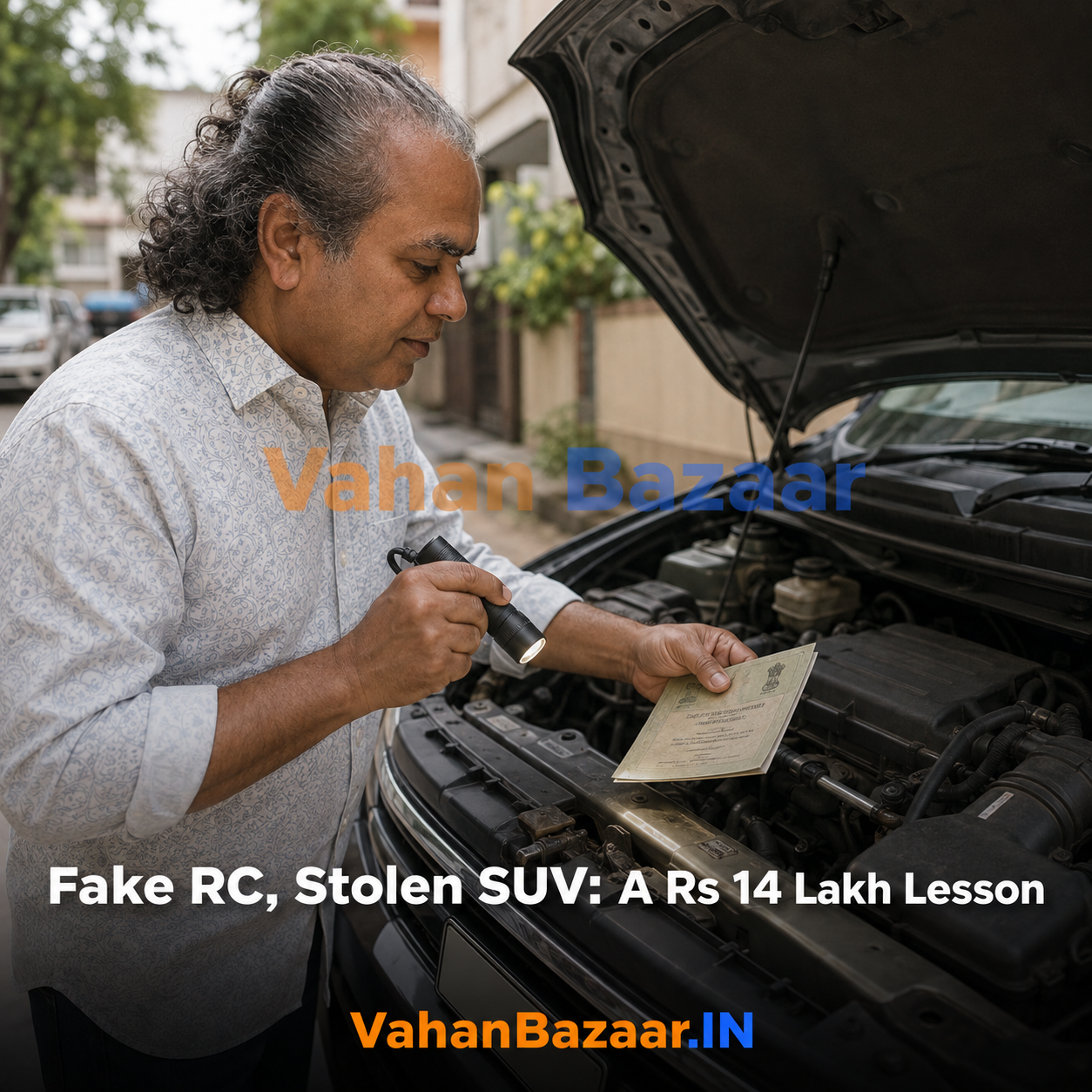
In April 2026 it was reported that a used-car trader in Bilaspur, Himachal Pradesh sold a stolen SUV for Rs 14 Lakh, using a fake registration certificate that carried incorrect chassis and engine numbers.
The buyer paid Rs 3 Lakh in cash and financed the remaining Rs 11.5 Lakh through a Punjab National Bank vehicle loan. The fraud came to light only when a police investigation established that the vehicle was stolen and that a theft case had already been registered in Amritsar, Punjab.
It is worth being precise about who did what here, because the useful lesson is not the obvious one. The bank followed a normal lending process. A vehicle loan is underwritten on the borrower's credit profile and on documents that are presented as genuine. There is no suggestion of wrongdoing by the lender, and treating this as a story about a bank getting something wrong would miss the point entirely.
The point is structural. Nowhere in a routine transaction of this shape does anybody independently confirm that the physical vehicle matches the government record. The trader controlled the paper. The paper looked right. Everyone downstream of the paper — including a buyer parting with Rs 14 Lakh and a lender releasing Rs 11.5 Lakh of it — was reasoning from the same forged starting point.
Loan approval is a statement about the borrower and the documents. It is not a statement about the vehicle. Those two things feel identical at the moment of purchase and are completely different things when a police investigation begins.
Why a Forged RC Beats the Eye and Loses to the Record
A registration certificate is a printed card. Producing a convincing one is a document exercise, and document exercises are exactly the sort of thing that has become easier over the years, not harder. Fonts can be matched. Layouts can be copied. Numbers can be typed.
What a forger cannot do is reach into the government vehicle database and change what is held against a registration number. The chassis number, the engine number, the make and model, the date of registration, the owner count, the registration status — those live in a record the seller does not control.
That asymmetry is the entire defence available to a buyer, and it is a strong one. It means the question you should be asking is not "does this document look genuine?" — a question you are poorly equipped to answer while standing in a stranger's driveway — but "does the record agree with this document?", which is a question anyone can answer in about a minute.
| Detail | What the paper RC in your hand shows | What the government record shows |
|---|---|---|
| Chassis number (VIN) | Whatever was printed on the card | The chassis number actually registered against that number plate |
| Engine number | Whatever was printed on the card | The engine number actually registered against that number plate |
| Owner serial | Can be understated to make the car look less traded | The owner count held in the record |
| Registration status | A clean-looking card says nothing about status | Active, suspended, blacklisted or cancelled, as recorded |
| Insurance validity | A policy document may be expired, cancelled or unrelated | Insurance validity as reflected in the record |
| Date of registration | Easy to present alongside a more flattering "model year" | The registration date the vehicle's real age is counted from |
| Pending challans | Never printed on an RC at all | Challan flags recorded against the vehicle |
| Theft or blacklist markers | Nothing on a forged card will ever say this | Blacklist flags as recorded against the vehicle |
Read down the middle column and then the right-hand one. Every single row in the middle column is controlled by whoever printed the card. Not one row in the right-hand column is.
The seller controls the document. Nobody controls the record. Rs. 99 pulls owner count, registration status, insurance validity, blacklist and challan flags, and the vehicle's real age.
What a Buyer Can Actually Cross-Check Before Paying
This is the practical half, and it is deliberately unglamorous. None of it requires mechanical knowledge. All of it can be done before any money moves.
Read the numbers off the car, not off the card
Every vehicle carries its chassis number — the VIN — stamped or plated on the body itself, and an engine number stamped on the engine block. Find both. Photograph both clearly, in good light, without the seller helpfully holding a torch at an angle. Then compare each character against what the government record returns for that registration number.
Look at the stampings themselves while you are there. Grinding marks around the plate, uneven character spacing, a rivet that does not match its neighbours, fresh paint confined to the area around the number, or a plate that sits slightly proud of the surface it is fixed to — none of these prove anything on their own, and all of them are reasons to slow down and insist on the record before you go further. A vehicle whose identity has been altered is a different problem from a vehicle whose paperwork is untidy, and the physical stampings are where the two are told apart.
Establish who has owned it, and how many of them there were
Owner count is the single most commonly understated fact in a used car conversation, and it is trivially checkable. A car described as single-owner that shows three transfers on the record tells you something about the car and rather more about the seller. Owner history also shapes price honestly: the market pays differently for a one-owner car and a fourth-hand one, and you should not be paying the first price for the second car.
Check registration status, including blacklist flags
A registration can be active, suspended, blacklisted or cancelled. A buyer looking at a printed card has no way of knowing which. This matters most in exactly the situation where it is hardest to detect: the paperwork looks fine, the car drives well, the seller is pleasant, and the status flag sitting against the registration number is the only thing in the entire transaction that would have told you to walk away.
Check insurance validity and the vehicle's real age
An insurance document handed to you is a piece of paper about a policy that may have lapsed, been cancelled, or been issued against a different vehicle entirely. Validity as reflected in the record is a different order of evidence. Age is the same story: the date of registration is what a vehicle's age is actually counted from, and it is frequently a year or more behind the "model year" a listing leads with.
Check the challans before you inherit them
Unpaid challans registered against a vehicle can block RC transfer at the RTO regardless of the buyer's own driving record. This is the failure mode that catches otherwise careful buyers: the deal completes, the money is gone, and the transfer stalls on penalties that were incurred by somebody else years earlier. Our explainer on how unpaid challans block RC transfer covers the mechanics, and the short version is that you want to know the number before you negotiate, not after.
Run the record check before you travel to see the car, and certainly before you pay token money. A deposit handed over on the strength of a document you have not cross-checked is the point at which a buyer's leverage disappears. The record costs Rs. 99. Recovering an advance from a seller who has stopped answering the phone costs considerably more than that.
The Wider Pattern: Weak Law, Slow Remedies
The Bilaspur case is dramatic because a theft was involved. Most of what goes wrong in the used car market is duller and far more common, and the remedies available afterwards are the same in both cases: slow, general-purpose, and dependent on you being able to prove what you were told.
Consider odometer tampering. Industry estimates put roughly one in five used cars in India as carrying a tampered odometer, with an estimated 300,000 clocked vehicles changing hands every year. That is not a fringe problem. And yet there is no Indian law that criminalises odometer tampering by name — the word "odometer" does not appear anywhere in the Motor Vehicles Act 1988.
What that leaves a buyer with is Section 420 of the Indian Penal Code for cheating and a complaint under the Consumer Protection Act 2019. Both are real and both are usable. Neither is fast. In a separate documented case, also from April 2026, a buyer discovered a 71,000 km rollback on a car he had owned for less than two weeks. His options were exactly those two: a general cheating provision in the criminal code, and a consumer forum complaint that could take years to resolve. Two weeks of ownership, and a remedy measured in years.
The pattern across both cases is the same. Indian law gives a defrauded used car buyer a route to justice. It does not give them a fast one, and it does not give them a specific one. Which pushes the entire weight of protection to the front of the transaction, before the money moves, where it costs almost nothing and works almost every time.
The market is formalising, just not evenly
It is worth saying that the direction of travel is good. Since March 2026, physical submission of Form 20 has not been accepted in most states; dealers now upload digitally verified documents directly to the government vehicle database, and roughly 90 percent of new non-transport vehicle registrations go through Dealer Point Registration. That is a meaningful reduction in the amount of paper floating between a buyer and a government record.
But that is the new car pipeline. The used market is a different animal, with a long tail of individual dealers and private sellers operating outside any digital chain of custody. The overwhelming majority of them are honest people running small businesses. The problem is not that the trade is crooked. The problem is that a buyer standing in front of a car has no way to tell the difference by looking, and the one participant with a clear incentive to misrepresent the vehicle is also the one supplying all the paperwork about it.
What This Means for Used Car Buyers
Three things follow from all of this, and they are all actionable today.
First, stop treating financing as verification. A sanctioned loan means a lender was satisfied with you and with the documents it saw. It is not a certificate of the car's provenance, and it never was. If your confidence in a used purchase rests partly on "the bank approved it", move that weight somewhere it can actually bear load. Our piece on why most used-car deals are now financed sets out how ordinary this situation has become.
Second, verify identity before you verify condition. A test drive tells you about a car. It tells you nothing about whether the car is legally sellable by the person selling it. Confirming that the seller's name appears on the record, that the chassis and engine numbers match, and that the registration is not carrying a blacklist flag comes before any conversation about tyres or service history. There is a natural order here and most buyers run it backwards. Our guide to checking whether the seller is the real registered owner and the breakdown of the six blacklist flags worth knowing both cover this ground, as does our tips article on cloned cars and VIN mismatch.
Third, price the check against the exposure, not against your coffee budget. This is the arithmetic that matters. The buyer in Bilaspur was exposed to Rs 14 Lakh, Rs 11.5 Lakh of it borrowed and repayable regardless of what the police eventually found. A Vahan Verify check pulls the car's VAHAN and RTO record against the registration number — owner count, registration status, insurance validity, blacklist and challan flags, and the vehicle's real age — for Rs. 99. A challan check is another Rs. 99, and both together cost Rs. 149 instead of Rs. 198 separately.
Rs 99 against Rs 14 Lakh of exposure. That is the whole trade.
This applies whether you are looking at listings in Amritsar, Chandigarh or anywhere else, and it applies with particular force in the SUV segment, where ticket sizes are high enough that a single bad transaction is genuinely life-altering for a middle-income household. Buyers working through the used SUV field or looking specifically at used Mahindra Scorpio listings are dealing in exactly the price band the Bilaspur case sat in. If you are browsing used car listings at Rs 10 Lakh and above, the record check is not an optional extra. It is the cheapest line item in the entire purchase.
None of this requires you to be suspicious of everyone you meet. Most sellers are honest, most cars are what they claim to be, and most transactions complete without incident. The record check is not an accusation. It is simply the difference between believing something and knowing it — and on a purchase this size, knowing costs Rs. 99.
Read the Record, Not the Paperwork
Owner count, registration status including blacklist flags, insurance validity, challan flags and the vehicle's real age, pulled from the VAHAN database against the registration number. The seller controls the document they hand you. Nobody controls the record. RC check Rs. 99, challan check Rs. 99, or both together for Rs. 149 instead of Rs. 198.
Not sure which check you need? See exactly what the Rs 99 check returns.
Frequently Asked Questions
A lender assesses the borrower's creditworthiness and the documents placed before it, and it values the asset it is lending against. That is a credit process, not a forensic examination of the vehicle. A lender does not, as a matter of routine, walk to the car, read the chassis and engine numbers stamped on the body and compare them line by line with the government vehicle record. So a sanctioned loan tells you the borrower qualified and the paperwork looked in order. It does not independently establish that the car matches its registration certificate.
Because a forger controls the paper and not the database. Printing a convincing-looking card with a real registration number and false chassis and engine numbers is a document exercise. Changing what the government vehicle record holds against that registration number is not. That asymmetry is the buyer's protection: the moment you stop reading the document the seller hands you and start reading the record held against the registration number, a forged RC has nothing left to stand on.
Find the chassis or VIN plate and the engine number stamped on the vehicle itself, photograph both clearly, and compare them character by character against what the government record returns for that registration number. Then check owner count, registration status including any blacklist flag, insurance validity and the vehicle's age from the date of registration. Look at the stampings themselves too: grinding marks, uneven spacing, fresh paint over the plate area or a rivet that does not match the others are all reasons to slow down.
There is no Indian law that criminalises odometer tampering by name. The word "odometer" does not appear in the Motor Vehicles Act 1988. Buyers fall back on general remedies: Section 420 of the Indian Penal Code for cheating, and a complaint under the Consumer Protection Act 2019. In a documented April 2026 case, a buyer who found a 71,000 km rollback on a car he had owned less than two weeks was left with exactly those two routes, and a consumer forum complaint that could take years.
An RC check costs Rs. 99 and a challan check costs Rs. 99. Both together cost Rs. 149 rather than Rs. 198 separately. Against a registration number, the check pulls the car's VAHAN and RTO record: owner count, registration status, insurance validity, blacklist and challan flags, and vehicle age. It is a read of the government record rather than of the seller's paperwork, which is the whole point of running it before money changes hands.