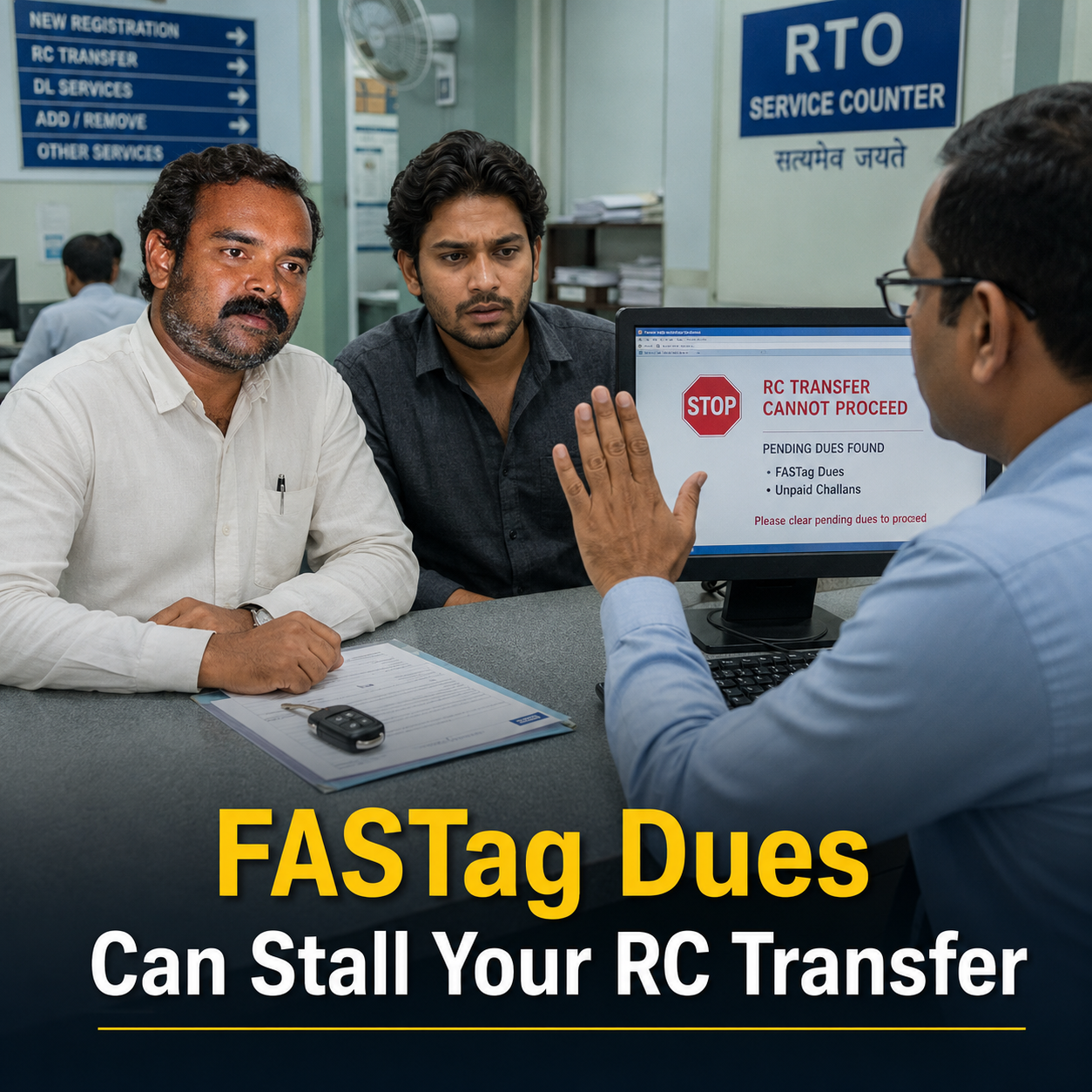
A used car deal rarely collapses over the big things. The price gets negotiated, the test drive goes fine, the paperwork looks complete — and then, at the RTO, a Rs. 300 toll balance nobody remembered stops everything. Under the tightened 2026 transfer procedure, RTOs are reported to withhold Form 28 — the transfer NOC — when the eChallan record shows unpaid e-challans, court-pending challans or FASTag-linked dues against the registration number, as reported across RTO advisories and industry coverage. The practice is not uniform across every state, but the direction of travel is unmistakable: transfer paperwork is increasingly cross-checked against the vehicle's dues record before it moves.
The principle behind it is the part every buyer and seller needs to internalise: dues follow the car, not the person. A challan issued to the previous owner, a toll deducted against a lapsed FASTag, a court-pending case from a camera two years ago — all of it sits against the registration number. When that number comes up for transfer, the record comes with it. And until the file clears, the seller stays legally exposed and the buyer cannot register. A five-minute check before the deal beats a three-month RTO tangle after it.
Every unpaid rupee against a registration number — challan, court case or FASTag toll — can surface exactly when the RC transfer is filed. Buyers should pull the car's dues record before paying a token; sellers should clear it before listing. Both checks take minutes.
Why Old Dues Now Surface at the RTO
For years, a vehicle's dues record and its transfer paperwork lived in separate silos. That gap has closed. The government's digitisation of vehicle records — the VAHAN registry, the Parivahan eChallan system and FASTag's toll trail — has given every registration number a single, connected history that any RTO can see in seconds. This is genuinely good for the used car market: it makes a vehicle's past transparent to anyone who checks, instead of known only to the seller.
The flip side is enforcement. As reported across RTO advisories and industry coverage, offices processing transfers under the tightened 2026 procedure are holding back Form 28, the no-objection certificate that a transfer or interstate move rides on, when the eChallan record shows anything pending — unpaid e-challans, challans that have escalated to court, or dues linked to the vehicle's FASTag. Because this is applied office by office rather than as a single published nationwide rule, two identical files can move at different speeds in different cities. What no longer varies is the risk: if the record is not clean, the transfer can stop.
Delhi has made the link explicit
Delhi's new traffic rules remove any ambiguity about where this is heading. Challans are now tied directly to licence and RC services: a challan left unpaid beyond 45 days can lead to the vehicle being blacklisted and RC or DL services being blocked. We covered the mechanics of that regime in detail in our piece on the 45-day challan deadline and the RC-insurance lock — the short version is that the days of ignoring a challan indefinitely are over in the capital, and other states tend to follow Delhi's enforcement template.
Buying used? A Rs. 99 challan check shows what the RTO will see before you pay a token.
What a Blacklist Flag Actually Freezes
Blacklisting sounds abstract until you list what it switches off. A blacklisted vehicle cannot complete an RC transfer, cannot renew road tax online, cannot obtain a fitness certificate, and cannot get an interstate NOC. For a used car changing hands, that is the entire paperwork chain — frozen. The buyer cannot become the registered owner; the seller cannot exit the record. We have written before about how a blacklisted used car traps its buyer, and the FASTag angle makes it easier than ever to stumble into: with barrier-free tolling, a car with a dead or unfunded tag keeps accumulating toll dues silently — no boom barrier ever stops it, but the balance keeps building against the registration number.
Here is the practical map of what can stall a transfer and how each item gets cleared.
| What blocks the transfer | Why it stalls the file | How to clear it |
|---|---|---|
| Unpaid e-challans | Pending dues visible on the eChallan record; Form 28 reported withheld until settled | Pay online on the Parivahan eChallan portal — usually minutes, instant receipt |
| Court-pending challans | Cannot be paid online; the case sits with a virtual or physical court | Court appearance or Lok Adalat settlement — can take weeks to list and close |
| FASTag-linked toll dues | Unpaid tolls accrue against the registration number, silently under barrier-free tolling | Recharge or regularise the tag and settle the outstanding toll balance |
| Blacklist flag on the RC | Freezes RC transfer, online road tax, fitness certificate and interstate NOC | Clear all dues first, then have the flag lifted before any RC service proceeds |
Form 28 withholding practice as reported across RTO advisories and industry coverage; timelines vary by state, office and case type.
Dues Follow the Car — and Liability Follows the Seller
The cruel symmetry of a stalled transfer is that it punishes both parties at once. Under the Motor Vehicles Act, the seller remains the registered owner until the RC transfer completes — which means the seller stays liable for challans, tolls and third-party claims generated by a car that is no longer in their driveway. Every camera challan the buyer collects, every toll the buyer skips, lands against the seller's name. If the car is involved in an accident before the transfer, the third-party liability question starts at the registered owner.
The buyer's clock is equally real: the law expects the transfer application within 14 days of the sale. A buyer who paid in full but cannot file because a court-pending challan is holding Form 28 is driving a car that is not legally theirs — uninsurable complications, no resale possibility, and no way out except resolving someone else's dues. Court-pending cases are the worst version of this, because they cannot simply be paid online; our explainer on court-pending challans that used car buyers inherit walks through exactly how those cases get resolved.
The stall is rarely caused by a dramatic sum. A few hundred rupees — one forgotten camera challan, one toll deducted against an empty FASTag wallet — surfacing at transfer time can hold a multi-lakh deal for weeks or months. The money is trivial; the process it triggers is not.
Five minutes now beats a three-month RTO tangle — pull the car's official record first.
What This Means for Used Car Buyers and Sellers
Buyers: pull the record before the token, not after
Everything above is knowable in advance. On VahanBazaar's Vahan Verify, a challan check costs Rs. 99 and pulls the car's official challan record by registration number — pending e-challans and court-pending cases included — in about a minute. A separate Rs. 99 RC check confirms the registration status, the owner count, and whether the RC carries a blacklist flag, drawn from the official VAHAN database. Run both before any token changes hands. If the record is clean, you proceed with confidence. If it is not, you now have leverage: ask the seller to clear the dues first, or price the delay into the deal — or walk away from a car whose transfer may not move for months. For a shortlisted car you are serious about, the Rs. 249 AI Vahan Inspection goes deeper on the vehicle's overall record in one report.
Sellers: a clean record is a selling point
Sellers have the mirror-image move. Check your own registration number for pending challans and FASTag balances before you list, settle anything outstanding, and your file has nothing to snag on. Remember that annual-pass and toll-history questions are now standard buyer diligence — see our note on the FASTag annual pass and the used car toll check — so a car that clears every check simply sells faster. A Rs. 99 verified listing on VahanBazaar completes the picture: your registration number is cross-checked against the official VAHAN database and your car goes live with a Verified badge, which answers the buyer's trust question before the first phone call. A seller who clears dues and lists verified is offering the one thing this new enforcement regime rewards — a transfer that can actually complete on schedule, taking your legal liability off the table the day it does.
The Bottom Line
The transfer process in 2026 has a memory. Parivahan's connected records have made every vehicle's history transparent — a genuine win for honest buyers and sellers — and RTOs are increasingly reported to act on that history before signing off Form 28. Delhi has already hard-wired the consequence: 45 days to pay, or blacklisting that freezes the RC transfer, online road tax, fitness certificate and interstate NOC. The dues follow the car; the liability follows the seller; the registration problem follows the buyer. All of it is avoidable with a Rs. 99 check that takes less time than the chai break at the RTO.
Check the Car's Challan Record Before You Pay a Token
A Rs. 99 Vahan Verify challan check pulls the car's official challan record — pending e-challans and court-pending cases — in about a minute. Add the Rs. 99 RC check for registration status, owner count and blacklist flag from the official VAHAN database.
Frequently Asked Questions
As reported across RTO advisories and industry coverage, RTOs under the tightened 2026 transfer procedure are withholding Form 28 — the transfer NOC — when the eChallan record shows unpaid e-challans, court-pending challans or FASTag-linked dues against the registration number. The practice varies by state and office, so it should not be read as a uniform nationwide rule, but the direction is clear: transfer paperwork is increasingly cross-checked against the vehicle's dues record, and even a small pending balance can hold the file until it is cleared.
Delhi's new traffic rules link challans directly to licence and RC services. Challans left unpaid beyond 45 days can lead to the vehicle being blacklisted and RC or DL services being blocked. A blacklisted vehicle cannot complete an RC transfer, renew road tax online, obtain a fitness certificate or get an interstate NOC — so a routine sale can stall entirely until the dues are settled and the blacklist flag is lifted.
Under the Motor Vehicles Act, the seller remains the registered owner — and stays liable for challans, tolls and third-party claims — until the RC transfer is completed in the buyer's name. The buyer, for their part, must apply for the transfer within 14 days of the sale. This is why a stalled transfer hurts both sides: the seller keeps absorbing legal exposure for a car they no longer drive, while the buyer is running a vehicle that is not yet legally theirs.
On VahanBazaar's Vahan Verify tool, a challan check costs Rs. 99 and pulls the car's official challan record — including pending e-challans and court-pending cases — by registration number in about a minute. A separate Rs. 99 RC check confirms registration status, owner count and whether the vehicle carries a blacklist flag, all drawn from the official VAHAN database. Running both before any token payment tells you exactly what stands between you and a clean transfer.
It depends on what is blocking it. A simple pending e-challan can be paid online in minutes and the file resubmitted within days. A court-pending challan needs a court appearance or a Lok Adalat settlement, which can add weeks. A blacklist flag requires clearing all dues and then waiting for the flag to be lifted before any RC service proceeds. In practice, a deal that would have closed in a fortnight can drift for weeks or even months — which is why a five-minute check before the deal beats an RTO tangle after it.