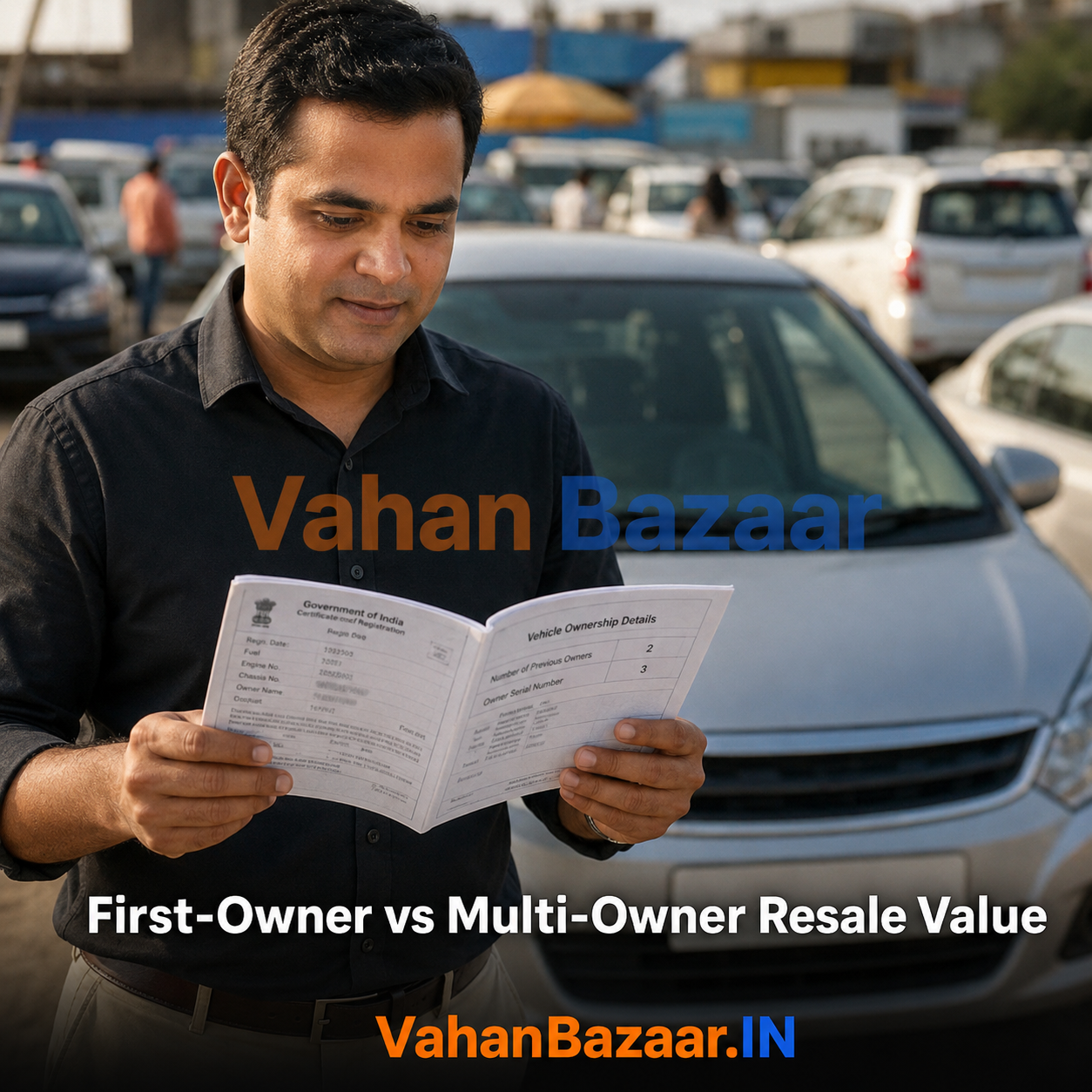
Walk through any used car negotiation in India and one word does more heavy lifting than almost any other: owner. "First owner." "Single hand." "Doctor-driven, one owner only." Sellers lead with it because they know exactly what it is worth — buyers pay more for a car that has passed through fewer hands, and everyone in the market understands why. The trouble is that the word is spoken far more often than it is true, and the number it refers to sits in a place the seller cannot edit: the VAHAN registration record.
This is a pricing article, not a morality tale. The question it answers is practical: how much does the number of previous owners actually move a used car's resale value in India, and how do you make sure the count you are paying a premium for is real? The ownership serial on the RC — the official record of how many owners a vehicle has had — is one of the cleanest value signals in the whole transaction. Read it correctly and you neither overpay for a mislabelled "first owner" nor walk away from a genuine one that a rival buyer will happily snap up.
A first-owner car generally trades at a premium and each extra owner typically softens the price — but the owner count on the listing is only a claim. The number that actually sets the value is the ownership serial in the VAHAN record, and a Rs. 99 RC check is how you confirm which one you are really buying.
What the Ownership Serial Actually Is
Every registered vehicle in India carries an ownership serial in its registration record — a simple counter that increases by one each time the car is legally transferred to a new owner. A car showing owner serial 1 has had a single registered owner since it left the showroom; serial 2 means it has been transferred once; serial 3 or higher means it has passed through three or more hands. This figure is maintained in the government VAHAN database, and it is the authoritative version of the "how many owners" question that the entire resale conversation revolves around.
The important thing for a buyer is that the seller does not control this number. A listing can say anything; a spoken assurance costs nothing; even a physical file of papers can be arranged to emphasise one story and quietly omit another. But the ownership serial in the VAHAN record reflects the transfers that were actually registered. That gap — between what a seller says and what the record holds — is precisely where owner-count pricing goes wrong for unwary buyers, and precisely where a quick check pays for itself many times over.
How Owner Count Affects Price
Owner count moves resale value through buyer confidence more than through any mechanical fact. A first-owner car tells a reassuring story: one person bought it, drove it, and (buyers assume) looked after it, with a single continuous thread of service and history that is easy to trace. That perception is real money in the market — a genuine first-owner car generally commands a premium over an otherwise identical car with more owners, because buyers will pay for the lower uncertainty.
Each additional previous owner works in the other direction. A car on its second or third owner typically trades lower, not because two owners necessarily damaged it, but because every extra transfer adds unknowns: more gaps where the service history might be incomplete, more people whose driving habits you cannot ask about, more chances that something was papered over along the way. The softening compounds gently — the step from first to second owner usually matters more to buyers than the step from third to fourth, by which point the market has already priced in "many hands."
Treat the owner-count effect as a general direction, not a fixed sum. As a broad industry rule of thumb, a genuine first-owner car sells at a premium and value softens with each added owner — but the size of that gap depends entirely on the individual car's condition, records and how the ownership story checks out. Do not accept a large "first owner" mark-up on a claim you have not verified.
Because the premium is real, the incentive to fake it is real too. It is common for sellers and some brokers to overstate ownership status — describing a car that is genuinely on its second or third owner as "first owner" or "single hand" to justify a higher asking price. A buyer standing in a parking lot has almost no way to disprove this by looking at the car; the paint, the interior and the polish reveal nothing about how many names have been on the registration. The only reliable counter is the government record.
Confirm the real owner count against the VAHAN record before you pay a premium for it.
Owner Count Is One Signal, Not the Whole Verdict
Here is the balancing truth that keeps buyers from throwing away good cars: a high owner count is a prompt to inspect more carefully, not an automatic reject. Owner count is one signal among several, and on its own it can mislead in both directions.
Consider two cars. The first is a single-owner hatchback — but that single owner ran it as a commercial vehicle, and it has covered heavy kilometres in stop-start city duty with the wear to match. The second is a two-owner sedan that was privately driven by two careful families, fully serviced at the dealership, and never in a serious accident. On owner count alone, the first car "wins." On everything that actually determines value and reliability, the second is the better buy. Number of owners tells you how many hands; it does not tell you what those hands did.
The signals that sit alongside owner count are:
- Service history. A complete, stamped record of scheduled servicing does more to justify a price than any owner-count claim. Gaps are the real warning sign.
- Accident and repair history. A car repaired after a major hit carries risk regardless of how many owners it has had. Check panels, welds and paint depth.
- Usage type. Personal use versus commercial or taxi use can matter more than the owner count itself. The VAHAN record's registration and usage details help you tell them apart.
- Odometer integrity. A low reading is only reassuring if it is genuine. Owner count and mileage should tell a consistent story; when they do not, dig deeper.
Read together, these turn owner count from a blunt yes/no into a useful lens. A higher owner count simply raises the bar of proof you should demand before paying — and lowers the price you should reasonably pay if that proof is thin. For the mileage side of the picture, our guide on verifying a used car's odometer reading against tampering shows how to sanity-check the kilometres the same way you sanity-check the owners.
Why the "First Owner" Claim Must Be Verified
The whole owner-count premium collapses if the count is wrong, and the direction of the error is almost always the same: cars get described as having fewer owners than they really do, never more. Nobody advertises a first-owner car as third-owner. So when you pay extra for "single hand," you are paying for a claim that only moves in the seller's favour — unless you check it.
Verification protects you two ways, and both save real money in a Rs. 3 Lakh to Rs. 8 Lakh transaction:
- It stops you overpaying. If the record shows the car is actually on its third owner, the "first owner" premium in the asking price evaporates, and you negotiate from the true position — or walk.
- It lets you buy with confidence. If the record confirms a genuine single owner, you can pay a fair premium without hesitation, and you will not lose the car to a quicker buyer while you dither over whether to trust the seller.
This is a distinct question from the broader problem of dishonest ownership claims and how to read the seller's story overall, which we cover in detail in our companion piece on checking a used car's first-owner claim against the VAHAN ownership record. Here the focus is narrower and about money: the count is a price input, and an unverified price input is a guess you are paying for.
How a Rs. 99 Check Confirms the Count in Two Minutes
You do not need to visit an RTO or wrestle with paperwork to settle this. Before you pay anything — ideally before you even travel to see the car — you can pull the vehicle's full registration record from the VAHAN database using Vahan Verify. A Rs. 99 RC check returns the details that matter for owner-count pricing and general safety in one go:
- The exact ownership serial — the official owner count — so you can match it against the seller's "first owner" claim on the spot.
- Registration status and validity, so you know the papers are current and the vehicle is legitimately registered.
- Insurance validity, so a lapsed or missing policy does not surprise you after purchase.
- Blacklist and challan flags, so you are not buying into a vehicle with pending violations or an official hold.
The whole check takes under two minutes from your phone. Against a purchase running into lakhs, spending Rs. 99 to confirm the single number the price hinges on is the cheapest insurance in the entire deal. It is exactly the discipline that a calm, unhurried buyer applies as a matter of course — and the same discipline that a festive-season rush tends to destroy, which is one more reason to shop when you have time to verify, a point we make in our note on buying in August before the festive price rise.
If a seller insists on "first owner" but the VAHAN record shows a higher ownership serial, treat that gap as your headline negotiating point — or your reason to walk. A car that is genuinely well kept has nothing to hide in its registration record, and an honest seller will welcome the check.
What This Means for Used Car Buyers
The number of previous owners is one of the most reliable value signals in the Indian used car market — but only when the number is real. A genuine first-owner car commands a premium because it lowers a buyer's uncertainty, and each additional owner typically softens both price and confidence. That relationship is qualitative, not a fixed percentage: the exact gap depends on the individual car, and it should always be read alongside service history, accident history and usage type rather than in isolation.
The practical takeaway is simple. Do not pay for an owner count you have not confirmed, and do not reject a car on owner count alone. Pull the VAHAN record first, match the ownership serial against what the seller told you, and then let the full picture — records, condition, usage — set the price. A Rs. 99 RC check on Vahan Verify turns "trust me, first owner" into a fact you can act on, in the two minutes before you commit lakhs. In a market where the premium words are cheap and the premium itself is not, that is the difference between paying for a story and paying for a car.
Confirm the Real Owner Count Before You Pay
Do not take "first owner" on trust. Pull the car's full VAHAN record with Vahan Verify — the exact ownership serial, registration status, insurance validity and challan or blacklist flags — for Rs. 99, in under two minutes, before you part with a rupee. Then browse verified listings and shop with confidence.
Frequently Asked Questions
Yes, as a general rule. In the Indian used car market a genuine first-owner car commands a premium, because buyers read a single owner as a sign of continuous care and a cleaner, easier-to-trace history. Each additional previous owner typically softens resale value and buyer confidence, since more hands usually means more unknowns about how the car was driven and maintained. This is a qualitative relationship, not a fixed formula — the exact effect depends on the car's condition, service record and how well the ownership story checks out against the VAHAN record.
Often, yes. A higher owner count is a prompt to inspect more carefully, not an automatic reject. A well-maintained second-owner car with a full service history and a clean accident record can be a better buy than a neglected first-owner car — and it usually trades lower, so you pay less. Ownership count is one signal among several: service history, accident history and usage type (personal versus commercial or taxi) all matter. Judge the individual car on evidence, and treat a higher owner count as a reason to negotiate and verify, not to walk away.
You cannot confirm it from the seller's word or the physical papers alone, because both can be presented selectively. The reliable way is to check the vehicle's registration record against the government VAHAN database, which lists the ownership serial — the official owner count. A Rs. 99 RC check on Vahan Verify pulls this record, along with registration status, insurance validity and blacklist or challan flags, so you can match the true owner count against the seller's claim in under two minutes before you pay anything.
Because "first owner" and "single hand" carry a premium in the resale market, some sellers and brokers describe a multi-owner car that way to justify a higher asking price or a quicker sale. It is often impossible for a buyer to disprove the claim by looking at the car, so the only dependable check is the government record. Verifying the ownership serial against the VAHAN database protects you from overpaying for a mislabelled car — and equally, it lets you confirm a genuine first-owner car so you do not walk away from a fair deal.
It can. A car's usage type is a separate and important signal. A single-owner car that spent its life as a commercial or taxi vehicle may have far higher wear than a two-owner car used privately, even though it shows fewer owners. That is why owner count should never be read in isolation. Check the VAHAN record for the registration and usage details, ask for the service history, and inspect for accident repairs — the full picture, not one number, tells you what the car is worth.
Related News
Continue reading on ownership records, verification and buying smart:
- First-Owner Claim: Checking Ownership Against the VAHAN Record
- Odometer Fraud: How to Verify a Used Car's Mileage in India
- Buy in August: Beat the Festive Price Rise and Get First Pick