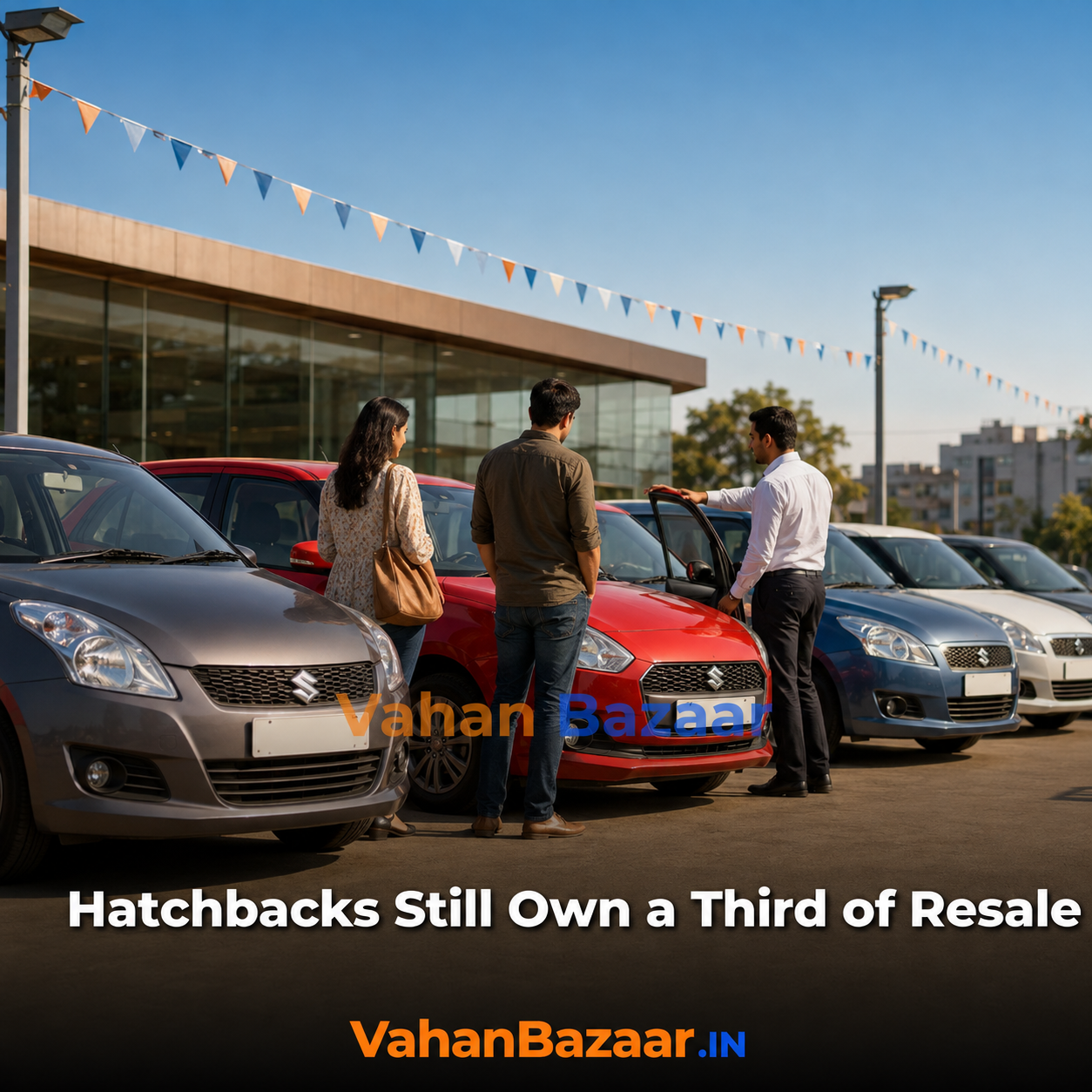
Read any Indian auto feed for a week and you would conclude that the hatchback is finished. Launch calendars are wall-to-wall SUVs. Manufacturers talk about SUVs on every earnings call. Showroom floors in Pune, Hyderabad and Gurugram put the tallest thing they sell nearest the door. Somewhere in all that noise, a great many hatchback owners have quietly concluded that their car is yesterday's product and that selling it will be a struggle.
The resale data does not support that conclusion at all. Micro and hatchback segments together command 33.82 percent of the used car market share on a 2025 base — roughly one in every three second-hand cars that changes hands in India. And the best hatchbacks are not merely holding on; they are among the strongest value retainers in the entire market.
This article is about the gap between those two pictures, because that gap is costing hatchback owners money at the negotiating table.
The Number That Contradicts the Headlines
Start with the share figure, because it is the one nobody puts in a headline. Micro and hatchback segments account for 33.82 percent of used car market share. That is not a legacy tail or a rural rump. That is a third of the country's second-hand transactions, happening every day, in every city with an RTO.
Now put the SUV number next to it, honestly. SUVs are the fastest-growing segment in the Indian used car market, at a 15.95 percent compound annual growth rate over 2026 to 2031. That is a real and significant figure, and nothing in this article disputes it.
Fast-Growing and Large Are Not the Same Thing
Here is the distinction that gets lost, and it is worth being precise about because both statements are true at the same time. A growth rate tells you how quickly a segment is expanding. A share figure tells you how big it already is. They answer completely different questions, and a segment can be the fastest-growing in the market while another segment remains the largest single block of demand.
SUV growth is being measured from a smaller base and is largely fed by buyers moving up from two-wheelers, first-time car buyers with bigger budgets, and families replacing sedans. Very little of it consists of hatchback demand evaporating. A used Swift buyer in Nashik on a Rs. 5 Lakh budget is not the same person as a used Creta buyer in Gurugram on a Rs. 12 Lakh budget, and the second one growing quickly does nothing to the first one's existence.
Percentage growth is always relative to the base it starts from. A segment doubling from a small base can post spectacular growth while a larger segment adding the same absolute number of cars posts a modest percentage. If you own a hatchback, the number that describes your sale is the 33.82 percent share of buyers looking for exactly what you have, not the growth rate of a segment you are not selling into.
How India's Top-Selling Hatchbacks Actually Hold Their Value
Share of market tells you there are buyers. Retention tells you what they will pay. On that second measure, the top Indian hatchbacks perform better than most owners expect.
A 2026 used car study reported by Autocar India puts the Maruti Swift at up to 73 percent of original value retained after five years — the best in class among hatchbacks. The Maruti Baleno retains up to 65 percent after five years, about 8 percentage points behind the Swift, and per the same study the Baleno holds its value best among midsize hatches. Those are not consolation numbers. Retaining nearly three-quarters of a purchase price across five years of Indian roads, monsoons and city traffic is a genuinely strong result.
| Hatchback | Reported value retention | Horizon | What sets the number |
|---|---|---|---|
| Maruti Swift | Up to 73% | 5 years | Best in class among hatchbacks. Reported as among India's best-selling hatchbacks, with monthly sales widely reported above 17,000 units, and dealers actively want them in stock because they sell fast. |
| Maruti Baleno | Up to 65% | 5 years | About 8 percentage points behind the Swift, and the strongest value holder among midsize hatches in the same study. |
| Toyota Glanza | Tracks the Baleno | 5 years | Closely matched mechanically with the Baleno, though the Toyota-badged car is often reported to carry a slight premium in the used market. |
| Hyundai i20 | About 37% depreciation | 3 years | Resale reported at around Rs. 4.45 Lakh in a single widely-cited estimate. The used i20 typically sits just below the Swift and Baleno on retention; higher reported service costs are one commonly cited reason. |
| Maruti WagonR | Least depreciation in bracket | Under Rs. 5 Lakh | Among the most value-retentive used cars in the sub-Rs. 5 Lakh band, which is also the most supply-starved part of the market. |
Two patterns are worth pulling out of that table. First, the badge premium is real but small: the Swift and Baleno sit close together, and the Glanza tracks the Baleno's mechanicals while attracting a slight premium purely on the Toyota badge and the ownership expectations that come with it. Second, running cost feeds directly into resale. The used Hyundai i20 is a better-equipped car than several of its rivals, but it typically sits just below the Swift and Baleno on retention; higher reported service costs are one commonly cited reason, because the used buyer is pricing the next three years of ownership, not the last three.
If you are trying to place your own car against these, the model pages for the used Maruti Suzuki Swift, the used Maruti Suzuki Baleno and the used Maruti Suzuki WagonR track live asking prices by age and city, which is a more useful reference point than a national average.
The Depreciation Curve, Year by Year
Retention after five years is the headline. The shape of the curve in between is what decides when you should sell.
Mass-market Indian hatchbacks — the Swift, WagonR and i20 among them — typically depreciate 12 to 18 percent in year one, 32 to 38 percent cumulatively by year three, and 48 to 52 percent cumulatively by year five.
| Age of hatchback | Cumulative depreciation | Value retained | What is happening |
|---|---|---|---|
| Brand new | — | 100% | — |
| 1 year old | 12–18% | 82–88% | The single steepest year. The car stops being new, the RC names a first owner, and the warranty clock has started. |
| 3 years old | 32–38% | 62–68% | The curve flattens. Roughly 20 percentage points spread across two full years, against 12 to 18 in the first twelve months. |
| 5 years old | 48–52% | 48–52% | Around half the original price still in the car, and the cheapest stretch of ownership ahead. |
The practical reading is simple. Depreciation on a hatchback is front-loaded, not linear. If you are past year three, the expensive part has already happened to you and waiting will not undo it. If you are inside the first eighteen months, every month of hesitation is coming off the same steep section of the slope. Our guide on depreciation curves by segment in India sets out how these shapes differ between hatch, sedan, SUV and EV, which matters if you are weighing a change of body type.
A third of used car demand is looking for exactly what you already own. A verified listing puts your hatchback in front of it for Rs. 49.
List My Car for Rs. 49Supply, Not Demand, Is Setting Hatchback Prices
Here is the part that should change how a hatchback owner thinks about their asking price. Supply constraints, especially in the Rs. 3-5 Lakh band, are pushing annual resale prices up by 8 to 10 percent.
That band is hatchback territory almost by definition. It is where the older Swift, the WagonR, the Alto and their contemporaries trade, and it is the entry point for a very large share of first-time car buyers in India. When supply in that band is tight, prices firm up — and the seller, not the buyer, holds the stronger hand.
New car pricing is feeding straight into this. Manufacturers hiked prices by 2 to 3 percent from January 2026, and Maruti announced a further increase of up to Rs. 30,000 across its range effective August 2026. Each of those increases quietly pushes another set of buyers out of the new-car showroom and into the used market, and a disproportionate number of them land in exactly the Rs. 3-5 Lakh bracket. Broader buying-preference data has been pointing the same way for a while, as our earlier piece on what used car buyers actually choose between hatchbacks and SUVs set out.
Rising new-car prices, tight supply under Rs. 5 Lakh and a third of all used demand pointed at your segment together mean a well-kept hatchback in 2026 is not a hard sell. That does not mean any hatchback sells easily. It means the ones that do not sell are usually failing on presentation and proof, not on the underlying market.
A USD 41.74 Billion Market That Is Only 17 Percent Organised
Zoom out and the scale becomes clearer. India's used car market stands at USD 41.74 billion in 2026 and is projected to reach USD 82.88 billion by 2031, a compound annual growth rate of 14.72 percent. It is roughly doubling in five years.
And yet only about 17 percent of that market is organised. More than four-fifths of transactions still happen through channels with no consistent verification, no standard documentation and no way for a buyer to independently confirm what a seller is claiming.
For a hatchback seller, that statistic is the whole problem in one line. Demand is not your constraint. Trust is. The buyer looking at your Swift has almost certainly heard a story about an odometer that was rolled back, a car with an owner count that did not match the RC, or a sale that stalled because pending dues surfaced at transfer time. They arrive sceptical, and in an 83-percent-unorganised market their scepticism is rational. What they cannot verify, they discount — and that discount comes out of your price.
What This Means for Used Car Sellers
Put the three findings together and the position of a hatchback owner in 2026 is a good one, provided it is handled properly.
- Demand is a third of the whole market. Micro and hatchback segments hold 33.82 percent of used car market share. You are not selling into a shrinking niche.
- Your car is a strong value retainer. Up to 73 percent retained after five years on a Swift, up to 65 percent on a Baleno, and the least depreciation in the sub-Rs. 5 Lakh bracket on a WagonR.
- Supply is on your side. Prices in the Rs. 3-5 Lakh band are rising 8 to 10 percent a year, and new-car hikes keep sending buyers your way.
- Trust is the bottleneck. Only about 17 percent of the market is organised, so the buyer's default position is caution.
If you own a Swift, Baleno, WagonR, i20 or Glanza, you are sitting on some of the most liquid stock in the Indian used market. Swifts in particular are reported to sell fast enough that used dealers actively want them in inventory. The constraint on your sale is almost never whether anyone wants the car. It is whether the person who wants it can believe you.
Why a Rs. 49 Verified Listing Pays for Itself
That is precisely the gap a verified listing on VahanBazaar is built to close, and every listing on the platform is verified — there is no unverified tier. For Rs. 49 you get:
- RC verification against the VAHAN database. Your registration number is cross-checked against government records, confirming registration date, owner count, RC status and insurance validity. The buyer does not have to take your word for the car's age or ownership history.
- A green Verified badge. It appears on your listing card in search results and on the listing page itself, before a buyer has read a word of your description — which is exactly when scepticism is highest.
- Priority placement. Verified listings sit higher in the buyer's consideration set, which matters when someone is scanning twenty hatchbacks in ten minutes.
- More enquiries, faster sales. On average, based on VahanBazaar listings data, verified listings draw around three times more buyer enquiries and sell roughly 40 percent faster.
For a hatchback, that combination matters more than it does for a rarer car. When a buyer is choosing between fifteen used Swifts of similar age and price, the differentiator is rarely the car. It is which seller has already answered the questions the buyer was going to ask. Liquidity only converts into cash when the buyer stops hesitating, and verification is the shortest route to that.
Every retention figure in this article is a segment average drawn from broad studies. Your specific car's number will be set by its condition, its owner count, its service history and the city you are selling in. Two same-year Swifts can be a full price band apart. Use these figures as the shape of the market, then price your own car on its own evidence.
A Third of the Market Wants Your Car. Prove It Is What You Say.
Micro and hatchback cars hold 33.82 percent of India's used car market, and the top hatchbacks retain up to 73 percent of their value after five years. In a market that is only about 17 percent organised, a Rs. 49 VAHAN-verified listing with a green Verified badge and priority placement is what turns that demand into enquiries. Every listing is verified — there is no unverified tier.
Create My Verified Listing — Rs. 49What This Means for Used Car Buyers
On the other side of the table, the same figures make a strong case for the segment. A hatchback that retains up to 73 percent of its value after five years is a car whose next owner also inherits a firm resale position — you are not buying into a collapsing asset. Add the fact that year one has already taken 12 to 18 percent out of the price on your behalf, and a two or three-year-old hatchback is one of the more rational purchases available in India right now.
The caution is the same one the 17-percent-organised statistic implies. Verify the car's real age, owner count, RC status and insurance validity before you negotiate rather than after, because depreciation is calculated from the registration date and a year in either direction moves the fair price meaningfully. A Vahan Verify check costs Rs. 49 and pulls those details from the VAHAN database, so you can price against the record rather than the advertisement. If you are still narrowing the shortlist, our roundups of the best used hatchbacks in India and the best used cars under Rs. 5 Lakh are a sensible starting point, and browsing verified listings is faster than working through unverified classifieds one call at a time.
Frequently Asked Questions
Yes. Micro and hatchback segments together command 33.82 percent of the used car market share on a 2025 base, which is roughly a third of every second-hand transaction in the country. SUVs are the fastest-growing segment at a 15.95 percent compound annual growth rate over 2026 to 2031, but a fast-growing share and a large stable share are two different things. SUV growth is being measured off a smaller base and is largely fed by new demand, not by hatchback owners disappearing.
A 2026 used car study reported by Autocar India puts the Maruti Swift at up to 73 percent of original value retained after five years, the best in class among hatchbacks. The Maruti Baleno retains up to 65 percent after five years, about 8 percentage points behind the Swift, and holds its value best among midsize hatches. Under Rs. 5 Lakh, the used Maruti WagonR shows the least depreciation in its bracket. These are segment averages, and your own car's number will be set by condition, owner count, service history and location.
Mass-market Indian hatchbacks such as the Swift, WagonR and i20 typically depreciate 12 to 18 percent in year one, 32 to 38 percent cumulatively by year three, and 48 to 52 percent cumulatively by year five. The curve is front-loaded, so the largest single-year loss happens in the twelve months right after registration, and it then flattens considerably.
Supply constraints, especially in the Rs. 3-5 Lakh band, are pushing annual resale prices up by 8 to 10 percent. New car pricing is adding to the pressure: manufacturers hiked prices by 2 to 3 percent from January 2026, and Maruti announced a further increase of up to Rs. 30,000 across its range effective August 2026. Every rupee added to a new hatchback pushes another buyer towards a good used one.
On average, based on VahanBazaar listings data, verified listings draw around three times more buyer enquiries and sell roughly 40 percent faster. A verified listing costs Rs. 49, cross-checks your registration number against the VAHAN database, carries a green Verified badge and gets priority placement. That matters most for hatchbacks because only about 17 percent of India's used car market is organised, so the constraint on a Swift or a WagonR is rarely demand. It is the buyer's ability to trust what the seller is claiming.