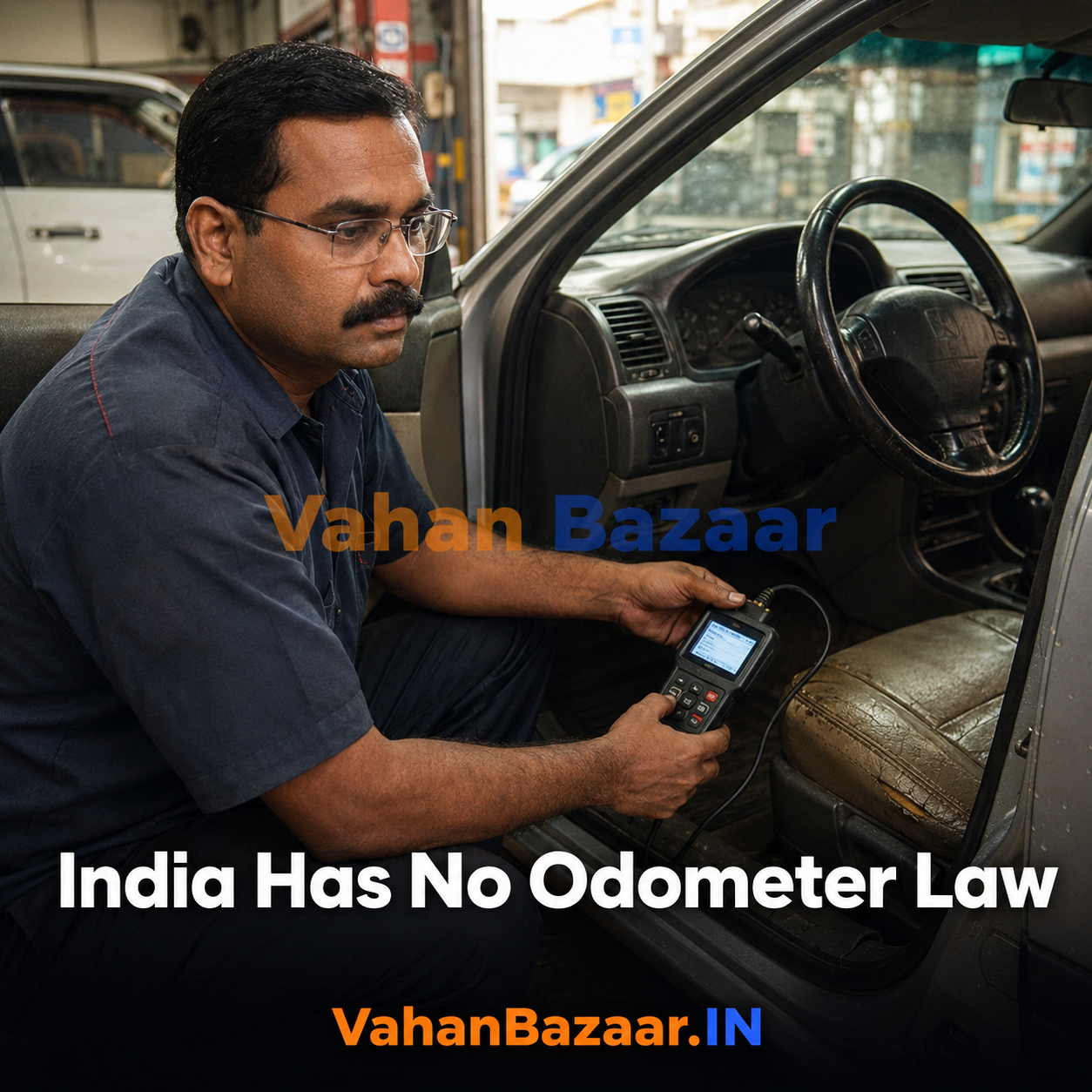
Ask any used car buyer what number they check first, and most will point at the odometer. It is the headline figure — low kilometres suggest a gently driven car, a longer life ahead, a fair price. Which is exactly why it is the number most worth faking, and in India, faking it carries a startling absence of legal risk. There is no law in India that criminalises odometer tampering by name. The Motor Vehicles Act 1988 covers registration, fitness, insurance, licensing and road safety, but if you search its text for the word "odometer", you will not find it. There is no dedicated anti-clocking offence to point to.
The result is a quiet, structural blind spot. Industry estimates suggest roughly one in five used cars in India carry a tampered odometer, and an estimated 300,000 — that is 3 lakh — clocked vehicles change hands every single year. A single rolled-back reading can inflate the asking price by anywhere from Rs. 50,000 to Rs. 2 lakh, depending on the model and year. This article explains why the problem persists despite digital dashboards, why the government's own record cannot show you the mileage, and what a buyer can actually do to avoid paying a premium for kilometres that never happened.
No Indian law names odometer tampering, and no government portal stores a car's mileage — so the reading on the dashboard is unverifiable by design. Your defence is to check the car's true age, owner count and registration status against the VAHAN record, and treat any mismatch with the seller's pitch as a red flag.
Why There Is No Odometer Law — and Why It Matters
The Motor Vehicles Act 1988 is the backbone of vehicle regulation in India. It defines how a car is registered, when it must pass fitness, why third-party insurance is mandatory, who may hold a driving licence, and countless rules on road safety. It is a broad and serious statute. But it was written around the machinery of registration and safety, not around the integrity of a resale figure — and so tampering with an odometer is not named anywhere in it as a specific offence.
That does not mean a cheated buyer is entirely without recourse; a person misled into overpaying may still pursue general fraud and consumer-protection remedies. But there is a world of difference between a named, easily invoked offence and a general remedy you must fight to establish after the money has gone. The absence of a dedicated provision means there is little deterrent at the point of sale, and the practical burden of catching a clocked car sits squarely on the buyer. When the law does not police a number, the buyer has to.
The Digital Odometer Myth
A common and comforting misconception is that digital odometers made tampering a thing of the past — that once the mechanical spinning drums gave way to a screen, the number became tamper-proof. The reality is more nuanced. Most modern cars store their mileage in the Electronic Control Unit, or ECU, which is genuinely harder to alter than the figure painted on a dashboard screen. So there is a kernel of truth to the reassurance.
But "harder" is not "impossible", and the number a buyer actually looks at is the one on the dashboard cluster — which can still be rolled back. Cars with rolled-back dashboard readings continue to change hands across the country. The digital display is not proof of a genuine reading; it is simply a cleaner-looking version of a number that may or may not be true. Trusting the screen because it is digital is exactly the mistake the trade relies on.
A crisp digital odometer reading of "42,000 km" on a five-year-old car looks reassuring precisely because it is digital. But the screen only displays what it has been told to display. Without an independent way to sense-check the car's true age and history, that number is a claim, not a fact.
A Rs. 40 Billion Market Where Most Deals Are Unwatched
The scale of the exposure follows the scale of the market. India's used car market is projected to cross USD 40 billion in 2026, with nearly 6 million units changing hands annually. That is an enormous flow of vehicles — and crucially, over 60 percent of those transactions still happen through unorganised channels: local brokers, roadside dealers, and direct owner-to-owner deals.
Unorganised does not mean dishonest, but it does mean unwatched. In a broker-led or C2C deal there is often no standardised inspection, no service-history verification, and no third party whose reputation is on the line if the odometer has been wound back. That is the environment in which an estimated 3 lakh clocked cars quietly move each year. The number is not a freak statistic; it is the natural output of a large market where the single most price-sensitive figure is both easy to fake and legally unprotected. If you are weighing where to buy, it is worth understanding how ownership channels shape risk before you even look at a specific car — a theme we return to across our vehicle blacklist and history checks coverage.
The odometer is unverifiable — but the car's true age, owner count and registration status are not. Check them against the VAHAN record before you pay.
What VAHAN Can and Cannot Tell You
Here is the fact that trips up most buyers, and the one that reframes the entire problem: the VAHAN and Parivahan record does not store odometer readings at all. There is no mileage figure sitting in the government database waiting to be checked. So if you were hoping a portal could simply tell you the car's real kilometres, that door is closed — for every buyer, everywhere.
But that is not the end of the story, because the odometer is only one way to catch a lie. What the government record does hold is arguably more useful for spotting a clocked car:
- The car's true age — the actual registration date, which no seller can talk away.
- Owner count and ownership history — how many hands the car has genuinely passed through.
- Registration status — whether the RC is active, and any hypothecation or insurance flags attached to it.
None of that is the mileage — but together it is how you catch a clocked car indirectly. If a seller pitches a "low-kilometre, single-owner" car and the record shows a vehicle that is older than implied or has passed through three or four owners, the story stops adding up. A car that has genuinely done 42,000 km in five years across a single careful owner is plausible; the same reading on a car the record shows changing hands four times in that period is not. The mismatch is the red flag, and the record is where you find it.
A "single-owner, low-km" pitch that does not match the owner count on the government record is the clearest warning sign there is.
How to Catch a Clocked Car in Practice
Because no law punishes clocking and no portal stores the mileage, catching a wound-back odometer is a matter of triangulation. No single check is definitive, but three together make it very hard for a clocked car to slip past you.
1. Verify the age and ownership trail against the record
This is the first and most powerful step, and it costs Rs. 99. A Vahan Verify check pulls the car's true age, owner count and registration status from the government VAHAN record, so you can sense-check the seller's mileage story against facts that cannot be edited on a dashboard. It is the step that turns "trust me, it's barely driven" into something you can actually test.
2. Read the physical wear
A car cannot hide how it has aged. Worn brake and clutch pedals, a shiny or frayed steering wheel, sagging or heavily creased driver's seat bolstering, and a polished gear knob all betray far more use than a low reading suggests. If the cabin looks like it has done 1.2 lakh km but the odometer says 40,000, believe the cabin.
3. Consider an OBD scan
An OBD, or On-Board Diagnostics, scan can flag mileage discrepancies stored across a car's electronic systems, which may not match the number on the cluster. It is a more technical step, usually done by a mechanic or inspection service, but it can expose a rollback that the dashboard hides.
Clocked vs Genuine: Reading the Signals
Laid out side by side, the difference between a car whose story holds together and one that does not becomes clear.
| Signal | Genuine Low-Km Car | Likely Clocked Car | How You Check It |
|---|---|---|---|
| Owner count vs pitch | Matches "single owner" claim | Record shows several owners | VAHAN record, Rs. 99 check |
| Age vs mileage | Kilometres plausible for the age | Reading too low for a car this old | True registration date on VAHAN |
| Cabin and pedal wear | Wear consistent with the reading | Wear far exceeds the reading | Physical inspection |
| Electronic mileage data | Systems agree with the cluster | Discrepancies across modules | OBD scan by a mechanic |
Indicative signals, not a guarantee; no single check is definitive. The VAHAN record does not store mileage — it reveals age, owner count and registration status, which is how a clocked car is caught indirectly.
Run the record check the moment a car makes your shortlist, not after you have driven across the city to see it. Walking into the meeting already knowing the car's true age and owner count means you can test the seller's mileage claim on the spot — and walk away from a mismatch without a broker's pressure standing over you.
What This Means for Used Car Buyers
The uncomfortable truth is that the odometer — the number buyers lean on most — is the number the system protects least. No law in India names odometer tampering as an offence, the digital dashboard that was supposed to fix it can still be rolled back, and the government record holds no mileage figure to check against. In a market crossing USD 40 billion where most deals happen out of sight, an estimated 3 lakh clocked cars a year is the predictable consequence, and a single rollback can quietly add Rs. 50,000 to Rs. 2 lakh to a price you should never have paid.
None of that leaves the buyer helpless — it just moves the defence from trusting a number to verifying a story. You cannot read the true mileage from any portal, but you can read the car's true age, its owner count and its registration status, and you can compare them to what the seller is telling you. When the "low-km, single-owner" pitch collides with a record showing an older car and multiple owners, you have caught the lie before your money moved. That verification is the whole game, and at Rs. 99 it is the cheapest insurance in the entire transaction. For a wider pre-purchase routine, our checklist of the 10 things to check before buying a used car puts this alongside every other step worth taking, and our coverage of how AI is now flagging 1 in 5 cars for odometer fraud shows where detection is heading next.
The Odometer Can Lie — the Record Cannot
No portal shows a used car's mileage, and no law punishes clocking. Your defence is a Rs. 99 Vahan Verify check that pulls the car's true age, owner count and registration status from the government VAHAN record — so a "low-km, single-owner" pitch either matches the facts or exposes itself before any money moves.
Frequently Asked Questions
There is no law in India that criminalises odometer tampering by name. The Motor Vehicles Act 1988 governs registration, fitness, insurance, licensing and road safety, but the word odometer does not appear in it — there is no specific provision that makes rolling back a reading a named offence. A cheated buyer may still pursue remedies through general fraud and consumer-protection routes, but there is no dedicated anti-clocking statute, which is precisely why the burden of verification falls on the buyer. The practical defence is to check the car's true age, owner count and registration status against the government VAHAN record before paying.
Industry estimates suggest roughly one in five used cars in India carry a tampered odometer, and an estimated 300,000 clocked vehicles change hands every year. The scale is not surprising: India's used car market is projected to cross USD 40 billion in 2026 with nearly 6 million units changing hands annually, and over 60 percent of those transactions still happen through unorganised channels such as local brokers, roadside dealers and direct owner-to-owner deals, where a rolled-back reading is hardest to catch.
No. It is a common misconception that digital odometers stopped tampering. In reality most modern cars store mileage in the Electronic Control Unit, or ECU, which is harder to alter than the dashboard screen — but the number shown on the dashboard can still be rolled back, and clocked cars with mismatched dashboard readings continue to change hands. The digital display is not proof of a genuine reading, so buyers should still verify a car's true age and history rather than trusting the figure on the cluster.
No. The VAHAN and Parivahan record does not store odometer readings at all, so no government portal can tell you a car's true mileage. What VAHAN does show is the car's registration details, its true age, the owner count and ownership history, hypothecation and insurance status. That is powerful for spotting a clocked car indirectly: if a seller pitches a low-kilometre, single-owner car but the record shows the vehicle is older or has passed through several owners, the story does not add up. A Rs. 99 Vahan Verify check surfaces exactly that mismatch before you pay.
Because no portal stores mileage and no law punishes clocking, verification is your defence. First, run a Rs. 99 Vahan Verify check on VahanBazaar to confirm the car's true age, owner count and registration status against the government VAHAN record, and treat any mismatch with a low-km, single-owner pitch as a red flag. Second, at inspection, look for physical wear on pedals, steering wheel and seats that betrays a car older than the dashboard claims. Third, an OBD, or On-Board Diagnostics, scan can flag mileage discrepancies stored in the car's systems. Together these turn a seller's claim into evidence you can check.
Related News
More on odometer fraud and used car buyer protection:
- AI Flags 1 in 5 Cars for Odometer Fraud
- AI Takes On Odometer Fraud in India
- Vehicle Blacklist Check Online 2026
- 10 Things to Check Before Buying a Used Car