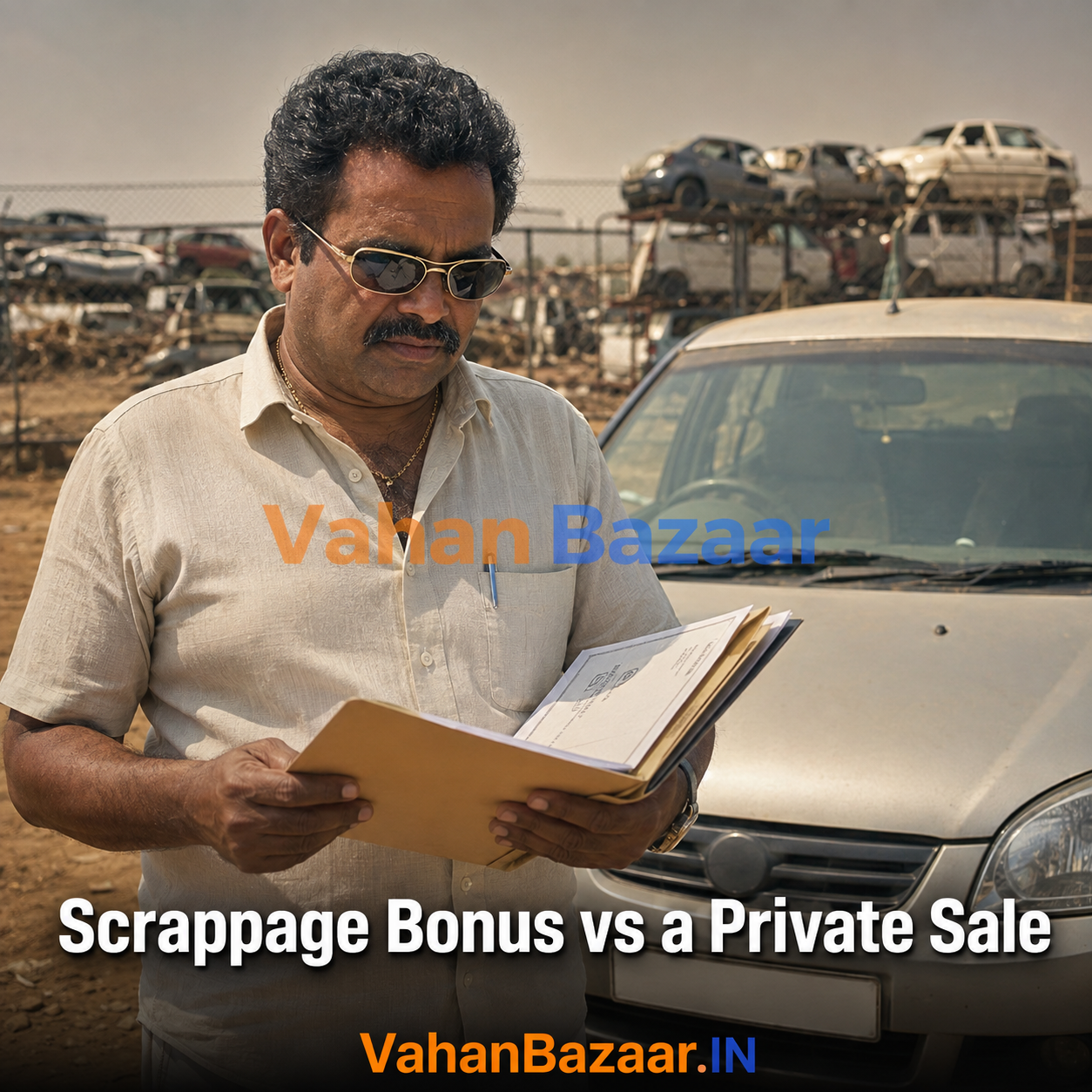
If you own an ageing car in India, August is the month people start telling you to get rid of it. Maruti Suzuki's August 2026 offers are out, and alongside the usual cash discounts and exchange bonuses sit scrappage bonuses of up to Rs 65,000 on some models. Among the specific August offers are Rs 15,000 cash on the Baleno petrol and Rs 35,000 cash on Grand Vitara Smart Hybrid variants.
Up to Rs 65,000 is a big enough number to end a conversation. For a car that has been sitting in the porch for two years with a slow puncture and an expired policy, it can feel like a rescue. And for a genuine end-of-life vehicle, it very often is.
But "up to" is doing a lot of work in that sentence, and so is the word "bonus". A scrappage bonus is not cash paid to you for your car. It is a reduction in the price of a new car, contingent on you buying that new car, from that manufacturer, and permanently surrendering the old one. Whether that beats simply selling the car to another person depends on a comparison most owners never actually run — because they do not know what the second option is worth.
You cannot compare two options when you only know the value of one. A verified listing is Rs 99 and tells you what the market will actually pay.
List Your Car — Rs 99What the Scrappage Route Actually Bundles
India's Vehicle Scrappage Policy took effect in April 2022, and it is a genuinely well-constructed piece of policy. It gives owners of genuinely old vehicles a dignified, documented exit, it feeds recycled material back into manufacturing, and it takes the least efficient vehicles off Indian roads. It is worth understanding properly rather than dismissing, because for a meaningful share of owners it is the right answer.
The manufacturer's bonus
This is the headline. Maruti's August offers put scrappage bonuses at up to Rs 65,000, varying by model. Note that word "up to": the top figure typically attaches to specific models and variants, and the bonus on the car you actually want may be considerably smaller. Ask for the number on your exact variant in writing before you build a decision on it.
The policy incentives
Sitting behind the manufacturer's offer are the incentives the policy itself provides. There is a motor vehicle tax concession of up to 25 percent for non-transport vehicles and up to 15 percent for transport vehicles. There is no fee for the issue of a new certificate of registration when you submit a Certificate of Deposit from a scrapping facility. And the policy provides for a 4 to 6 percent discount on the ex-showroom cost of a new vehicle against a scrappage certificate.
The 4 to 6 percent ex-showroom discount and a manufacturer's scrappage bonus are frequently the same benefit expressed two different ways, not two benefits you collect one after the other. Some dealers also treat the scrappage bonus and the exchange bonus as alternatives rather than additions. Before you commit, ask for a written break-up showing which components apply together and which are mutually exclusive on your chosen variant. The tax concession and the waived registration fee are administered through the RTO on submission of the Certificate of Deposit, separately from anything the dealer offers.
The conditions attached
Three conditions define the route, and none of them is hidden — they are simply easy to skip past when a large number is on the table.
First, the benefit is conditional on buying a new car, and generally from the manufacturer running the offer. If you were not planning to buy a new Maruti this year, a Rs 65,000 discount on one is not Rs 65,000 of value to you. It is Rs 65,000 off a purchase decision that was not on your list. That is a perfectly good deal for someone already at the showroom, and a poor reason to walk into one.
Second, the vehicle must be physically deposited at a Registered Vehicle Scrapping Facility. As of early 2026 approximately 80 to 90 RVSFs hold provisional or final registration across India. That network is growing, but it is not dense. If the nearest facility is a few hundred kilometres from you, the towing or driving cost, the paperwork and the days involved belong in your calculation.
Third, and most permanently, the registration certificate is cancelled. Scrapping is irreversible. There is no version of the decision where you change your mind in three months. Nearly 4 Lakh vehicles had been scrapped in India up to December 2025, and none of them came back.
What the Private Sale Route Gives You Instead
The private sale is the unglamorous option, and its advantages are all of the same kind: they are about freedom rather than about a number on a banner.
You receive money, not a discount. It arrives with no obligation attached. You can put it towards a new Maruti if you like, and still take the exchange or cash offers running that month. Or you can put it towards a car from any other brand, or a newer used car, or nothing at all. Cash keeps every option open in a way that a manufacturer-linked bonus cannot.
You also keep the car's remaining registration life intact and transfer it to somebody who wants it. A running car with valid registration has genuine utility to a buyer who could not otherwise afford one, which is exactly the demand pool that keeps the under Rs 3 Lakh segment so active.
The costs are real too. A private sale takes longer — days or weeks rather than a single showroom visit. You have to field enquiries, allow inspections, and negotiate. And critically, you have to prove the car's history. A buyer paying their own money wants to know the owner count, the registration status, whether any financier's charge is still recorded against the vehicle, and whether there are pending dues. A seller who cannot evidence those things is negotiating from a weak position, and the discount a doubtful buyer demands can quietly wipe out the advantage the private route had in the first place.
The Two Routes, Side by Side
| Consideration | Scrappage route | Private sale |
|---|---|---|
| What you receive | A discount on a new vehicle, up to Rs 65,000 on some Maruti models in August 2026 | Money, with no strings attached |
| Must you buy a new car? | Yes, and generally from that manufacturer | No |
| Extra policy benefits | Up to 25% motor vehicle tax concession, no fee for the new certificate of registration, 4 to 6% ex-showroom discount against a scrappage certificate | None |
| Where the car goes | Physically deposited at one of roughly 80 to 90 RVSFs nationwide | To a buyer, wherever they are |
| Effect on the RC | Permanently cancelled | Transferred, remaining life retained |
| Time and effort | Single showroom transaction plus the deposit trip | Days to weeks of enquiries, inspections and negotiation |
| What you must prove | Ownership and the deposit | The car's full record — owner count, RC status, dues, any financier's charge |
| Reversibility | None | You can decline every offer and keep the car |
When Scrappage Genuinely Wins
Be honest about this, because it wins more often than sceptics admit.
The clearest case is a car that will not pass its fitness test. Under the framework, passenger vehicles older than 20 years and commercial vehicles older than 15 years must pass a fitness and emissions test to keep their registration. Vehicles that fail are classed as end-of-life vehicles, lose their registration certificate and are recommended for scrapping. If your car is at or near that threshold and you already know it will not clear the test, its private resale value is being crushed by exactly the same clock the scrappage bonus is offering to buy you out of. A buyer facing a registration that may not survive its next test will price that risk savagely, if they bid at all.
The second clear case is the owner who was buying a new car from that manufacturer anyway. If a new Maruti is already the decision, the bonus is pure gain: you were going to spend the money regardless, and the old car's alternative use was limited. Add the road tax concession and the waived registration fee and the package is entirely worth having.
The third is a car that genuinely is finished — a major mechanical failure that costs more to repair than the car can ever be worth, extensive corrosion, flood damage, or a vehicle that has been immobile long enough that recommissioning it is a project. Some cars really are at the end. The policy exists precisely for them, and using it is the responsible outcome.
When the Private Sale Wins
The mirror image is equally clear. A car that runs, has a clean record and years of registration left is worth more to a person than to a shredder, and this is where owners routinely under-sell themselves.
Popular, easily maintained models hold their utility for a long time in India. A well-kept WagonR, Swift or Alto with service records and honest kilometres has a queue of interested buyers in most Indian cities, because parts are everywhere, mechanics know them, and running costs are predictable. Our buyer guides to the Swift and the WagonR exist because that demand is persistent, not seasonal. The same is true across the wider used Maruti Suzuki range, including the Baleno.
Geography matters as well. Demand for older, affordable cars is deep in markets like Lucknow and Jaipur, while a car with clean paperwork often finds a quicker buyer in a large market such as Delhi simply because more people are looking on any given day. An owner comparing a fixed scrappage bonus against a resale value they have never tested is comparing a known number with an assumption.
July and August see pre-festive stock build-up, with dealer discounts typically running at 60 to 70 percent of March levels. That means new-car offers — including scrappage bonuses — are meaningful now but not at their annual peak. It also means more people are shopping, which is generally good for a private seller too. If your car is sound, testing the resale market during this window costs you very little and tells you a great deal.
The One Number That Decides It
Every argument above collapses into a single input: what is the car genuinely worth today?
Most owners answer that question from memory, from what a neighbour was told, or from what a dealer mentioned in passing while quoting a new car. None of those is a market price. The market price is what an actual buyer, with actual money, will actually pay this month for this car with this record and these kilometres on the odometer.
There is only one honest way to establish it, and that is to put the car in front of buyers and see what comes back. If the enquiries and the offers land below the scrappage bonus and its associated benefits, you have your answer, and you can walk into the showroom with confidence rather than hope. If they land above it, you have just saved yourself from surrendering a working asset for a discount on a purchase you may not have needed.
The comparison is only expensive if you skip it.
What This Means for Used Car Sellers
The practical sequence is straightforward, and it costs less than most owners expect.
Start by establishing whether the car is on the wrong side of the fitness threshold. Passenger vehicles older than 20 years need to pass that test to keep their registration, and if yours is close and unlikely to clear it, the scrappage route moves to the front of the queue. If it is comfortably inside its registration life and running well, keep both options open.
Next, get your own paperwork straight before a buyer challenges it. Owner count, current RC status, whether any old financier's charge was ever terminated, and any pending dues attached to the vehicle — these are the questions that turn a confident sale into a nervous discount. A Rs 99 record check against the VAHAN database tells you what a buyer is going to find, and gives you time to fix anything before it becomes a negotiating lever in somebody else's hand.
Then test the market properly. A verified listing on VahanBazaar costs Rs 99. Every listing is cross-verified against the VAHAN database, which holds the government's own registration records, and carries a green Verified badge that every buyer can see, along with priority placement. On average, based on VahanBazaar listings data, verified listings draw around three times more buyer enquiries and tend to sell about 40 percent faster. That badge matters most on exactly the kind of car this article is about — an older vehicle where the buyer's main worry is what they cannot see. Being able to prove the record is what separates a seller who gets a fair price from one who gets talked down.
Give the listing a fortnight, in this pre-festive window when buyers are already circulating. If the enquiries are thin and the offers weak, the scrappage bonus, the tax concession and the waived registration fee are genuinely the better package, and you should take them without regret. If your phone rings, you have learned that a running car with a clean record was worth more than Rs 65,000 of conditional discount — and you have learned it for Rs 99, which is the cheapest piece of information in the entire decision. Cars in the under Rs 5 Lakh bracket move quickly when their paperwork is beyond argument.
Find Out What Your Car Is Worth Before You Surrender It
A scrappage bonus is a known number. Your car's market value is not — until you test it. A verified listing on VahanBazaar is Rs 99, cross-checked against the VAHAN database, carries a green Verified badge and gets priority placement. On average, based on VahanBazaar listings data, verified listings draw around three times more buyer enquiries and tend to sell about 40 percent faster.
List Your Car — Rs 99Want to see the record first? Run a Rs 99 VAHAN check.
Frequently Asked Questions
It depends entirely on what the car is worth today, and on whether you were going to buy a new car from that manufacturer anyway. The scrappage bonus is a discount on a new vehicle, not cash in hand, and the headline figure is an upper limit that varies by model. A private sale gives you money with no obligation to buy anything. If your car will not clear its fitness test, or is genuinely at the end of its usable life, the scrappage route often wins. If it is running well, has a clean record and years of registration left, a private sale usually returns more value because you keep the option of buying nothing, or of buying from any brand you like.
The policy, which took effect in April 2022, provides a motor vehicle tax concession of up to 25 percent for non-transport vehicles and up to 15 percent for transport vehicles, no fee for the issue of a new certificate of registration on submission of a Certificate of Deposit, and a 4 to 6 percent discount on the ex-showroom cost of a new vehicle against a scrappage certificate. Manufacturers may run their own scrappage bonuses on top of, or as their expression of, that discount, so read the dealer's break-up carefully rather than assuming everything stacks.
Passenger vehicles older than 20 years and commercial vehicles older than 15 years must pass a fitness and emissions test to keep their registration. Vehicles that fail are classed as end-of-life vehicles, lose their registration certificate and are recommended for scrapping. If your car is close to that threshold and unlikely to pass, its private resale value is being squeezed by the same clock, and the scrappage route becomes a far stronger option.
As of early 2026 approximately 80 to 90 Registered Vehicle Scrapping Facilities hold provisional or final registration across India, and nearly 4 Lakh vehicles had been scrapped up to December 2025. It matters practically: the vehicle has to be physically deposited at an RVSF, so if the nearest one is several hundred kilometres away, the logistics and the time cost have to go into your comparison alongside the bonus.
Stop guessing and test the market. Look at what comparable cars of the same model, year and fuel type are actually listed at, then list your own car and see what enquiries it draws. A verified listing on VahanBazaar costs Rs 99, is cross-checked against the VAHAN database, carries a green Verified badge and gets priority placement. On average, based on VahanBazaar listings data, verified listings draw around three times more buyer enquiries and tend to sell about 40 percent faster. Once you have real enquiries in hand, the comparison with a scrappage bonus stops being a guess.