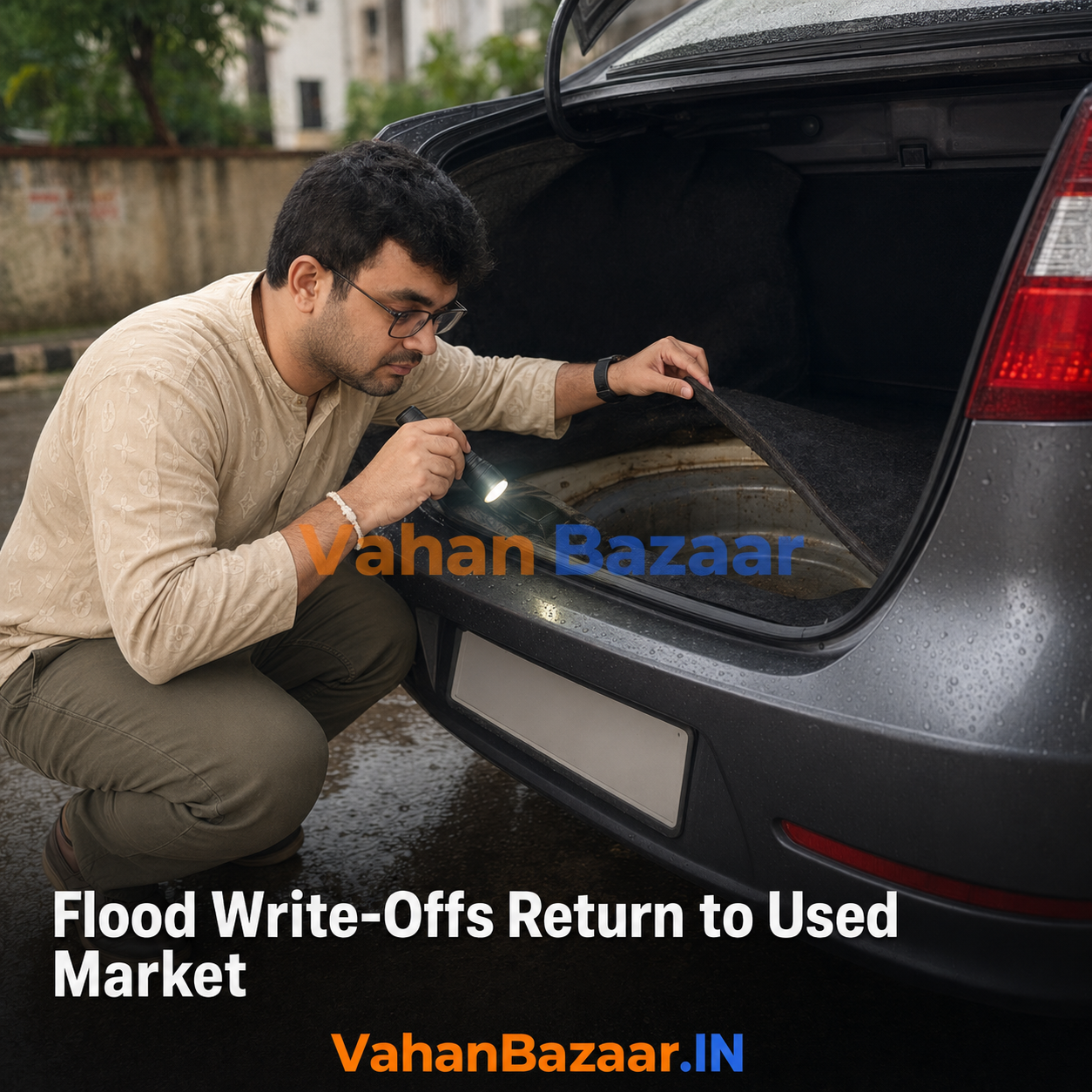
Most writing about flood-damaged cars stops at the advice stage. Smell the carpets, look for rust, walk away if something feels off. That is useful as far as it goes, and it does not go very far, because it treats a flooded car as a mystery to be sniffed out rather than as the predictable end product of a process anyone can understand.
The process is an insurance calculation, and it is almost entirely mechanical. A surveyor works out what it would cost to put a water-damaged car right. That figure is set against the vehicle's Insured Declared Value — the sum the policy agrees the car is worth. If the repair estimate crosses roughly 75 percent of the IDV, the insurer generally stops planning a repair and starts preparing a settlement. The car has not become unrepairable. It has stopped being worth repairing.
Everything downstream flows from that one line. Who owns the wreck, whether any documentary trace exists, and whether the car turns up nine weeks later in an ordinary listing at an ordinary price — all of it is decided by which side of 75 percent the assessment lands on, and by which type of policy the owner happened to be holding when the water arrived.
Insurance validity and registration status are fields in the government vehicle record. Rs. 99 puts them in front of you before you negotiate, not after.
Constructive Total Loss, Worked Out in Rupees
The phrase in policy documents is constructive total loss, and the word constructive is carrying real weight. It does not mean the car was destroyed. It means the car still exists, could be fixed, and is not going to be, because fixing it costs more than the insurer has agreed the vehicle is worth. Under IRDAI norms a vehicle is generally treated as a total loss when repair costs exceed 75 percent of the IDV, and at that point the insurer settles on IDV rather than on repair cost, subject to policy terms. If a car is fully submerged and declared a total loss, the compensation is based on IDV.
An illustration of the threshold
Take a hatchback with an IDV of Rs. 5,00,000. That is the figure the policy schedule carries, and it is the number every subsequent decision is measured against. Seventy-five percent of Rs. 5,00,000 is Rs. 3,75,000. That is the line.
| Illustration | Assessed repair cost | Share of IDV | Outcome |
|---|---|---|---|
| Car A | Rs. 3,90,000 | 78 percent | Above the line. Treated as a constructive total loss and settled on IDV |
| Car B | Rs. 3,40,000 | 68 percent | Below the line. Repaired under the claim and returned to the road |
These figures are an illustration, not a quotation from any real claim. What they show is how narrow the deciding margin can be. Car A is only Rs. 15,000 above the threshold and Car B is Rs. 35,000 below it, yet the two vehicles go to completely different places. Car B stays with its owner as a repaired car with a claim on its record. Car A is bought out at IDV, the wreck passes to the insurer, and it enters the salvage stream.
This is also why the IDV that an owner sets at renewal quietly shapes what happens after a flood. A car insured at a low IDV to save premium reaches the 75 percent line on a smaller repair bill, so it is written off more readily. A car insured close to its true market value has more headroom before the arithmetic tips. Anyone who has ever wondered why the IDV field matters beyond the annual premium will find it explained in more depth in this guide to setting the right IDV on a used car.
Insurers do not keep wrecks. Disposing of salvage is a normal, regulated part of settling total-loss claims, and rebuilders who buy damaged vehicles, restore them properly and sell them honestly are running a perfectly proper trade. The issue for a used-car buyer is not that salvage exists. It is that a competently rebuilt car looks like any other car at the retail end, and a buyer who does not know the process exists never thinks to ask about it.
The Policy Type Decides Whether There Is a Trail at All
Here is the part almost nobody explains, and it matters more than the 75 percent rule itself. Everything described above only happens if the owner had a policy that covered the flood in the first place.
Flood, cyclone, heavy rain and waterlogging damage sit on the own-damage side of a motor policy. They are covered under a comprehensive policy, or under a standalone own-damage cover that an owner can buy separately, independent of their third-party insurance. They are not covered by a third-party-only policy, because third-party insurance exists to cover damage the vehicle causes to another person or another person's property. It has nothing to say about the policyholder's own car sitting in four feet of water.
| Policy type | Flood damage to your own car | Damage you cause to others | What it leaves behind |
|---|---|---|---|
| Comprehensive | Covered | Covered | A claim, a survey, and either a repair record or a total-loss settlement |
| Third-party only | Not covered | Covered | Nothing. No claim is made, so no assessment and no settlement exist |
| Standalone own-damage | Covered | Not covered by this policy; held separately | A claim and a survey on the own-damage side |
Why plenty of older cars carry third-party cover only
It is a cost decision, and an entirely rational one. IRDAI fixes third-party base premiums for private cars at Rs. 2,094 for engines up to 1000cc, Rs. 3,416 for 1001cc to 1500cc, and Rs. 7,897 above 1500cc, with 18 percent GST applying on top — so a small hatchback owner is looking at roughly Rs. 2,471 all-in for the legal minimum. A comprehensive policy on an ageing car can cost several times that. Every private car must carry a minimum three-year third-party policy at the time of new purchase, and a familiar pattern follows: the bundled cover runs out, the own-damage side is not renewed, and the car carries on with third-party protection alone. That is exactly the situation described in this piece on the three-year insurance cliff on used cars.
The consequence for the used market is worth stating plainly. A comprehensively insured car that floods badly generates a survey, an assessment, a settlement and a change in the policy record. A third-party-only car that floods just as badly generates nothing at all. It gets dried out and repaired at the owner's own cost, or sold as-is, and no part of the insurance system ever records what happened. The car with no trail is not the one that was written off. It is the one that was never claimed for.
The Consequential Loss Gap
There is a second route out of the claims system, and it catches even properly insured owners.
When a car stalls in standing water, the instinct is to turn the key again. Doing so typically draws water into the engine and causes damage that insurers classify as consequential loss — damage arising from an action taken after the original event rather than from the event itself. Consequential loss is commonly excluded from standard policies. The relevant protection is the engine protect add-on, and an owner who did not buy it is likely to find the largest single item on the repair estimate falling outside the claim.
That owner now faces a choice between paying for a major engine repair privately or moving the car on. Both outcomes end with a vehicle whose most serious damage never appeared in any claim file. Owners who want to understand what the add-on actually buys will find it covered in this explainer on engine protect and other add-on covers, and the wider list of reasons claims come apart is set out in this guide to why car insurance claims get rejected in India.
The written-off car is, in a sense, the better-documented case. A total-loss settlement at least produces a survey, a payout and a change in the vehicle's insurance position. The uninsured flood car and the excluded-engine flood car produce nothing. When you are assessing a used car after a monsoon, absence of an insurance event is not the same thing as absence of damage.
Why August and September, and Not July
The seasonal pattern is a timing effect rather than anything sinister, and the clock is written into regulation. IRDAI requires claims to be resolved within 30 days of the last required document being received. Work forward from there.
- The water event. The car is submerged or waterlogged at the height of the monsoon.
- Survey and assessment. A surveyor establishes the repair cost and sets it against the IDV. The 75 percent question is answered here.
- Settlement. Where it is a total loss, the insurer settles on IDV, within the 30-day window that runs from receipt of the last document.
- Disposal of the salvage. The insurer does not retain the vehicle. It moves on through normal salvage channels.
- Reconditioning. Drying, cleaning, replacement of trim and carpets, electrical work, paint. This is weeks of work, not days.
- Retail listing. The car is advertised, and by this stage it presents as an ordinary used vehicle at an ordinary price.
Run that sequence from a June or July inundation and you land in August or September. That is the whole explanation for why the tail of the monsoon, rather than the peak, is when previously water-affected stock begins showing up as normal listings — particularly in cities that flood routinely, which is why buyers browsing used cars in Mumbai, Chennai or Kolkata in these two months should be reading the paperwork with more attention than usual.
What a Buyer Can and Cannot See
Physical inspection is worth doing. It is simply not sufficient on its own, and it is important to be honest about which half of that sentence applies to your situation.
The signs that survive a hurried repair
- Silt lines under the carpets. Lift the floor covering rather than looking at it. Fine sediment settles in the footwell pressings and is tedious to remove completely.
- The spare-wheel well. The lowest enclosed point in most cars, frequently overlooked in a rushed clean-up, and a reliable place to find residue and rust.
- Corrosion on seat rails and seatbelt-anchor bolts. Exposed steel low in the cabin that no amount of shampooing protects. Surface rust on these in a car of otherwise sound condition is a question worth asking.
- A damp or heavily masked smell. Persistent mustiness is one signal. An unusually strong air freshener in a car being sold is another.
- Electrical faults. Water and wiring looms age badly together. Work every window, every mirror adjustment, the central locking, the infotainment, the speakers, every warning lamp on start-up.
- Mismatched interior trim. Carpets, seat fabric or door cards that look newer than the rest of the cabin, or that do not quite match each other, indicate replacement rather than wear.
A fuller walkthrough of these checks is set out in this flood-damaged used car inspection guide, and general seasonal care is covered in this piece on monsoon car maintenance.
Why the list above is not enough
Here is the honest limitation. Every item on that list assumes a hurried job. A car that has been thoroughly and competently reconditioned — new carpets, treated and sealed metal, replaced wiring sections, a properly detailed interior — will pass a careful buyer's inspection on a Sunday morning, because a proper restoration is meant to. Skilled work is not designed to leave clues.
Flood history also leaves no mark on a photograph. There is no angle, no lighting and no lens that carries the information. And there is no field in the vehicle record labelled flood damage, so there is nothing to look up directly either. What that leaves you with is the documentary record around the car, read for what it implies rather than what it states.
What the Record Carries That the Photograph Cannot
Two fields in the government vehicle record do real work here, and both are visible: insurance validity and registration status.
Insurance validity is the more revealing of the two once you know what the settlement process does. A total-loss settlement is not a quiet event in the policy record — it ends the cover on that vehicle. So an own-damage position that stops abruptly, or an insurance picture that changes shape around a monsoon month rather than at a normal renewal date, is a question worth putting to the seller directly. It is not proof of anything on its own. It is a prompt to ask, and asking is free.
Registration status matters for the same structural reason. Where a vehicle has been through a total-loss process, the registration position may reflect it. A status that is anything other than clean and active deserves an explanation before money changes hands, not after. The related habit of checking a used car's insurance before buying is worth building for reasons that go well beyond flood risk.
A Vahan Verify check pulls that record against the registration number before you pay for the car: owner count, registration status, insurance validity, blacklist and challan flags, and vehicle age. An RC check costs Rs. 99, a challan check costs Rs. 99, and both together cost Rs. 149 rather than Rs. 198 separately.
What This Means for Used Car Buyers
The practical position in August is not that used cars should be avoided. Post-monsoon is a genuinely active period with real inventory and real negotiating room, and treating every listing as suspect is both exhausting and wrong. The adjustment is narrower than that.
Understand that a fraction of what comes to market in these weeks has a water history, that the 75 percent IDV threshold is what produced it, and that the least documented cases are the uninsured and the excluded-engine ones rather than the formally written-off ones. Then behave accordingly: inspect physically, knowing a good repair defeats a good inspection; read the insurance and registration record, knowing it is the only part of the story a seller cannot restyle; and treat a price that is meaningfully below the market for that model, year and reading as a question rather than a bargain. If you are comparing across models, the used car section and the full listings are the place to establish what normal looks like before you decide whether a particular car is priced oddly.
Sellers have the mirror-image opportunity, and it is a straightforward one. In a month when buyers are unusually alert to water damage, being the seller whose paperwork is already verified is a commercial advantage rather than an administrative chore. A listing whose registration details have been cross-checked against the VAHAN database removes the exact doubt that makes August buyers hesitate.
Read the Record Before You Read the Carpets
Insurance validity, registration status, owner count, vehicle age, blacklist and challan flags — pulled from the VAHAN database against the registration number before you pay a token. It will not print the words flood damage, because no Indian record does. It will show you an insurance position that ended abruptly and a registration status that is not clean, which is precisely what a photograph cannot carry. RC check Rs. 99, challan check Rs. 99, or both together for Rs. 149 instead of Rs. 198.
Frequently Asked Questions
Only under a comprehensive motor policy, or under a standalone own-damage cover bought separately. Flood, cyclone, heavy rain and waterlogging damage all fall under the own-damage side of the policy. A third-party-only policy does not cover it at all, because third-party insurance covers damage the vehicle causes to another person or their property, not damage to the policyholder's own car. Car owners in India can buy a standalone own-damage cover independently of their third-party insurance if they want flood protection without a bundled comprehensive policy.
Under IRDAI norms, a vehicle is generally treated as a total loss when the assessed cost of repair exceeds 75 percent of its Insured Declared Value. At that point the insurer stops working out what the repair would cost and settles on the IDV instead, subject to policy terms. As an illustration, on a car with an IDV of Rs. 5,00,000 the 75 percent line sits at Rs. 3,75,000. An assessment of Rs. 3,90,000, which is 78 percent of IDV, tips the car into total-loss territory. An assessment of Rs. 3,40,000, which is 68 percent, does not, and that car is repaired and returned to the road.
Usually not on a standard policy. When a car stalls in deep water and the driver tries to restart it, the resulting engine damage is typically classified as consequential loss, meaning damage that follows from an action taken after the original event rather than from the event itself. Insurers commonly exclude consequential loss unless the owner has bought an engine protect add-on. This matters to used-car buyers because it is one of the routes by which a badly water-affected car gets repaired privately, outside the claims system, leaving no insurance trail behind it.
It is a timing effect, not a conspiracy. IRDAI requires an insurer to resolve a claim within 30 days of receiving the last required document. Add the survey, the settlement, the disposal of the salvage and the weeks of reconditioning that follow, and a car flooded in June or July is realistically ready to be advertised somewhere in August or September. That is why the tail of the monsoon, rather than the peak of it, is when previously water-damaged stock starts appearing as ordinary listings.
No Indian record carries a field labelled flood damage, so there is nothing to look up directly. What the vehicle record does carry is insurance validity and registration status, alongside owner count, vehicle age, and blacklist and challan flags. Those are the signals worth reading, because an own-damage policy that ended abruptly, or a registration status that is anything other than clean and active, is the kind of thing a photograph cannot show you. A Vahan Verify RC check on VahanBazaar costs Rs. 99, a challan check costs Rs. 99, and both together cost Rs. 149 instead of Rs. 198.