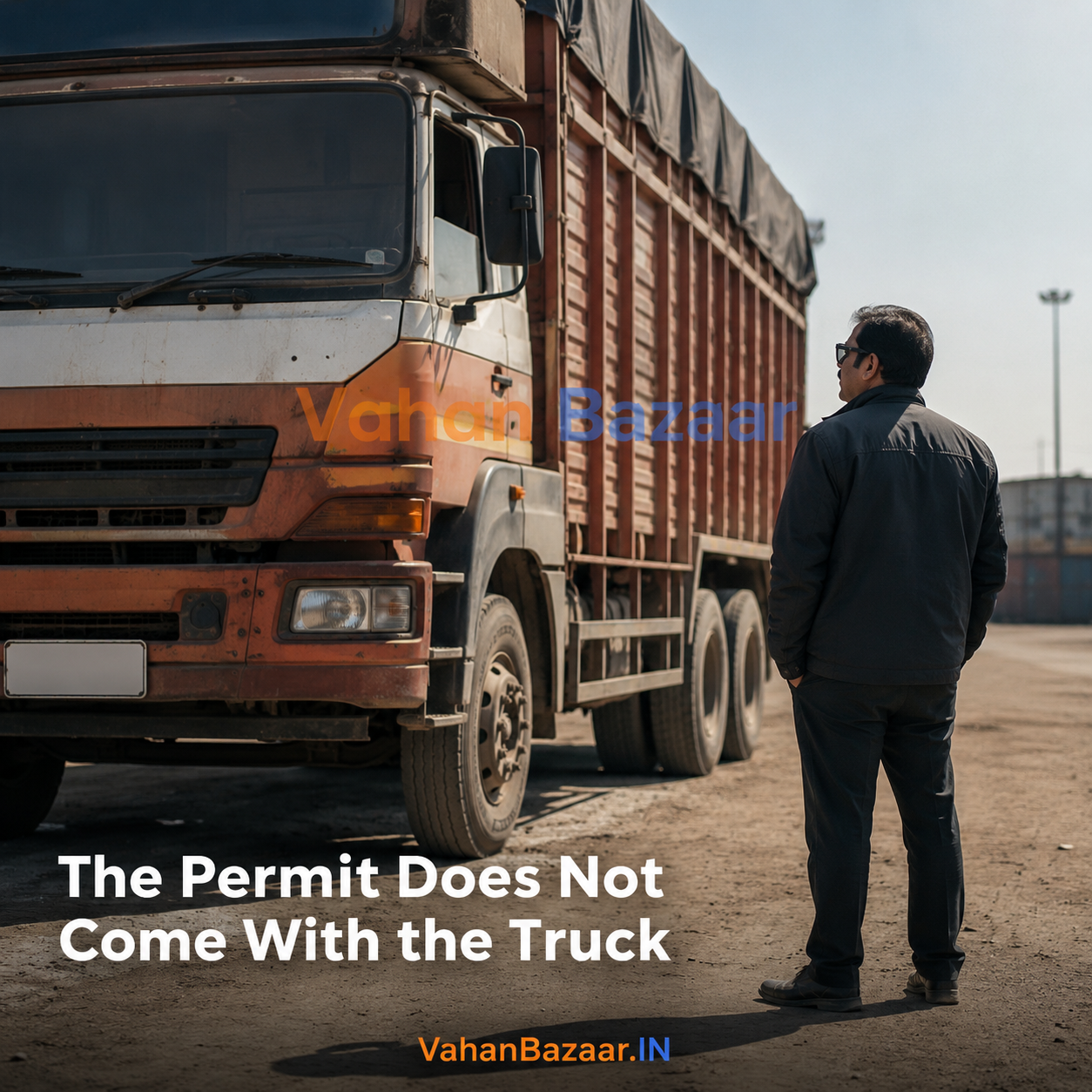
Buyers of used commercial vehicles are, as a group, more careful than buyers of used cars. They inspect properly, they know what a worn chassis looks like, and they can usually estimate a rebuild cost within a few thousand rupees. They are buying an income-producing asset and they treat it that way.
Which makes it striking how consistently the same error recurs. The vehicle is checked thoroughly. The paperwork that decides whether it can legally earn is not, because the buyer assumes it travels with the truck. It does not.
What a Permit Actually Is
A permit authorises a particular vehicle to be used for a particular kind of carriage over a defined area. A national permit, which allows goods vehicles to operate across state boundaries, must cover a minimum number of contiguous states including the operator's home state, and it is obtained through the home state's transport authority.
The crucial characteristic, and the one that catches buyers, is that permits are vehicle-specific and tied to the operator holding them. They are not an attribute of the vehicle that persists through a change of ownership the way a chassis number does. When the vehicle is sold, the new owner deals with the permit in their own right, which in practice means applying afresh rather than inheriting the seller's arrangement intact.
The composite fee element of the national permit regime has largely moved online through the Parivahan portal, which has made renewal considerably less painful than it once was. The initial application still typically involves submitting the relevant forms and supporting documents to the home state's transport authority in person, so it is a process with a timeline attached, not a same-day formality.
How the Mistake Plays Out
The pattern is consistent. A buyer finds a well-kept goods vehicle at a fair price from a seller who has been running it on a route similar to the one the buyer has in mind. The seller mentions, accurately, that the vehicle has a valid permit. The buyer hears that as the vehicle comes with a permit, pays, and takes delivery.
The vehicle then sits. Not because anything is wrong with it, but because the buyer cannot legally put it to work until the permit position is sorted out in their own name, and that takes as long as it takes. Every day of that is a day of lost revenue against an asset that has been paid for, frequently with borrowed money on which instalments have already started.
Buying a used truck or pickup? Confirm the registered owner, hypothecation status and pending challans before you commit working capital to it.
The Penalty Side Is Worse Than the Delay
Some buyers, having discovered the position, take the view that they will operate while the paperwork catches up. This is a poor trade. Operating a goods vehicle without a valid permit exposes the operator to substantial penalties under the Motor Vehicles Act, running into the tens of thousands of rupees, and to the possibility of the vehicle being detained at a checkpoint.
A detained truck is not a fine. It is a stopped business, a stranded load, and a customer relationship that may not survive. Against that, waiting for the permit is comfortably the cheaper option, and planning for it before purchase is cheaper still.
The Checks That Belong Alongside It
The permit question sits within a wider set of commercial-vehicle checks that differ from what a private car needs. A transport vehicle requires a valid fitness certificate to operate at all, and that certification is periodic throughout its working life rather than a once-in-fifteen-years event. Establish the current fitness validity and, on an older vehicle, form a realistic view of what the next test will cost including any work needed to pass it.
Then the standard record checks, which matter more here because the sums are larger. Goods vehicles are financed heavily by owner-operators and small fleets, so an active hypothecation entry is common and will block the ownership transfer until the financier's No Objection Certificate is obtained. And a working truck accumulates challans at a rate a private car does not, because it covers far more ground under far more enforcement, with overloading and documentation offences adding to the usual traffic ones.
Where the vehicle is registered in one state and will be operated in another, add the No Objection Certificate and re-registration process to the timeline and the budget, and note that it depends on the vehicle being clear of outstanding dues, which loops directly back to the challan and tax position.
What This Means for Used Vehicle Buyers and Sellers
For buyers, the discipline is to price the whole thing rather than the truck. Write down the purchase price, the fitness position and the likely cost of the next test, the permit process for your intended use and its timeline, re-registration and NOC costs if the vehicle is moving between states, outstanding challans and tax, and insurance. That total is what the vehicle actually costs to put to work, and it is frequently a long way from the advertised price. Our checklist for used trucks and pickups works through each item.
Start the permit conversation with your transport authority before you choose a vehicle, not after. What you need depends on your route and your intended carriage, and knowing it in advance changes which vehicles are worth looking at.
For sellers, be precise rather than reassuring. Telling a buyer the vehicle has a valid permit is true and, on its own, misleading, because the buyer will hear it as an assurance that they inherit it. A seller who explains the position accurately and can show a clean record, clear challans and a current fitness certificate deals with better-prepared buyers and argues less about price. A verified listing at Rs 99 cross-verifies the vehicle against the government record and carries a Verified badge that every buyer sees. On average, based on VahanBazaar listings data, verified listings receive around three times more buyer enquiries and typically sell about 40% faster.
The record checks themselves are the cheap part. An RC check costs Rs 99 and returns the registered owner and hypothecation position, a challan check costs Rs 99, and both together are Rs 149 rather than Rs 198. On a commercial vehicle purchase running to several Lakh, against the cost of a truck that cannot legally carry a load, it is not a close call.
Check the Vehicle Before You Commit Capital
Registered owner, hypothecation position and pending challans against any commercial registration number. RC check Rs 99. Add the challan position and take both for Rs 149 instead of Rs 198 separately.
List Verified — Rs 99Frequently Asked Questions
Not automatically. Permits are vehicle-specific and tied to the operator holding them, so they do not pass to a new owner as an attribute of the vehicle the way a chassis number does. When a goods vehicle is sold, the new owner must deal with the permit in their own right, which in practice means applying afresh rather than inheriting the seller's arrangement. Establish what the vehicle currently holds and what your intended use requires before agreeing a price.
A national permit allows goods vehicles to operate across state boundaries and must cover a minimum of four contiguous states, including the operator's home state. It is obtained through the home state's transport authority. The composite fee element has largely moved online through the Parivahan portal, though the initial application typically still involves submitting the relevant forms and supporting documents to the home state's regional transport authority in person.
Operating without a valid permit exposes the operator to substantial penalties under the Motor Vehicles Act, running into the tens of thousands of rupees, and to the possibility of the vehicle being detained at a checkpoint. A detained vehicle means a stopped job, a stranded load and a customer relationship that may not recover, which is why waiting for the permit is comfortably cheaper than operating without one.
Beyond the permit, establish the fitness certificate's current validity, since a transport vehicle requires periodic certification throughout its working life and cannot legally operate once it lapses. Check the registered owner and hypothecation position, because commercial vehicles are heavily financed and an active entry blocks the ownership transfer until the financier's NOC is obtained. Check pending challans, which accumulate faster on a working truck, and if the vehicle is moving between states, budget for the NOC and re-registration process.
On VahanBazaar an RC check costs Rs 99 and returns the registered owner and hypothecation position against the registration number, while a pending challan check costs Rs 99, with both together available at Rs 149 rather than Rs 198 separately. Against a commercial vehicle purchase running to several Lakh, usually financed, that is a very small amount to spend establishing who owns the vehicle and what is owed on it.