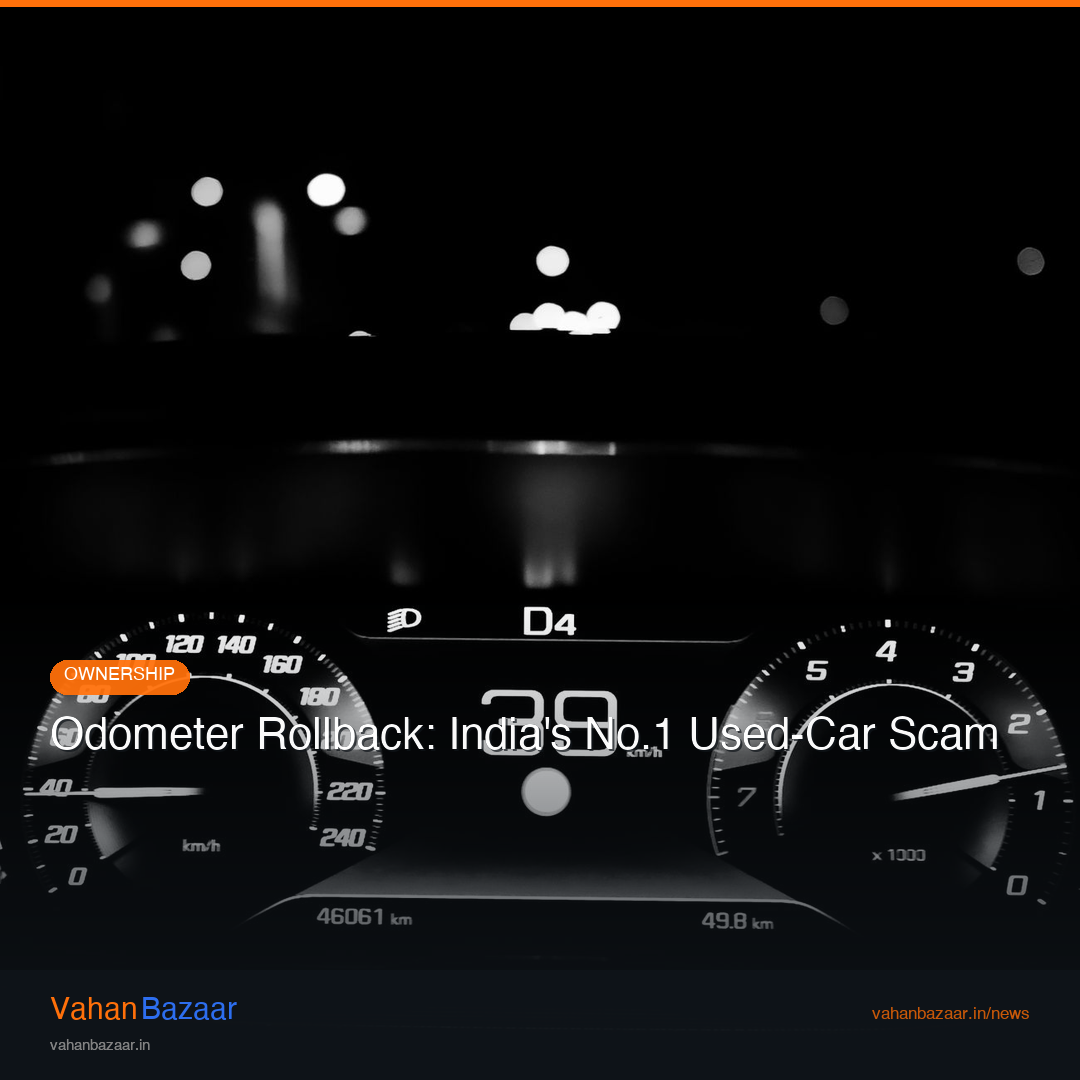
The most common way an Indian used-car buyer loses money is not a dramatic accident cover-up or a forged registration paper. It is the single number staring back from the instrument cluster — the kilometres on the odometer. Winding that number back to make a tired, high-mileage car look barely driven is the oldest trick in the second-hand trade, and in India it remains stubbornly widespread. A car that has genuinely covered 1.2 Lakh kilometres, quietly shown as 55,000, can carry an asking price tens of thousands of rupees higher than it deserves, and most buyers never spot the difference until the repairs start piling up.
Two things changed the stakes recently. First, the law now treats mileage tampering as a criminal offence, not a mere sharp practice. Second, buyers have finally understood that the one check most of them rely on — the government VAHAN record — does not, and cannot, expose it. This article explains why odometer rollback is so common, what the law now says, and, most importantly, the exact sequence a careful buyer follows to catch it before handing over a single rupee of deposit.
Why Odometer Rollback Is So Common in India
The scale of this scam has less to do with technology and more to do with market structure. According to industry data, over 60 percent of used-car transactions in India still run through unorganised channels — local brokers, roadside dealers and direct person-to-person sales. In that world there is no standard inspection, no audited history and very little accountability once the money has changed hands. A seller who winds an odometer back by 40,000 or 50,000 kilometres faces almost no chance of being caught at the point of sale, and the reward is an inflated asking price that a trusting buyer pays in full.
The mechanics of the fraud are cheap and quick. On older cars with mechanical dials, the reading could be spun back by hand. On modern cars the mileage lives in the electronic control unit, and a plug-in tool can rewrite it in minutes — which, ironically, makes a digital odometer no safer than an analogue one unless it is properly interrogated. The number on the dashboard is, in the end, just a claim. Treating it as a verified fact is where most buyers go wrong, and our detailed walkthrough on how odometer rollback is detected in India shows just how routinely the displayed figure is manipulated.
Kilometres are the single biggest driver of a used car's condition after age. Lower mileage implies less engine wear, a fresher clutch and gearbox, and more life left in the suspension and tyres. That is why buyers pay a premium for it — and exactly why a fraudulent seller has every incentive to fake it. A rolled-back reading does not just tell a lie; it manufactures a price the car has not earned.
It Is Now a Crime, Not Just a Trick
For years, sellers treated odometer tampering as a victimless bit of salesmanship. The law is now unambiguous that it is not. Rolling back or otherwise tampering with an odometer to deceive a buyer about distance travelled is cheating under Bharat Nyaya Sanhita (BNS) Section 318 — the provision that has replaced the familiar Section 420 of the old Indian Penal Code. The punishment is serious: imprisonment of up to seven years and a fine. This is not a compoundable traffic matter; it is a criminal offence carrying real jail exposure for the person who tampered with the meter and sold the car on a false reading.
The buyer's protection does not end with the criminal side. A person who has been cheated in this way can also approach a District Consumer Commission under the Consumer Protection Act, 2019, and seek a refund or compensation for the loss suffered. In practice this means a buyer who later proves the odometer was tampered has two parallel routes — a criminal complaint and a consumer claim — rather than simply having to absorb the loss. The catch, of course, is that both routes are after-the-fact remedies. They are far less pleasant than catching the fraud before you pay, which is what the rest of this guide is about.
A criminal complaint or a consumer case can take months and demands evidence — old service invoices, a diagnostic report, expert testimony. It is a genuine remedy, but a slow and stressful one. The far better outcome is never to buy the tampered car in the first place. The few minutes and few hundred rupees you spend verifying mileage before paying are trivial next to the cost of unwinding a fraudulent purchase through a tribunal.
Why a VAHAN Check Alone Will Not Catch It
Here is the point that surprises most buyers, and the reason odometer fraud survives even in the hands of careful shoppers. The government VAHAN and RTO records do not display kilometres driven. The VAHAN database holds the registration date, the number of previous owners, the registration status, insurance and road-tax validity, and the vehicle's specifications — but nowhere in that record is there a field for the distance the car has covered. A VAHAN lookup, however thorough, simply cannot reveal that an odometer has been wound back.
This does not make the VAHAN check useless — far from it. It gives you the one thing you need to judge the odometer against: the car's true age. A Vahan Verify check for Rs 99 confirms the registration date, owner count and status straight from the government record, which is the baseline you use to ask the obvious question — does this reading make sense for a car this old? Verification and odometer-checking are two separate jobs, and you need both. The registration date is the anchor; the mileage is the claim you test against it.
So a rolled-back odometer has to be caught the old-fashioned way: by cross-referencing the registration date, the service-history and PUC records, the physical wear on the car, and an OBD or ECU diagnostic scan, all against the number on the dash. When four independent signals agree, the reading is probably honest. When they contradict it, you have a fraud on your hands. Our field checklist on how to spot a tampered odometer breaks each of these signals down in detail.
The Age-Versus-Kilometres Rule of Thumb
Start every used-car inspection with one simple mental sum. A normally used Indian car covers roughly 10,000 to 15,000 kilometres a year. Multiply the car's age by that band and you get the range a genuine reading should fall into. A figure sitting far below that range is not proof of fraud, but it is a clear signal to investigate hard before you go any further. The table below turns the rule into quick reference numbers.
| Car age | Typical genuine reading (~10,000-15,000 km/yr) | Investigate hard if the meter shows |
|---|---|---|
| 3 years | ~30,000-45,000 km | Under 18,000 km |
| 5 years | ~50,000-75,000 km | Under 25,000 km |
| 8 years | ~80,000-120,000 km | Under 40,000 km |
| 10 years | ~100,000-150,000 km | Under 55,000 km |
Indicative ranges based on the ~10,000-15,000 km/yr norm. Genuinely low-use cars exist, but they should be backed by a matching service history and matching physical condition — never taken on trust.
A genuinely low-kilometre car is not impossible — a second family car used only for weekend errands can rack up far less than the average. The rule is not that low readings are always fake; it is that a low reading must be corroborated by the rest of the evidence. If a five-year-old car shows 22,000 kilometres and the seat, pedals, tyres and service book all agree, it is plausible. If they do not, you are almost certainly looking at a rollback.
How to Catch Odometer Fraud Before You Pay
Once the age-versus-reading test raises a flag, move to the physical and documentary checks. Fraud that fools the eye rarely fools all four of these signals at once, because a tamperer can rewrite a number but cannot easily fake years of accumulated wear. The table lays out what to look at and what a rolled-back car tends to reveal.
| What to check | What it tells you |
|---|---|
| Brake & clutch pedal rubber | Worn-smooth or replaced pedals on a "low-km" car point to heavy use the meter is hiding |
| Steering wheel & gear knob | A shiny, frayed or polished rim rarely matches a genuinely low reading |
| Driver's seat & bolsters | Sagging cushions and worn side bolsters betray long hours behind the wheel |
| Tyres & battery date | Multiple tyre changes or an early battery replacement imply far more distance than shown |
| Service & PUC records | Kilometre readings printed on past invoices and PUC certificates should climb steadily, never jump backwards |
| OBD / ECU diagnostic scan | Stored mileage values or fault logs in the control unit can contradict the dashboard number |
The single most powerful documentary check is the service and PUC trail. Every authorised service and every pollution-under-control certificate records the odometer reading on the date it was issued. Lined up in order, those readings should rise in a smooth, believable curve. A reading that leaps and then drops — 90,000 kilometres on a two-year-old invoice, then 60,000 at the time of sale — is a rollback caught red-handed. If you are inspecting without a workshop to hand, our guide on how to inspect a used car without a mechanic and the broader 10 things to check before buying a used car walk you through doing this yourself.
Before you drive across town to view a car, line up its age against the odometer and run the photos and the VAHAN record together. An AI Vahan Inspection for Rs 249 reads the seller's photos alongside the official registration record and flags condition and mismatch risks — including visible wear that does not square with a low reading — so you can rule out the obvious frauds from your phone, before you ever commit a deposit.
Where an AI Vahan Inspection Fits In
Cross-referencing four signals sounds like a lot of work for a buyer looking at several cars, and it is. This is exactly the gap the AI Vahan Inspection at Rs 249 is built to close. Our AI reads the car's photos and its VAHAN record together and flags condition, mismatch and red-flag risks before you commit a deposit. Because it lines up the registration age drawn from the government record against the wear visible in the images, it surfaces precisely the inconsistency that betrays a rollback: heavy interior, seat and pedal wear on a car whose meter claims very low kilometres.
It works best paired with a Vahan Verify check at Rs 99, which confirms the registration date, owner count and status — the age baseline you sanity-check the odometer against. Verify establishes how old the car truly is; the AI Inspection tests whether the car's condition and claimed mileage are consistent with that age. Together, for well under Rs 300, they let you filter out the cars that fail the basic smell test before you spend a rupee on travel, a mechanic or a token advance. Neither replaces a physical inspection of a car you are serious about, but both stop you wasting that effort on a car that was never honest to begin with.
What This Means for Used-Car Buyers
The takeaway is simple and it runs against the grain of how most people buy a second-hand car in India. The odometer reading is a claim, not a fact — and in a market where over 60 percent of deals happen in unorganised channels, it is a claim that is frequently false. The law is now firmly on the buyer's side: mileage tampering is cheating under BNS Section 318, punishable with up to seven years in jail, and a cheated buyer can pursue compensation before a District Consumer Commission. But those are remedies for after the damage is done.
The winning move is to verify before you pay. Do not lean on a VAHAN check to catch mileage fraud — it cannot, because the record does not carry kilometres. Instead, use the VAHAN record to establish the car's true age with a Vahan Verify at Rs 99, run the age-versus-reading test, and let an AI Vahan Inspection at Rs 249 line the car's photos up against its official record to flag any wear that does not match a low odometer. A few hundred rupees and a few minutes spent this way is the cheapest insurance in the entire used-car process — and the difference between buying the car you were promised and inheriting someone else's tired one at a fresh-car price.
Catch Mileage Fraud Before You Pay a Deposit
An AI Vahan Inspection for Rs 249 reads the car's photos and its VAHAN record together to flag condition, mismatch and red-flag risks — including wear that does not square with a low odometer — before you commit. Pair it with a Rs 99 Vahan Verify to lock down the car's true age first.
Get an AI Inspection — Rs 249Frequently Asked Questions
Yes. Rolling back or otherwise tampering with an odometer to deceive a buyer about how far a car has been driven is treated as cheating under Bharat Nyaya Sanhita Section 318, the provision that has replaced the old Section 420 of the Indian Penal Code. It is punishable by imprisonment of up to seven years and a fine. On top of the criminal side, a buyer who has been cheated can approach a District Consumer Commission under the Consumer Protection Act, 2019, and seek a refund or compensation. So mileage tampering is not a grey-area sharp practice — it is a criminal offence with real jail exposure for the seller.
No. The government VAHAN and RTO records hold the registration date, owner count, registration status, insurance and tax details and similar data, but they do not store or display the kilometres a vehicle has covered. This is exactly why odometer fraud survives even when a buyer runs a registration check. A VAHAN lookup confirms the age and history baseline of the car, but the mileage on the meter has to be verified separately by cross-referencing service and PUC records, the physical wear on the car, and a diagnostic scan of the electronic control unit. Treat the VAHAN check and the odometer check as two different jobs.
Start with the age-versus-reading test. A normally used Indian car covers roughly 10,000 to 15,000 kilometres a year, so a five-year-old car showing under 25,000 kilometres deserves suspicion. Then look for wear that does not match a low reading: a worn brake and clutch pedal rubber, a shiny or frayed steering wheel, sagging driver's seat bolsters and tyres or a battery newer than the mileage would justify. Cross-check the odometer against dates and readings printed on past service invoices and PUC certificates, because a genuine history shows kilometres climbing steadily. Finally, an OBD or ECU diagnostic scan can reveal stored mileage values or fault records that contradict the dashboard number.
It is one of the most common scams in the market, largely because of how fragmented that market is. According to industry data, over 60 percent of used-car transactions in India still run through unorganised channels such as local brokers, roadside dealers and direct private sales, where there is little accountability and no standard inspection. In that environment, winding an odometer back by a few tens of thousands of kilometres to lift the asking price is a low-effort, high-return trick, and it is difficult for an ordinary buyer to detect by eye. That is why cross-verification, rather than trust, is the only safe approach.
An AI Vahan Inspection for Rs 249 reads the car's photos and its official VAHAN record together and flags condition, mismatch and red-flag risks before you commit a deposit. Because it lines up the registration age from the government record against the visible wear in the images, it can surface exactly the kind of inconsistency that points to a rolled-back odometer, for example heavy interior and pedal wear on a car whose meter claims very low kilometres. Pair it with a Vahan Verify check for Rs 99, which confirms the registration date and owner count so you have a firm age baseline to sanity-check the odometer against, and you have a low-cost way to filter out the obvious frauds before you ever pay.