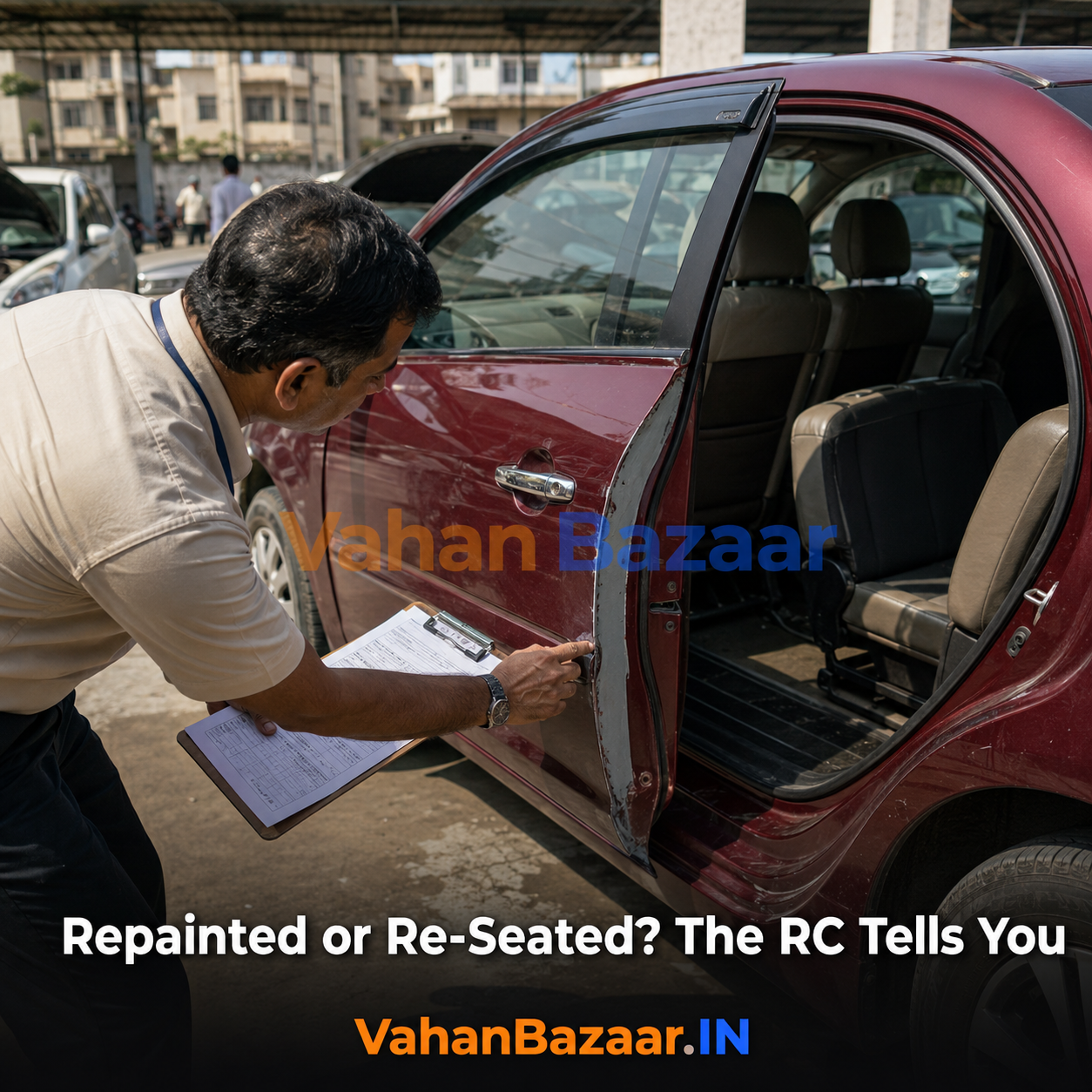
Most used car buyers in India inspect the car and then read the registration certificate. Very few do it the other way round, and almost nobody does both at the same time, line by line. That is a pity, because three of the plainest fields on an Indian RC — colour, seating capacity and type of body — quietly tell you whether the car in front of you is the car the government thinks it is.
A gleaming white hatchback whose record says silver. A family MPV advertised as a five-seater when the record says seven. A hardtop conversion on what was registered as something else. A bench seat pulled out to make room for luggage. None of these look dramatic on a Sunday morning test drive. All of them are, in the eyes of the law, alterations — and if they were never endorsed by the registering authority, they follow the car into your name.
Colour, seating capacity and body type are recorded on the RC. If the physical car does not match, an alteration happened, and unless it was endorsed by the registering authority the paperwork is out of step with the vehicle — which is exactly the kind of thing that surfaces at transfer time or at a claim counter. Read the record before you pay a deposit, not after.
Three RC Fields Most Buyers Never Read
The Indian registration certificate is issued in Form 23, or as a smart card in Form 23A, prescribed under Rule 48 of the Central Motor Vehicles Rules, 1989. Alongside the registration number, chassis number, engine number, class of vehicle and month and year of manufacture, the form carries three entries that describe what the car physically is:
- Colour or colours of body, wings and front end — not just "white", but the recorded description of the finish as registered.
- Seating capacity (including driver) — the number the vehicle was registered to carry, driver counted.
- Type of body — saloon, hatchback, station wagon, hard top, and so on, depending on how it was registered.
These are not decorative. They are the state's description of the vehicle, and every downstream process — transfer of ownership, fitness, insurance underwriting, a police check at a barricade — reads them as fact. When the metal disagrees with the record, one of them is wrong, and it is never the record that gets the benefit of the doubt.
What the Law Actually Says About Altering a Car
The governing provision is Section 52 of the Motor Vehicles Act, 1988, headed "Alteration in motor vehicle". Sub-section (1) is the core rule and it is worth reading in its own words: no owner of a motor vehicle shall so alter the vehicle that the particulars contained in the certificate of registration are at variance with those originally specified by the manufacturer.
That single sentence is why an unendorsed change matters. The test is not whether the modification is tasteful, or safe, or common. The test is whether the vehicle now differs from what the RC records as the manufacturer's original specification.
What the 2019 amendment changed
The Motor Vehicles (Amendment) Act, 2019 reworked Section 52 in two directions at once. It added an Explanation defining "alteration" as a change in the structure of a vehicle which results in a change in its basic feature, which narrows the concept — a fresh coat of paint is not obviously a structural change. It also added a proviso empowering the Central Government to prescribe specifications and conditions for approved alteration and retrofitment, with the manufacturer's warranty not treated as void in those cases, and inserted sub-section (1A) requiring manufacturers to alter or retrofit safety equipment when the Central Government so directs.
At the same time, the 2019 amendment introduced Section 182A, which deals with offences relating to construction, maintenance, sale and alteration of motor vehicles. Section 182A(4) provides that an owner who alters a motor vehicle, including by way of retrofitting of motor vehicle parts, in a manner not permitted under the Act or the rules and regulations made under it, is punishable with imprisonment which may extend to six months, or with a fine of five thousand rupees per such alteration, or with both. The phrase "per such alteration" is the one to notice: on a heavily worked-over car, the arithmetic is not a single flat fine.
Approval, and the fourteen-day report
Section 52 does not forbid every change. Section 52(2) permits alterations with the approval of the registering authority, including converting a vehicle into an adapted vehicle for a person with disability, subject to conditions prescribed by the Central Government — which is also the route by which fuel conversions are regularised and the fuel entry on the RC updated. Where a change has already been made without that prior approval, Section 52(3) puts a clock on it: the owner must, within fourteen days of making the alteration, report it to the registering authority in whose jurisdiction he resides, and forward the certificate of registration to that authority along with the prescribed fee, so that the particulars of the alteration can be entered in the certificate.
Two more sub-sections matter to a used car deal. Section 52(4) requires a registering authority other than the original one making such an entry to communicate the details to the original registering authority, so the change propagates through the record. And Section 52(5) bars a person holding a vehicle under a hire-purchase agreement from making any alteration except with the written consent of the registered owner — relevant on any car still carrying a financier's interest.
Section 52(3) places the duty to report an unapproved alteration on the owner who made it. On a used car, that is the seller. If you buy first and discover the mismatch later, the paperwork problem is yours to solve, and you will be the one explaining to an RTO counter what was changed and when — without having been there.
The Supreme Court's position
In Regional Transport Officer and Others v. K. Jayachandra and Another, decided on 9 January 2019, the Supreme Court set aside a Kerala High Court view that structural alteration was permissible under state rules, and held that no vehicle can be altered so as to change the original specification made by the manufacturer. Particulars specified by the manufacturer for entry in the certificate of registration cannot be altered. It is the clearest statement Indian courts have given on the subject, and it is why an RTO counter tends to be unimpressed by the argument that "everyone does it".
Before you agree a price, pull the recorded colour, seating capacity and body type and read them against the car.
Colour: The Repaint That Never Reached the RTO
Repainting a car is not banned. What is not optional is bringing the record into line, because the colour of the body, wings and front end is an entry on the certificate of registration. Until the registering authority updates it, the RC describes a car that no longer exists.
The process is unglamorous and broadly consistent across states: apply to the registering authority for the change, get the car repainted in the approved shade, present it for inspection, and have the new colour entered in the record and the certificate reissued. On fees, Rule 81 of the Central Motor Vehicles Rules, 1989 sets the charge for recording an alteration in the certificate of registration at half the fee payable for issue of a certificate of registration. For a light motor vehicle in the non-transport category that fee is Rs. 600, so the alteration entry works out to roughly Rs. 300 — the figure published by state transport departments including Telangana — with an additional charge where a smart-card certificate in Form 23A has to be reissued. State-level variations and service charges exist, so treat these as the statutory baseline rather than a final bill.
One colour rule is absolute rather than procedural. Rule 121(1) of the Central Motor Vehicles Rules prohibits any motor vehicle from being painted olive green except vehicles belonging to the Defence Department. No endorsement makes that one legal.
A wrap sits in a slightly different place from a respray, because it is reversible and does not permanently change the paint — but it changes what the car looks like to a police officer comparing it against the record, which is the practical point. If you are weighing one against the other, our guide to car wrap versus paint, including the RTO and insurance angles, sets out where each option leaves you.
Most repaints on used cars are honest — stone chips, sun-faded roofs, a resprayed panel after a knock. But a full colour change is also the cheapest way to make a car look different from the one in an old photograph, and a repaint over an entire flank is a common way to hide repair work. A colour on the car that does not match the colour on the record is worth a straight question before it is worth an assumption.
Seating Capacity: The Seven-to-Five Swap
Seating capacity including the driver is a recorded particular, and it moves in both directions in the used market. Owners of seven-seat MPVs and SUVs pull the third row out permanently to create boot space and then sell the car as a five-seater. Owners of five-seat vehicles have a bench added to squeeze in more passengers. Removing a bench also touches occupant safety fittings — seat belt anchorages and the mountings that were engineered for that row.
Either way, the number on the RC and the number of usable seats in the car no longer agree. That is a change to a recorded particular, and Section 52 is the provision that governs it. A buyer who intends to carry seven people needs the RC to say seven; a buyer told the car is a five-seater needs to understand why the record disagrees.
| What you see on the car | What to check on the record | Buyer risk if unendorsed |
|---|---|---|
| Colour differs from RC entry | Colour of body, wings and front end | Record and vehicle disagree at any check; repaint may also be masking repair work |
| Third row removed or bench added | Seating capacity (including driver) | Recorded particular no longer matches; seat belt and anchorage fitment also affected |
| Hardtop, roof or body conversion | Type of body, class of vehicle | Structural change touching the manufacturer's original specification |
| Fuel kit fitted after purchase | Fuel entry on the RC | Legal with approval under Section 52(2); a problem only when the endorsement was skipped |
| Aftermarket film on the glass | Not an RC entry, but a live challan risk | Pasting film on safety glass was prohibited nationwide by the Supreme Court in 2012 |
Body Type: Where Structure Really Changes
Body type is the field where Section 52 bites hardest, because a hardtop conversion, a roof chop, a panel-van conversion or a change to the load area is precisely the "change in the structure of a vehicle which results in a change in its basic feature" that the 2019 Explanation describes. This is the territory the Supreme Court addressed in the 2019 ruling above, and it is the category where an RTO is least likely to regularise the change after the fact.
It is also the category where a buyer's downstream costs are highest. A vehicle whose body no longer matches its recorded type can run into difficulty at fitness inspection, at transfer, and at any point where an officer compares the vehicle against the record. If you want the general map of what can and cannot be done legally to a car in India, our reference on legal car modifications and what is actually allowed is the companion piece to this one, and the position on bull bars and crash guards is a good example of a popular fitment that regulators have moved against.
The Insurance Consequence, Stated Honestly
This is where a lot of writing on the subject overstates the case, so it is worth being precise. Motor insurance in India is a contract of utmost good faith. The insured is expected to disclose material facts, and an insurer can question a claim where something undeclared changed the nature of the risk it agreed to cover. An unendorsed structural alteration, a changed seating capacity, or a modification that affects how the vehicle behaves is exactly the sort of thing an insurer will ask about after a serious loss.
But rejection is not automatic. Indian courts have consistently held that materiality is judged case by case, and that a non-disclosure must genuinely be material to the risk before a claim can be repudiated — a broadly pro-policyholder line that stops insurers from treating every technical omission as a licence to decline. The Supreme Court has said as much in the insurance non-disclosure cases it has decided in recent years.
The realistic buyer's read is therefore not "your claim will be rejected". It is this: an unendorsed alteration hands the insurer a legitimate question to ask at the worst possible moment, and puts you on the wrong side of an argument you did not create and cannot easily evidence, because you were not the person who made the change. There is also a second-order effect — a policy written for a vehicle described one way, covering a vehicle that is physically another, is a mismatch that our piece on the VAHAN flags that complicate an insurance claim looks at in more detail. The clean answer is to have the alteration endorsed on the RC and declared to the insurer, so the policy, the record and the metal all describe the same car.
Why It Surfaces at RC Transfer
Buyers often ask why a mismatch that nobody noticed for four years suddenly becomes a problem the week they try to put the car in their name. The answer is that transfer of ownership is the moment the record is actively worked on. The application goes to the registering authority that holds the file; the particulars are read; and where the vehicle does not correspond to what is recorded, the alteration has to be regularised under Section 52(3) before the record can be cleanly updated. Physical mismatches are a well-known reason for transfer applications to stall, as our report on RC transfers rejected over chassis and engine mismatches sets out.
The same logic explains why fuel conversions are the best-behaved category of alteration in the Indian market: the endorsement route under Section 52(2) is well travelled, buyers know to ask for it, and the RC visibly says so. Anyone who has bought a converted car knows the drill from our guide to checking the fuel endorsement and cylinder test on a used CNG car. Colour, seating and body type deserve exactly the same discipline, and get it far less often.
How to Check Before You Pay a Deposit
At the car, with your own eyes
Open the doors and count the seats, driver included. Look under the rear carpet and in the boot floor for capped anchorage points or unused seat-belt mountings — the tell that a row was removed. Check the paint in the door shuts, under the bonnet lip and inside the fuel flap, where the original factory colour usually survives a respray. Run a fingertip along panel edges for overspray on rubber seals. Look at the roof line and rear quarters for anything that does not match how that model left the factory.
Against the official record, before money moves
Then do the part almost nobody does: read the recorded particulars and compare them item by item. A Rs. 99 Vahan Verify check on VahanBazaar returns the vehicle's VAHAN record — the recorded particulars, registration status, owner count and insurance validity — in one lookup from your phone, so you can hold the record next to the car while you are still standing beside it. If you also want to know what is outstanding on the same vehicle, the combined RC and challan check is Rs. 149 rather than Rs. 198 for the two bought separately. Our breakdown of exactly which fields a Rs. 99 check returns shows what you are reading before you buy it.
The timing matters more than the amount. Once a token or advance has changed hands, the conversation shifts from "should I buy this" to "how do I get my money back" — a shift covered in our piece on the checks that belong before the advance, not after. A mismatch discovered before the deposit is simply a negotiating position: either the seller regularises the alteration and hands over an updated certificate, or the price reflects the work and the fee still to come.
Colour, seating capacity, body type, owner count and insurance validity — one lookup, before the deposit.
What This Means for Used Car Buyers and Sellers
For buyers, the discipline is short. Treat colour, seating capacity and type of body as verification fields, not trivia. If any of the three disagrees with the car, ask the seller directly what was changed and whether it was endorsed, and ask to see the updated certificate of registration rather than a promise. Remember that Section 52(3) makes reporting the seller's obligation, so the fair place for that work and its cost to sit is with them, before the sale, not with you afterwards. And remember that a clean-looking RC is a starting point rather than a conclusion — a theme we have covered before in why a clean RC is not enough on its own.
For sellers, the message is even simpler, and it is a commercial one. An unendorsed alteration is a discount waiting to be demanded. A seven-seater sold as a five-seater invites a haggle; a repaint that the record does not know about invites suspicion about accident history that may be entirely unfounded. Regularising the change under Section 52(3) costs a modest statutory fee and a trip to the registering authority, and it converts a red flag into a documented feature. Buyers in Delhi, Pune, Hyderabad and Chennai increasingly run a record check before they travel to see a car at all, which means the mismatch is now found before the viewing rather than during it.
None of this is an argument against buying a modified car. Plenty of alterations are useful, safe and entirely lawful once they are approved and entered on the record. The argument is against buying a car whose paperwork and physical reality have quietly drifted apart — because the drift does not stay quiet forever, and it stops being the previous owner's problem the moment the car becomes yours. Read the record first, and the rest of the deal is much easier to judge.
Read the Record Before You Read the Price Tag
Colour, seating capacity and body type are recorded particulars — and an unendorsed alteration follows the car into your name. A Rs. 99 Vahan Verify check pulls the vehicle's VAHAN record, including the recorded particulars, registration status, owner count and insurance validity, so you can compare it against the car before any deposit moves. Add the challan check and both together are Rs. 149 instead of Rs. 198.
Frequently Asked Questions
Repainting itself is not banned, but the colour is a recorded particular of the registration certificate. Form 23 and Form 23A, prescribed under Rule 48 of the Central Motor Vehicles Rules, 1989, carry an entry for the colour or colours of the body, wings and front end. Once the car no longer matches that entry, the record and the vehicle disagree, and the change has to be intimated to the registering authority so the certificate of registration can be updated. Rule 81 of the Central Motor Vehicles Rules sets the fee for recording an alteration in the certificate of registration at half the fee payable for issue of a certificate of registration — for a private car that works out to about Rs. 300 in most states, with an extra charge where a smart-card certificate in Form 23A has to be reissued. One colour is absolute: Rule 121(1) bars any vehicle other than those belonging to the Defence Department from being painted olive green.
Section 52(1) of the Motor Vehicles Act, 1988 says no owner of a motor vehicle shall so alter the vehicle that the particulars contained in the certificate of registration are at variance with those originally specified by the manufacturer. The Explanation inserted by the Motor Vehicles (Amendment) Act, 2019 defines alteration as a change in the structure of a vehicle which results in a change in its basic feature. Section 52(2) allows certain alterations, including conversion into an adapted vehicle, with the approval of the registering authority and subject to conditions prescribed by the Central Government. Section 52(3) requires an owner who has made an alteration without approval to report it to the registering authority within fourteen days and forward the certificate of registration with the prescribed fee so the particulars can be entered. Section 52(5) bars a person holding a vehicle under a hire-purchase agreement from altering it without the registered owner's written consent.
Only once the change is regularised. Seating capacity, including the driver, is a recorded particular of the certificate of registration, so a car sold as a five-seater when the record says seven — or the reverse — is carrying an unendorsed alteration. Section 52(3) puts the obligation to report the alteration and get the particulars entered on the owner who made it, which means the seller, not you. If you buy first and discover the mismatch later, you inherit the problem of proving what was done and when. Ask the seller to complete the endorsement and hand over an updated certificate of registration before you pay, or negotiate on the basis that the work and the fee are still pending.
Not automatically, but it is a real exposure. Motor insurance is a contract of utmost good faith and the insured is expected to disclose material facts, so an insurer can question a claim where an undeclared change altered the risk it agreed to cover. Indian courts have repeatedly held that materiality is decided case by case and that a non-disclosure must genuinely be material to the risk before a claim can be repudiated, so a rejection is not a foregone conclusion. The practical point for a buyer is that you do not want to be the person arguing that question after a crash. If a car has been altered, get the change endorsed on the certificate of registration and declared to the insurer so the policy, the record and the metal all say the same thing.
Pull the official record and read it against the car in front of you. A Rs. 99 Vahan Verify check on VahanBazaar returns the vehicle's VAHAN record, including the recorded particulars, registration status, owner count and insurance validity, so you can compare colour, seating and body type line by line before any money moves. If you also want the challan position on the same car, the combined RC and challan check is Rs. 149 rather than Rs. 198 for the two bought separately. Run it from your phone while you are still standing next to the car — a mismatch found before the deposit is a negotiation, and a mismatch found afterwards is your problem.
Related News
More on RC particulars, modifications and pre-purchase checks:
- RC Transfer Rejected: The Chassis and Engine Mismatch Trap
- VAHAN Flags That Complicate Your Insurance Claim
- Buying a Used CNG Car: Fuel Endorsement and Cylinder Test
- How to Check a Used Car's RC Before Buying