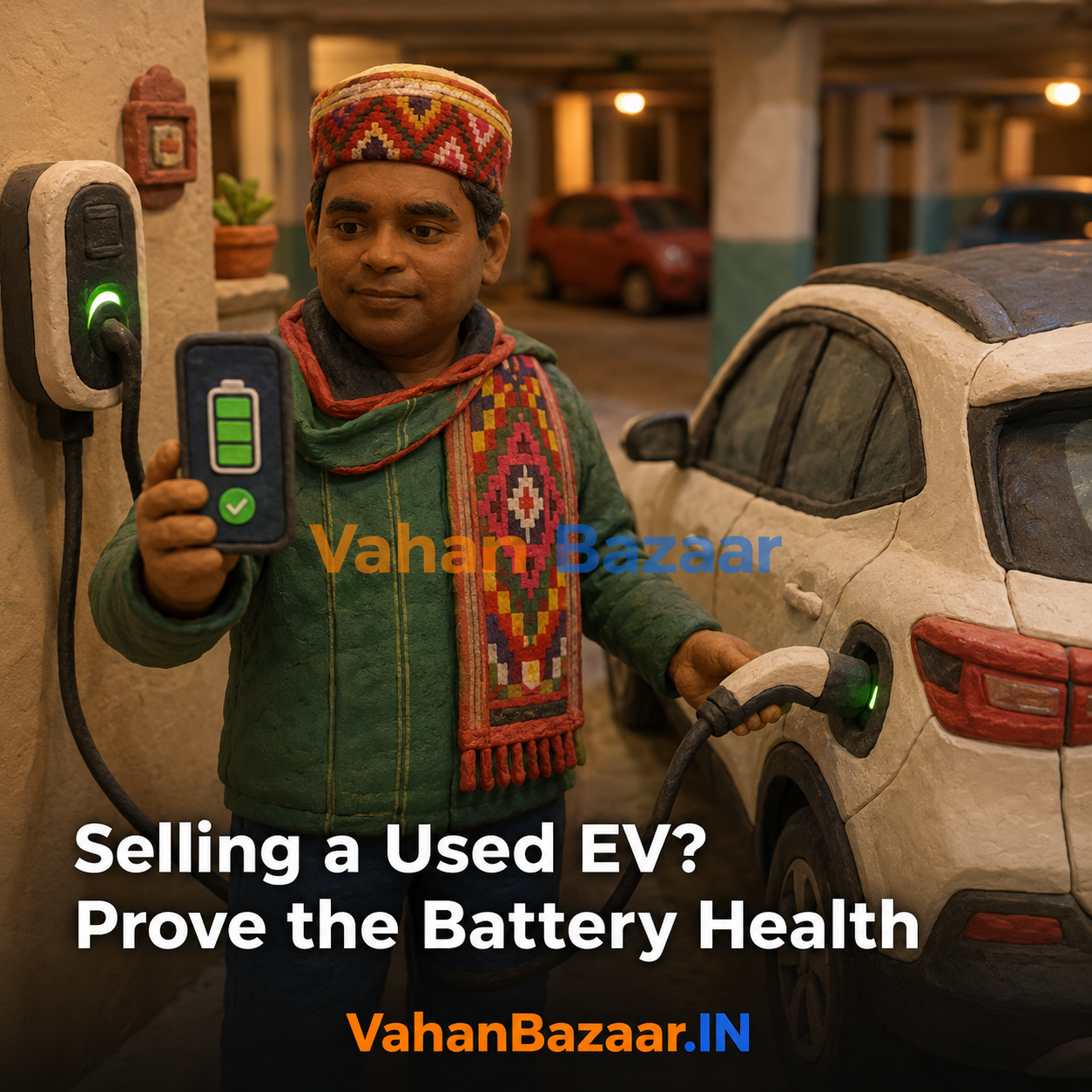
India's switch to electric cars is no longer a trickle. In the four-wheeler passenger-vehicle segment, EV penetration rose from 5.9% in April to 6.6% in May 2026, with Tata Motors leading the EV market at over 39% share, followed by Mahindra and JSW MG. Across all vehicle categories, India recorded roughly 27 lakh EV sales in the twelve months from June 2025 to May 2026. The first big wave of those cars is now reaching its second owner, and a growing number of Indian sellers are about to learn a hard lesson: a used EV that is genuinely in good shape can still fetch a poor price, simply because the buyer cannot be sure of it.
The reason is specific to electric cars and it sits at the heart of every used-EV negotiation. For a petrol or diesel car, the buyer's fear is spread across the engine, gearbox, clutch and bodywork. For an EV, almost all of the fear collapses onto one component: the battery. The pack is the single most expensive part of the car and the one the buyer understands the least. And here is the gap that defines the market today: India has no universally accepted standard yet to certify used-EV battery health for resale. With no trusted signal of how healthy the pack is, buyers do the only rational thing they can with missing information. They assume the worst and price the car down to protect themselves, even when the car in front of them is excellent.
That is the problem you are up against as a seller, and it is also the opportunity. The discount is not really a discount on your car; it is a discount on the buyer's doubt. Remove the doubt and the discount goes with it. The way you remove it is by proving two things at once: that the battery is healthy, and that the car is exactly what you say it is. The first you prove with a battery State of Health reading, the remaining warranty and a service history. The second you prove with a Verified Listing on VahanBazaar's Sell My Car page, which cross-verifies the car against the government VAHAN database. Battery health plus a verified record is your price lever.
For a used EV, the battery is most of the value and most of the buyer's fear. Because India has no national certificate for used-EV battery health, buyers default to assuming the worst and lowball even a good car. The seller who can prove the car is in good standing — a strong SoH reading, remaining battery warranty, full service history, and a clean, verified registration record — converts that doubt into a fair price. The battery health plus a verified record is the lever that protects your money.
Why Used EVs Get Discounted on Doubt
Start with the depreciation pattern, because it is widely misunderstood. An EV typically loses 15-25% of its value in the first year, then roughly 8-12% per year after that. Taken at face value, that sounds like EVs fall off a cliff. But the headline depreciation hides a split. For popular mass-market EVs from brands like Tata, Mahindra, Hyundai and MG, three-year value retention in metros is typically 65-75% — comparable to similar petrol or diesel models — provided the battery health and the remaining warranty are strong. The cars that crater below that band are not a different model; they are the same model with an unproven or weak battery and a buyer who has no way to tell the difference.
That is the asymmetry every seller needs to grasp. The retained value is sitting there to be claimed. What pulls a good EV below it is not the car's actual condition but the buyer's inability to verify the battery. Faced with two identical-looking three-year-old electric hatchbacks, a buyer who cannot read either battery will offer the same cautious, lowball figure for both. The seller of the genuinely healthy car loses out, not because the car is worse, but because it looks the same as the tired one from the outside.
The battery is the whole negotiation
When a buyer inspects a used petrol car, they can listen to the engine, feel the clutch, and read the odometer. When they inspect a used EV, the one thing they most want to know — how much battery life is left — is invisible to the eye. A pack at 90% State of Health and a pack at 70% can sit in cars that look identical in the showroom. So the buyer fills the gap with fear, and fear is expensive. Your job as a seller is to replace that fear with a number and a record, so the buyer is negotiating on facts instead of on worst-case guesses.
The lowball offer on your used EV is rarely an opinion about your specific car. It is a default setting the buyer applies to every used EV because India has no trusted battery-health signal. That means the discount is reversible. The moment you hand the buyer a strong SoH reading, the remaining warranty, a clean service history and a verified record, you have taken away the reason the discount existed in the first place.
Battery Strong vs Battery Weak: What It Does to Your Price
The clearest way to see the stakes is to put a proven-healthy EV next to an unproven one over the same period. The depreciation curve is the same on paper; the price the seller actually achieves is not, because the buyer prices the two very differently.
| What the buyer sees | Battery proven strong | Battery weak or unproven |
|---|---|---|
| State of Health (SoH) | Reading above 85% shown to buyer | No reading; buyer assumes the worst |
| Remaining battery warranty | Years of cover still left, in writing | Unknown or close to lapsing |
| Three-year retention (metros) | Typically 65-75% for mass-market EVs | Driven well below that band by doubt |
| Year-one drop | 15-25% (normal for the segment) | 15-25%, then compounded by distrust |
| Annual drop after year one | Roughly 8-12%, in line with the model | Buyer prices in steeper, faster loss |
| Negotiating position | Seller defends the retained value | Seller accepts a doubt discount |
The two columns are the same car. The only difference is whether the seller arrived with proof or with a story. Depreciation is not the enemy here — every car depreciates, and the EV figures are normal for the segment. The enemy is the unpriced uncertainty that drags a healthy car below the band it deserves. Proof is what holds the line at 65-75%.
The Three Proofs That Defend Your Price
If battery health plus a verified record is the lever, then these are the three things you assemble before you list. Each one answers a question the buyer is already asking in their head, whether they say it out loud or not.
State of Health measures how much of the battery's original capacity remains, and a reading above 85% is generally considered healthy. This is the single most persuasive number you can put in front of a used-EV buyer, because it converts the abstract fear of a degraded pack into a concrete figure. Many EVs can surface a usable indication of battery condition through the car's own systems or a service check; whatever the source, having a recent reading to show takes the biggest unknown off the table before the buyer has to ask.
EV makers in India typically back the battery with a long warranty, and a used EV that still has years of that cover left is worth materially more than one whose warranty is nearly spent. Put the remaining warranty in writing and present it up front. For a nervous buyer, a transferable warranty on the most expensive part of the car is a safety net that justifies paying closer to the retained value rather than the doubt-discounted floor. It tells them that even in the worst case, the part they fear most is covered.
The first two proofs speak to the battery. This one speaks to trust in the car itself. A full service history shows the EV was cared for, and a registration record cross-verified against the government VAHAN database confirms the registration is active and the paperwork is clean — no surprises on owner count, status or validity. For a buyer primed to distrust used EVs, a verified record is the scaffolding that makes them believe your battery proof in the first place. It signals that you have nothing to hide, which is exactly what an anxious buyer needs to feel before they pay a fair price.
Do not assume your EV's good condition speaks for itself. It does not, because the most important part of the car is invisible. A clean, well-kept electric car with no battery reading, no warranty paperwork and an unverified listing looks identical to a tired one in the buyer's eyes, and gets the same lowball offer. Silence on the battery is read as a problem with the battery. Lead with proof, not with assurances.
How a Verified Listing Turns Proof Into Price
You can hold the best battery report in the world, but if the buyer does not trust the listing it sits in, the report does not land. This is why the listing itself matters as much as the proofs you bring to it. On VahanBazaar's Sell My Car page, a Verified Listing for Rs 99 cross-verifies your car against the government VAHAN database and shows buyers a green Verified badge confirming the registration is active and the records are clean. That badge is the trust scaffolding that lets you present your battery-health and warranty proof to a buyer who is otherwise primed to distrust used EVs.
| What you get | Verified Listing — Rs 99 |
|---|---|
| VAHAN record cross-verification | Yes — checked against the government database |
| Green Verified badge to buyers | Shown on the listing |
| Placement in search | Priority placement |
| Trust signal for a nervous EV buyer | Strong — record and badge back your proof |
| Cost to list | Rs 99 |
The numbers make the case. On average, based on VahanBazaar listings data, verified listings draw around 3 times more buyer enquiries and tend to sell about 40% faster. For a used EV, where the buyer's hesitation is the whole obstacle, more enquiries and a faster sale are exactly what a verified record buys you. For an EV that needs to overcome distrust to fetch its retained value, the verified record is what makes the battery proof believable.
A Verified Listing confirms the car's official record: it cross-verifies the registration against the government VAHAN database and shows buyers a green Verified badge with priority placement. It is the trust layer your listing sits in. It does not, on its own, measure your battery's State of Health — that is the reading and warranty you bring. Use the two together: the verified record makes the buyer believe you, and your battery proof gives them the reason to pay the retained value.
What This Means for Used Car Sellers
The story of the used-EV market in 2026 is not that electric cars depreciate badly. The figures — 15-25% in year one, 8-12% a year after, and 65-75% retention over three years in the metros for popular models — are normal for the segment and competitive with petrol and diesel. The real story is that this retained value is conditional. It is paid only to the seller who can prove the battery is healthy and the car is clean. The seller who cannot prove it watches the same car get discounted on doubt, not on fact.
So change what you lead with. Before you set a price, before you field a single enquiry, assemble your three proofs: a State of Health reading above 85% if your battery delivers it, the remaining warranty in writing, and a clean service history. Then put them inside a listing the buyer can trust by taking the Verified Listing on the Sell My Car page, so the green badge and the VAHAN-cross-verified record do the work of convincing a wary buyer. As more electric cars from Tata, Mahindra, Hyundai and MG reach the resale market, the sellers who command 65-75% retention will be the ones who treated battery health and a verified record as their price lever — not the ones who hoped the buyer would simply take their word. If you are weighing the timing too, our guide on the best time to sell a used car in India pairs naturally with getting the proof in order first.
List Your EV — Verified for Rs 99
A Verified Listing on the Sell My Car page cross-verifies your car against the government VAHAN database and shows buyers a green Verified badge, with priority placement in search results. On average, based on VahanBazaar listings data, verified listings draw around 3 times more buyer enquiries and tend to sell about 40% faster. Give your battery-health proof a listing buyers trust.
List Your EV — Verified for Rs 99Every VahanBazaar listing is a Verified Listing for Rs 99. For an electric car that has to overcome a buyer's default distrust to fetch its retained value, that verification is what makes your State of Health reading and warranty proof land — because the buyer believes a verified record in a way they will not believe a story.
Frequently Asked Questions
Because India has no universally accepted standard yet to certify used-EV battery health for resale. The battery is most of an EV's value and most of a buyer's fear, so without a trusted signal of how healthy the pack is, buyers default to assuming the worst and price in that uncertainty. A genuinely good car gets lowballed alongside a tired one. The lack of a trusted battery-health signal is the single biggest obstacle to selling a used EV at a fair price, which is why a seller who can prove the car's standing is the one who commands the retained value.
State of Health, or SoH, measures how much of the battery's original capacity remains. A reading above 85% is generally considered healthy and tells a buyer the pack still holds close to its rated range. If your EV reports a strong SoH, that figure is one of the most persuasive things you can put in front of a buyer, because it converts the abstract fear of a degraded battery into a concrete number. Pair the SoH reading with the remaining battery warranty and a full service history and you have addressed the buyer's single biggest worry directly.
An EV typically loses 15-25% of its value in the first year and then roughly 8-12% per year after that. But for popular mass-market EVs from brands like Tata, Mahindra, Hyundai and MG, three-year value retention in metros is typically 65-75%, which is comparable to similar petrol or diesel models, provided the battery health and the remaining warranty are strong. In other words, the retained value is there to be claimed, but only if you can prove the battery and the record back it up. A weak or unproven battery is what drags an EV below that band.
A Verified Listing for Rs 99 on VahanBazaar's Sell My Car page cross-verifies your car against the government VAHAN database and shows buyers a green Verified badge confirming the registration is active and the records are clean. For a used EV that buyers are primed to distrust, that verified record is the trust scaffolding that lets you present your battery-health and warranty proof to someone who would otherwise discount on doubt. On average, based on VahanBazaar listings data, verified listings draw around 3 times more buyer enquiries and tend to sell about 40% faster.
Four things together: a strong State of Health reading for the battery, the remaining battery warranty in writing, the full service history showing the car was maintained, and a clean, verified registration record from the government VAHAN database confirming the registration is active and the paperwork is in order. The first three speak to the battery and the car's care; the verified record removes doubt about the title and history. Presented together, they answer the used-EV buyer's two questions at once: is the battery healthy, and is the car what the seller says it is.