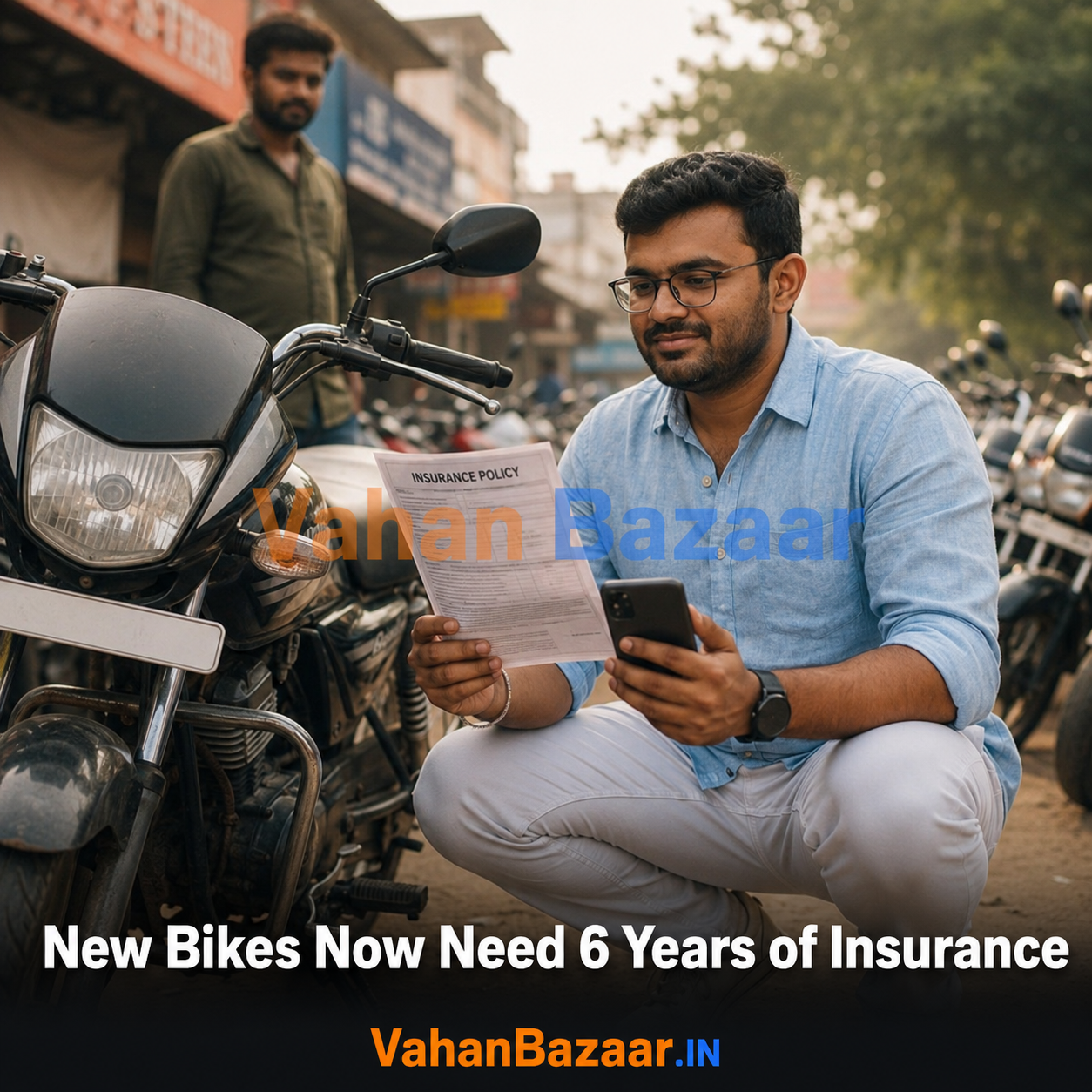
In an early-August 2026 order, a Supreme Court bench of Justices Sanjay Karol and Prashant Kumar Mishra extended the minimum third-party motor insurance that has to be bought at the moment a new vehicle is purchased. A new two-wheeler now needs 6 years of cover paid for upfront, where five years was the requirement before. A new car now needs 4 years, up from three.
Read the coverage that followed and you would think only car buyers were affected. Almost every explainer led on the four-year figure, put a table of car premium slabs underneath it, and stopped there. That is an odd editorial choice in a country where two-wheelers are the overwhelming majority of registered vehicles, where the average buyer is far more price-sensitive at the counter, and where a lapsed policy on a scooter is one of the most ordinary and most consequential gaps in the whole system.
So here is the two-wheeler side of it, and then the part that matters if you are buying or selling second-hand rather than walking into a showroom.
This requirement attaches to a new vehicle at its first registration. It is a condition of the original purchase, not a property of the machine. A used bike does not carry an unexpired block of mandated cover across to you when you buy it, and nobody at the RTO will hand you six years of protection because the first owner once bought some. What the law has always required, separately and continuously, is that a vehicle in use in a public place carries valid third-party cover. After the sale, that duty is yours.
What the Court Actually Ordered
Strip the order down and it does four distinct things. It lengthens the upfront cover at purchase. It pushes enforcement towards automation. It floats an idea about fuel stations that has been widely misreported. And it changes what a buyer must be shown at the counter.
| Vehicle bought new | Previous requirement | Requirement after the 2026 order |
|---|---|---|
| Two-wheeler | 5 years of third-party cover at purchase | 6 years of third-party cover at purchase |
| Car | 3 years of third-party cover at purchase | 4 years of third-party cover at purchase |
| Used vehicle of either kind | Valid third-party cover required whenever the vehicle is used in a public place | Unchanged. The new upfront durations do not attach to a resale |
Notice the third row, because it is the row nobody wrote about. Nothing in the order reaches into the second-hand market to create a new duration obligation. The used-vehicle position is what it always was: the bike must be insured when it is ridden, and whoever is riding it carries that risk.
Where the Five-Year and Three-Year Rules Came From
The durations being replaced were not arbitrary. They came from the Supreme Court's own 2018 judgment in S. Rajaseekaran v. Union of India, a road-safety matter that has run for years and has produced a series of directions on helmets, road engineering, trauma care and insurance. That judgment introduced the idea that third-party cover should be bought in a long block at the time of purchase rather than renewed annually, precisely because annual renewal is where two-wheeler cover quietly falls away.
The logic is behavioural rather than legal. A rider who buys a bike on finance, pays for a year of insurance bundled into the on-road price and then faces a standalone renewal notice twelve months later is a rider who very often does not renew. Front-loading the cover removes that decision point for several years. Moving two-wheelers from five to six years extends that protected window by one more year, which in practice covers a large part of the period during which a first-owner bike is most likely to be sold on.
ANPR Cameras Linked to Insurance and VAHAN Records
The half of the order with the longest tail is the enforcement direction. The court directed that Automatic Number Plate Recognition cameras on highways and roads be linked with insurance records held by the Insurance Information Bureau of India and with vehicle registration data on the VAHAN portal.
Think about what that actually changes. Today, an uninsured two-wheeler is usually discovered in one of two ways: a physical stop by an officer, or a crash. Both are episodic, and both depend on someone being in the right place. Link the camera network to the insurance database and the registration database, and the discovery becomes passive. A number plate is read, the plate is matched against the insurance record, and a vehicle without valid cover is flagged without anyone standing at the roadside.
For a used-bike buyer this is the sentence to sit with. The bike you are about to buy will be read by cameras on your commute whether or not you ever get stopped. If its cover has lapsed and you did not check, you are not relying on luck at a checkpoint any more. You are relying on a database not noticing, which is not a plan.
It is also worth being realistic about timelines. A directive to link systems is the beginning of an integration project across camera networks, insurers and registration data, not a switch that flips next week. But the direction of travel is settled, and it points one way: the gap between what is on the record and what is on the road keeps getting narrower.
The Fuel-Station Idea Is a Pilot to Be Examined, Not a Rule
This is where a lot of the reporting overreached, so let us be exact about it.
The court asked IRDAI, in consultation with the Ministry of Road Transport and Highways, to examine a pilot project linking fuel purchase to a vehicle's insurance status, under which an uninsured vehicle could be refused fuel until cover is bought. That is the whole of it. It is a request to study a pilot. It is not an operative rule, there is no notified scheme behind it, and nothing at your local pump changes because of it.
No fuel station is under an obligation to check your insurance today, and you should treat any message telling you otherwise, or any service offering to "fix" your fuel eligibility, with real suspicion. The only sound reason to keep a two-wheeler insured is the one that already existed: it is legally required when the vehicle is used in a public place, and an uninsured rider carries third-party liability personally.
Four Tiers of Cover at the Point of Purchase
The fourth strand of the order is about disclosure, and it is genuinely useful. The court directed that a buyer be offered a four-tier policy option at purchase: the compulsory third-party cover, plus three optional tiers covering passengers, personal accident protection, and damage to the vehicle itself.
The reason this matters is that most Indian two-wheeler owners have only a fuzzy sense of what their policy actually does. Third-party cover protects other people from you. It does nothing at all for your own bike, and a rider who assumes a "valid insurance" sticker means the scooter will be repaired after a fall is in for an unpleasant conversation. If that distinction is not second nature to you, our explainer on own damage cover versus third-party cover lays out exactly which of the two pays for what, and why the cheaper option is cheaper.
Laying all four tiers on the table at the showroom forces that conversation at the one moment the buyer is actually paying attention. It should, over time, produce a used-bike population where more machines have a meaningful claims history rather than a bare legal minimum.
A Word on the Premium Figures Being Quoted
Several reports paired the order with a table of premiums. Those figures are IRDAI's notified third-party rates for private cars, excluding GST, and they run at Rs. 2,094 for engines up to 1000cc, Rs. 3,416 for 1001cc to 1500cc, and Rs. 7,897 above 1500cc.
They are car rates. They are not two-wheeler rates, and multiplying one of them by six to estimate what a new bike buyer will pay is simply wrong arithmetic on the wrong base. Two-wheeler third-party premiums sit in their own engine-capacity slabs at their own levels, and we are not going to print a number on this page that we have not verified against the current notification. If you want the figure for a specific bike, take it from the notified rate applicable to that engine capacity on the day you buy, not from a news table.
What the car figures are useful for is scale. Even at the top car slab, the compulsory cover is a small fraction of the vehicle's price. On a two-wheeler, where the machine itself may cost well under a Lakh, the compulsory element is smaller still in absolute terms. Whatever the objection to buying six years upfront is, it is a cash-flow objection at the showroom counter rather than a claim that the vehicle has become unaffordable.
Why the Court Pushed This Hard
The bench described the number of uninsured vehicles on Indian roads as shocking, and that word is doing real work. Industry estimates commonly suggest that more than half of the vehicles on Indian roads are running without valid cover, though there is no single official figure and any number you see quoted should be read as an estimate rather than a count.
Two-wheelers are widely understood to be the worst-affected segment, for reasons that are easy to see in ordinary life. The bike is cheap, the renewal is a separate transaction from anything else the owner does, the penalty risk feels remote, and the vehicle often changes hands informally within a family or a neighbourhood without anyone touching the paperwork. Every one of those factors compounds in the used market, which is where most two-wheelers spend the majority of their lives.
What This Means for Used Bike Buyers
Here is the practical translation. Four things change about how you should approach a second-hand two-wheeler.
The six-year block does not come with the bike
If a seller tells you the bike is "covered for years because of the new rule", that is not how it works. The upfront purchase requirement bound the first owner at first registration. What you inherit is a vehicle with whatever insurance position actually exists on the day of the sale, which could be a live policy with years left, a policy expiring next month, or nothing at all. Establish which of the three you are dealing with before you agree a price, not after.
Insurance status is invisible from the outside
You can see a dented tank. You cannot see a lapsed policy. There is nothing about a well-cleaned five-year-old commuter bike that tells you whether its cover ran out eighteen months ago, and there is no honest way to work it out by looking. This is the single most common blind spot in a private two-wheeler deal, and it survives precisely because the pre-purchase inspection everyone does is a physical one.
A printed policy copy is not proof
A policy document in a plastic folder proves that a policy existed on the day it was printed. It does not prove the policy is live now, that the premium was paid, that it was not cancelled, or that it belongs to the vehicle in front of you rather than to another bike the seller owned. The record is the thing that settles it, and our guide on checking a used bike or scooter against the VAHAN record walks through what the official entry shows and how to read the fields that a seller cannot edit.
The insurance position on that record also feeds directly into what you pay going forward. A bike with continuous, uninterrupted cover carries an accumulated no-claim bonus that has real cash value, and a gap in cover destroys it. Before you accept a seller's account of their claims history, read our note on checking insurance and no-claim bonus on a used two-wheeler, because the difference between a clean record and a broken one shows up in your renewal premium for years.
Challans and dues travel with the vehicle
The other thing the camera-and-database direction accelerates is challan capture. Automated enforcement generates automated penalties, and unpaid challans attach to the vehicle in a way that becomes your problem at transfer time. If the bike you are looking at has been ridden uninsured or carelessly, the evidence is usually sitting in the challan history, which is also the cheapest possible character reference for the previous owner. Our walkthrough on checking and clearing challans on a used bike covers what to do when you find them, and who should pay.
Check the Bike Before You Pay
Registration status, recorded insurance position, fitness validity, hypothecation against a loan and blacklist flags, pulled from the official record against any registration number. RC check Rs. 99, challan check Rs. 99, or both together for Rs. 149.
A minute of checking against a purchase of thirty, fifty or eighty thousand rupees is not a difficult trade to justify, and the Vahan Verify check is deliberately priced so that walking away from a bad bike costs you almost nothing. The expensive mistake is the one you make with your own money, on a machine whose history you accepted on trust.
What This Means for Sellers
If you are on the other side of the deal, this order shifts the ground slightly in your favour, provided you are organised about it.
The reason is that automated enforcement raises the value of a clean record. Once buyers absorb the idea that cameras and databases are being stitched together, the questions they ask change. They stop asking whether the bike runs well and start asking whether anything is going to follow them home. A seller who can answer that immediately, with the record rather than an assurance, closes faster and argues about price less.
Practically, that means three things before you list. Make sure the insurance position on the record is accurate and, if the policy has lapsed, say so plainly rather than letting the buyer discover it. Clear outstanding challans, because a buyer who finds them will use them to reopen the price. And if the bike was bought on finance, confirm that the hypothecation has actually been removed from the record after the loan closed, since a lender's name still sitting on the entry will stall the transfer no matter how long ago you made the final payment. Our guide to checking hypothecation on a two-wheeler explains how that entry gets stuck and how to get it lifted.
Doing all three before you advertise, rather than during a negotiation, is what separates a sale that completes from one that stalls. A verified listing at Rs. 99 cross-checks the vehicle against the official record and carries a Verified badge, which removes the friction that kills most private two-wheeler deals: the buyer's quiet suspicion that the description and the record do not match.
The Short Version
New two-wheelers need 6 years of third-party cover bought at purchase, new cars need 4 years, and both figures replace the durations set by the 2018 judgment. Cameras are to be linked to insurance and registration records, which makes uninsured riding a database problem rather than a roadside one. A fuel-linked pilot has been sent for examination and is not a rule. Buyers at showrooms must be shown four tiers of cover rather than handed the minimum.
And none of it attaches to the used bike you are looking at this weekend. That machine carries whatever cover actually exists today, and the only way to know what that is, without taking anyone's word for it, is to pull the record against the registration number before the money moves. Rs. 99 against a purchase running into tens of thousands is the cheapest part of the entire transaction, and the only part that cannot be polished, repainted or explained away.
Frequently Asked Questions
No. The requirement applies at the point a new two-wheeler is bought and registered for the first time. A used bike changing hands is not a first registration, so nothing in the order forces a second-hand buyer to purchase 6 years of cover in one go. What the law has always required is that the vehicle carries valid third-party cover whenever it is used in a public place. That obligation sits on the person riding the bike, which after the sale is you.
In an early-August 2026 order, a bench of Justices Sanjay Karol and Prashant Kumar Mishra extended the minimum third-party cover that must be bought when a new vehicle is purchased. New two-wheelers move from 5 years to 6 years, and new cars move from 3 years to 4 years. The earlier durations came from the court's own 2018 judgment in S. Rajaseekaran v. Union of India. The court also directed that ANPR cameras be linked with insurance records held by the Insurance Information Bureau of India and with vehicle registration data on the VAHAN portal.
Not today. The court asked IRDAI, in consultation with the Ministry of Road Transport and Highways, to examine a pilot project that would link fuel purchase to a vehicle's insurance status, under which an uninsured vehicle could be refused fuel until cover is bought. That is a pilot to be examined, not an enforced rule, and no such condition applies at a fuel station right now. Treat it as a direction of travel rather than something that changes your next fill-up.
Insurance status is invisible from the outside, and a printed policy copy in the seller's folder proves only that a policy existed on the day it was printed. Start from the official record instead. Pull the vehicle's entry from the VAHAN database against its registration number, which shows the registration status, the recorded insurance position, the fitness validity, any hypothecation against a loan, and blacklist flags. On VahanBazaar an RC check costs Rs. 99 and a challan check costs Rs. 99, or both together for Rs. 149.
The court directed that a buyer be offered a four-tier policy option at the point of purchase. The first tier is the compulsory third-party cover, which is the legal minimum. The remaining three are optional add-ons covering passengers, personal accident protection for the owner-driver, and damage to the vehicle itself. The intent is that the buyer sees all four choices laid out at the showroom rather than being handed the cheapest legal minimum by default.