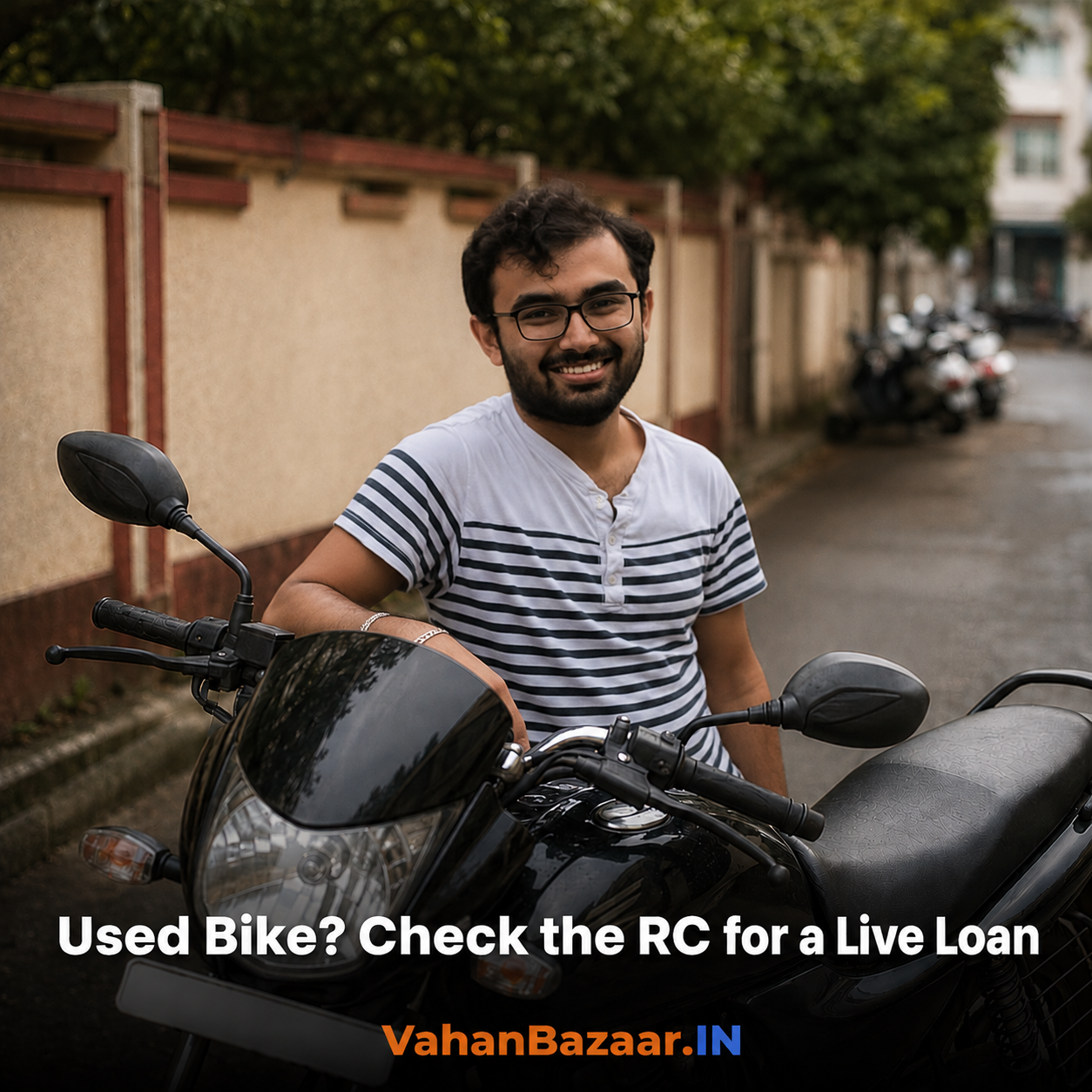
A used car purchase has friction in it. There is a viewing, a negotiation, usually a bank transfer, and enough money involved that both sides slow down. A used bike often has none of that. The price fits in a pocket, the buyer and seller frequently know each other or know someone in common, and the whole thing can be done in an afternoon.
Which is why a particular problem shows up disproportionately on two-wheelers: the loan that was paid off years ago and is still sitting on the registration record.
What Hypothecation Actually Is
When a vehicle is bought on finance, the lender's interest is recorded against it. The registration carries an entry reading, in effect, hypothecated to the lender's name. It is not a lien on the paperwork — it is a field in the vehicle's record.
Repaying the loan does not remove it. That is the single fact that causes all the trouble. The final EMI closes the loan with the lender; it does not, by itself, change the registration record. The removal is a separate act, historically requiring the owner to obtain a No Objection Certificate from the lender and file Form 35, the application for termination of hypothecation, with the RTO.
An open hypothecation entry blocks the transfer of ownership. The RTO will not move the vehicle into your name while another party's interest is recorded against it, and it does not matter that the loan was fully repaid in 2019. From the record's point of view the lender still has an interest. You will have paid for the bike and be unable to register it, and the fix requires the cooperation of a seller who has already been paid and a lender who has no relationship with you.
What Changed in March 2026, and Why It Is Not a Solution Yet
This is the part worth understanding properly, because a half-informed version of it is actively dangerous.
From 1 March 2026, MoRTH introduced a digital route under which banks and non-banking financial companies can report loan closures directly through the VAHAN and Parivahan system. The lender submits the closure details and the NOC digitally, the details are verified, and the hypothecation is removed with an updated RC issued that no longer carries the lender's entry.
That is a genuine improvement, and where it works it removes the most common failure point in second-hand two-wheeler transfers.
Automatic removal has not been implemented across all states or by every lender. It is being rolled out in stages, with more transport departments, banks and NBFCs being brought in over time. So a seller who has heard that removal is now automatic may sincerely believe their record is clean when it is not, because their state or their lender is not yet live on the digital route. A partial rollout produces more confident wrong answers than no rollout at all.
The practical consequence is that on any given used bike there are now three possible states, and they look identical from the outside: the loan is open; the loan is closed and the entry has been removed; or the loan is closed and the entry is still there. Only the record distinguishes them.
What the Record Tells You
A check against the registration number returns the hypothecation position directly — whether a financier's interest is currently recorded against the vehicle — along with the fields that decide the rest of the transaction: registration status and validity, date of first registration and therefore true age, the owner serial number, and any blacklist entry.
On a two-wheeler the owner serial number is worth as much attention as the hypothecation field. Bikes change hands informally and frequently, sometimes without the transfer ever being registered, so the number of people who have actually owned a bike and the number recorded against it can diverge. The record tells you what the RTO believes, which is what governs the transfer.
Check the Bike Before You Pay
Hypothecation against a loan, registration status and validity, date of first registration and true age, owner serial number and blacklist flags — pulled from the official record against any registration number. RC check Rs. 99, challan check Rs. 99, or both together for Rs. 149.
Our tip on whether there is still a loan on that scooter walks through reading the field itself, and the companion guide to running a full record check on a used bike or scooter covers the other fields worth reading at the same time.
If the Entry Is Still There: What It Takes to Clear It
Finding an open entry is not necessarily a reason to walk away. If the loan is genuinely closed, it is an administrative job with a known cost — the question is who does it, and before or after money changes hands.
- The lender's NOC. Obtained from the financier who held the loan. These are typically valid for 90 days from issue, which is a real constraint — an NOC obtained and then sat on becomes useless and has to be requested again.
- Form 35, the application for termination of hypothecation, available through the Parivahan portal or the RTO.
- Supporting documents — the original RC, a valid insurance copy, a current pollution certificate, and government-issued identity and address proof.
- The fees. The RTO hypothecation termination fee is typically around Rs. 100 for a two-wheeler, with a further charge in the region of Rs. 200 for the new smart card RC. Fees vary by state.
- Filing, either online through the Parivahan portal where the state supports it, or in person at the RTO.
The sum involved is small. The sequencing is what matters, and it points one way: this is the seller's job, done before you pay. Once the money has moved, you are dependent on a seller with no remaining incentive and a lender who does not know you. Before the money moves, it is simply a condition of sale, and a reasonable seller will accept it as one.
The Other Clock: The Transfer Deadline
There is a second reason not to let a hypothecation problem drift, and it is one many buyers do not know about.
Under the Motor Vehicles Act, an ownership transfer must be completed within 14 days for a sale within the same state, and within 45 days where the vehicle moves between states. Delay attracts a penalty, in the region of Rs. 500 for two-wheelers and Rs. 1,000 for four-wheelers. So an unresolved hypothecation does not merely sit there being inconvenient — it consumes a statutory window while it is being sorted out.
For context on the wider costs, a two-wheeler transfer including the transfer fee and smart card RC typically comes to somewhere around Rs. 700 to Rs. 1,200, with hypothecation removal adding roughly Rs. 200 to Rs. 500 on top. None of these are large numbers. All of them are avoidable surprises. Our guide to RC transfer for a used bike covers the full process including the identity verification steps.
What This Means for Used Bike Buyers
Three practical rules, none of which cost anything except the order you do things in.
First, check the record before you pay, not after. The registration number is on the plate, so this requires nothing from the seller and can be done from your phone before you have even seen the bike. It is the one check that cannot be answered by looking at the vehicle, and it is the one that decides whether the purchase can complete.
Second, do not accept "the loan is closed" as an answer to "is there a hypothecation entry". Those are two different questions, and since March 2026 the gap between them has become harder for an honest seller to see. They may be entirely right about the loan and entirely wrong about the record.
Third, make removal a condition of sale with the money held back until it is done. This is normal, and any seller who has actually closed their loan will understand why you are asking. While you are at it, run a challan check too — outstanding challans have their own way of holding up transfers, and our note on checking and clearing used bike challans covers that side. Both checks together cost Rs. 149.
If the bike passes on paperwork and you are down to a serious candidate, the remaining question is condition, which the record cannot answer. An AI Vahan Inspection at Rs. 249 reads the vehicle's photographs alongside its record and flags condition and mismatch risks before a deposit changes hands.
What This Means for Sellers
If you are selling a bike you once financed, assume the entry is still on the record until you have seen evidence that it is not.
The digital removal route may well have cleared it for you, and if so you have nothing to do. But it may not have, depending on your state and your lender, and discovering that in the middle of a sale is the worst way to find out. A buyer who runs a check and finds an open loan you told them did not exist will usually just leave — not because they think you lied, but because they no longer know what else you might be wrong about.
Check your own record first, clear anything outstanding, and then list. A verified listing at Rs. 99 cross-checks the vehicle against the official record and carries a Verified badge, so the hypothecation and registration position is settled on the listing rather than discovered mid-negotiation. On average, based on VahanBazaar listings data, verified listings draw about three times the buyer enquiries and sell around 40 percent faster than unverified ones. The one-time fee is Rs. 99.
Sellers of financed cars face the same issue in a slightly different form, and our guide to selling a financed car under the automatic removal route covers that case.
The Short Version
Repaying a two-wheeler loan does not remove the lender's entry from the registration record. Since 1 March 2026 lenders can report closures digitally through VAHAN so that removal happens without the owner filing anything — but the rollout across states and lenders is partial, so a seller can be sincerely wrong about their own record.
An open entry blocks the transfer regardless of what was actually repaid, and the statutory transfer window is 14 days within a state and 45 days across states. Clearing a genuinely closed loan needs the lender's NOC, valid about 90 days, plus Form 35 and roughly Rs. 100 in RTO fees for a two-wheeler with a further charge for the new card.
All of which is easy before you pay and very difficult afterwards. The registration number is on the plate, the check costs Rs. 99, and it is the only way to tell a closed loan that came off from a closed loan that did not.
Frequently Asked Questions
Not by itself. Repaying the loan closes it with the lender, but the entry recorded against the vehicle in the registration record is a separate matter that historically required the owner to obtain a No Objection Certificate from the lender and file Form 35 with the RTO. Since 1 March 2026 lenders can report closures digitally through VAHAN so that removal happens without the owner filing anything, but that rollout is partial across states and lenders. The only reliable way to know is to read the record.
Run a check against the vehicle's registration number, which is visible on the number plate and therefore requires nothing from the seller. The record returns the hypothecation position directly, showing whether a financier's interest is currently recorded against the vehicle, along with registration status and validity, date of first registration, owner serial number and any blacklist entry. On VahanBazaar an RC check costs Rs. 99, and an RC and challan check together cost Rs. 149.
The amounts are small. The RTO hypothecation termination fee for a two-wheeler is typically around Rs. 100, with a further charge in the region of Rs. 200 for the new smart card RC, and fees vary by state. You also need the lender's NOC, which is usually valid for about 90 days from issue, plus Form 35, the original RC, valid insurance, a current pollution certificate and identity and address proof. In practice the total sits within the roughly Rs. 200 to Rs. 500 that hypothecation removal adds to a two-wheeler transfer.
No. An open hypothecation entry blocks the transfer of ownership, and the RTO will not move the vehicle into your name while another party's interest is recorded against it. Whether the loan was actually repaid years ago makes no difference to that position. This is why removal should be a condition of sale completed before payment: afterwards you depend on a seller who has already been paid and a lender who has no relationship with you.
Under the Motor Vehicles Act the transfer must be completed within 14 days for a sale within the same state, and within 45 days where the vehicle moves between states. Delay attracts a penalty, in the region of Rs. 500 for two-wheelers and Rs. 1,000 for four-wheelers. This is a further reason not to let a hypothecation problem drift, because sorting one out consumes the statutory window. A two-wheeler transfer typically costs around Rs. 700 to Rs. 1,200 including the transfer fee and smart card RC.