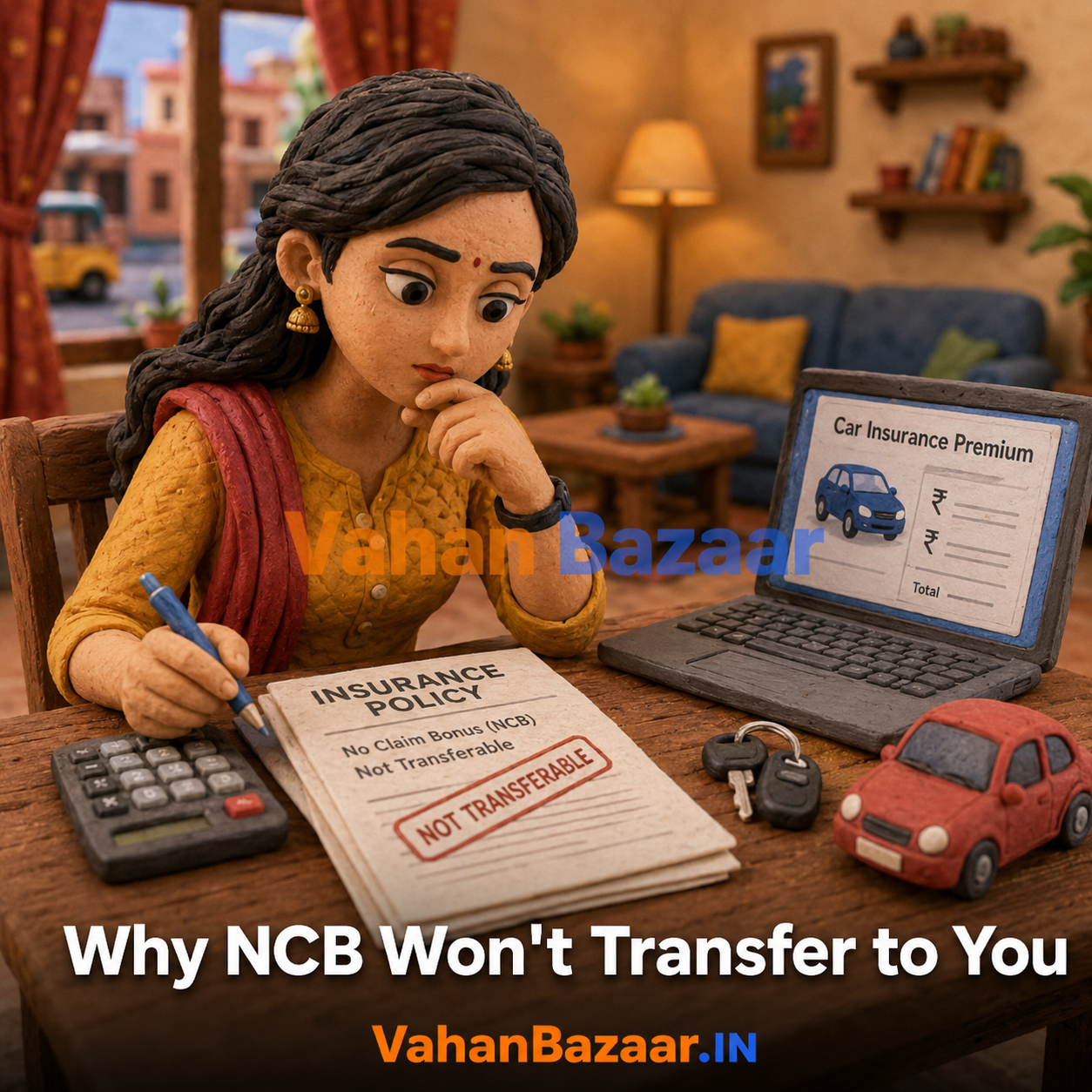
One of the most reassuring lines a used-car seller can offer is "insurance is already done, it has plenty left on it." It sounds like one less thing to worry about, and many buyers tick the insurance box in their head and move on to negotiating the price. But the cover that comes with a used car does not work the way most buyers assume. Two things that feel like they should pass to you with the car simply do not, and both of them carry a real cost that turns up at exactly the wrong moment.
The first is the No Claim Bonus, the discount the seller earned for years of not claiming. Under the rules set by the insurance regulator, that bonus belongs to the person, not the car, so it does not transfer to you when ownership changes hands. The second is the policy itself: a motor policy must be in the name of the vehicle's registered owner, so once the registration moves to you but the policy is still in the seller's name, the cover is legally void and an own-damage claim can be rejected. Neither of these is a scam or a loophole; they are the plain mechanics of how Indian motor insurance works. They are also predictable costs you can plan for, once you know the rule and check the car's status before you pay.
Confirming where the existing cover stands takes one step. A Rs 99 Vahan Verify check reads the car's official record straight from the government VAHAN database and shows the registration status, owner count, vehicle age, and insurance validity, so you know the policy's position and the transfer you will need to do before any money changes hands.
The No Claim Bonus is attached to the insured individual, not the vehicle, so the seller's discount stays with the seller and does not pass to you. Separately, a motor policy must be in the registered owner's name, so a policy still in the seller's name after the sale is legally void. To keep your cover live you must transfer the insurance into your name, commonly within 14 days of the purchase. Both points mean used-car insurance is a real cost line to budget for, not a free extra that rides along with the car.
What the No Claim Bonus Actually Is
The No Claim Bonus, usually shortened to NCB, is a reward built into a comprehensive motor policy for not making a claim. For every full year you go without claiming, your discount on the own-damage portion of the next renewal premium steps up. It starts at 20% after one claim-free year and climbs to a maximum of 50% after five consecutive claim-free years. A seller who has driven carefully for half a decade may be paying a premium with the full half-off applied, which is exactly why the cover looks so cheap when they describe it.
Here is the standard grid that almost every insurer follows, so you can see how the discount accumulates over time.
| Consecutive claim-free years | Standard NCB discount | Who it belongs to |
|---|---|---|
| After 1 year | 20% | The policyholder, not the car |
| After 2 years | 25% | The policyholder, not the car |
| After 3 years | 35% | The policyholder, not the car |
| After 4 years | 45% | The policyholder, not the car |
| After 5 years | 50% | The policyholder, not the car |
The crucial column is the last one. The discount is tied to the person who earned it, not to the registration plate. The seller built up that record over years of careful driving, and the regulator's rule lets them keep it. When they sell the car, they can request an NCB retention certificate and carry the full discount across to whatever car they buy next. The bonus walks out the door with the seller. It does not stay with the car for you to inherit.
Because the No Claim Bonus follows the insured person, it can move with them between insurers on renewal with proof of their claim-free record, but it always stays with the original policyholder. That is the whole reason it cannot transfer to you with the car. The bonus is also lost if a claim is made during the year, or if the policy lapses and is not renewed within 90 days of expiry, so even the seller has to keep it alive to keep it.
Why This Is a Cost, Not Just a Technicality
It is easy to read all this as paperwork trivia, but it shows up directly on your wallet in the first year of ownership. The seller may have been paying a low premium precisely because their NCB had it heavily discounted. You start from zero. On the same car, with the same insured value, your first-year own-damage premium can be meaningfully higher than what the seller was paying, simply because the discount that made their number look small does not come with the car.
None of that is hidden if you expect it. The point of knowing the rule is that you can build the real first-year insurance figure into your offer, rather than budgeting on the seller's discounted number and getting a shock at renewal. Treat the insurance as a fresh cost of ownership from day one, the same way you would treat road tax or a service, and the surprise disappears.
What Transfers and What Doesn't When You Buy
Used-car buyers carry a rough mental model that "everything comes with the car." For the registration and the physical vehicle that is broadly true, with the right paperwork. For the financial bits attached to the previous owner, it is not. The table below sets out, item by item, what actually moves to you when you buy a used car and on what condition.
| What you are buying | Does it transfer to you? | The condition or catch |
|---|---|---|
| Registration Certificate (RC) | Yes | Only after the RTO transfer is completed via Form 29 and Form 30; until then the car is still the seller's on record |
| Own-damage insurance cover | Only if you transfer it | The policy must be moved into your name to stay valid; a policy left in the seller's name is void |
| No Claim Bonus (NCB) | No | It belongs to the seller as a person; they keep it via an NCB retention certificate and carry it to their next car |
| Third-party liability cover | Transfers with the car | Still record the change of ownership with the insurer so the policy reflects the correct registered owner |
Read the middle column closely. The RC transfers, but only when you complete the RTO formalities. The insurance cover is yours only if you actively transfer the policy. And the NCB does not come to you at all. The single biggest mistake buyers make is reading the seller's "insurance is sorted" as covering all three, when in fact it covers none of them automatically.
The Two Traps That Cost Buyers Money
Two specific situations turn this rule from a footnote into an out-of-pocket loss. Each one is easy to avoid once you know to look for it.
Buyers often estimate their running cost using the premium the seller quotes, then find their own renewal is higher because the up-to-50% discount the seller earned stays with the seller. This is not a one-off either: you have to rebuild your own claim-free record from scratch to earn that discount yourself. Budget the first-year premium on the assumption of no inherited bonus, and the gap stops being a nasty surprise. For the wider picture on how comprehensive cover is priced, our explainer on comprehensive versus third-party insurance is a useful companion.
The most expensive trap is doing nothing. Once the RC is in your name but the policy still names the seller as the insured, the cover is legally void because a motor policy must be in the registered owner's name. If you have an accident in that window, the own-damage claim can be rejected and you pay for the repair yourself. The fix is to transfer the policy into your name after the purchase, which insurers commonly require within 14 days, for a nominal fee that varies by insurer. We go deeper into how these rejections happen in our piece on used-car insurance claim rejection and transfer.
Do not drive on a policy that still names the seller. It feels covered, the certificate is in the glovebox and the dates are valid, but in the eyes of the insurer the registered owner and the insured no longer match, and an own-damage claim can be rejected on that basis alone. Transfer the policy into your name straight after the sale, inside the window your insurer specifies, and keep the cover live exactly when you might need it most.
How New-Car Rules Differ, for Context
It helps to see the used-car position against the new-car rules, because the two are not the same. For a brand-new private car, the regulator mandates a three-year third-party policy at the point of sale, with the option to buy annual own-damage cover separately rather than being locked into a long own-damage bundle. The standard own-damage deductibles are set too: Rs 1,000 for cars up to 1500cc and Rs 2,000 for cars above 1500cc. Those structures are built into the first sale of the car.
For a used car, you are stepping into the middle of someone else's policy cycle, not starting a fresh one. That is why the transfer step and the NCB rule matter so much: nothing about the previous owner's arrangement is automatically yours. If you want the full detail on the broader framework, our roundup of the 2026 car insurance rules and the guide to the three-year third-party rule for used-car buyers both sit alongside this one.
A Rs 99 record check confirms the car's official status from the VAHAN database: registration status, owner count, vehicle age, and insurance validity. It tells you whether the existing cover is current and the transfer you will need to do into your own name. It does not quote your premium, which depends on your own profile and the insured value, and it does not by itself assess the car's physical condition. Use it as the cheap first filter, then plan the premium and the policy transfer on top.
What This Means for Used Car Buyers
The headline is simple: insurance does not come free with a used car in the way the seller's pitch suggests. The discount they built up is theirs to keep, so your first-year premium starts without it, and the policy in the glovebox protects nobody until you move it into your name. Both of those are ordinary, knowable costs. The buyers who get caught out are not unlucky; they are the ones who took "insurance is sorted" at face value and never checked the position before paying.
So treat the cover as a fresh line in your ownership budget from day one. Before you agree a price, confirm the existing policy's status and validity, plan for a first-year premium with no inherited bonus, and earmark the small transfer fee to move the policy into your name inside your insurer's window. A lapsed certificate or an expired pollution check are the kind of thing that quietly sits on a car you are about to buy, and our guide to lapsed insurance and PUC on used cars shows how to spot them. The cheapest, highest-leverage step in all of this is the Rs 99 record check that tells you where the insurance stands before the money leaves your hands.
Know the Insurance Position Before You Pay
For Rs 99, Vahan Verify pulls a car's official record from the government VAHAN database and shows the registration status, owner count, vehicle age, and insurance validity. See whether the existing cover is current and the transfer you will need to do into your own name before you commit any money.
Want a fuller read once the record is clean? AI Vahan Inspection for Rs 249 reads the car's photos and its official record together, so you get the verified history and an assessment of the visible condition side by side. For the insurance question, the Rs 99 Vahan Verify is the right first move to confirm where the existing cover stands; step up to the inspection once the car clears that gate and you are serious about it.
Frequently Asked Questions
No. Under IRDAI rules the No Claim Bonus is tied to the insured individual, not the vehicle, so it cannot be transferred to a new owner when a car changes hands. The seller keeps their NCB and can carry it to their next car using an NCB retention certificate. As the buyer you do not inherit it, which means the discount the seller had built up, which can be up to 50% after five consecutive claim-free years, does not pass to you. Your own-damage premium on the same car starts without that discount.
Only if you transfer it into your name. IRDAI requires a motor policy to be in the name of the vehicle's registered owner. Once the RC is transferred to you but the policy is still in the seller's name, the policy is legally void and an own-damage claim can be rejected. To keep the cover valid you must transfer the insurance into your name after the purchase, commonly required within 14 days of the sale, paying a nominal transfer fee that varies by insurer.
The standard NCB grid starts at 20% after one claim-free year and rises in steps to 50% after five consecutive claim-free years. The bonus applies only to the own-damage part of a comprehensive premium, not the third-party part. The NCB is lost if a claim is made during the year, or if the policy is not renewed within 90 days of its expiry. Because it belongs to the policyholder rather than the car, the seller carries their accumulated NCB to their next vehicle and the buyer starts fresh.
Buyers often assume insurance comes with the car, but the discount the seller had built up does not pass to you, so your first-year own-damage premium on the same car can be meaningfully higher than the seller was paying. On top of that, if you forget to transfer the policy into your name, your cover is void exactly when you need it. Both of these are predictable costs to budget for, not surprises, once you know the rule. Confirming the policy's status before you pay lets you plan for the premium and the transfer rather than discover them later.
Pull the car's official record from the government VAHAN database before you pay. For Rs 99, a Vahan Verify check uses only the registration number and returns the registration status, owner count, vehicle age, and insurance validity. Reading that tells you whether the existing cover is current and the transfer you will need to do into your own name, so you can budget for the first-year premium and the transfer rather than find out after the money has changed hands.