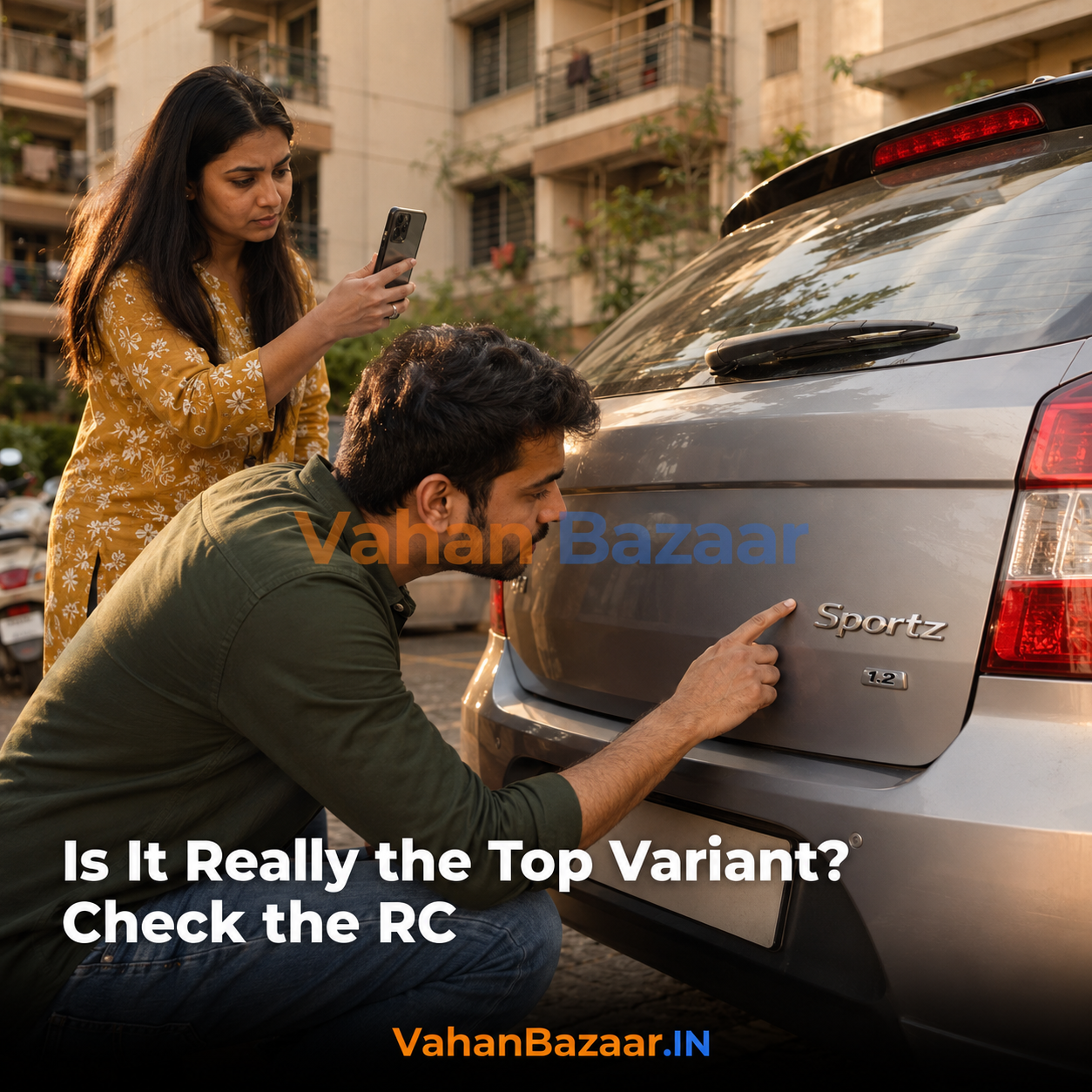
A stick-on badge costs a few hundred rupees. A set of aftermarket alloy wheels costs a few thousand. A retrofitted touchscreen with a reversing camera costs a little more. Put all three on a base hatchback, photograph it well, and you have something that looks convincingly like the flagship variant in a listing. Ask for the flagship price and a surprising number of buyers will pay it, because almost nobody arrives at a viewing with the full variant chart in their head.
This is variant inflation — quietly one of the most profitable small lies in the Indian used car market. It is not the dramatic fraud of a cloned chassis or a rolled-back odometer. It is simply a seller describing an LXi as a ZXi, or a base Creta as the fully loaded one, and letting the accessories do the arguing. The car is real, the papers are real, the seller may even be pleasant. Only the price is wrong — and it is wrong by a lot.
The registration record does not carry a trim label like ZXi or SX(O), so it cannot by itself prove a variant. What it does carry — maker and model description, cubic capacity, fuel used, class of vehicle, body type and manufacturing month and year — is enough to catch the big lies and to narrow the car down. Pair it with the VIN-decoded build sheet for the final word.
Why Variant Inflation Works So Well
Three things make this trick easy. First, trim badges in India are almost always adhesive or clip-on, and replacements are freely available. A ZXi badge on the boot lid of an LXi takes about a minute to fit. Second, the visual cues buyers actually use to judge a trim — alloy wheels, a touchscreen head unit, fog lamps, a reversing camera, seat covers that hide fabric grade — are all retrofittable. The aftermarket in every Indian city sells exactly the parts that separate a base car from a loaded one, precisely because owners of base cars want them. Third, and most importantly, the buyer usually has no reliable reference. Manufacturers reshuffle trim names constantly, and a model that was sold as E, EX, S, SX and SX(O) in one generation may be sold as E, EX, EX(O), S(O), SX, SX Premium and King in the next, which is exactly what the Creta line-up looks like in 2026.
So the buyer sees alloys and a big screen, hears "top model, fully loaded", and mentally files the car at the top of the price band. That instinct is what is being sold. The same instinct is at work when a car is advertised with a newer model year than it actually carries, which is why we wrote separately about checking whether a used car is really the model year it claims — the pattern is identical, only the field being fudged is different.
The Money at Stake: Base Versus Top on Everyday Cars
It is easy to dismiss variant inflation as a minor exaggeration until you look at what separates the ends of a single model range. These are ex-showroom figures as listed in July 2026, for the new car, and while a used car's price is obviously lower, the trim premium depreciates alongside the car rather than vanishing from it.
| Model | Base variant (ex-showroom) | Top variant (ex-showroom) | Spread |
|---|---|---|---|
| Maruti Swift | About Rs. 5.79 Lakh (LXi) | About Rs. 8.80 Lakh (ZXi Plus AMT dual-tone) | About Rs. 3.01 Lakh |
| Tata Nexon | About Rs. 7.40 Lakh (Petrol Smart MT) | About Rs. 14.40 Lakh (Diesel Fearless+ AMT) | About Rs. 7.00 Lakh |
| Hyundai Creta | About Rs. 10.91 Lakh (E) | About Rs. 20.11 Lakh (top trim) | About Rs. 9.20 Lakh |
On a hatchback, the difference between the bottom and the top of one range is roughly the price of a decent second-hand car in its own right. On a compact SUV like the Creta it approaches the full price of a new entry hatchback. Even on a five-year-old example, being talked up one or two trims can cost a buyer well into six figures. That is why the two minutes it takes to check the record is among the best-value habits a used car buyer can build, and why our guide on how to value a used car without overpaying starts with establishing what the car actually is before arguing about what it is worth.
Before you agree a price, confirm the engine capacity, fuel type and model description on the government record.
What the Registration Record Actually Carries
The certificate of registration is not a marketing document, which is exactly what makes it useful. Its contents are prescribed by law. Form 23 under Rule 48 of the Central Motor Vehicles Rules, 1989 — and its laminated-card and smart-card equivalents in Form 23A — set out the particulars that must appear, and they include the maker's name, the type of body, the month and year of manufacture, the number of cylinders, the chassis number, the engine number, the fuel used in the engine, the horse power, the cubic capacity, the maker's classification, the wheel base, the seating capacity including the driver, the unladen weight and the colour of the body.
Read that list again and notice what is absent. There is no field called "variant". There is no legally defined slot for LXi, ZXi, E or SX(O). Anyone telling you that a registration lookup will simply print the trim level is overselling what the document is. What the record gives you is a set of hard, maker-declared attributes that a seller cannot repaint or re-badge.
| Record field | What it settles | What it cannot settle |
|---|---|---|
| Maker and model description | The model family and, in many records, a manufacturer-supplied description string | Reliable trim naming across every maker and year |
| Cubic capacity | Which engine is fitted, where a model offers more than one | Trim level, where all trims share one engine |
| Fuel used | Petrol, diesel, CNG or electric as recorded | Whether a CNG kit is factory-fitted or retrofitted |
| Class of vehicle | Private car versus a commercial or cab class | How hard the car was actually used |
| Month and year of manufacture | The car's true build age versus the advertised year | Facelift or feature-pack changes within a model year |
| Body type and seating capacity | Hatchback, sedan, SUV; 5-seat versus 7-seat configurations | Interior trim, upholstery grade or feature list |
Where Cubic Capacity Settles the Argument — and Where It Does Not
When the engine genuinely identifies the car
Cubic capacity becomes powerful evidence when a model is sold with more than one engine and those engines are locked to particular trims. The Hyundai Creta is the cleanest example on sale today. It is offered with three distinct 1.5-litre units: a 1,497cc naturally aspirated petrol, a 1,493cc diesel and a 1,482cc turbo-petrol. Those are three different numbers on the record. And as of July 2026, the turbo-petrol is available only on the flagship King trim, paired exclusively with a seven-speed dual-clutch gearbox.
That single fact turns a Rs. 99 lookup into a decisive test. If a seller in Pune or Hyderabad advertises a fully loaded turbo-petrol Creta and the record returns 1,497cc, the car is a naturally aspirated petrol, and it is not the flagship. No badge, no alloy wheel and no aftermarket screen changes that number. The same logic applies wherever a diesel commands a premium over a petrol in the same model, because 1,493cc and 1,497cc are not the same entry on a government record even though both read as "1.5" in conversation.
When the engine proves nothing at all
Now the honest limitation, and it matters more than the marketing around vehicle checks usually admits. On most Indian models, cubic capacity does not change between trim levels. The current Maruti Swift runs the same 1,197cc Z12E three-cylinder petrol engine in every variant from the LXi at the bottom to the ZXi Plus at the top. A record showing 1,197cc is equally consistent with the cheapest Swift and the most expensive one. On that car, cubic capacity tells you nothing whatsoever about trim, and any claim that it does is simply false.
A registration lookup narrows the field and catches the big lies. It does not, on its own, prove that a car is a ZXi rather than a VXi when both share the same engine, the same body and the same fuel. Treat it as the first filter, not the final verdict — and if a service tells you otherwise, be sceptical of everything else it tells you too.
The lies the record does catch every time
Even with that limitation, the record reliably kills four claims that cost buyers the most money:
- A different engine. Turbo versus naturally aspirated, diesel versus petrol, or a swapped engine whose number no longer matches the record. An engine-number mismatch is also the fastest route to a rejected ownership transfer, as we covered in why RC transfers get rejected on chassis and engine mismatches.
- A different model family. If the maker-model description does not match the car in front of you, or the body type and seating capacity contradict the listing, you are not looking at what was advertised at all.
- A commercial past sold as private. The class of vehicle field distinguishes a private car from a cab or commercial class. An ex-fleet car that has run a hard life in Bangalore traffic is worth materially less than a privately owned example of the same trim, whatever the badge says.
- A fuel claim that does not fit the line-up. On the current Swift, factory CNG is offered on the VXi, VXi Opt and ZXi variants — not on the LXi and not on the ZXi Plus. So a "ZXi Plus CNG" listing does not correspond to anything the factory built. The caveat, in fairness, is that a retrofitted kit endorsed onto the record will also show a CNG fuel type, so treat this as a question to ask rather than a conviction to hand down.
Pair the Record With the VIN-Decoded Build Sheet
Once the record has confirmed the model family, the engine and the fuel, the trim question is settled by the seventeen-character chassis number, or VIN. The manufacturer encodes the build specification against that number, and an authorised service centre can pull the original build sheet for the car — the factory record of exactly which variant left the line, in which colour, with which options. Most brand service centres will do this on request for a car being inspected, and it is worth the phone call on any purchase where two trims are separated by more than a Lakh.
That gives you a clean two-step process. The government record, run in a couple of minutes from your phone, tells you the car is genuinely a 2022 Creta with the 1,497cc naturally aspirated petrol engine, registered as a private vehicle, with the manufacturing month and year matching the claim. The build sheet then tells you whether that 1,497cc Creta left the factory as an EX or an SX Premium. Neither step alone is complete; together they close the gap that badges and alloys were exploiting. Verifying that the person selling the car is the registered owner is a separate but equally important check, covered in our piece on whether the seller is really the registered owner.
Check the RC and the pending challan position together for Rs. 149 instead of Rs. 198 as two separate checks.
What to Do When the Record Contradicts the Listing
Not every contradiction is fraud, and treating it as such will lose you good cars. Sort what you find into two piles.
The first pile is cosmetic inflation. The car is a genuine VXi with aftermarket alloys, a retrofitted touchscreen and a ZXi badge someone stuck on years ago. There is nothing sinister here, and the accessories may even be worth having. But the price must be reset to the market value of a VXi, plus a modest allowance for accessories that are in good condition — not the market value of a ZXi. Say so plainly, show the record on your phone, and negotiate from the lower number. Sellers who genuinely did not know the difference will usually accept it; sellers who knew exactly what they were doing will suddenly become flexible. Our guide on how to negotiate the best price on a used car is worth reading before that conversation.
The second pile is structural contradiction, and it deserves a much harder line. A model family that does not match. An engine capacity that rules out the claimed powertrain. A vehicle class that says commercial when the seller says private. A manufacturing month and year that does not match the advertised age. Any of these should stop the transaction until the seller explains it in writing. Above all, do not pay token money first and verify later — token amounts are difficult to recover once handed over, and the entire point of a two-minute check is that it happens before your money moves.
Ask for the registration number in the very first message, before you agree to a viewing. Run the check from your phone. Match the maker-model description, cubic capacity, fuel type, vehicle class and manufacturing month and year against the listing. Then, and only then, spend a Saturday travelling to see the car.
What This Means for Used Car Buyers
Variant inflation survives because it sits in the gap between what a car looks like and what a car is, and because that gap has historically been expensive to close. It is not expensive any more. A registration number and a couple of minutes will tell you the maker and model description, the cubic capacity, the fuel used, the class of vehicle, the body type, the seating capacity and the month and year of manufacture — every one of them a maker-declared fact rather than a seller's adjective.
Be clear-eyed about the boundary. If every trim of the car you are considering shares one engine, the record will not name the trim, and you should go to the VIN-decoded build sheet for that. But the record will tell you, instantly and cheaply, whether the fundamentals of the listing survive contact with the government data — and in a market where one model range can span Rs. 9 Lakh from bottom to top, the fundamentals are where the real money is lost. A single Rs. 99 Vahan Verify check on VahanBazaar is the cheapest insurance against paying flagship money for a base car, and if you want the pending challan position on the same vehicle, the combined RC and challan check costs Rs. 149 rather than Rs. 198 as two separate lookups.
The buyer who checks first negotiates from facts. The buyer who trusts the badge negotiates from someone else's story — and pays for the difference for the rest of the time they own the car.
Confirm What the Car Actually Is — Rs. 99
Badges, alloys and a retrofitted screen can be added in an afternoon. The maker-model description, cubic capacity, fuel type, vehicle class and manufacturing month and year cannot. One Vahan Verify check pulls all of it from the VAHAN database before you agree a price — or take the combined RC and challan check for Rs. 149 instead of Rs. 198 separately.
Frequently Asked Questions
Not by itself, and any service that claims otherwise is overselling. Form 23 under Rule 48 of the Central Motor Vehicles Rules, 1989 records the maker's name, model, cubic capacity, fuel used, class of vehicle, type of body, month and year of manufacture, chassis number and engine number. It does not carry a trim label such as LXi, ZXi, E or SX(O) as a legally defined field. What the record does is narrow the possibilities and catch the big lies: a different engine capacity, a different model family, a commercial vehicle class, or a fuel type that does not match the variant being claimed. For the final trim confirmation you pair the record with the VIN-decoded build sheet from the manufacturer or an authorised service centre.
Usually not. On the current Maruti Swift, every variant from the LXi to the ZXi Plus uses the same 1,197cc Z12E petrol engine, so cubic capacity says nothing about trim. Where it does help is when a model offers more than one engine and the engines are locked to particular trims. The Hyundai Creta is sold with a 1,497cc naturally aspirated petrol, a 1,493cc diesel and a 1,482cc turbo-petrol, and as of July 2026 the turbo-petrol is offered only on the flagship King trim. If a seller advertises a top-spec turbo Creta and the record shows 1,497cc, the claim does not hold.
The gap is large enough to be worth a two-minute check. On the Maruti Swift, ex-showroom prices in July 2026 run from about Rs. 5.79 Lakh for the LXi to about Rs. 8.80 Lakh for the ZXi Plus AMT dual-tone — roughly Rs. 3 Lakh between the ends of one hatchback range. On the Hyundai Creta the ex-showroom span is about Rs. 10.91 Lakh to Rs. 20.11 Lakh, and the Tata Nexon runs from about Rs. 7.40 Lakh to about Rs. 14.40 Lakh. Those premiums depreciate with the car, but they do not disappear, so paying a top-variant price for a base car is a five-figure or six-figure mistake.
Treat it as a pricing conversation first and a red flag second. If the difference is cosmetic — aftermarket alloys, a retrofitted touchscreen, added badges — the car is simply a lower trim with accessories, and the price should be renegotiated to the lower trim's market value, not the flagship's. If the record contradicts something structural, such as a different model family, a different engine capacity, a commercial vehicle class or a manufacturing year that does not match, walk away or insist the seller explains it in writing before any token money changes hands.
Run the registration number through a Vahan Verify check on VahanBazaar for Rs. 99. It pulls the car's record from the VAHAN database, including the maker and model description, cubic capacity, fuel type, vehicle class, body type, seating capacity, month and year of manufacture, registration status and insurance validity. If you also want the pending challan position on the same car, the combined RC and challan check is Rs. 149 rather than Rs. 198 as two separate checks. Run it before you travel to see the car, not after you have paid a token amount.
Related News
More on reading a used car's paperwork before you pay:
- How to Check a Used Car's RC Before Buying: Complete 2026 Guide
- Is That Used Car Really a 2022 Model?
- A Clean RC Is Not Enough: Inspect First
- How to Value a Used Car: Fair Price Guide