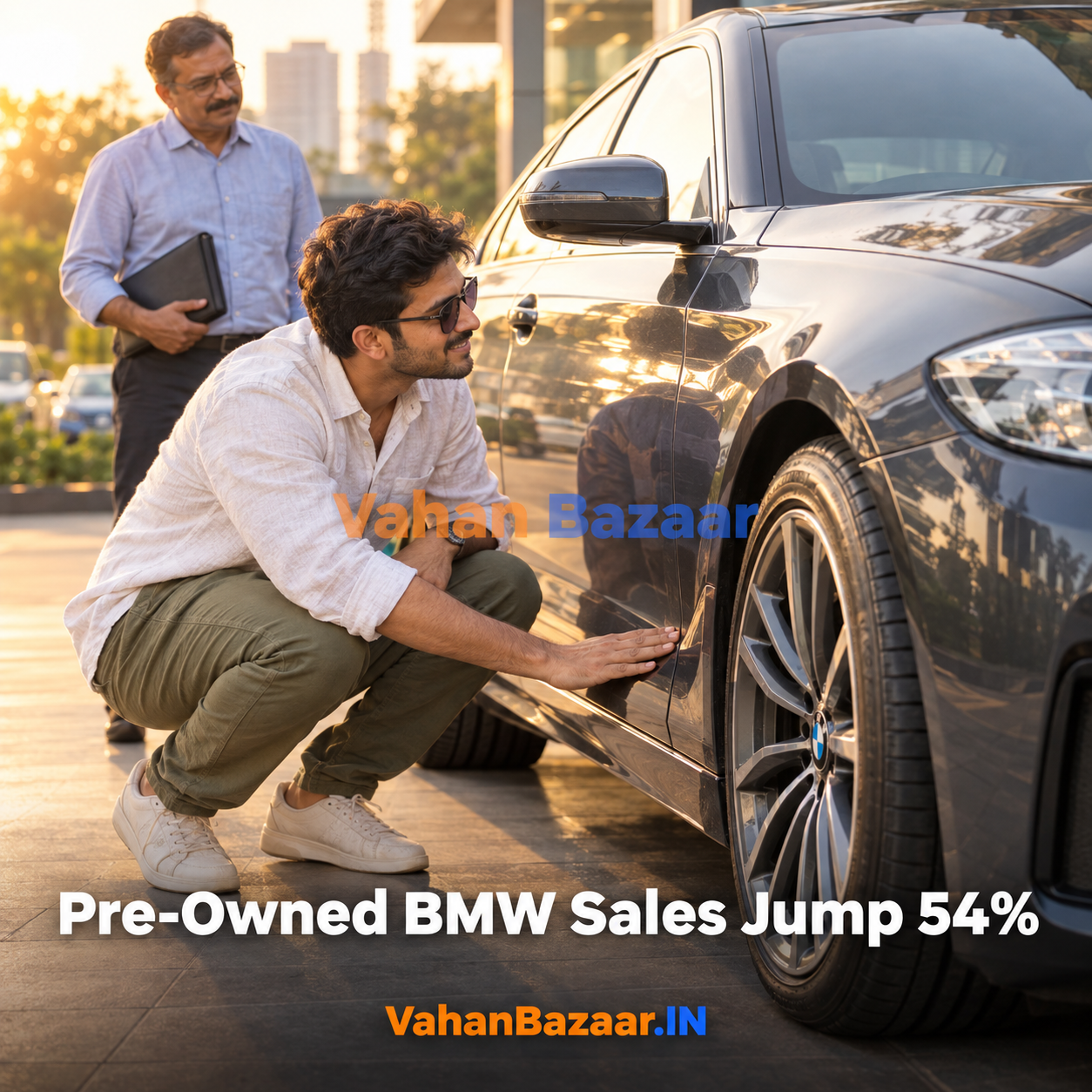
There is a moment in the Indian used car market that did not exist a decade ago. A buyer who has spent fifteen years in hatchbacks and mid-size sedans works out that a five-year-old German saloon costs about what a new top-spec family SUV costs, and decides that this is the year. It is a rational decision, and it is happening at scale.
BMW India's certified pre-owned sales rose 54 per cent year-on-year in the first half of 2026. Mercedes-Benz India has said its own pre-owned business grew at a double-digit pace, supported by strong residual values. Both of those are healthy numbers for a market that used to treat a used luxury car as an eccentric purchase rather than an obvious one.
The problem is not the certified programmes. The problem is what happens the moment a buyer steps outside one.
The Numbers Behind the Shift
India's luxury car market was valued at USD 1.52 billion in 2026 and is projected to grow at a 5.16 per cent compound annual rate to USD 1.96 billion by 2031, according to Mordor Intelligence. That is steady rather than explosive growth at the new-car end, which makes the pre-owned movement all the more interesting: the second-hand side is growing considerably faster than the new side it feeds off.
Two forces are pushing in the same direction. The first is price. Since early 2025, India's three leading German luxury brands have raised prices repeatedly, driven by currency movement, imported components and logistics costs. The increases have run to roughly Rs. 3 Lakh on some entry-level models and Rs. 35 Lakh to Rs. 40 Lakh on certain top-end cars, on Business Standard's reckoning. Every one of those increases makes the equivalent three-year-old car look better value, and it does that automatically, without any marketing spend.
The second is scale. India's pre-owned car market is projected to reach 9.5 million units by 2030 on S&P Global's forecast. Luxury is a small slice of that total, but it is the slice with the highest ticket value and by some distance the highest cost of getting it wrong.
You will find published reports arguing both that BMW and that Mercedes-Benz led India's luxury segment in the first half of 2026. The sources genuinely disagree, so we are making no leadership or ranking claim at all. What is not in dispute, and what actually matters to a buyer, is that the pre-owned side of this segment is growing quickly across brands. Manufacturer-level positioning is a headline. The condition of the specific car in front of you is the only thing that will affect your money.
A Certified Programme Is a Good Product. Most Luxury Resale Does Not Go Through One.
It is worth being direct about this, because the rest of the article depends on it. A manufacturer's certified pre-owned programme is a genuinely good thing to buy. The car goes through the brand's own workshop. The service history usually sits inside the brand network and can be retrieved. There is warranty cover and after-sales support attached, which on a car with expensive parts is not a nice-to-have. You pay a premium for certification, and the premium buys something real.
Now consider where most used luxury cars in India actually change hands. They change hands privately, between individuals, and through independent dealers who are not part of any manufacturer programme. A car that was certified when it left the brand's showroom in 2023 is, by its third owner, just a car being sold by somebody on a classifieds listing. The certification did not transfer. The warranty has usually run out. The workshop inspection was three years and two owners ago.
The supply side makes this more common, not less. Corporate lease and fleet returns arrive in the used market in volume and at predictable intervals, and ex-demonstrator cars carry a registration history that a listing rarely spells out. Neither of those is a problem in itself. Both are situations where the paperwork tells you something the seller may not volunteer.
| What the buyer gets | Manufacturer certified programme | Private or independent sale of the same car |
|---|---|---|
| Workshop inspection before sale | Part of the programme | Only if you arrange and pay for it |
| Service history from the brand network | Usually retrievable | Whatever the seller chooses to show you |
| Warranty and after-sales cover | Typically included | Usually none |
| Accident-repair disclosure | A programme standard | No standard at all |
| Registration and legal status verified | Handled as part of the sale | Entirely your responsibility |
| Price | A premium, for the above | Lower, because none of the above is included |
Read that last row carefully. The private sale is cheaper precisely because the assurance has been removed from the package. That is a legitimate trade, and plenty of well-informed buyers make it deliberately. It stops being legitimate only when the buyer does not realise the trade has been made.
Why the Downside Scales Faster Than the Price
A buyer moving from a Rs. 6 Lakh hatchback to a Rs. 30 Lakh German saloon instinctively assumes the risk has gone up five times, in line with the price. It has not. Several of the failure modes go up far more than five times, because they are tied to parts and labour costs rather than to the purchase price.
1. An undisclosed accident repair
This is the single biggest one. A structural repair on a luxury car involves panels, sensors, cameras and calibration work that a mass-market car simply does not carry, and a repair done cheaply tends to announce itself later rather than sooner. A large share of accident-repaired cars in India change hands without the repair ever being disclosed to the buyer, and the tell-tales are visual before they are mechanical: panel gaps that do not match side to side, and respray shading that shifts from one panel to the next. That is exactly what a careful walkaround, or a photograph analysis of the four walkaround angles, is looking for.
2. A live loan or a missing no-objection certificate
Luxury cars are financed more often than they are bought outright, and a hypothecation entry that is still live on the registration record blocks the transfer until the lender issues a no-objection certificate. The seller is frequently not being dishonest here. They finished paying, moved on, and never went back to have the entry removed. The consequence is the same either way: you have paid for a car you cannot put in your own name.
3. A lapsed fitness certificate or unpaid road tax
These are administrative, unglamorous and perfectly capable of stalling a transfer for weeks. An expired fitness certificate stops the RC transfer until it is regularised, and road tax status varies enough between states that a car brought in from another state can carry a liability the seller has genuinely forgotten about. Both of these sit in the government record and can be read in two minutes before you travel to see the car.
4. One module can cost more than a small car's annual running cost
This is the part that surprises first-time luxury buyers most. On an imported-parts car, a single control module, an air suspension strut or an electronic component can cost more than a budget hatchback owner spends running their car for a year. Localisation is slowly changing this at the edges — Audi's plan to build six models in India by 2027 is the kind of move that eventually improves parts availability and resale economics for a whole segment — but for a car already on the road today, the parts position is what it is. Knowing which components on that specific model and year are the expensive, common failures is worth more on a luxury car than on any other kind.
5. The record itself can be the forgery
High-value vehicles attract document fraud in a way that ordinary cars do not, simply because the return on a forged registration certificate scales with the value of the car it is attached to. Enforcement action against organised registration rackets has repeatedly turned up luxury vehicles at the centre of it. The defence is dull and effective: check the registration number against the government record rather than against the piece of paper the seller hands you. A printed document can be produced by anyone. The VAHAN database entry cannot.
The Arithmetic Nobody Does Before Paying Rs. 30 Lakh
Here is the calculation that should settle the question, and it takes about ten seconds.
| Purchase price | Rs. 49 record check, as a share of price | Rs. 249 full inspection, as a share of price |
|---|---|---|
| Rs. 5 Lakh | About 0.010 per cent | About 0.050 per cent |
| Rs. 20 Lakh | About 0.0025 per cent | About 0.012 per cent |
| Rs. 30 Lakh | About 0.0016 per cent | About 0.008 per cent |
| Rs. 40 Lakh | About 0.0012 per cent | About 0.006 per cent |
Rs. 249 against a Rs. 30 Lakh car is roughly eight-thousandths of one per cent of the purchase price. It is less than the fuel and tolls most buyers spend travelling to two viewings. Against that sits a single undisclosed accident repair, a live loan that blocks the transfer, a lapsed fitness certificate or a known-expensive module that was already on its way out when the car was photographed for the listing. Any one of those costs multiples of the inspection, and the last three can cost multiples of it every year you own the car.
The instinct to skip the check because the car is expensive and the seller seems respectable has the logic precisely inverted. The more the car costs, the smaller the check becomes as a proportion, and the larger the thing it is protecting.
AI Vahan Inspection — Rs. 249The Section Luxury Buyers Should Read First
Of the seven sections in the Rs. 249 report, the one that earns its keep hardest on an expensive car is the model-specific known issues section. It covers that exact make, model and year in the Indian market: the common problems owners report, any recalls, the typical failure points, parts availability and real-world fuel economy, drawn from owner forums and auto journalism.
On a Rs. 6 Lakh hatchback that section is useful. On a Rs. 30 Lakh imported-parts car it changes the negotiation. Knowing that a particular engine and gearbox combination in a particular model year has a documented weak point tells you what to ask the seller, what to have the workshop look at, and what the repair would realistically cost if it goes. Parts availability matters in the same way. A component that is routinely stocked is an inconvenience. A component with a long lead time is a car sitting in a workshop for a month.
The rest of the report supports that. You get the full VAHAN record — the same fields as our Rs. 49 record check, included rather than charged twice — covering registration status, blacklist and NOC flags, the loan or hypothecation entry with the financer's name, insurance company and validity, fitness validity, road tax and PUC status, registered RTO, date of first registration and the month and year of manufacture, plus the owner name and owner serial number. In some states the government source masks the owner name and returns only a first name; we show exactly what the source returns and never fill in a guess.
You also get pending challans across all states with one-tap payment at a flat Rs. 29 convenience fee per transaction, an AI analysis of each of your eight photographs with three to five factual observations on each, an odometer cross-check against the registration year that flags a statistically suspicious reading, twelve inspection questions to put to the seller, and a do's and don'ts list with a negotiation cheatsheet. The engine bay photograph in particular rewards attention — a great deal is visible in a bay photograph before anyone opens a spanner.
The Rs. 249 report is a records-plus-photographs analysis. It is not a physical mechanical inspection, and it cannot replace a workshop check or an ECU scan. On a German car with air suspension, forced induction and a dozen electronic modules, the workshop visit stays essential. What the report does is decide which cars deserve that visit and tell the technician where to look. It takes 60 to 90 seconds, downloads as a PDF, is not stored after the session, and if a charge goes through without a report arriving, it is refunded within 24 hours.
What This Means for Used Car Buyers
If you are buying inside a manufacturer's certified programme, much of this is already handled, and you are paying for that. Read the paperwork anyway, but the structural work has been done.
If you are buying the same car privately or from an independent dealer, the order of play is straightforward and it costs less than a tank of fuel.
First, pull the record from the registration number before you travel. The number is visible in almost every listing photograph. Registration status, blacklist and NOC flags, a live loan and the financer's name, insurance validity, fitness validity, road tax, the registered RTO, first registration date and manufacture month and year, owner name and owner serial number. That is a two-minute filter that removes the cars you should never have driven across the city to see.
Second, take the eight photographs and run the full inspection. Front, passenger side, rear, driver side, engine bay, trunk, odometer and front cabin interior, plus up to four optional tyre close-ups. The four walkaround angles are the ones designed to catch panel-to-panel paint mismatch, which is the most reliable visual tell-tale of accident repair. On a luxury car, get the model-specific issue list in hand before you negotiate, not after.
Third, and only then, book the workshop inspection. A lift and an ECU scan on a German car is money well spent, but it is money well spent on a shortlist, not on every car you see. Use the cheap checks to build the shortlist.
Fourth, complete the transfer properly. A no-objection certificate from the lender if a loan was ever recorded, a valid fitness certificate, road tax settled, and the transfer actually filed rather than intended. On a Rs. 30 Lakh asset, an unfiled transfer is not a loose end, it is an unowned car.
If you are still building the shortlist, our car listings and the used car section are the place to start, and every listing there carries a registration number you can check before you pick up the phone.
Rs. 249 Against a Rs. 30 Lakh Decision
Full VAHAN record, pending challans across all states, AI analysis of your eight photographs with three to five observations each, an odometer cross-check against the registration year, model-specific known issues for that exact make, model and year including parts availability and typical failure points, twelve questions for the seller and a negotiation cheatsheet. One-time Rs. 249, ready in 60 to 90 seconds, downloadable as a PDF. Cars only. It is a records-and-photographs analysis, not a substitute for a workshop inspection.
AI Vahan Inspection — Rs. 249The Short Version
Pre-owned luxury in India is growing quickly. BMW India's certified pre-owned sales rose 54 per cent year-on-year in the first half of 2026, and Mercedes-Benz India reported double-digit growth in its pre-owned business on the back of strong residual values. The underlying luxury market was worth USD 1.52 billion in 2026 and is projected to reach USD 1.96 billion by 2031 at a 5.16 per cent compound annual rate, while India's pre-owned car market overall is forecast to reach 9.5 million units by 2030. Repeated new-car price increases since early 2025 — roughly Rs. 3 Lakh on some entry-level models and Rs. 35 Lakh to Rs. 40 Lakh on certain top-end cars — keep making the three-year-old alternative look better.
Certified programmes are a good product and we are not arguing otherwise. But most used luxury cars in India are not sold through one, and outside that fence the buyer gets no workshop inspection, no retrievable service history, no warranty and no disclosure standard, on a car where a single module can cost more than a budget car's annual running cost.
So do the cheap step first, and do it before you travel. Read the registration number off the listing, pull the record, take the eight photographs, get the model-specific issue list, and take the survivors to a workshop. Rs. 249 on a Rs. 30 Lakh car is roughly eight-thousandths of one per cent of what you are about to spend. There is no version of that arithmetic where skipping it is the clever move.
Frequently Asked Questions
For most first-time luxury buyers, yes. A certified programme is a genuinely good product and we have no interest in pretending otherwise. The car has been through the brand's own workshop, the service history is usually available from within the brand network, and the warranty and after-sales support that come with certification are worth real money on a car whose parts are expensive. You pay a premium for that, and the premium buys something. Our argument is not that certified programmes are overpriced. It is that most used luxury cars in India are not sold through one. The moment the same BMW, Mercedes-Benz or Audi is sold privately, or through an independent dealer who is not part of the manufacturer's programme, none of that assurance travels with the car, and the buyer is on their own with a vehicle worth Rs. 20 Lakh to Rs. 40 Lakh.
Seven sections, for a one-time Rs. 249, delivered in about 60 to 90 seconds and downloadable as a PDF. First, the full VAHAN record for the car, which is everything in our Rs. 49 report included at no extra charge. Second, pending challans across all states, with one-tap payment at a flat Rs. 29 convenience fee per transaction. Third, an AI analysis of each of your eight photographs with three to five factual observations on each, where the four walkaround angles are designed to catch panel-to-panel paint mismatch. Fourth, an odometer cross-check against the registration year that flags a statistically suspicious reading so you can investigate further. Fifth, model-specific known issues for that exact make, model and year in the Indian market, covering common problems, recalls, typical failure points, parts availability and real-world fuel economy. Sixth, twelve inspection questions to ask the seller. Seventh, a do's and don'ts list with a negotiation cheatsheet. The report is not stored after the session, and if a charge goes through and the report does not, it is refunded within 24 hours.
No, and on a luxury car in particular we would rather say that plainly than let the impression stand. The Rs. 249 report is a records-plus-photographs analysis. It reads the government record, reads your eight photographs, and tells you what the model is known for. It cannot put the car on a lift, it cannot plug into the ECU, and it cannot hear a bearing. On a German car with air suspension, a turbocharged engine and a dozen electronic modules, a proper workshop inspection and an ECU scan remain essential before you pay. What the Rs. 249 report does is tell you which cars are worth taking to that workshop and what to ask the technician to look at when you get there. It is the filter, not the verdict.
Start with the record, because it is the cheapest and the fastest. Pull the registration record from the number plate before you travel: registration status, blacklist and NOC flags, loan or hypothecation entry and the financer's name, insurance company and validity, fitness certificate validity, road tax status, the registered RTO, the date of first registration and the month and year of manufacture, and the owner name with the owner serial number. A live hypothecation entry blocks the transfer until the lender issues a no-objection certificate, and a lapsed fitness certificate will stop the transfer too. Then take the eight photographs and run the full inspection, so the walkaround angles are checked for paint mismatch and you get the model-specific issue list for that exact year. Only after all of that does it make sense to book a workshop inspection, and only after the workshop does it make sense to release money.
The Rs. 249 AI Vahan Inspection is built for cars only. It needs eight specific photographs of a car, being the front, the passenger side, the rear, the driver side, the engine bay, the trunk, the odometer and the front cabin interior, plus up to four optional tyre close-ups. It does not support two-wheelers. Our Rs. 49 record check is the one that covers cars, bikes and commercial vehicles alike, and it returns the registration and legal picture for any of them. If you are buying a two-wheeler or a commercial vehicle, the Rs. 49 record check is the right tool. If you are buying a car, and especially an expensive one, the Rs. 249 report adds the photograph analysis, the odometer cross-check and the model-specific known issues on top of that same record.