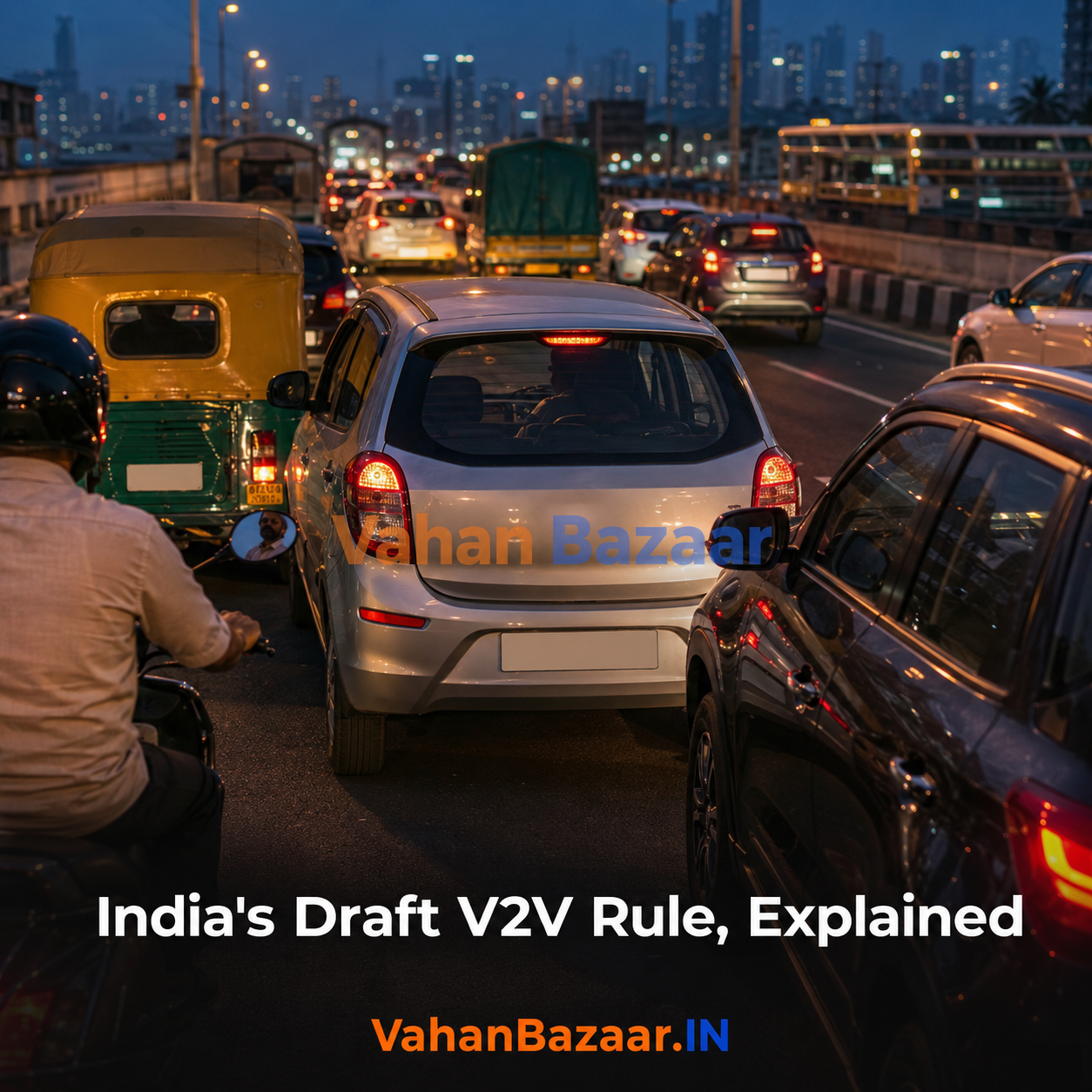
In early August 2026 the Ministry of Road Transport and Highways issued a draft notification proposing that vehicles sold in India be capable of talking to one another. Not through an app, and not through a phone in a windscreen cradle, but through a dedicated radio link built into the vehicle at the factory, working to a defined technical standard so that a two-wheeler from one manufacturer and a goods vehicle from another can understand each other on the same stretch of highway.
It is a genuinely significant proposal, and it has been reported with a level of confusion that deserves clearing up. Two dates are involved, they do two quite different things, and a great many readers have come away believing that new cars must carry this equipment from 2027. They must not. The distinction matters, and it is worth setting out properly.
Equally worth setting out is what the proposal does not do, because that is where most Indian car buyers actually live. This is technology for vehicles that have not been built yet. Every car currently on an Indian road, and every used car available for purchase today, sits on the other side of the line.
This is a draft notification open to public consultation, not law. Nothing described in this article currently applies to any vehicle, new or used. The ministry will review comments received during the 30-day window before deciding whether to issue a final notification, and the dates and requirements may change before that happens.
What MoRTH Has Actually Proposed
The draft proposes phased introduction of vehicle-to-vehicle communication systems built to AIS-230, an Automotive Industry Standard. The idea behind V2V is simple enough to explain in a sentence: vehicles broadcast short, frequent messages about what they are doing, and vehicles nearby receive those messages and use them to warn their drivers about things the driver cannot yet see.
A car braking hard three vehicles ahead in dense traffic on a national highway is invisible to you. A vehicle travelling the wrong way around a blind curve is invisible until it is not. An ambulance working through a jammed arterial road is audible only when it is already close. These are precisely the situations V2V addresses, and they are common on Indian roads in a way they are not everywhere else, because our traffic is mixed. Two-wheelers, cars, buses and goods vehicles share the same lanes at very different speeds, and sightlines are frequently obstructed.
The draft covers three vehicle categories, and the phasing applies to all three. Before the timeline, it is worth being clear about what those category letters mean, because they are used constantly in Indian regulatory documents and rarely explained.
Which Vehicles the Draft Covers
- Category L covers two- and three-wheelers. In Indian terms, that is motorcycles, scooters, and the three-wheelers that carry passengers and goods in every town in the country.
- Category M covers passenger-carrying vehicles. Hatchbacks, sedans, SUVs, MPVs, and up through vans and buses.
- Category N covers goods-carrying vehicles, from small pickups through to heavy trucks.
Between them, that is essentially the entire road fleet. Including category L is notable, because two-wheelers make up the overwhelming majority of vehicles on Indian roads and are involved in a disproportionate share of serious road injuries. A V2V scheme that covered only cars would miss most of the traffic it was meant to protect against.
The Two Dates, Untangled
Here is the part that has caused the confusion. The draft sets out two phases with two different dates, and they impose two different obligations.
| Phase | Proposed date | Applies to | What it would require |
|---|---|---|---|
| Phase 1 | 1 October 2027 | L, M and N category vehicles manufactured on or after this date | Conditional compliance. Where a V2V communication system is fitted, that system must comply with AIS-230. Fitting one is not required. |
| Phase 2 | 1 October 2028 | All newly manufactured L, M and N category vehicles | Mandatory fitment. A V2V communication system must be fitted, if the draft is approved in its current form. |
Read the first row again, because it is the one that gets misreported. Phase 1 is a standards phase, not a fitment phase. It says that if a manufacturer chooses to put a V2V system into a vehicle built on or after 1 October 2027, that system has to meet AIS-230 rather than being some proprietary arrangement that only works between two models from the same brand. It does not oblige any manufacturer to fit anything.
The reason for structuring it this way is practical. A communication standard is worthless unless everyone speaks the same language, and there needs to be a window in which early systems are built to the common standard before the common standard is required of everyone. Phase 1 creates that window. Phase 2 is the point at which fitment itself would become compulsory on newly manufactured vehicles.
So the honest answer to "is it 2027 or 2028" is: 2027 for the standard, 2028 for the mandate, and neither of them yet, because this remains a draft.
The Technology Behind It
The draft describes factory-fitted On-Board Units, or OBUs, using Cellular Vehicle-to-Everything technology, known as C-V2X. These operate in the 5.875 GHz to 5.925 GHz band, a slice of spectrum set aside internationally for exactly this kind of short-range safety messaging between vehicles and roadside infrastructure.
The word to hold on to there is factory-fitted. An OBU is not a dashcam or a music system. It has to be wired into the vehicle's electrical supply, tied to positioning hardware accurate enough to place the vehicle in the correct lane, shielded so it does not interfere with everything else in the car, secured against tampering, and validated against the vehicle's own safety functions. That is a design-stage integration decision, not something a workshop bolts on afterwards.
What AIS-230 Actually Covers
AIS-230 lays down minimum technical, functional, performance, environmental and cybersecurity requirements for these systems. In practice that spans several distinct areas of testing.
RadioRadio performance, plus receiver sensitivity and selectivity, so the unit hears weak messages from a distance and is not deafened by nearby transmissions.
PositioningGNSS and positioning requirements, so the vehicle knows accurately where it is and can be placed correctly relative to other vehicles.
ElectricalElectrical and power-supply requirements, covering how the unit behaves across the voltage conditions a vehicle actually sees.
EMIElectromagnetic interference and compatibility, so the unit neither disrupts nor is disrupted by the rest of the vehicle's electronics.
SecurityCybersecurity and communication security, which matters enormously when a vehicle is accepting messages from strangers and acting on them.
SafetyRoad-safety application performance, meaning the warnings themselves have to work correctly, not merely be transmitted.
That last one deserves emphasis. A system that receives a message perfectly but warns the driver too late, or warns constantly about nothing, is a hazard rather than a safety feature. Anyone who has driven a car with an over-sensitive parking sensor knows how quickly drivers learn to ignore an alert that cries wolf.
The Four Safety Applications the Draft Defines
The draft names four road-safety applications. Each is a specific scenario the system must handle.
| Application | The situation it addresses |
|---|---|
| Emergency Brake Alert | A vehicle ahead brakes hard. Vehicles behind are alerted, including those that cannot see the braking vehicle because of traffic, a bend or poor visibility. |
| Forward Collision Warning | The vehicle ahead is closing dangerously or has stopped. The driver is warned before the gap becomes unrecoverable. |
| Wrong-way Driving Alert | A vehicle is travelling against the direction of traffic. Approaching vehicles are alerted, which on a divided highway is the difference between a scare and a head-on impact. |
| Emergency Vehicle Alert | An ambulance, fire tender or police vehicle is approaching. Drivers are told before the siren is audible over traffic and closed windows. |
Read as a set, these are recognisably Indian problems. Wrong-way driving on divided roads and service lanes is a familiar hazard. Emergency vehicles struggling through congested city traffic is a daily sight in every metro. And rear-end collisions in dense, mixed-speed traffic are among the most common crash types on our highways.
Where This Sits Alongside Existing Safety Rules
V2V is not the only safety technology moving through the Indian regulatory system. Driver-assistance features have been working their way down the price ladder for some time, and are increasingly found on mainstream models rather than only at the top of the range, as our look at Level 2 driver assistance under Rs 15 Lakh sets out. There has also been separate regulatory movement on driver-assistance requirements for larger passenger vehicles.
The important difference is what each of them depends on. Driver assistance uses cameras and radar mounted on the vehicle, so it reacts to what the vehicle itself can perceive. V2V works on messages from other vehicles, which means it can warn about things no sensor on your car could possibly detect, such as a hard-braking vehicle four positions ahead in a queue. The two are complementary rather than competing, and a fleet running both would be considerably safer than one running either alone.
Crash-test performance is a third and separate axis, and remains the one with the most immediate relevance to a used car buyer, since a car's structural rating was fixed when it was built. We have covered how a safety rating relates to an actual used car inspection, and the distinction is worth understanding before you shop.
What This Means for Used Car Buyers
Here is the part that matters if you are buying a car in the next few months rather than the next decade.
Because V2V is factory-fitted and cannot be meaningfully retrofitted, the draft draws a hard technology line through India's vehicle fleet. On one side sit vehicles built before the proposed requirement takes effect, which is every vehicle on the road today and every used car you can buy today. On the other side sit vehicles built afterwards.
India's used market runs on cars that are typically three to ten years old. Even if the draft were finalised exactly as written, vehicles built to the standard would not begin entering the mainstream used market in numbers until well into the 2030s. For anybody buying a used car now, this is not a purchasing consideration. It is background.
Which means the practical takeaway is emphatically not "wait for V2V". Telling someone buying a Rs 5 Lakh hatchback in 2026 to wait for 2028 technology to reach the used market is useless advice. They need a car now, for work, for school runs, for the reasons people buy cars.
The genuinely useful takeaway is this: judge a used car on what it actually has and what its record actually says, not on features it was never going to have. A verifiable safety-feature checklist you can confirm today is worth vastly more to you than a standard arriving in 2028.
Check the equipment, not the brochure
Work through what the specific car in front of you is fitted with. How many airbags does this variant actually have, as opposed to how many the top variant has. Does it have ABS with electronic brake-force distribution. Does it have electronic stability control, which is a meaningful safety feature and is far from universal on older mainstream cars. Are there ISOFIX child seat mounts and rear three-point belts. If it is a recent higher variant, what driver-assistance features are genuinely present and working, as distinct from listed in a specification sheet you found online.
If you are still shortlisting, our best-of guides by category and budget are a reasonable place to narrow down before you start looking at individual cars, and the live listings let you filter down to what is actually available.
The model-year trap
This is where buyers lose money, and it is worth understanding precisely. Equipment varies by model year and by variant within the same nameplate. A manufacturer might add a pair of airbags as standard in one model year, change the variant naming the following year, and drop a feature quietly the year after that. What a brochure claims for "the model" is not what the specific car parked in front of you has.
Sellers are not always being dishonest about this. Many genuinely believe their car has features it does not, because they read the same brochure you did. But the gap between the nameplate's specification and this particular car's specification is real money, and it is entirely on the buyer to close it.
The way you close it is with the official record. The registration record establishes the actual model year and the vehicle's particulars, which is the anchor everything else hangs off. Once you know the true manufacturing and registration year, you know which specification applies, and you can check the car against that rather than against a generic listing. It also tells you the ownership history, the registration status, the insurance validity position, and whether there are blacklist or challan flags against the vehicle.
You cannot buy safety technology that does not exist yet. You can verify what is actually true about the car you are looking at, starting with its real model year and official record.
Recalls belong in the same check
While you are establishing the model year, use it. Safety recalls are issued against specific manufacturing periods, not against model names, so knowing the exact build year is what lets you determine whether a car falls inside a recall window and whether the remedy was carried out. We have covered this in the context of airbag recalls affecting popular Indian models, and it is a check that costs nothing but the effort of doing it once you have the correct year in hand.
What This Means for Sellers
If you are selling, do not let this headline worry you. A 2026-registered car is not devalued by a 2028 standard in any near-term way. There is nothing in the draft that restricts, penalises or deregisters existing vehicles, and nothing that changes what your car is worth this quarter.
But fleets do date, and this is one more slow current running in the same direction as every other. A car you are already planning to move on from is generally worth moving on sooner rather than later, because time takes value off a used car steadily and gives none of it back. Age, mileage, the arrival of a facelifted successor, and the gradual raising of the safety baseline all push the same way.
What actually helps a sale is the same thing that helps a buyer: a car whose claims can be checked. A verified listing at Rs 99 cross-verifies the vehicle against the government record and carries a Verified badge that every buyer sees, which removes the biggest single friction in a private sale, namely the buyer's doubt about whether the description is true. On average, based on VahanBazaar listings data, verified listings receive around three times more buyer enquiries and tend to sell about 40 percent faster.
The Sensible Way to Hold All This
A V2V requirement, if finalised, would be a real advance for Indian road safety, and the choice to include two- and three-wheelers from the start is the right one for a country whose roads look like ours. It deserves the consultation it is getting, and the 30-day window exists precisely so that the people who will build and buy these systems can say what they think before anything is fixed.
None of which changes the decision in front of a used car buyer this month. The car you can buy is the car that exists. Establish what it genuinely has, confirm its real model year and its record against the VAHAN database, check for outstanding recalls and pending challans, and pay a price that reflects what you found. That is a complete method, it works today, and it does not require waiting for anything.
An RC check costs Rs 99 and returns the ownership history, registration status, insurance validity, vehicle age and any blacklist or challan flags. A challan check costs Rs 99. Both together cost Rs 149 rather than Rs 198 separately. Against a purchase running to several Lakh, that is the least expensive certainty you will buy all year. If you are still browsing, the model hubs are a useful way to compare what different generations of the same car were actually fitted with.
Verify the Car You Can Actually Buy
Ownership history, registration status, insurance validity, vehicle age and blacklist or challan flags, pulled from the official record against any registration number. RC check Rs 99. Add the challan position and take both for Rs 149 instead of Rs 198 separately.
List Verified — Rs 99Frequently Asked Questions
No. What exists at present is a draft notification from the Ministry of Road Transport and Highways proposing phased vehicle-to-vehicle communication requirements under the AIS-230 standard. The draft is open for public consultation for 30 days, after which the ministry will review the comments received before deciding whether to issue a final notification. Nothing in it applies to any vehicle on the road today, and the dates in the draft may change before anything becomes law.
They do two different things. The proposed first phase, from 1 October 2027, would apply to L, M and N category vehicles manufactured on or after that date and would require that where a V2V communication system is fitted, it must comply with AIS-230. It does not require anyone to fit one. The proposed second phase, from 1 October 2028, is where fitment itself becomes mandatory for all newly manufactured L, M and N category vehicles, if the draft is approved in its current form. In short, 2027 sets the standard for systems that are fitted, and 2028 is when fitting one would become compulsory.
Not in any meaningful consumer sense. The draft describes factory-fitted On-Board Units using Cellular Vehicle-to-Everything technology, integrated with the vehicle's electrical system, positioning hardware and safety functions, and validated against radio performance, environmental and cybersecurity requirements. That is a manufacturing-stage integration, not an accessory. Treat every car you can buy used today as sitting on the pre-V2V side of the line, and judge it on the safety equipment it actually has.
There is nothing in the draft that penalises, restricts or deregisters existing vehicles. It addresses newly manufactured vehicles only. India's used market runs on cars that are typically three to ten years old, so vehicles built to the proposed standard would not reach the mainstream used market for many years after 2028. A car bought today will be judged on the same things it is judged on now, which are its condition, its record and the safety equipment it left the factory with.
Check what the specific car in front of you has, not what the brochure claims for the nameplate. Establish the actual number of airbags, whether it has ABS with electronic brake-force distribution, whether it has electronic stability control, the presence of ISOFIX child seat mounts and rear three-point belts, and any driver-assistance features on higher variants. Equipment varies sharply by model year and by variant within the same model name, so confirm the true model year and vehicle particulars from the official record rather than from the seller's description. On VahanBazaar an RC check costs Rs 99, a challan check costs Rs 99, and both together cost Rs 149 instead of Rs 198 separately.