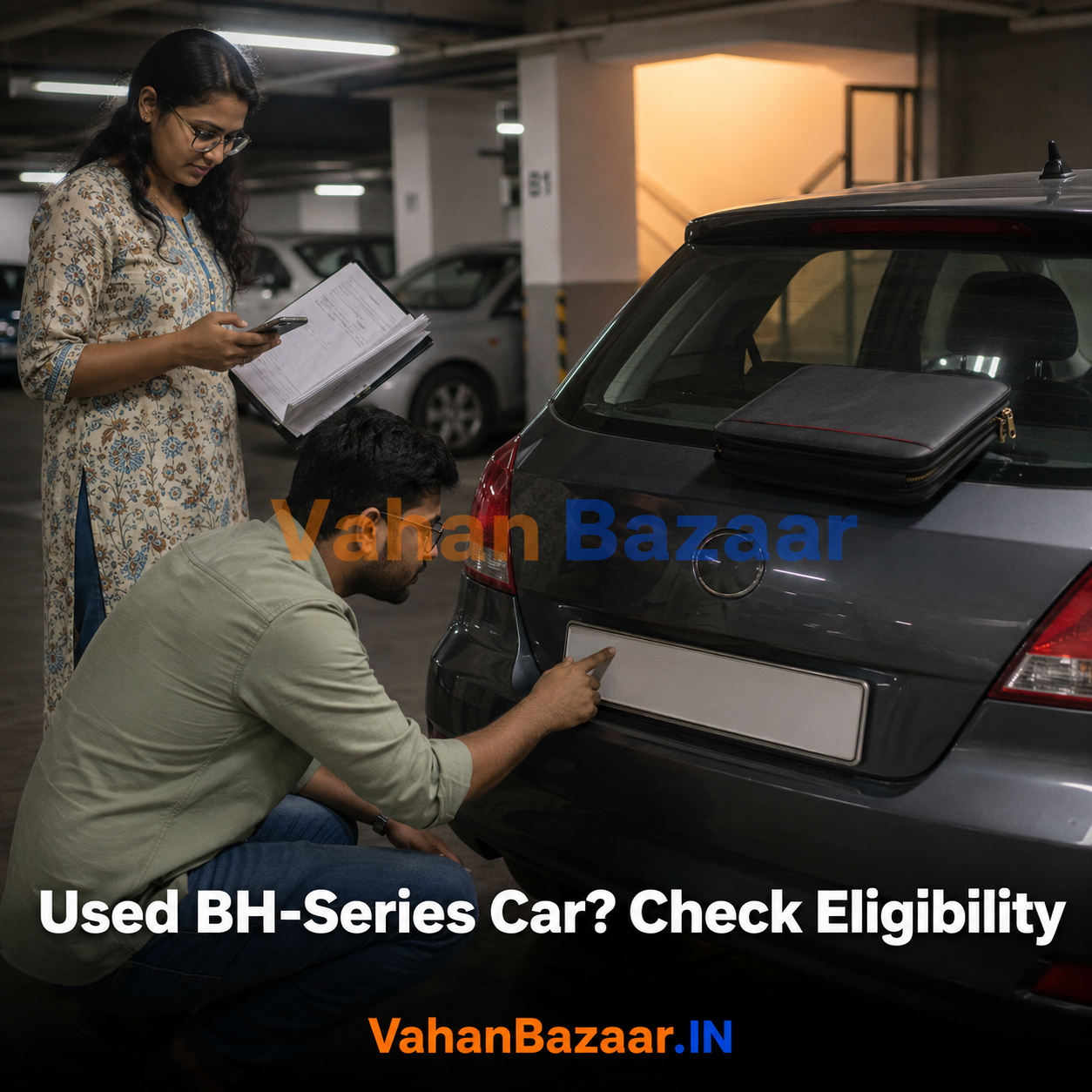
The Bharat Series was a genuinely good idea. Introduced in 2021, it solved a real irritation for people whose jobs move them between states: rather than re-registering a car every time you relocate, you register once on a national series and take it with you. The plate reads in the format 26 BH 9876 AB, with the first two digits marking the year of registration.
What nobody thought about carefully enough was what happens when that car is sold. Five years on, the first meaningful cohort of BH-registered vehicles is arriving in the used market, and the answer turns out to matter a great deal to whoever buys them. The Ministry of Road Transport and Highways notified a standard operating procedure for BH-series vehicle transfers on 10 June 2026 — clarity that arrived roughly at the moment the market needed it.
Eligibility Belongs to the Owner, Not the Car
This is the sentence that catches people, so it is worth stating plainly before anything else. A BH registration is a privilege attached to the person who registered the vehicle, not a property of the vehicle itself.
Eligibility under Rule 47 of the Central Motor Vehicles Rules covers central and state government employees, employees of public sector undertakings, defence personnel, and private-sector employees whose employer maintains registered offices in four or more states or union territories. That last category is the widest and the least understood — it turns on the employer's footprint, not the employee's seniority or salary.
When such a person sells the car, the buyer does not inherit their employment. If the buyer runs a shop, or works for a firm operating in a single state, or is retired, or is a student, they do not meet Rule 47. The car is perfectly legal to buy. The plate is not theirs to keep.
A used-car buyer sees a clean, well-maintained car with an unusual-looking plate, hears "it works in every state, no re-registration needed", and takes that as a feature of the vehicle. It is a feature of the seller. Unless the buyer independently qualifies under Rule 47, the vehicle has to be moved onto the registration series of the buyer's own state after transfer.
The Money: Two-Year Blocks Versus Lifetime Tax
The BH scheme's other distinctive feature is how road tax is paid, and it is the part with the clearest financial consequence for a buyer.
Ordinary state registration in India works on a lifetime road tax model: you pay a large single amount at registration covering fifteen years. BH works in two-year blocks instead, paid repeatedly across the vehicle's fifteen-year life. The rate is set against the vehicle's invoice value.
| Invoice value | BH road tax rate | Adjustments |
|---|---|---|
| Below Rs. 10 Lakh | 8% | Add 2% for diesel vehicles. Reduce by 2% for electric vehicles. |
| Rs. 10 Lakh to Rs. 20 Lakh | 10% | |
| Above Rs. 20 Lakh | 12% |
For a buyer, this produces two different outcomes depending on eligibility.
If you are BH-eligible and keep the registration, you inherit the two-year block obligation. That is not a penalty, but it is a recurring payment that a buyer used to lifetime road tax may not have budgeted for. It is worth confirming which block the vehicle is currently paid up to before you agree a price.
If you are not eligible and convert to your own state's series, you generally face that state's lifetime road tax, calculated on the vehicle in its current condition. The two-year payments the seller already made were for the BH scheme; they do not carry across as a credit against your state's lifetime demand. Whether any refund is available for the unused portion depends on the states involved and is not something to assume. This is a real, sometimes substantial cost, and it belongs in the negotiation rather than in a surprise at the RTO counter.
What the SOP Changed
Before June 2026, BH transfers were being handled inconsistently. Different RTOs took different views on whether an ineligible buyer could hold the plate at all, on what documentation an eligible buyer needed to prove their status, and on how conversion to a state series should be processed. Buyers and sellers were getting different answers in different districts, which is exactly the situation in which used-car deals fall apart late.
The standard operating procedure notified on 10 June 2026 sets out a common process. The practical effect for a used-car buyer is that the question now has a defined answer rather than a local one — which is better, but only if you ask the question before you pay rather than after.
BH transfers must follow BH rules. A buyer can keep the plate only if they independently qualify under Rule 47. The SOP standardises how that is verified and processed; it does not create a route for an ineligible buyer to hold a BH registration.
What to Confirm Before You Pay Anything
The BH question sits on top of the ordinary used-car checks rather than replacing them, and a buyer looking at a BH car has slightly more homework than usual, not less.
- The registration series and date. The BH format is visible on the number itself, and the first two digits give the registration year. Confirm both against the record rather than against the plate on the car.
- Your own eligibility, honestly assessed. If you are a private-sector employee, the test is whether your employer has registered offices in four or more states or union territories. Check it with your employer rather than guessing.
- Which two-year block the tax is paid up to. If you are keeping the plate, this is your next bill.
- RC status. Active, suspended, blacklisted or cancelled. Nothing else on this list matters if the status is not clean.
- Owner serial number. How many hands the car has actually passed through, which is frequently not the number in the advertisement.
- Hypothecation. Whether a lender still has a live claim on the vehicle.
- Insurance validity and challan or blacklist flags. An expired policy means you drive home uninsured; unpaid challans can block the transfer NOC entirely.
Every item on that list except your own employment status sits on the vehicle's VAHAN record, and the record is the authoritative version — not the plastic card in the seller's hand, which is a snapshot of the day it was printed. Pulling the record takes under a minute. A Vahan Verify check costs Rs. 49, and the RC and challan checks together cost Rs. 79 rather than Rs. 98 separately.
What This Means for Used Car Buyers
A BH-series car is not a car to avoid. It is frequently a well-kept vehicle owned by someone in stable employment who moved states for work, which is not a bad profile. What it is, is a car with an extra condition attached, and the condition is about you rather than about the car.
Work out your eligibility first, then price the deal accordingly. If you qualify, the BH plate is a genuine convenience and you should say so in the negotiation only after you have used the conversion cost as leverage — because the seller's other prospective buyers may well not qualify. If you do not qualify, get a realistic figure for your state's lifetime road tax on that vehicle and treat it as part of the purchase price. It frequently is not small.
And in both cases, run the registration record before the token amount, not after. The related questions that sink used-car deals — a live loan, an unpaid challan, a status that is not active — are the same for a BH car as for any other, and they are the ones that turn a good vehicle into a six-week argument. If you are still browsing, our verified used car listings carry a VAHAN cross-check on every car.
What This Means for Used Car Sellers
If you hold a BH registration and are preparing to sell, be upfront about it in the listing. The buyer pool for your car is narrower than for an equivalent state-registered vehicle, and pretending otherwise only means the deal collapses later and more expensively.
Stating the position clearly — that the plate can be retained by a BH-eligible buyer and otherwise needs converting — does two useful things. It filters out buyers who would have walked away at the RTO, and it signals to the ones who remain that you know what you are selling. A verified listing on VahanBazaar costs Rs. 49 and puts the car's VAHAN-cross-checked record in front of buyers alongside your description, which is exactly the kind of transparency that turns an unusual registration from a red flag into a footnote.
Frequently Asked Questions
The Bharat Series is a national registration format introduced in 2021 for private, non-transport vehicles, designed so that people who relocate between states do not have to re-register the vehicle each time. Eligibility is set out in Rule 47 of the Central Motor Vehicles Rules and covers central and state government employees, public sector undertaking employees, defence personnel, and private-sector employees whose employer has registered offices in four or more states or union territories. A BH plate reads in the format 26 BH 9876 AB, where the first two digits are the year of registration.
You can buy the car, but you cannot simply inherit the plate. Ownership transfer of a BH-series vehicle has to follow BH rules, and keeping the vehicle on the BH series requires the new owner to be independently eligible under Rule 47. A buyer who does not qualify has to have the vehicle converted to the registration series of their own state, which is an additional process with an additional cost. The Ministry of Road Transport and Highways notified a standard operating procedure for BH-series transfers on 10 June 2026, which was overdue clarity on exactly this point.
BH road tax is paid in two-year blocks rather than as a single lifetime payment, and the rate depends on the invoice value: 8 percent below Rs. 10 Lakh, 10 percent between Rs. 10 Lakh and Rs. 20 Lakh, and 12 percent above Rs. 20 Lakh, with an additional 2 percent for diesel vehicles and a 2 percent reduction for electric vehicles. This matters to a buyer for two reasons. First, if you keep the BH registration you inherit the obligation to keep paying in two-year blocks. Second, if you convert to a state series, you generally face the destination state's lifetime road tax on top of what has already been paid.
Start with the registration number itself, since the BH format is visible on it, then confirm the registration date, the current RC status, the owner serial number, whether a hypothecation entry is still live, insurance validity, and whether there are blacklist or challan flags against the vehicle. The BH question sits on top of all the ordinary used-car checks rather than replacing them. Pulling the VAHAN record before you pay a token amount costs Rs. 49 through Vahan Verify on VahanBazaar.
It narrows the buyer pool, which is the honest way to put it. Any buyer who wants to keep the plate has to be BH-eligible themselves, and any buyer who is not has to factor in the cost and effort of converting to a state series. Neither is fatal to a sale, but both are friction, and friction shows up in the price. A seller who understands this and states the position openly in the listing tends to do better than one who lets the buyer discover it at the RTO.