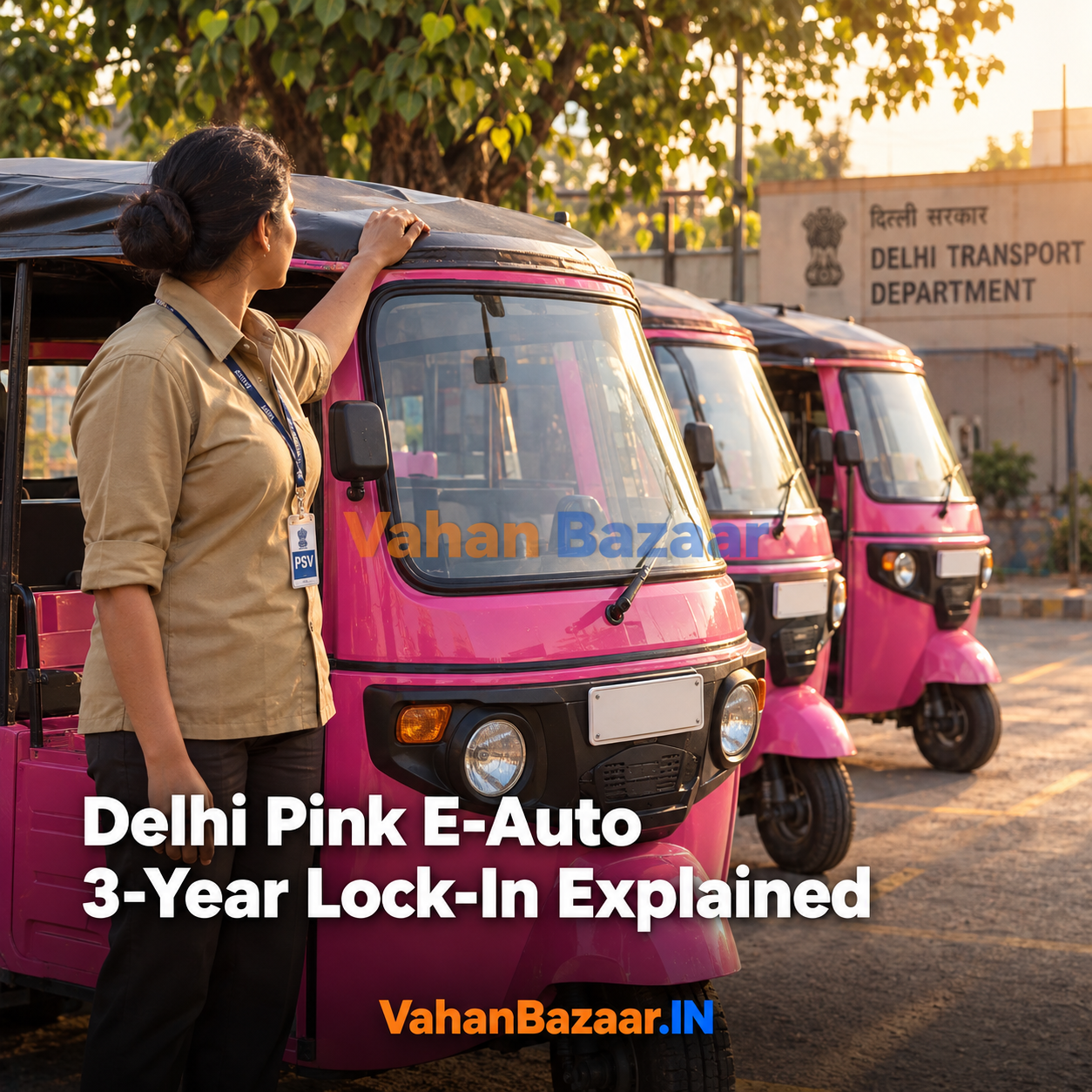
On 23 September 2026 the Delhi Cabinet, chaired by Chief Minister Rekha Gupta, approved a scheme with a long name and a short purpose. DURGA, or Driving Upliftment and Rozgar for Women/Transgender Green E-Auto, will put 1,300 pink electric autos on Delhi's roads in its first phase, driven by 1,170 women and 130 transgender persons, with no more than 90 and 10 respectively allotted in each revenue district. The stated aim is self-employment with dignity and a safer ride for passengers early in the morning and late at night.
That is the headline, and it is a good one. This article is about a line further down the cabinet note that matters to a different set of people entirely: every e-auto allotted under DURGA carries a mandatory three-year lock-in, during which it cannot be sold, transferred or otherwise disposed of. That single condition reaches past the beneficiaries and into the second-hand three-wheeler market, and a used e-auto buyer in Delhi needs to understand it before 2027 arrives.
What the Cabinet Approved
The eligibility rules are specific, and they matter to buyers later, so it is worth setting them out plainly. A woman applicant must be a resident of Delhi aged between 20 and 40, hold a valid voter identity card, an LMV driving licence and a PSV badge, and come from a family whose income in 2025-26 did not exceed Rs. 5 Lakh. Neither she nor her family may already own a registered transport vehicle or three-wheeler, and a woman with more than three children is not eligible. A transgender applicant needs a valid transgender certificate issued by the office of a District Magistrate in Delhi, and the same age, residency, voter ID, licence and PSV badge conditions apply.
| Condition | Women applicants | Transgender applicants |
|---|---|---|
| Phase one allotment | 1,170 e-autos, maximum 90 per revenue district | 130 e-autos, maximum 10 per revenue district |
| Age | 20 to 40 years | 20 to 40 years |
| Documents | Delhi residency, voter ID, LMV licence, PSV badge | Delhi residency, voter ID, LMV licence, PSV badge, District Magistrate's transgender certificate |
| Income and ownership | Family income up to Rs. 5 Lakh in 2025-26; no registered transport vehicle or three-wheeler in the family; not more than three children | Reported conditions focus on the documents above; check the final notification |
| Lock-in | 3 years, no sale, transfer or disposal | 3 years, no sale, transfer or disposal |
| Application | Dedicated online portal; no opening date had been announced as of 24 September 2026 | |
Two things are not yet public, and it is better to say so than to guess. The support is expected to come as a subsidy on the purchase and interest support on the vehicle loan, but the government has not published the amounts. Reports at the time of the 2026-27 Budget put the provision for women's and transgender persons' e-autos at Rs. 20 crore, but the cabinet note released this week does not restate a figure, so treat that number as reported rather than confirmed. And the application portal had not opened as of 24 September 2026; anyone offering to "book" a DURGA slot for a fee before it does is not offering anything the government has created.
What a Lock-In Actually Is
A lock-in is not a promise the beneficiary makes. It is a condition attached to the vehicle's registration, and that difference is the whole story for a used buyer.
When you buy any registered vehicle in India, the sale is not complete when money changes hands or when the seller signs a delivery note. It is complete when the transport authority records the transfer of ownership and the registration certificate is reissued in your name. On a scheme vehicle inside its lock-in, that step does not happen. The RTO refuses the transfer because the vehicle is under a condition that says it cannot be transferred. The seller may have every intention of honouring the deal. The buyer may hold a signed agreement, a receipt and the keys. None of it produces a registration certificate with the buyer's name on it.
A vehicle registered in someone else's name, insured in someone else's name, with a permit issued to someone else, financed by a loan someone else is repaying. The buyer cannot renew the insurance in their own name, cannot answer for the permit, and if the loan falls into default the lender's recovery action lands on the vehicle regardless of who paid for it. On a commercial three-wheeler, where the vehicle is a livelihood, that is a worse outcome than losing the deposit.
This is why the lock-in is worth an article of its own. A three-wheeler is bought to earn, and it earns on paperwork: permit, fitness, insurance, tax. Every one of those is tied to the registered owner. A used e-auto that cannot be re-registered to its buyer is not a cheap e-auto. It is a vehicle the buyer cannot legally operate as their own.
Delhi Has Done This Before, and Enforced It
A buyer might reasonably ask whether a condition on paper is actually policed. In Delhi's case, the answer comes from two places.
The five-year auto lock-in that went to the High Court
In 2023 the Auto Driver Kalyan Union petitioned the Delhi High Court against a five-year lock-in on the transfer of three-seater auto-rickshaws. The union's argument was not that the restriction was ignored; it was that it was enforced so firmly that owners could not sell for medical reasons or replace an older auto with an electric one. The government's counsel told the court in June 2023 that it would take a policy decision on carving out exceptions. Whatever came of that process, the case itself is evidence that a Delhi transfer lock-in is a real barrier at the RTO counter, not a formality.
The three-year lock-in in the notified EV Policy 2026
The Delhi EV Policy 2026, in force from 1 July 2026 to 31 March 2030, carries its own three-year lock-in for anyone who takes a state incentive on an electric vehicle. That one is narrower: it stops the subsidised vehicle being re-registered in another state within three years of purchase, and the enforcement tool is the no-objection certificate, which the department simply does not issue. The earlier draft, reported as EV Policy 2.0, had proposed a broader five-year restriction on selling or transferring a subsidised vehicle at all, again enforced by withholding NOCs. That broader version was not carried into the notified policy, which we covered in our report on the draft's scrappage-linked subsidies. The point for DURGA is that the department already runs a lock-in through its own paperwork, and the DURGA condition is broader than the EV policy's, not narrower.
Taken together: Delhi has a precedent for an auto lock-in that was enforced hard enough to end up in court, and a live administrative mechanism for holding a lock-in through NOC and transfer refusal. There is no reason to expect the DURGA condition to be treated more softly than either.
What the Record Shows a Buyer, and What It Does Not
Here is where fairness and practicality meet. The registered owner's name and gender do not identify a scheme vehicle, and no buyer should assume anything from them. Women and transgender persons own and drive autos in Delhi on their own account, outside any scheme, and treating every such seller as a DURGA beneficiary would be both wrong and insulting. The scheme is identified by the vehicle's record, not by the person selling it.
Four fields in the VAHAN database do the work.
1. Date of first registration
DURGA vehicles do not exist yet. The portal had not opened as of 24 September 2026, so the first allotments will be registered after that, most likely into 2027. A Delhi e-auto with a first-registration date from that period onwards is in the window; one registered earlier is not a DURGA vehicle, whatever else it might be. This is the fastest filter and it is a date, not a judgement.
2. Hypothecation
The scheme's support is expected to run partly through interest support on a vehicle loan, which means a scheme vehicle will almost certainly show a hypothecation entry against a lender. A hypothecation entry on its own does not mean DURGA, because most commercial three-wheelers are financed. But a hypothecation entry is a transfer blocker in its own right: no lender's charge is cleared, no transfer is recorded. On a scheme vehicle inside its lock-in you would be looking at two independent blocks on the same transfer.
3. Vehicle class and permit category
A DURGA e-auto is an L5M passenger three-wheeler carrying a Delhi passenger permit. The vehicle class is in the record. The permit is separate paperwork, but the record's class and category tell you which permit to ask for and whether the vehicle is the category the seller says it is. Our guide to permit and registration checks on autos and e-rickshaws walks through the permit side in detail.
4. Colour
The record carries a colour field, and scheme autos are pink. A pink L5M e-auto first registered in Delhi in 2027 with a lender's charge on it is telling you something. It is not proof, but it is enough to ask the direct question and to ask for the allotment letter if the answer is yes.
None of this replaces asking the seller plainly whether the vehicle came through DURGA and when the lock-in ends. But a seller's answer is a claim, and the record is where a claim is tested. If the answer is no and the record shows a pink L5M passenger auto first registered in Delhi in 2027 under hypothecation, the conversation should slow down considerably.
The Checklist for Any Used E-Auto
The lock-in is one condition among several that can stop a used three-wheeler being transferred or operated. The checklist below applies to every used e-auto in India, scheme vehicle or not, and it applies in this order because this is the order that costs least and disqualifies fastest.
| Check | Where it shows | Why it stops a deal |
|---|---|---|
| Registration status and vehicle class | VAHAN record | Suspended or cancelled status ends it; the class settles whether it is an e-auto or a low-speed e-rickshaw |
| Hypothecation | VAHAN record | A lender's charge blocks transfer until cleared, however sincerely the seller says the loan is closed |
| Insurance validity | VAHAN record | A commercial vehicle without cover cannot legally carry passengers, and a lapsed policy is a cost you inherit |
| Tax and fitness validity | VAHAN record | Hard limits on the vehicle's ability to work; price the deal from the expiry date, not the delivery date |
| Pending challans | Challan check | Fines follow the vehicle and can stall a transfer until settled |
| Blacklist entry | VAHAN record | A blacklisted vehicle cannot be transferred at all until the flag is lifted |
| Permit | Separate document | Must be seen and verified with the issuing authority; the record does not confirm it |
| Scheme lock-in | Inferred from the record, confirmed by asking | The RTO refuses the transfer until the lock-in ends |
Six of those eight checks are answered by the VAHAN database against nothing more than the registration number. On VahanBazaar the RC check is Rs. 99, the challan check is Rs. 99, and the full report combining both is Rs. 149. It works on any registered vehicle, which matters here because the same check that clears a used car clears a used e-auto, a taxi, a bus or a truck. If the vehicle you are looking at is a low-speed e-rickshaw rather than an L5M auto, our report on used e-rickshaw permit checks under PM E-Drive covers the differences that apply on that side of the market.
What This Means for Used E-Auto Buyers
The immediate effect is small, because the first DURGA vehicles have not been allotted. The effect over the next three years is not, because 1,300 e-autos will enter Delhi's fleet under a condition that most used buyers have never had to think about, and a small number of them will be offered for sale early. Some of those offers will come from beneficiaries under financial pressure. Some will come from third parties who have taken the vehicle over informally and are looking for a buyer who will not ask. A buyer who does not know the lock-in exists will not know to ask.
So the buyer's job is narrow. Before travelling to see any used e-auto in Delhi, run the record check on the registration number. Read the date of first registration, the vehicle class, the hypothecation entry and the colour. If the vehicle sits in the DURGA window, ask the seller plainly and ask for the allotment letter. Then work through the rest of the checklist: status, insurance, tax, fitness, challans, blacklist, and the permit as its own document. The three-wheeler market's other traps, including the low-speed e-rickshaw sold as an e-auto and the vehicle that was never registered at all, are covered in our earlier piece on Delhi's shift to electric-only three-wheeler registrations.
And do not treat a lock-in as a discount opportunity. A locked-in vehicle at a low price is not a bargain with a wait attached. It is a vehicle you cannot register, insure or operate as your own for as long as the condition runs, and the seller's circumstances can change in that time in ways that leave you with nothing.
What This Means for Sellers
If you are a DURGA beneficiary, the lock-in is not a suggestion. For three years from allotment the vehicle cannot be sold, transferred or otherwise disposed of, and any informal arrangement that hands the vehicle to someone else leaves you as the registered owner, the permit holder, the insured party and the borrower on a vehicle you no longer control. If your circumstances change, the route is through the scheme's own process, not the second-hand market, and the notification when it is published should be read closely for what that process is.
If you are selling any other used e-auto in Delhi, the lock-in helps you, because it is one more reason for buyers to want proof rather than promises. Pull the record yourself before listing, know what the hypothecation, fitness and tax fields say, and put those dates in front of a buyer instead of asking them to take your word. A vehicle whose record is clean and whose permit is in order is worth materially more than an identical-looking one where any of that is uncertain, and the gap widens as buyers learn what to ask.
The Short Version
Delhi's DURGA scheme, approved by the Cabinet on 23 September 2026, will allot 1,300 pink e-autos in its first phase, 1,170 to women and 130 to transgender persons, with no more than 90 and 10 per revenue district. Applicants must be Delhi residents aged 20 to 40 with a voter ID, an LMV licence and a PSV badge, and a family income under Rs. 5 Lakh in 2025-26. Support through a purchase subsidy and loan interest support is expected, but the amounts are not yet published, and the application portal had not opened as of 24 September.
Every scheme vehicle carries a 3-year lock-in: no sale, no transfer, no disposal. Delhi has enforced auto lock-ins before, firmly enough to be challenged in the High Court in 2023, and its notified EV Policy 2026 runs a three-year lock-in of its own through NOC refusal. A used buyer who pays for a locked-in vehicle inherits one that cannot be registered in their name.
The owner's name and gender identify nothing. The record does: date of first registration, hypothecation, vehicle class and colour. Run the Rs. 99 check first, ask the seller plainly, then work through insurance, tax, fitness, challans, blacklist and the permit. In that order, because that is the order that costs least and disqualifies fastest.
Frequently Asked Questions
No. The Delhi Cabinet's approval on 23 September 2026 attached a mandatory three-year lock-in to every e-auto allotted under the DURGA scheme. During that period the vehicle cannot be sold, transferred or otherwise disposed of. A private sale agreement between a beneficiary and a buyer does not override that condition. The transport authority will not process an ownership transfer on a locked-in vehicle, so the buyer would be paying for a vehicle that stays registered in someone else's name.
The registered owner's name and gender do not identify a scheme vehicle, and it would be wrong to assume anything from them. What does help is the record itself: the date of first registration, which for DURGA vehicles will be after the scheme's portal opens; a hypothecation entry against a lender, because the scheme's support is expected to run through a vehicle loan; the vehicle class and permit category; and the colour field, since scheme autos are pink. Put those together with a plain question to the seller, and ask to see the allotment letter if the answer is yes.
Yes. In 2023 the Auto Driver Kalyan Union challenged a five-year lock-in on the transfer of three-seater auto-rickshaws in the Delhi High Court, arguing it stopped owners replacing their vehicles with electric autos; the government told the court it would look at carving out exceptions. Separately, the notified Delhi EV Policy 2026, in force from 1 July 2026, carries a three-year lock-in that stops a subsidised vehicle being re-registered in another state, enforced by withholding the no-objection certificate. Delhi's transport department has both the precedent and the administrative tools to hold a lock-in.
Six things, in this order: registration status and vehicle class from the VAHAN database; hypothecation, because a lender's charge blocks transfer until it is cleared; insurance validity; tax and fitness validity, which on a commercial three-wheeler are hard limits on earning; pending challans, which follow the vehicle; and any blacklist entry. Then ask to see the permit as a separate document. An RC check on VahanBazaar is Rs. 99, a challan check is Rs. 99, and the full report combining both is Rs. 149. It works on any registered vehicle, from an e-auto to a truck.
Read the Record Before You Pay for the Vehicle
Date of first registration, registration status, vehicle class, colour, hypothecation against a lender, insurance, tax and fitness validity, and blacklist flags — pulled from the VAHAN database against any registration number, e-auto or car, bike or truck. RC check Rs. 99, challan check Rs. 99, or the full report for Rs. 149.