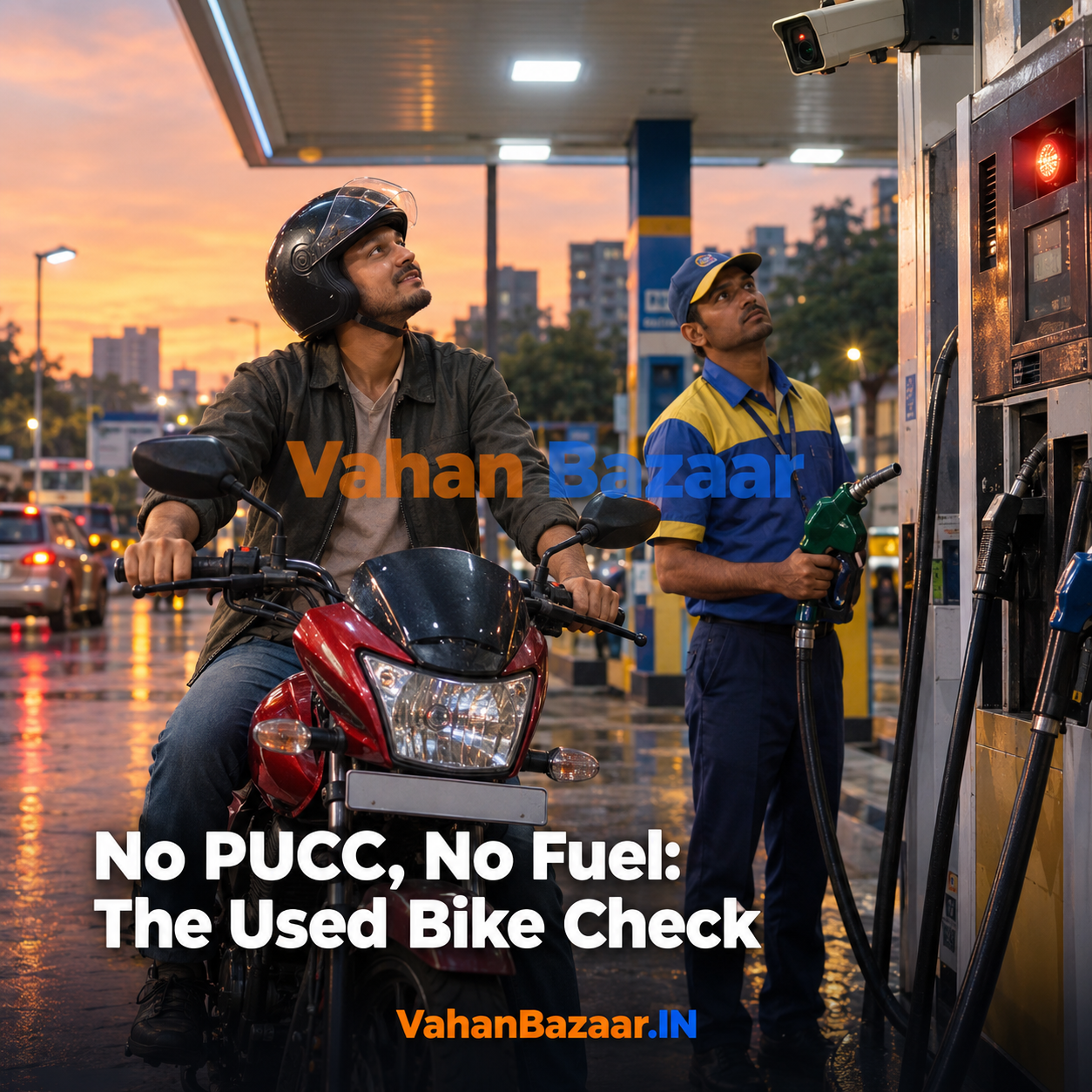
From 1 October 2026, a vehicle without a valid Pollution Under Control Certificate is not supposed to be refuelled at any petrol, diesel or CNG station in Delhi-NCR. The authority for that is Direction No. 101 from the Commission for Air Quality Management (CAQM), the statutory body that sets air-quality rules for the National Capital Region, issued on 15 May 2026 and in force from the start of this month.
Delhi is enforcing it the hard way. About 500 fuel stations in the capital are fitted with Automatic Number Plate Recognition (ANPR) cameras. The camera reads the registration number as the vehicle pulls up, checks it against the national vehicle database, and if the PUCC is missing or expired, the dispenser stays locked until the certificate is renewed. No argument with the attendant changes that, because the attendant is not the one saying no.
This is not day one. Delhi first ran a "No PUC, No Fuel" drive from December 2025, with cameras, voice alerts at pumps and police support, and the Delhi environment minister said at the time that over two lakh PUCs were issued within days of it starting. What 1 October changes is the reach and the rigour: the rule now covers the whole NCR, which means Gurugram, Faridabad, Ghaziabad, Noida and the rest, and in Delhi the human discretion that used to let a familiar face through has been replaced by a camera and a database lookup.
Most coverage has treated this as a story for people who already own a vehicle. It is at least as much a story for people about to buy one, and for two-wheeler buyers in particular, because a used bike or scooter is exactly the kind of vehicle whose PUC history nobody thinks to ask about until the pump says no.
A used bike you buy on Saturday can be refused petrol on Sunday. The camera does not know or care that the vehicle changed hands yesterday. It reads the plate, finds no valid PUC against it, and locks the pump. The seller's cheerful "PUC is just lapsed, you can get it done anytime" becomes your problem the moment the tank runs dry, and if the bike cannot pass the test, it becomes a much bigger problem than Rs. 99.
What Changed on 1 October, and What Did Not
Three things are worth separating, because they get run together in casual conversation and they are not the same rule.
The PUC rule is the new one in its NCR-wide form. It applies to every vehicle regardless of age or fuel. If the certificate on the record is missing or has expired, the pump is meant to refuse fuel. For a BS-VI vehicle the PUC is typically valid for one year after the first-year certificate, so a well-kept bike only needs the test once a year, which is also why a long gap says so much about how the bike was kept.
The age rule is older and Delhi-specific in origin. Petrol vehicles over 15 years and diesel vehicles over 10 years are end-of-life in Delhi under the National Green Tribunal's 2015 order, which the Supreme Court upheld in 2018. Fuel denial to such vehicles was phased in from 1 November 2025 in Delhi and five NCR districts and was scheduled to extend to the rest of NCR from 1 April 2026. Two-wheelers are petrol vehicles, so a 15-year-old scooter sits on the wrong side of this line. We covered the age limits in detail in our piece on checking a vehicle's age before buying in Delhi-NCR.
The GRAP layer sits on top of both and switches on and off with the air. The revised Graded Response Action Plan schedule CAQM has approved for the 2026 season has 48 actions across four stages: 25 in Stage I, 8 in Stage II, 10 in Stage III and 5 in Stage IV. At Stage III, BS-IV and older diesel light and medium goods vehicles registered outside Delhi face restrictions; older trucks face them at Stage IV; and the essential-goods exemption runs to 31 October 2026. That layer is mostly a commercial-vehicle story, which we looked at separately in our note on the BS-IV goods vehicle restrictions in NCR, but the point for a bike buyer is that the emission norm on a vehicle's record is now a thing the system can act on, not a line on a form.
What the Camera Checks, and Where Each Answer Lives
The camera at the pump is not inspecting the bike. It is inspecting the bike's record. That matters because you can inspect the same record, for the same registration number, before you have paid a rupee, and it will tell you the same things the camera will be told.
| What the camera checks | Where it comes from | What a used-bike buyer should do |
|---|---|---|
| PUC validity | The PUC validity date held on the central registration record, updated when a certified centre issues a certificate | Pull the record before paying. Note the expiry date and how long any gap has been. Make a fresh PUC test a condition of sale |
| End-of-life age (Delhi) | The registration date on the record, which fixes the true age: petrol over 15 years, diesel over 10 | Compare the registration date with the model year the seller quotes. A bike "from 2012" that was registered in 2011 is a year closer to the line than you were told |
| Emission norm (under GRAP) | The fuel type and emission norm fields on the record, set at first registration | Confirm the norm on the record matches what the listing claims. On a two-wheeler this mostly affects resale value and future-proofing rather than today's fuel access |
Notice that none of the three is a physical attribute you can see at a kerbside viewing. A bike can look immaculate and have no valid PUC. It can have a fresh number plate and a registration date that puts it within a year or two of end-of-life. The only way to know is the record.
What the Record Shows, and What It Tells You About the Bike
A Vahan Verify RC check pulls the central registration record for any registration number, and a bike or scooter number works exactly like a car number. For Rs. 99 it returns PUC validity, insurance validity, the registration date, fuel type and emission norm, the owner serial number, hypothecation and blacklist status. Read together, those fields say more about how a two-wheeler was kept than an hour of looking at it.
PUC validity: the gap is the story
A current PUC is the baseline. An expired one is not automatically a reason to walk away, but the length of the gap is a reason to ask questions. A bike that lapsed a few weeks ago was probably in daily use by someone who forgot. A bike whose PUC lapsed a year or more ago was one of three things: parked for a long time, ridden while dodging enforcement, or unable to pass the test. Each of those is worth knowing before you agree a price. Our guide to the PUC test itself covers what the centre actually measures and why an old, poorly maintained engine fails it.
Insurance validity: the lapse that travels with the PUC
Insurance validity sits beside PUC validity on the same record, and the two tend to lapse together, because an owner who has stopped bothering with one has usually stopped bothering with the other. There is a sharper point too: as we reported earlier, a lapsed PUC can complicate an insurance claim. So a bike with both expired is a bike that has been running without cover and without a valid certificate, and if it was ever in a scrape during that period, you will not find it in any claims history. For two-wheelers specifically, the no-claim bonus check is where seller stories most often fall apart.
Registration date: the true age, not the model year
Sellers quote model years. The record holds a registration date. For most of a bike's life the gap does not matter; near the 15-year end-of-life line in Delhi it matters enormously, because the line is drawn on the record's date, not on the seller's memory. Our explainer on the Delhi-NCR end-of-life check walks through what to do when a bike sits within a couple of years of the limit.
Fuel type and emission norm
These are set at first registration and do not change. On a two-wheeler the practical effect today is mostly on resale: with GRAP now able to act on norms, an older-norm bike will be a harder sell in NCR in a year or two than it is now. Price accordingly.
Owner serial, hypothecation and blacklist
These three are not about pollution at all, but they come with the same Rs. 99 and they are the fields that stop a sale outright. A financier still on the record means the bike cannot transfer to you until the charge is lifted. A blacklist flag means it may not transfer at all. The owner serial tells you whether the "first owner" story is true. Our general guide to checking a used bike or scooter's VAHAN record covers each of these in turn.
Once you have seen the record, the move is simple. If the PUC is expired, tell the seller the deal goes through after a fresh PUC test, at their cost, with the certificate reflected on the record before you pay the balance. An honest seller with a healthy bike loses an hour. A seller whose bike cannot pass has just told you why it was for sale.
Fake Certificates Do Not Fool the Camera
The weakest link in the old system was the paper certificate. A printed PUC slip could be bought, and in earlier reporting we covered the fake PUC racket operating over messaging apps in Delhi and Haryana. The camera-and-database model closes that door for pump access, because the lookup is against what the registration record says, not what the rider holds in a pocket. For a buyer this cuts both ways: a seller cannot wave a slip at you as proof, and you should not accept one. What counts is the validity date on the record, which is what you see in the check. Our piece on why a VAHAN database check beats a paper PUC covers the mechanics.
Read the Record the Pump Camera Reads
PUC validity, insurance validity, registration date and true age, fuel type and emission norm, owner serial number, hypothecation and blacklist status, for any bike, scooter or car registration number, in about a minute. RC check Rs. 99, challan check Rs. 99, or both together for Rs. 149.
What This Means for Used Bike Buyers in Delhi-NCR
The practical order of checks has changed. Until now, most two-wheeler buyers in NCR looked at the bike first, haggled second, and sorted paperwork third, with the PUC somewhere near the bottom of the paperwork pile. The camera at the pump moves PUC to the top, because it is the one thing on the list that can leave you stranded the day after you buy.
Before you travel to see the bike, ask for the registration number and run the record. It takes about a minute and it tells you whether the bike has a current PUC, how long any gap has been, whether insurance is live, how old the bike really is, and whether anyone else still has a claim on it. A seller who will not share the number of a bike they are publicly advertising has answered your question already.
At the viewing, match the chassis and engine numbers on the bike to the record, and treat the physical inspection as a second filter rather than the first. The inspection can tell you about the chain, the brakes and the tyres. It cannot tell you whether the pump will serve you tomorrow.
Before you pay, make the PUC test a written condition of sale and hold the balance until the fresh certificate shows against the record. Do the same for any open challan: a challan check is Rs. 99 on its own or Rs. 149 together with the RC check, and challans attach to the vehicle, not to the person who earned them.
If you ride for a living, all of this matters twice over. A delivery rider whose bike is refused fuel loses a day's income, not just a convenience, and the bikes that circulate in the gig-rider market have often had hard lives and patchy records. Our guide to checks for a used delivery bike goes into the specifics.
One more thing on penalties. Riding without a valid PUC is an offence that attracts a challan under the Motor Vehicles Act. We are deliberately not quoting a figure here because published amounts conflict, but it is not trivial, and a used bike with a long PUC gap may already have one on its record.
If You Are Buying a Used Car Instead
Everything above applies to a car as well, with two differences in emphasis. First, the diesel end-of-life limit in Delhi is 10 years rather than 15, so the registration date matters sooner. Second, cars are more likely to carry a financier on the record, which makes the hypothecation field a bigger part of the picture. The same Rs. 99 RC check covers both. We wrote the car-first version of this story in our piece on the No PUC, No Fuel rule and the used car check, and the longer background on bikes, including green tax and the record check, is in our earlier piece on used bike PUC and green tax checks. If the air gets bad enough for the odd-even layer to return, our explainer on Delhi-NCR's odd-even and pollution rules is the one to keep handy.
The Short Version
From 1 October 2026, under CAQM Direction No. 101 of 15 May 2026, a vehicle without a valid PUC is not meant to be refuelled anywhere in Delhi-NCR. In Delhi, about 500 fuel stations now have cameras that read the plate and check the record before the pump unlocks. The rule has been running in Delhi since December 2025; what is new is the whole-NCR reach and the camera doing the refusing.
For a used bike or scooter buyer in Delhi, Gurugram, Faridabad, Ghaziabad or Noida, the first check is no longer the chain and the tyres. It is the PUC validity date on the registration record, read alongside insurance validity, the registration date that fixes the true age against Delhi's 15-year petrol and 10-year diesel limits, the emission norm, the owner serial, and any financier or blacklist flag. All of it sits on one record, the same record the camera reads, and reading it costs Rs. 99.
Then make the PUC test a condition of sale. A bike that passes costs the seller an hour. A bike that cannot has just saved you from buying it.
Frequently Asked Questions
From 1 October 2026, under CAQM Direction No. 101 dated 15 May 2026, vehicles without a valid Pollution Under Control Certificate are not to be refuelled at petrol, diesel and CNG stations anywhere in Delhi-NCR. In Delhi, about 500 fuel stations are fitted with number plate cameras that read the registration number, check PUC validity against the national vehicle database and block dispensing if the certificate is missing or expired. Delhi had already run a version of this drive from December 2025, so 1 October is an expansion across NCR and a tightening, not the first day.
Yes. PUC validity is held on the vehicle's central registration record, which is the same record the pump camera checks. A Vahan Verify RC check on VahanBazaar costs Rs. 99, works for any bike, scooter or car registration number, and shows PUC validity alongside insurance validity, registration date, fuel type and emission norm, owner serial number, hypothecation and blacklist status. Do it before you pay, not after.
A short recent gap on a bike that was clearly in daily use is usually just carelessness. A long gap is different: it means the bike was parked, was being ridden while dodging the camera, or could not pass the test. Either way, make a fresh PUC test a condition of sale and have the seller do it before money changes hands. If the bike cannot pass, you have learned something important for the price of nothing.
A lapsed PUC can complicate an insurance claim, as earlier reporting on this has covered. Insurance validity and PUC validity both sit on the registration record, so one Rs. 99 check tells you where the bike stands on both. For a used two-wheeler, also check whether the no-claim bonus story the seller tells matches what the record and the policy actually say.
Delhi's end-of-life limits apply to petrol vehicles over 15 years and diesel vehicles over 10 years, under the NGT's 2015 order upheld by the Supreme Court in 2018, and two-wheelers are petrol vehicles. Fuel denial to such vehicles was phased in from 1 November 2025 in Delhi and five NCR districts and was scheduled to extend to the rest of NCR from 1 April 2026. The registration date on the record tells you the true age, which is not the same as the model year a seller quotes.