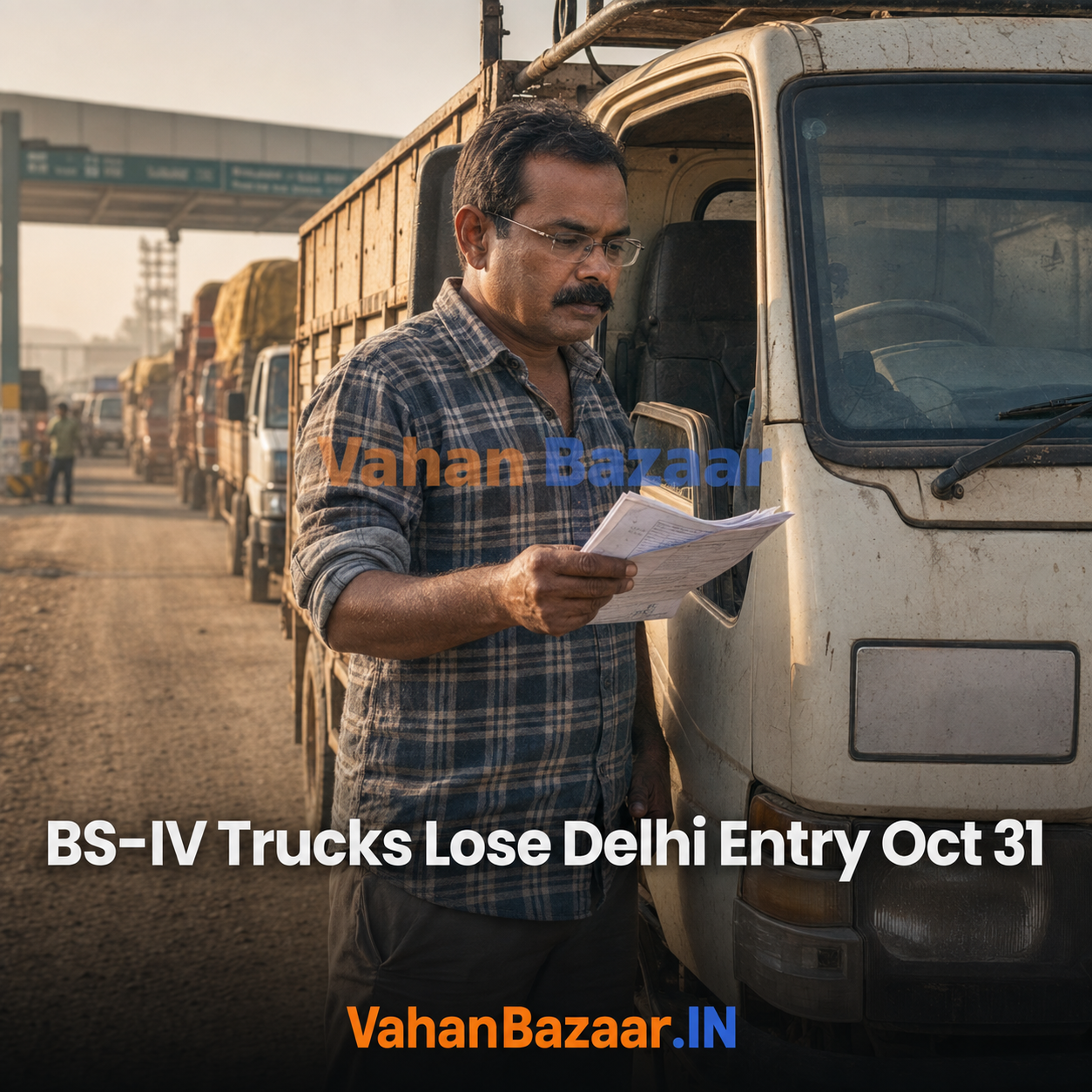
As of today the concession has 60 days left to run, and it lapses on Saturday 31 October 2026. That is long enough to make a considered decision and not long enough to make it twice. An operator holding pre-BS-VI goods stock that works into Delhi has three options, and which one is correct depends entirely on what the vehicle is recorded as: sell into a market outside the affected region while the buyer pool is still wide, redeploy it onto routes that never touch the region, or retire it under the scrappage route. Establish the emission stage and first registration date from the record before choosing — a great many operators infer the stage from the year of purchase, and that inference is unreliable, because vehicles built before a cutover continued to be registered after it.
Most of what gets written about emission norms concerns cars, and most of it concerns the future. This one concerns neither. It concerns light, medium and heavy goods vehicles — the pickups, tempos and trucks that people buy second-hand specifically to earn a living with — and the deadline is close enough to be inside the buying window of anyone reading this.
The position, in one paragraph. Under a direction issued by the Commission for Air Quality Management, entry into Delhi by commercial goods vehicles registered outside the city has been limited to BS-VI compliant vehicles since 1 November 2025. When that restriction came in, BS-IV compliant goods vehicles were given a transitional concession allowing them to continue entering — but only up to 31 October 2026. That concession has been running quietly in the background for the better part of a year. It now has about ten weeks left.
A used goods vehicle is bought to do a specific job on specific routes. If the job involves running into Delhi and the vehicle is a BS-IV registered outside the city, the vehicle stops being able to do that job on a known date. Nothing about the engine, the body or the maintenance changes. The permission does. A buyer who does not check this is not buying a truck with a small problem — they are buying a truck that cannot perform the work they costed it against.
Who Is Covered, and Who Is Not
The restriction is narrower than the headlines usually suggest, and the exclusions matter as much as the inclusions. Two facts about the vehicle decide the outcome: where it is registered, and what it runs on. Age is not the test, and neither is condition.
| Goods vehicle | Position on entry into Delhi | Effect of 31 October 2026 |
|---|---|---|
| Registered in Delhi | Not covered by the entry restriction | Unchanged |
| BS-VI diesel, registered outside Delhi | Permitted | Unchanged |
| CNG or LNG | Permitted | Unchanged |
| Electric | Permitted | Unchanged |
| BS-IV, registered outside Delhi | Permitted under a transitional concession | Concession lapses on 31 October 2026 |
| Below BS-IV, registered outside Delhi | Already restricted since 1 November 2025 | Already applies |
Read the table from the buyer's side rather than the regulator's. A CNG tempo and a BS-VI diesel pickup are in the same position on 1 November as they are today. A BS-IV diesel goods vehicle on a non-Delhi registration is the only row that changes, and it is also one of the most common configurations in the affordable end of the used commercial market — which is precisely why this deserves attention now rather than in November.
Directions of this kind get amended, extended and clarified, and enforcement practice is a separate question from what the direction says. Nothing here is a substitute for checking the current position with the Transport Department or the Commission for Air Quality Management before you commit a vehicle to a route. Treat the date as the thing to plan around and verify, not as something to assume will hold or assume will slip.
How to Establish Whether a Used Truck Is BS-IV or BS-VI
This is the practical question, and it is where a lot of second-hand commercial deals go wrong — not through fraud, but through vagueness. A seller says the vehicle is BS-VI because they believe it is, or because the last owner told them so, or because a sticker on the cab says something. None of that is evidence.
The reliable anchor is the date of first registration. BS-VI became the applicable standard for new vehicles sold and registered in India from 1 April 2020. A goods vehicle first registered comfortably before that date is not a BS-VI vehicle, whatever anyone says about it. That single date does most of the work.
The registration record is where you get that date without relying on anyone's memory. Pulling the vehicle's entry from the VAHAN database against its registration number returns the registration date and the fuel type, and in the same look also settles the things that decide whether the purchase can complete at all: the registration status, the owner serial number, whether a financier still holds a charge over the vehicle, and any blacklist entry.
That last group matters more on a commercial vehicle than most buyers expect. An open hypothecation blocks the transfer regardless of what has actually been repaid. A blacklist flag surfaces at exactly the wrong moment. And on goods vehicles specifically, there is a whole layer of permit and fitness paperwork sitting on top of the ordinary registration position — our guide to checking permit, fitness and NOC on a used truck or pickup covers what has to be in order before the vehicle can legally earn, and it is not a short list.
Check the Vehicle Before You Pay
Registration date and true age, fuel type, registration status, owner serial number, hypothecation against a loan and blacklist flags, pulled from the official record against any registration number. RC check Rs. 99, challan check Rs. 99, or both together for Rs. 149.
One more trap worth naming, because it is specific to commercial vehicles and it catches people who did everything else right. A permit does not travel with the vehicle the way the registration does — we covered this in detail in our piece on why permits do not transfer with a used truck. Buying a goods vehicle that is currently working a route tells you nothing about whether you will be able to work that route, and the emission-norm question sits on top of that rather than replacing it.
What This Means for Used Truck and Pickup Buyers
Three practical positions, depending on what you are buying the vehicle for.
If the work involves Delhi
Then the emission norm is not a detail, it is the deciding specification. A BS-IV goods vehicle on an outside registration will not be able to do that work once the concession lapses, and a lower purchase price does not compensate for a vehicle that cannot perform the job. Establish the registration date from the record before you negotiate, not after you have paid a deposit.
If the work never goes near Delhi
Then this particular direction does not reach you, and a sound BS-IV vehicle at a sensible price may be a perfectly good buy. Two things still belong in your thinking. Emission-norm restrictions have historically spread from one city to others rather than staying put, so a BS-IV goods vehicle carries some regulatory risk across a long ownership. And when you come to sell, part of your buyer pool will be people who do need those routes. Neither is a reason to walk away. Both are reasons to pay a price that reflects them.
If you are choosing between fuels
CNG, LNG and electric goods vehicles sit outside this restriction entirely, which is a genuine and underrated advantage of those configurations in the used market right now. That advantage comes with its own homework rather than for free. A retrofitted CNG installation must be properly endorsed on the registration record, and running a goods vehicle on the wrong class of insurance policy voids the cover at precisely the moment you need it — our note on why a private car policy does not cover a goods vehicle explains how that gap opens up and what it costs.
What This Means for Sellers
If you own a BS-IV goods vehicle registered outside Delhi and you were planning to sell it in the next year, the timing question is real and it points one way.
The reason is not that the vehicle becomes worthless — it does not. It is that the pool of buyers who can use it for the highest-value work shrinks on a known date, and buyers price a restriction that has already arrived far more harshly than one that is still weeks away. A restriction in the future is a negotiating point. A restriction in force is a fact the buyer builds their entire offer around.
Beyond timing, the ordinary preparation matters more on a commercial vehicle than on a car, because a commercial buyer is assessing whether the vehicle can legally earn from day one. Clear outstanding challans. Confirm the hypothecation has actually been removed from the record if the loan has closed, rather than assuming it lapsed when you made the final payment. Get the fitness and permit position straight, and be accurate about it. Our guide to selling a used truck and handling permit, NOC and tax covers the sequence, including the surrender steps sellers routinely forget.
Doing that work before you advertise rather than during a negotiation is what separates a completed sale from a stalled one. A verified listing at Rs. 99 cross-checks the vehicle against the official record and carries a Verified badge, which answers the commercial buyer's first and most reasonable question — whether the vehicle's paperwork actually matches the vehicle — before they have to ask it.
The Short Version
Commercial goods vehicles registered outside Delhi have needed to be BS-VI to enter the city since 1 November 2025. BS-IV goods vehicles were granted a transitional concession that runs out on 31 October 2026. Delhi-registered goods vehicles, BS-VI diesels, CNG, LNG and electric vehicles are not affected.
If you are buying a used truck, tempo or pickup in the next ten weeks and the work touches Delhi, the registration date is the specification that decides whether the vehicle can do the job — and it is on the record, not in the seller's description. Rs. 99 against a purchase that is meant to generate income for years is the cheapest part of the transaction, and the only part that settles the question rather than leaving it to a conversation.
Frequently Asked Questions
A temporary relaxation ends. Under a direction issued by the Commission for Air Quality Management, entry into Delhi by commercial goods vehicles registered outside the city has been restricted to vehicles meeting BS-VI standards since 1 November 2025, with BS-IV compliant light, medium and heavy goods vehicles allowed in as a transitional concession only up to 31 October 2026. After that date the concession lapses and those BS-IV vehicles fall under the same restriction as the rest. Enforcement details and any subsequent amendment are matters for the authorities, so confirm the current position with the Transport Department or the Commission before planning a run.
The restriction is aimed at commercial goods vehicles registered outside Delhi that do not meet BS-VI standards. Goods vehicles registered in Delhi itself are not covered by the entry restriction. Neither are BS-VI compliant diesel goods vehicles, nor vehicles running on CNG or LNG, nor electric goods vehicles. In other words the deciding factors are where the vehicle is registered and what it runs on, not how old it looks or how well it has been maintained.
The most reliable route is the vehicle's own registration record rather than the seller's description or a sticker on the body. BS-VI became the applicable standard for new vehicles sold and registered in India from 1 April 2020, so the date of first registration is the single most useful indicator: a goods vehicle first registered well before that date will not be BS-VI. Pull the vehicle's entry from the VAHAN database against its registration number to establish the registration date and fuel type, alongside the registration status, owner serial number, hypothecation and blacklist position. On VahanBazaar an RC check costs Rs. 99.
It affects what the vehicle can be used for, and value follows use. A goods vehicle whose economics depend on running into Delhi becomes worth less to an operator who needs that route once the concession ends, because the vehicle can no longer do the job. The same vehicle may be worth the same as before to an operator working routes that never touch the restricted area. This is why a single national resale figure is misleading for commercial vehicles: the price depends on which work the buyer intends to put it to.
Directly, no. The restriction concerns entry into a specific area, and a vehicle working routes that never enter it is unaffected by this particular direction. Indirectly it is still worth knowing, for two reasons. Emission-norm restrictions have tended to spread from one city to others over time rather than remain isolated, so a BS-IV goods vehicle carries some regulatory risk over a long ownership. And the resale pool you will eventually sell into includes buyers who do need those routes. Neither is a reason to avoid a sound vehicle, but both belong in the price you agree.