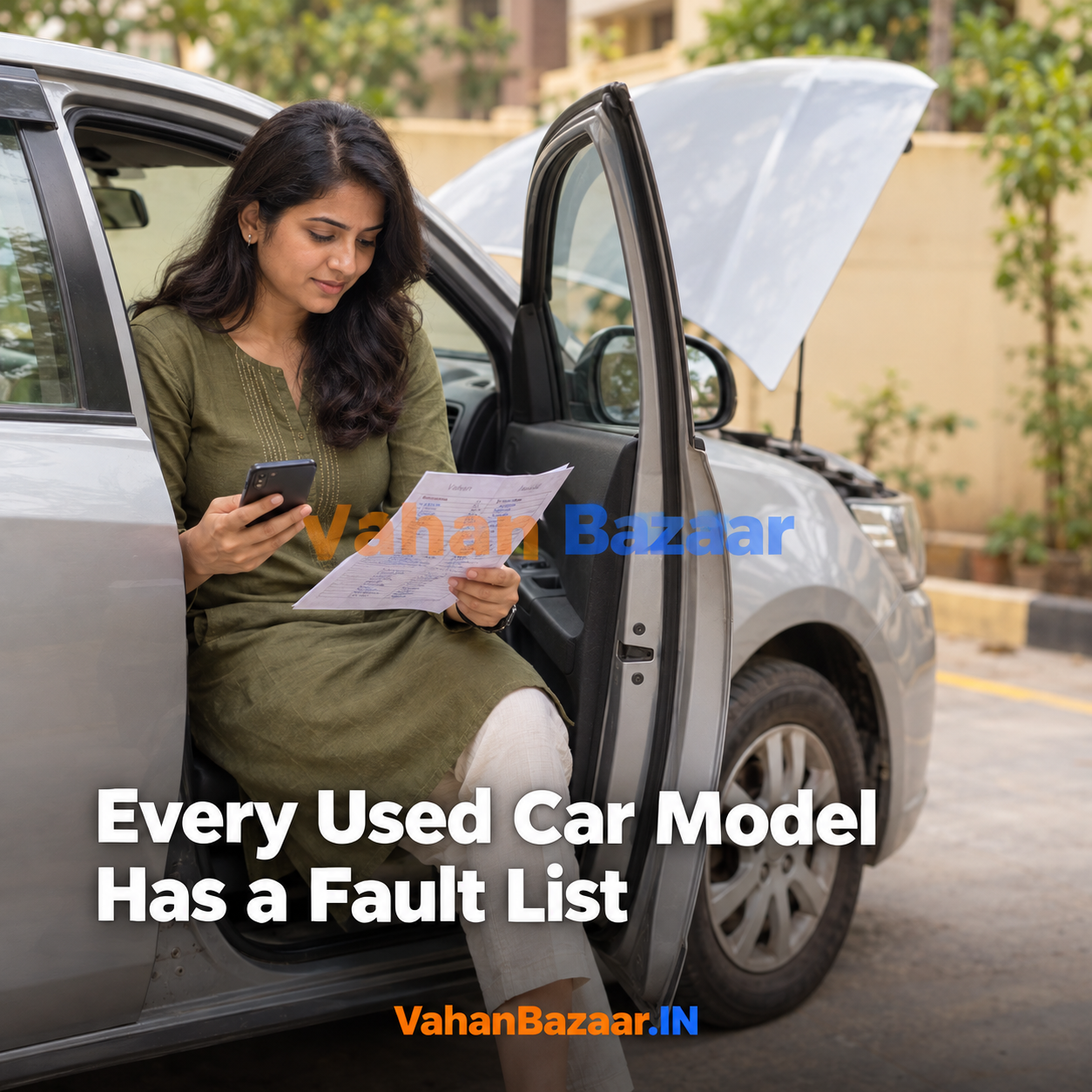
Watch somebody inspect a used car and you will see a fairly consistent routine. They walk the panels looking for a ripple in the paint. They crouch at each wheel and read the tyre. They open the bonnet, look at an engine they do not really recognise, and close it again. They drive for ten minutes, mostly in second gear, on a road the seller chose. Then they negotiate.
Every one of those steps is worth doing. But they all share a limitation: they interrogate this car, and only this car, using twenty minutes of a stranger's attention. None of them ask the question that a good mechanic asks before he has even seen the vehicle, which is what this particular machine is known to do to its owners.
The Question Nobody Asks Before the Viewing
Cars are not one-off objects. They are manufactured in the hundreds of thousands, to the same design, with the same suppliers and the same compromises, and they therefore fail in patterns. A gearbox family that eventually needs an expensive control unit. A timing chain that stretches earlier than the manual suggests. An infotainment head unit for which no affordable replacement exists once the warranty is gone. A turbocharger actuator. An air-conditioning compressor that gives up in its eighth Indian summer. A diesel particulate filter that clogs because the car spent its life on four-kilometre school runs and never got hot enough to clean itself.
None of this is secret. Owners of every popular model in India discuss these things for years, in enormous detail, on public forums. Auto journalists write long-term reports that say the same things more politely. Manufacturers issue recalls and service bulletins. The knowledge is genuinely public.
The trouble is that it is scattered. It sits in three years of threads, in comment sections, in a review published in 2019 and a follow-up published in 2023, none of it indexed by model year and fuel type, none of it summarised. No buyer is going to read it during a viewing, and very few will read it the night before. So the most useful information available about a used car is also the information most reliably ignored.
India has no law requiring a private seller to disclose a vehicle's accident or flood history to a buyer. A seller who says nothing about a submerged interior or a repaired structural member has broken no disclosure rule, because there is no disclosure rule to break. Industry repair estimates for hidden flood damage in India run from Rs. 50,000 to Rs. 3 Lakh. That gap between what the seller knows and what you are told is the whole reason buyers have to arrive already informed.
Step One: Establish What the Car Actually Is
Every fault list begins with an identity, and the identity has to come from the record rather than from the advertisement. This sounds pedantic until you notice how often the two disagree.
A fault pattern frequently differs between the petrol and the diesel version of the same nameplate, between the manual and the automatic, and between an early production year and a facelifted one. Get the identity wrong and you have researched a different car. So the starting point is the registration number, and what the VAHAN database says against it: make, model, variant where it is recorded, fuel type, engine and chassis number, date of first registration and the month and year of manufacture.
That last pair matters more than buyers expect. A car registered in January is very often manufactured the previous year, and the model-year difference can be the difference between the version with the known problem and the version after it was quietly fixed. Variant claims deserve the same treatment, which is why we wrote separately about checking whether a car really is the top variant the listing says it is. And where the engine or chassis number on the record does not match the metal, the problem is bigger than a fault list, as anyone who has had an RC transfer rejected for a chassis or engine mismatch will tell you.
A Rs. 49 record check settles the identity question on its own, for cars, bikes and commercial vehicles alike. It is also the correct first spend if all you want is the legal and ownership picture.
Step Two: Find That Model's Known Failure Points
With a confirmed identity, the research becomes tractable. You are no longer asking the impossibly broad question of what goes wrong with used cars. You are asking what owners of this engine, in this body, in this market, with Indian fuel, Indian dust and Indian traffic, have reported over the years.
Three sources carry most of the value. Owner communities are the richest, because they contain the complaints that never reach a press release. Long-term journalism is more disciplined and better at separating a genuine design weakness from one unlucky car. Recall notices and service campaigns are the most authoritative of the three, because a manufacturer has admitted the problem in writing, and a recall that was never performed on a particular car is a concrete thing to ask a seller about.
Read together, these tell you not just what fails but roughly when, and that is the part that turns research into a decision. A component that typically gives trouble after a certain distance is a very different proposition on a car showing 40,000 km than on one showing 1.2 Lakh km. Age and usage pattern matter too: a diesel that has done mostly highway distance and a diesel that has done the same distance in city crawl are not the same car, a distinction we went into when looking at what high-kilometre diesel repairs actually cost.
Step Three: Convert Each Fault Into a Check or a Question
Research that stays as research is useless at a viewing. Every known weakness has to become either something you can look at, listen to or feel, or something you ask the seller directly and then watch him answer.
The table below is deliberately generic. It maps categories of known trouble to the check and the question, without attaching any of them to a named model, because which of these applies to the car in front of you depends entirely on what that model is actually known for.
| Category | What to check at the viewing | What to ask the seller |
|---|---|---|
| Transmission | Cold-start engagement, hesitation or shunting between the lower gears, any warning lamp on start-up, and whether the gearbox behaves differently once warm | When was the transmission fluid last changed, has any control or mechatronic unit been replaced, and is there a bill for it |
| Turbo and exhaust after-treatment | Smoke on a hard pull from low revs, whistle or flutter that changes with load, and whether any regeneration or filter warning has appeared | What proportion of its life was short city runs, has the particulate filter ever been cleaned or replaced, and has the turbo been touched |
| Electrical and infotainment | Every switch, every window, the screen through a full boot cycle, reversing camera, all speakers, and whether any module resets while you sit in the car | Has the head unit or any electronic module been replaced, was it a genuine part, and is a replacement still available for this generation |
| Air-conditioning and cooling | Cooling at idle as well as at speed, compressor cycling noise, radiator fan behaviour, coolant colour and level, and any sweet smell in the cabin | Has the compressor or condenser been changed, has the coolant ever been topped up unusually often, and has the car ever overheated |
| Suspension and steering | Knocks over a rough patch at low speed, steering that wanders or self-centres poorly, uneven tyre wear across each axle | When were the bushes, links or struts last replaced, and has the car had a wheel alignment done recently and why |
Notice what these questions do beyond gathering facts. A seller who has genuinely maintained a car answers them easily and often produces a bill. A seller who is hiding something will usually change the subject, and that is information too. If you want the general-purpose version of this list rather than the model-specific one, our piece on the 12 questions to ask a used-car seller covers the ground that applies to every car regardless of badge.
Step Four: Price the Parts Before You Negotiate
This is the step buyers skip most often, and it is the one that decides how much a known fault should actually cost the seller in the negotiation.
A fault is not a fixed quantity. The same failure on a model that sold in very large numbers and on a low-volume model are entirely different events. On the mass-market car, the part is stocked widely, aftermarket alternatives exist, and an independent garage down the road has done the job a hundred times. On the low-volume car, the discontinued one, or the one whose manufacturer has since withdrawn from India, the same repair can mean a long wait for a single assembly at a price nobody negotiates.
So the right sequence is: find the known weakness, establish whether the car in front of you shows it, and only then find out what the fix costs and how long the part takes to arrive. A buyer who knows all three walks into the negotiation with a specific number instead of a vague sense that the car needs work. Browsing what comparable cars are actually listed at, on our model pages and across the used car section, gives you the other half of that conversation.
Where the Fault List Meets the Car in Front of You
Model research is one axis. The condition of this specific example is the other, and neither is much use alone.
The physical evidence tends to concentrate in a few places. The engine bay holds more of it than most buyers realise, from fluid colour to fresh sealant in places no factory puts sealant, which we set out in detail in our guide to engine bay forensics for used car buyers. The panels hold the rest: paint that does not match from one panel to the next is the most reliable single tell-tale of accident repair, and accident repair is routinely not disclosed at all, because as noted above there is no obligation to disclose it.
Electric cars add an axis of their own, where the single most expensive component is also the one least visible from outside, a problem we looked at in our piece on used EV battery health.
What the Rs. 249 Report Does, and What It Does Not
The AI Vahan Inspection exists because that four-step method is exactly the kind of work a buyer cannot do standing in a stranger's driveway. It is a one-time Rs. 249, takes 60 to 90 seconds, and the report downloads as a PDF. It is built for cars and needs eight photographs, being the front, passenger side, rear, driver side, engine bay, boot, odometer and front cabin interior, plus up to four optional tyre close-ups.
Seven sections come back. The full VAHAN record is included rather than charged twice, so the identity question from step one is answered first. Pending challans across states are listed, payable in one tap with a flat Rs. 29 convenience fee per transaction. Each photograph gets three to five factual observations, with the four walkaround angles specifically designed to catch panel-to-panel paint mismatch. The odometer reading is cross-checked against the registration year and flagged if it is statistically suspicious. Then comes the section this article is about: model-specific known issues for that exact make, model and year in the Indian market, covering common problems, recalls, typical failure points, parts availability and real-world fuel economy, drawn from owner forums and auto journalism. That research becomes 12 inspection questions to ask the seller, followed by a do's and don'ts list and a negotiation cheatsheet.
This is a records-plus-photographs analysis. It is not a physical mechanical inspection and it cannot replace a workshop check or an ECU scan. It cannot put the car on a ramp, listen to a cold start or road-test a gearbox. What it can do is tell you which of those things are worth paying a workshop to look at on this particular model, which is a far better use of a mechanic's time than asking him to check everything. Our comparison of AI photo inspection against a workshop PDI sets out when each is the right call, and the wider DIY versus mechanic versus AI inspection comparison covers the cost trade-offs.
Two further honest notes. The report is not stored after the session, so download the PDF. And if a charge goes through but the report does not, it is refunded within 24 hours.
AI Vahan Inspection — Rs. 249What This Means for Used Car Buyers
India's pre-owned car market is projected to reach 9.5 million units by 2030 on S&P Global's estimate, which means a great many more first-time buyers arriving with no mechanical background and no network of people who know which cars to avoid. The organised end of the trade will absorb some of that. Most private sales will not.
The practical advice is a change of order rather than a change of effort. Do the research before the viewing, not after it, and do it against the record rather than the advertisement. Arrive with a short list of things this model is known to do and a matching set of questions, and you will learn more in twenty minutes than a buyer who is looking at everything equally will learn in two hours.
Then keep the two categories of risk separate. The legal and ownership risks, which are blacklist flags, a live loan on the record, a mismatched owner name or a car whose papers will not transfer, are answered by the Rs. 49 record check and can cost you the entire purchase price if you skip them. The mechanical and condition risks are answered by research, photographs and, where there is genuine doubt, a workshop. The Rs. 249 report covers the first category completely and does the research and photograph half of the second, then tells you honestly where a mechanic has to take over.
And when a known weakness does show up on the car you are looking at, treat it as a price, not a verdict. A documented repair with a bill is often better than a car that has never needed the part and is about to. What you are buying protection against is not the fault itself. It is the version of the fault nobody mentioned, on a model whose parts take three weeks to arrive.
Know What the Model Does Before You See the Car
Rs. 249, once, for a car. Full VAHAN record included, pending challans across states, AI analysis of eight photographs, an odometer cross-check against the registration year, model-specific known issues for that exact make, model and year covering recalls, failure points, parts availability and real-world fuel economy, 12 questions to ask the seller, and a negotiation cheatsheet. Records and photographs, not a mechanical inspection — and we will tell you where a workshop still has to take over.
AI Vahan Inspection — Rs. 249Frequently Asked Questions
It means the report does not stop at the car in front of you. Once the exact make, model, year, fuel type and variant are established from the registration record, one section of the report researches that precise combination in the Indian market and sets out what owners of it commonly report: recurring problems, any recalls, the components that typically fail first, how easily and cheaply parts can be obtained, and the real-world fuel economy owners actually see rather than the figure on the brochure. It then converts that research into 12 inspection questions you can ask the seller on the spot. The value is that the research is done before you arrive, not during a Sunday viewing when you have twenty minutes and no reception.
No, and we will not pretend otherwise. The Rs. 249 AI Vahan Inspection is a records-plus-photographs analysis. It reads the government registration record, checks pending challans across states, analyses the eight photographs you upload, cross-checks the odometer reading against the registration year, and researches the model. What it cannot do is put the car on a ramp, listen to a cold start, plug into the engine control unit or road-test a gearbox. If the research flags a transmission, turbo or electronics concern on that model and the car you are looking at shows any related symptom, a workshop inspection or an ECU scan is the correct next step and Rs. 249 has just told you exactly what to ask the workshop to look at.
It does not take the seller's word for it. The identity used for the research comes from the registration record held in the VAHAN database, which carries the make, model, variant where recorded, fuel type, engine and chassis number, date of first registration and the month and year of manufacture. A listing that says top variant, or that quietly rounds a 2017 car up to 2018, does not change what the record says. Because the fault pattern of a car very often differs between the petrol and the diesel, between the manual and the automatic, and between an early and a late model year, starting from the record rather than the advertisement is not a formality. It decides which fault list you are given.
Because a fault you can fix cheaply at any neighbourhood garage and a fault that needs an imported assembly and a three-week wait are not the same fault, even if they announce themselves with the same noise. On a model that sold in very large numbers, the parts network is deep, aftermarket alternatives exist and independent garages have seen the problem many times. On a low-volume model, a discontinued one, or one whose manufacturer has withdrawn from India, the same repair can mean a long wait and a dealer-only price. This is why the report reports on parts availability alongside the failure points: the availability, not the failure, is usually what determines whether a repair is an inconvenience or a reason to walk away.
No. The Rs. 249 AI Vahan Inspection is built for cars only. It requires eight photographs in a specific set, being the front, passenger side, rear, driver side, engine bay, boot, odometer and front cabin interior, with up to four optional tyre close-ups, and the photograph analysis is calibrated around a car's panels and proportions. For a two-wheeler, a three-wheeler or a commercial vehicle, the Rs. 49 record check is the tool that applies, and it does support those classes. It returns the ownership and legal picture from the VAHAN database, which is the part that most often costs a buyer the whole purchase price.