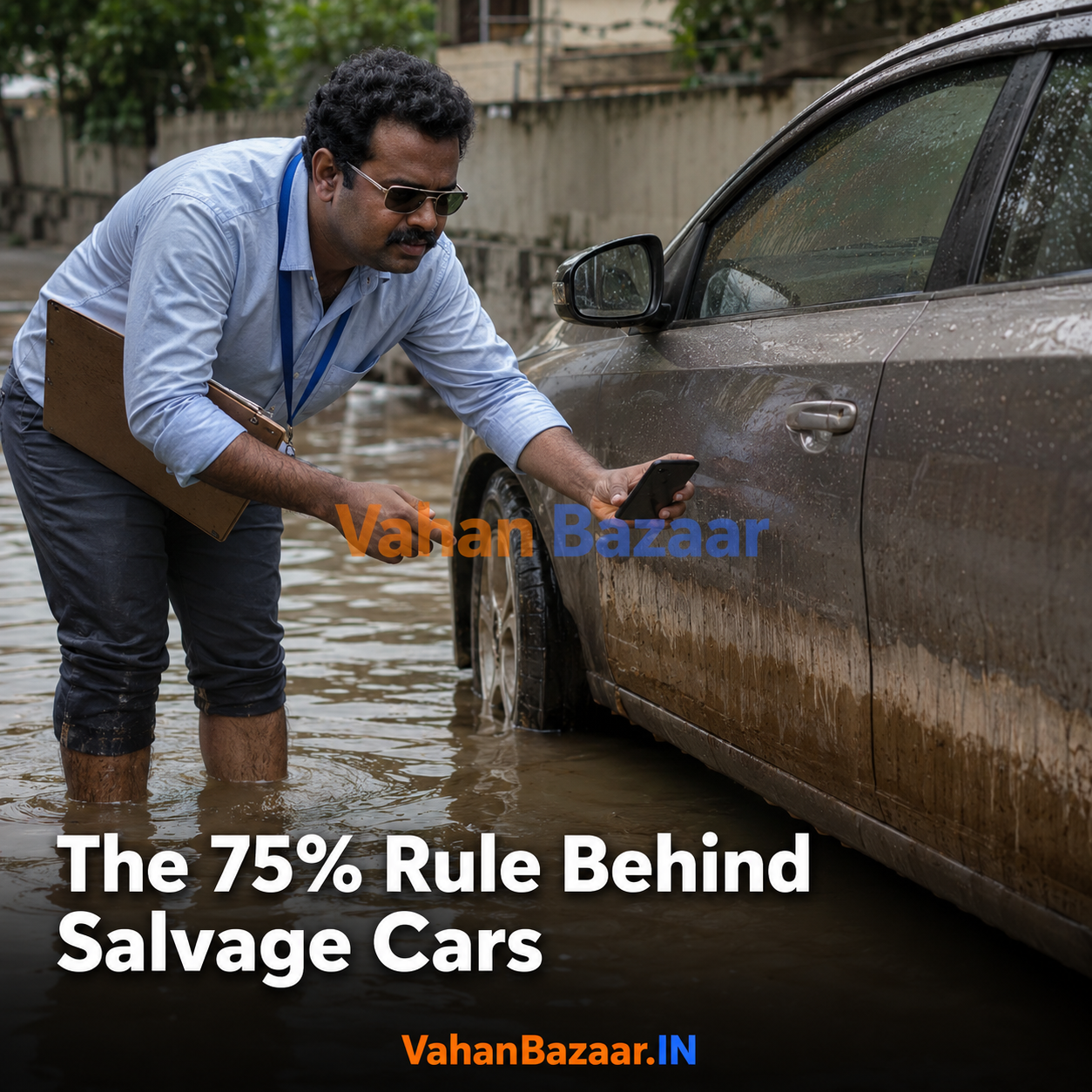
August is the heaviest month of the monsoon across much of India, and every serious flood event ends the same way for a few thousand vehicles. Not with a repair. With a calculation.
The calculation is unglamorous and almost mechanical. A surveyor assesses what it would cost to put the car right. That figure is set against the vehicle's insured declared value — the sum the policy says the car is worth. If the repair estimate crosses roughly 75 percent of the IDV, the insurer generally stops thinking about repair and starts thinking about settlement. The car may be perfectly repairable in an engineering sense. It has simply stopped being worth repairing.
That threshold is where salvage comes from. Everything that happens to flood-damaged cars afterwards — including the ones that reappear months later in perfectly ordinary used-car listings — flows from this one arithmetic decision.
Constructive Total Loss, Explained Properly
The term used in policy documents is constructive total loss, and the word constructive is doing real work. It distinguishes this from a car that has been physically destroyed. A constructive total loss is a car that still exists, could be fixed, and is not going to be — because fixing it would cost more than the insurer has agreed the car is worth.
The settlement mathematics then depends on what happens to the wreck, and there are two common routes.
| Route | What the owner receives | Where the wreck goes |
|---|---|---|
| Insured keeps the salvage | IDV less policy excess less the assessed value of the wreck | Stays with the original owner, who may repair and later sell it |
| Insurer takes the salvage | IDV less policy excess | Passes to the insurer and typically into a salvage auction |
Both routes put a badly damaged car back into circulation. The second is the one that produces volume, because insurers do not keep wrecks — they dispose of them, and salvage auctions are where a great deal of India's flood-damaged inventory changes hands. The first is quieter but more common than people assume, particularly where the owner is attached to the vehicle or believes they can repair it cheaply.
Neither route is improper. An owner who keeps their own salvage, repairs it and drives it for years is doing nothing wrong. A rebuilder who buys at auction, restores properly and sells honestly is running a legitimate business. The problem is not the existence of salvage. It is the silence that so often travels with it into the next sale.
What the Insurer Is Required to Do
A total loss is not just a payment. There is a paperwork sequence attached, and it is worth knowing because it is the closest thing to an official trail that exists.
On settling the claim, the insurer is required to cancel the insurance policy and intimate both the registered owner and the concerned regional transport authority of that cancellation. Where the insurer takes the salvage, the owner is generally required to transfer ownership of the damaged vehicle into the insurer's name. In some cases the owner is additionally asked to cancel the vehicle's registration at the RTO.
On paper, that is a reasonably robust process. In practice it has two weaknesses that matter enormously to a used-car buyer.
The first is completion. These steps depend on parties actually following through, and a proportion of the time they do not — the intimation is made but the registration is never cancelled, the vehicle is never transferred, and the record carries on looking much as it did before.
The second is legibility. Even where every step is completed correctly, the outcome is a policy cancellation and an intimation between an insurer and a transport authority. It is not published as a plain damage-history flag against the registration number that a retail buyer can look up and read. India does not operate a branded-title system in which a written-off car carries a permanent, visible mark on its registration for the rest of its life.
A car can go through a total-loss settlement, be auctioned, be repaired and be sold to a private buyer while presenting registration paperwork that looks entirely unremarkable. The buyer is not being careless when they fail to spot it. They are looking at a record that was never designed to tell them.
Why Nobody Has to Tell You
Several countries handle this with a compulsory branded title: once a vehicle is written off, its title permanently records the fact, and selling it without that disclosure is an offence. India has no equivalent. There is no mandatory damage-disclosure law for used-vehicle sales.
A buyer who is actively misled is not without options. Recourse exists under the Consumer Protection Act, 2019, before the district consumer commission, and deliberate misrepresentation to obtain money can attract the general criminal law on cheating. But both are remedies applied after the money has gone, both take time and cost money, and both require proving what the seller knew — which, with a car that passed through an auction and one or two intermediate hands, is frequently impossible.
The realistic protection is not legal. It is checking before you pay.
What a Buyer Can Actually Verify
Be clear-eyed about what is and is not available, because vague advice to "check the history" is worse than useless.
What you can confirm independently from the registration record: the RC status, whether active, suspended, blacklisted or cancelled. The registration date, which gives you the car's true age against whatever the advertisement claims. The owner serial number, which is frequently higher than a seller admits. Whether a hypothecation entry is still live. Insurance validity. Blacklist and challan flags against the number.
None of those is a damage report. What they do is establish whether the car is what it is being presented as — and in practice, a vehicle with a complicated past very often has something else irregular about it as well, because the same carelessness that hides a flood tends to leave other loose ends. A Vahan Verify check costs Rs. 49, with RC and challan checks together at Rs. 79 rather than Rs. 98 separately, and takes under a minute.
What you should ask the seller for: continuous comprehensive insurance documents covering the whole ownership period. This is the single most useful thing a private buyer can request, and it is entirely reasonable to insist on. A total-loss settlement causes the policy to be cancelled, which means the insurance record shows a discontinuity — a policy that ends abruptly, a gap, or a sudden change of insurer. Around a known flood event in a known flood-affected district, that pattern is the strongest signal available to an ordinary buyer.
What you should inspect physically: water lines and silt in places nobody cleans, the spare wheel well, under the carpet in the boot, inside seat rails, the seat belt when pulled fully out. Corrosion on bolt heads and bracket edges under the bonnet that does not match the car's age. A persistent damp or heavily perfumed smell. Electrical behaviour that is intermittent rather than absent — windows that hesitate, warning lights that appear and clear. Our guide to spotting flood and salvage cars goes through the physical inspection in detail.
What This Means for Used Car Buyers
The practical rule for the next few months is simple: treat any unusually well-priced car being sold in or shortly after a flood-affected month as a car that needs an explanation, not a car that needs a quick decision.
A genuine bargain survives scrutiny comfortably. A seller with a straightforward story hands over insurance documents without hesitation, is relaxed about an independent inspection, and does not mind waiting a day while you pull the registration record. Pressure to close quickly — a competing buyer, an urgent relocation, a token that must be paid today — deserves exactly the suspicion it sounds like it deserves.
Run the VAHAN record before any money changes hands, get the insurance continuity in writing, and look under the boot carpet. Those three steps cost a few hundred rupees and an afternoon, against a repair bill that on a properly flooded car runs to lakhs and never quite ends. If you would rather start from cars that have already been cross-checked, our verified used car listings carry a VAHAN check on every vehicle.
What This Means for Honest Sellers
If you are selling a car in a flood-affected region this season, you are about to be treated with suspicion you have not earned. Buyers will be cautious, will ask pointed questions, and will discount for doubt regardless of your car's actual history.
The answer is to make the doubt unnecessary. Have your comprehensive insurance documents for the full ownership period ready before you list. Welcome an independent inspection rather than tolerating it. And list the car with its registration record already cross-checked against the VAHAN database, so a buyer can see the owner count, registration date, RC status and insurance validity confirmed rather than claimed. A verified listing on VahanBazaar costs Rs. 49 and carries a green Verified badge — which, in a month when every buyer is braced for a flood car, is worth considerably more than it costs.
Frequently Asked Questions
It is the working threshold most Indian insurers apply when deciding whether to repair a damaged vehicle or write it off. If the estimated cost of repair exceeds roughly 75 percent of the vehicle's insured declared value, the insurer generally declares a constructive total loss rather than authorising the repair. The car may well be physically repairable; the point is that repairing it is no longer economically sensible relative to what the policy says it is worth. The exact threshold and its application vary between insurers and policy wordings.
The starting point is the insured declared value, from which the policy excess is deducted. What happens to the wreck then determines the rest. In one common arrangement the insured keeps the salvage and the value of the wreck is deducted as well, so the payout is IDV less excess less salvage value. In the other the insurer takes possession of the wreck and pays IDV less excess. The second route is how large volumes of salvage end up in insurer hands and, subsequently, at auction.
Yes. On settling a total loss the insurer is required to cancel the insurance policy and intimate both the registered owner and the concerned regional transport authority of that cancellation. The owner is generally required to transfer ownership of the damaged vehicle to the insurer where the insurer takes the salvage, and in some cases is asked to cancel the vehicle's registration at the RTO. The practical difficulty for a buyer is that these processes are not always completed, and even when they are, the resulting record is not surfaced as a plain damage-history flag on the vehicle.
India has no mandatory damage-disclosure law equivalent to the branded-title systems used in some other countries. Nothing compels a private seller to volunteer that a car was flooded or previously written off. A buyer misled about it may have recourse under the Consumer Protection Act, 2019, or for cheating under the general criminal law, but that is a remedy after the fact and an expensive one. Prevention through independent checking is far cheaper than recovery through a complaint.
You can independently confirm the vehicle's registration record: RC status, registration date and the car's true age, owner serial number, whether a hypothecation entry is live, insurance validity, and any blacklist or challan flags. A Vahan Verify check on VahanBazaar costs Rs. 49, with RC and challan checks together at Rs. 79. Alongside that, ask the seller for continuous comprehensive insurance documents across the ownership period, because an unexplained gap or an abrupt change of insurer around a known flood event is the most useful single signal available to a private buyer.