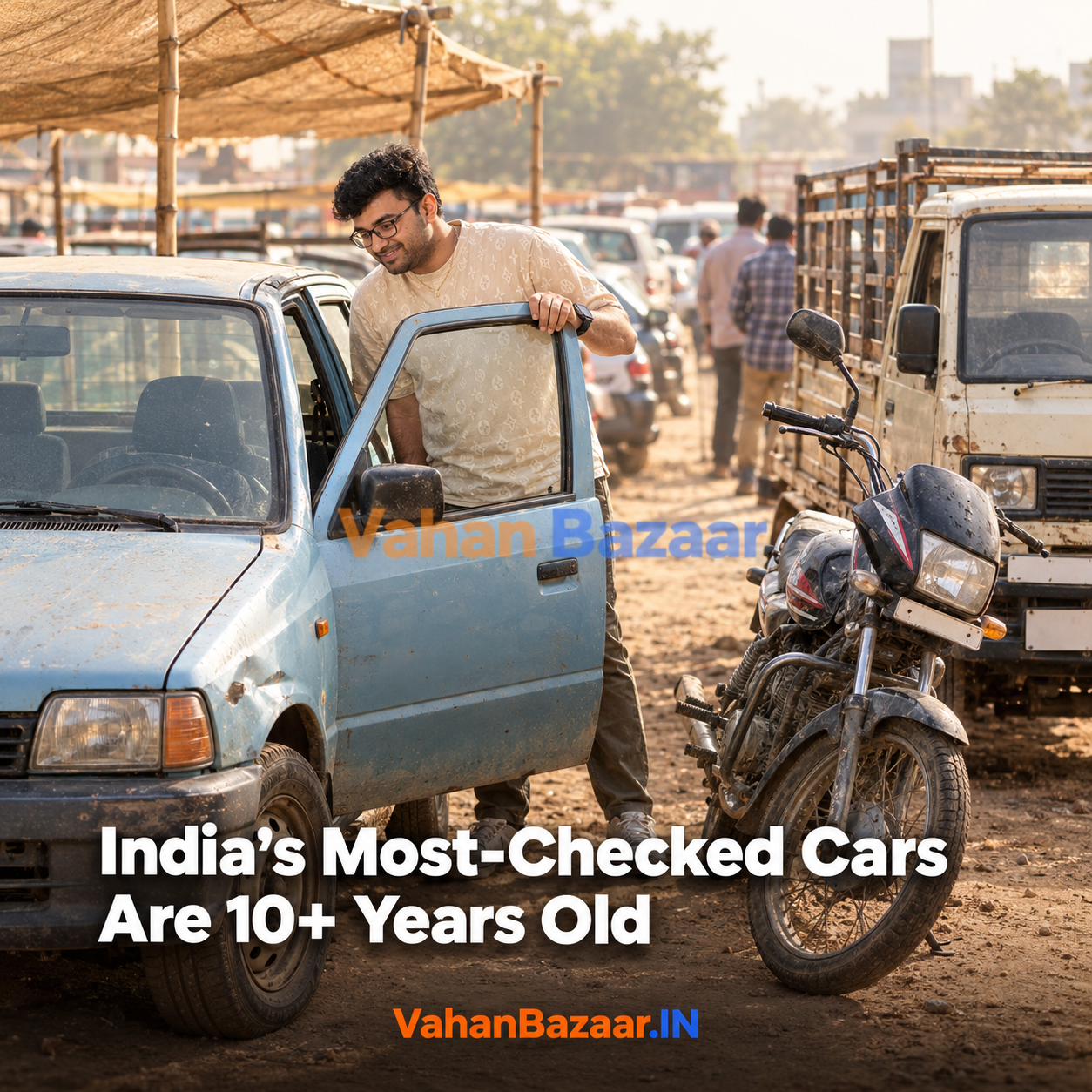
Almost everything written about buying a used vehicle in India is written about a car that is three or four years old, still under some kind of warranty, and worth somewhere north of Rs. 6 Lakh. That is the car the reviews cover, the car the comparisons are built around, and the car most buying guides quietly assume you are looking at.
It is not what people are actually checking. Based on VahanBazaar buyer-report data — the vehicles our own buyers pay to run a record check on — the demand sits almost entirely at the old, cheap end of the market, and a surprisingly large part of it is not cars at all.
Two patterns come out of that data clearly enough to be worth writing about. The first is age: the cars checked most are budget models roughly ten to seventeen years old. Small hatchbacks and compact sedans, some of them from the mid-2000s, most from the early 2010s, plus older people-movers. The ordinary Indian second-hand car, in other words. The second is category: close to a third of paid checks are on vehicles that are not cars — commuter motorcycles through to larger premium bikes, goods vehicles including small trucks and pickups, and three-wheelers, both electric goods carriers and passenger autos. Almost nobody pays to check a nearly-new premium vehicle.
This is our own first-party data about what our buyers choose to verify. It is not a national statistic and we are not presenting it as one. But it describes real purchasing decisions made with real money, and the pattern in it is the opposite of what most buying advice implies. It is also, on examination, completely rational.
Why Old and Cheap Is Exactly Where Checking Pays
The instinctive reading of that data is that people are being careful about the wrong things — fussing over a Rs. 2 Lakh hatchback while waving through a Rs. 20 Lakh SUV. The instinct is wrong, and it is worth taking apart properly, because the reasoning generalises to anyone reading this who is about to buy at the budget end.
1. Risk accumulates with time, not with price
A three-year-old car has had one owner, one insurance cycle, no fitness renewal and, at most, one loan that is probably still running and openly disclosed. There has not been enough elapsed time for much to go wrong on paper.
A fourteen-year-old car is a different object entirely. It has had multiple owners. It has been through several insurers, with gaps in between. It may have moved between states, which brings a transfer and a road-tax position with it. It has probably carried at least one loan, and the question of whether that loan was formally closed on the record is separate from whether it was repaid in the owner's mind. It has had fourteen years in which challans could attach to it. The number of things that can be wrong with a vehicle scales with how long it has existed, not with what it costs. Buyers checking old vehicles are checking where the paperwork has had time to accumulate, and that is the correct place to look.
2. The consequence is proportionally larger at the bottom
This is the part that most reverses the intuition. Take an illustration, and treat it strictly as one: suppose a vehicle carries a single unresolved problem that costs Rs. 40,000 to clear — an uncleared lender's charge that has to be chased, a blacklist entry, an expired fitness position, an accumulated challan balance. On a Rs. 2.5 Lakh car, that is roughly sixteen percent of everything you paid. On a Rs. 25 Lakh car, the identical problem is under two percent, and is an irritation rather than an injury.
Verification matters more, not less, as the vehicle gets cheaper. The buyer with the least money to lose has the most to lose proportionally, and has the least cushion to absorb a surprise. The thought "it is only a two-lakh car, why would I spend on checking it" gets the arithmetic exactly backwards. It is the twenty-lakh buyer who could shrug off the problem, and the two-lakh buyer who cannot.
3. Old vehicles sit closest to the age walls
A private vehicle in India is registered against an initial fifteen-year period, after which renewal decisions, fitness requirements and end-of-life questions start to carry real cost. A car in its second decade is walking towards that boundary, which means its remaining usable runway is the dominant question in whether the price is fair. Two cars that look identical in a photograph can have very different amounts of life left, and the record is the only place the true clock lives, because the date of first registration and the month and year of manufacture are recorded there and nowhere the seller controls. We have covered what actually happens at that boundary in our piece on the fifteen to twenty year cost wall, and it is the single most under-priced factor in old-car buying.
4. A vehicle bought to earn cannot afford a paperwork problem
This is where the non-car share of the data starts to make obvious sense. A goods vehicle or a passenger three-wheeler is very often not a possession at all — it is a piece of income-generating equipment, bought on the expectation that it starts earning immediately. A permit, fitness or registration problem on that vehicle does not merely inconvenience the owner the way it would on a family hatchback. It stops the vehicle earning from the first day, while the instalments carry on regardless.
That changes the value of a pre-purchase check completely. If a problem costs you a fortnight of lost earnings plus the cost of clearing it, then a check that costs less than a single day's takings is not a considered expense, it is obvious. The interaction between challans and commercial paperwork has tightened considerably too, as we set out in our report on challans freezing permit and fitness work. A buyer purchasing a working vehicle now has to care about the seller's outstanding challan position, because it can attach to the paperwork the vehicle needs in order to work.
5. The informal end of the market carries the least documentation
Newer, more expensive vehicles tend to move through channels that generate paper: organised dealers, finance companies, service histories that are actually maintained. The old and inexpensive end moves hand to hand, often locally, often with a folder of documents that is incomplete and a verbal history that cannot be checked.
That is not a criticism of anyone in that market. It is simply a description of where the information asymmetry is worst. Where there is least documentation, an independent record is worth the most, because it is the only thing in the transaction that neither party wrote. Buyers at that end are not being paranoid. They are compensating, correctly, for having nothing else to go on. It fits with something we have written about before: most used-vehicle buyers in India are buying for the first time, which means they have no prior transaction to pattern-match against and every reason to want an external opinion.
What Each Segment Is Actually Checking For
The record holds the same fields for every vehicle type, but the field that decides the purchase differs a lot by segment. It is worth being specific about which one matters where, and equally specific about what the record still cannot tell you in each case.
| Vehicle segment | Why buyers check it | Record field that matters most | What the record still cannot tell you |
|---|---|---|---|
| Entry hatchback, around a decade old | Cheapest entry into car ownership, usually bought by a first-time buyer with no cushion for surprises | Date of first registration and month and year of manufacture, for true remaining runway | Engine and gearbox condition, rust under the sills, whether the stated kilometres are real |
| Compact sedan from the early 2010s | Often a third or fourth owner, with a long and loosely described history behind it | Registered owner serial number, which materially moves the price and cannot be verified any other way | Accident and repair history, quality of past servicing, structural work behind a repaint |
| Older MPV or people-mover | Bought for capacity, frequently after heavy family or shared-use mileage | Vehicle class and registration status, which reveal whether it has been used privately or commercially | Suspension and clutch wear from constant full-load running, interior fatigue |
| Commuter motorcycle | Low price and a fast, cash-heavy resale market where paperwork often lags the handover | Hypothecation, since small two-wheeler loans are routinely repaid but never removed from the record | Engine health, chain and sprocket wear, whether it has been down the road |
| Premium or large-capacity motorcycle | Higher value, frequent ownership churn, and a real risk of an unresolved finance position | Hypothecation and insurance validity, because both tend to lapse between enthusiast owners | Crash damage to frame or forks, quality of aftermarket work, true service history |
| Small goods carrier or pickup | Bought to earn, so any paperwork problem stops income immediately rather than merely annoying the owner | Vehicle class and fitness validity, which together decide whether it can legally do the job | Chassis and load-bearing condition, engine hours behind the odometer, past overloading |
| Three-wheeler, goods or passenger | Low capital, immediate earning use, and often a first business asset rather than a vehicle purchase | Vehicle class, which determines whether goods or passengers may legally be carried | Battery health on an electric unit, drivetrain wear, real duty cycle it has already served |
Read the last column down and you get the honest limit of any record check. It settles the legal and financial position of the vehicle completely, and it settles nothing about condition. That division holds for every row.
The Same Check, the Same Price, on Any Registration Number
Date of first registration and true age, month and year of manufacture, registration status, vehicle class, registered owner serial number, fuel type, hypothecation against a lender, insurance and fitness validity, and blacklist flags — pulled from the VAHAN database. Works identically on cars, two-wheelers, goods vehicles and three-wheelers. RC check Rs. 99, challan check Rs. 99, or both together for Rs. 149.
What to Check When the Vehicle Is Not a Car
Because so much buying advice is car-shaped, buyers of bikes, trucks and autos often assume the record simply does not cover them, or that a record check is something you do for a car purchase and not for a bike. Neither is true, and the assumption costs people money.
The VAHAN database holds the same fields for a two-wheeler, a goods vehicle or a three-wheeler as it does for a car. On any registration number you get the date of first registration, the month and year of manufacture, the registration status, the vehicle class, the registered owner serial number, the fuel type, whether a lender still holds a hypothecation charge, the insurance validity, the fitness validity and any blacklist entry. The check costs the same, runs the same way, and answers the same questions.
Two fields deserve extra attention outside the car world.
Hypothecation is the one that bites hardest on two-wheelers. Small bike loans are short, they get repaid quickly, and the no objection certificate very often never makes it back to the record. The seller genuinely believes the loan is finished, and in every practical sense it is, but the entry is still sitting there and it blocks transfer until it is cleared. This is the single most common avoidable problem in a used bike purchase, which is why we have written separately on what a used bike's record hides that a car's does not. The same mechanism operates on cars — our explainer on the hypothecation trap covers how a repaid loan stays visible on the record — but on bikes it happens far more often, because the sums are small enough that nobody bothers to finish the paperwork.
Vehicle class is the field that matters most on anything bought to earn. It is easy to skim past, because on a private car it rarely changes anything. On a commercial or passenger-carrying vehicle it is the whole question: the class determines what the vehicle may legally be used for, and a vehicle bought to generate income has to be in the right class with the right permissions or it cannot legally do the job you bought it for. A goods carrier that is not registered as one, or a passenger three-wheeler in the wrong class, is not a bargain. It is a vehicle you cannot legally put to work. Check the class before you check anything else, and check that it matches the use you have in mind rather than the use the seller describes.
Fitness validity carries more weight on a commercial vehicle than on a private one, because the renewal cycle is shorter and the cost is real rather than notional. A vehicle approaching a fitness decision is approaching a bill, and that bill belongs in your offer price. Our breakdown of how commercial fitness fees step up from year ten sets out where those thresholds sit and why an older working vehicle can look cheap and then quietly stop being cheap.
Where the Record Stops on an Old Budget Car
Everything above argues for checking the record on exactly the vehicles most people assume are not worth checking. It is worth being equally honest about where that check ends.
On an old budget car, the record settles the legal and financial position — age, ownership count, registration status, hypothecation, fitness, blacklist, insurance validity — and it says nothing whatsoever about condition. On a decade-old car, condition is most of the risk. A fourteen-year-old hatchback with a completely clean record can still have a tired engine, a repainted quarter panel hiding structural work, and a clutch with a month left in it. The record was never designed to tell you about any of that.
That gap is what our AI Vahan Inspection at Rs. 249 is built for. It reads uploaded photographs alongside the VAHAN record and flags condition issues, mismatches between what the record says and what the images show, and the visual patterns that usually indicate past repair. Be clear about what that is worth: it is a first-pass filter and a negotiation aid, so you know what to ask about and what to argue over before you spend a day travelling to see a vehicle. It is not a replacement for a physical mechanical inspection by a qualified technician, and it cannot become one, because the things it cannot see are things no photograph contains.
What This Means for Buyers
The practical takeaway is a single reframe. If you are buying an old budget car, a used commuter motorcycle or a small commercial vehicle, you are in the highest-value segment for a record check, not the lowest. The vehicle's low price is the reason to check it, not the reason to skip it.
Three things follow from that. First, run the record before you travel and before you negotiate, because it needs only the registration number, which is visible on the vehicle and legible in most listing photographs, and because it is the check most likely to end a conversation outright. Second, if the vehicle is not a car, do not assume the tool is not for you — the fields are the same and the price is the same. Third, on anything you intend to earn from, read the vehicle class first and match it against the use you have in mind, not the use you were told about.
If you want the full sequence rather than the argument, our seven-step verification checklist for first-time buyers lays it out in order, and it applies to a fifteen-year-old hatchback exactly as it applies to a three-year-old one.
The less a vehicle costs, the larger a problem is as a share of what you paid, and the more years it has behind it, the more problems have had time to attach. Cheap and old is not the segment where checking is optional. It is the segment where checking has the highest return.
What This Means for Sellers
If you are selling an older budget vehicle, the pattern in this data is describing your buyer. They arrive suspicious, because everything about the segment tells them to be: long histories, thin documentation, and no way to distinguish your honestly described vehicle from someone else's problem. So they discount both, and you pay for ambiguity created by vehicles you have never seen.
The way out is to settle the record before the questions get asked. A verified listing at Rs. 99 cross-checks the vehicle against the official record and carries a Verified badge, so age, ownership count and registration position are established on the listing rather than argued about on a phone call. On average, based on VahanBazaar listings data, verified listings draw about three times the buyer enquiries and sell around 40 percent faster. Rs. 99 is. Sellers of older, cheaper vehicles face the most doubt in the market, which means they have the most doubt to remove and the most to gain from removing it.
The Short Version
Based on VahanBazaar buyer-report data, the vehicles our buyers pay to check are budget models roughly ten to seventeen years old, and close to a third of paid checks are on two-wheelers, goods vehicles and three-wheelers rather than cars. Almost nobody pays to check a nearly-new premium vehicle.
That pattern is rational for five reasons that all point the same way. Paperwork risk accumulates with elapsed time, not with price. A given problem is a far bigger share of a Rs. 2.5 Lakh purchase than of a Rs. 25 Lakh one. Old vehicles sit closest to the renewal and fitness decisions that carry real cost. A vehicle bought to earn stops earning the moment its paperwork fails. And the informal end of the market has the least documentation, so an independent record is worth the most there.
The record runs identically on any registration number, car or not: RC check Rs. 99, challan check Rs. 99, both for Rs. 149. On anything bought to earn, read the vehicle class first. On an old car, remember the record settles the legal position and not the condition, which is what the Rs. 249 photo-plus-record read is for, as a filter and a negotiating position rather than a verdict. And commit to a physical mechanical inspection by a qualified technician before you pay, because nothing described here replaces it.
Frequently Asked Questions
Based on VahanBazaar buyer-report data, the vehicles our own buyers pay to check are overwhelmingly old and inexpensive. The cars checked most are budget models roughly ten to seventeen years old: small hatchbacks, compact sedans and older people-movers, the ordinary Indian second-hand car rather than the three-year-old SUV. Close to a third of paid checks are not on cars at all, but on commuter and premium motorcycles, small goods vehicles and three-wheelers. Almost nobody pays to check a nearly-new premium vehicle. This is our own first-party data on what our buyers choose to verify, not an industry-wide or national figure.
Yes. Vahan Verify runs on the registration number, and the VAHAN database holds the same fields for a two-wheeler, a goods vehicle or a three-wheeler as it does for a car: date of first registration, month and year of manufacture, registration status, vehicle class, registered owner serial number, fuel type, hypothecation, insurance validity, fitness validity and any blacklist entry. The RC check is Rs. 99, the challan check is Rs. 99, and both together are Rs. 149, at the same price regardless of vehicle type. Many readers assume it is a car-only tool, which is why a large share of the checks being run on non-car vehicles surprises people.
It is worth more on a cheap car, not less, which is the opposite of how most buyers behave. The reason is proportion. Take an illustration: on a Rs. 2.5 Lakh car, an unresolved problem costing Rs. 40,000 to fix is about sixteen percent of everything you paid. The same Rs. 40,000 on a Rs. 25 Lakh car is under two percent and is an irritation rather than an injury. Older budget vehicles also carry more accumulated history, because owners, insurers, loans and challans all pile up with time rather than with price. Both effects push the same way.
Everything you would check on a car, plus vehicle class as a priority. The class field determines what the vehicle may legally be used for, and a vehicle bought to earn has to be in the right class with the right permissions or it cannot legally do the job you bought it for. After that, fitness validity matters more on a commercial vehicle than on a private one because the renewal cycle is shorter and the cost is real, and any blacklist entry or accumulated challan position matters because it can freeze the paperwork the vehicle needs in order to work.
No. The record settles the legal and financial position of a vehicle, which on an old car is genuinely worth settling, but it holds nothing about crashes, repairs, the true odometer reading or mechanical condition. On a decade-old car, condition is most of the risk. The AI Vahan Inspection at Rs. 249 reads uploaded photographs alongside the record to flag condition and mismatch issues, and it is useful as a first-pass filter and a negotiation aid. It is not a replacement for a physical mechanical inspection by a qualified technician, and no photograph-based read can become one.