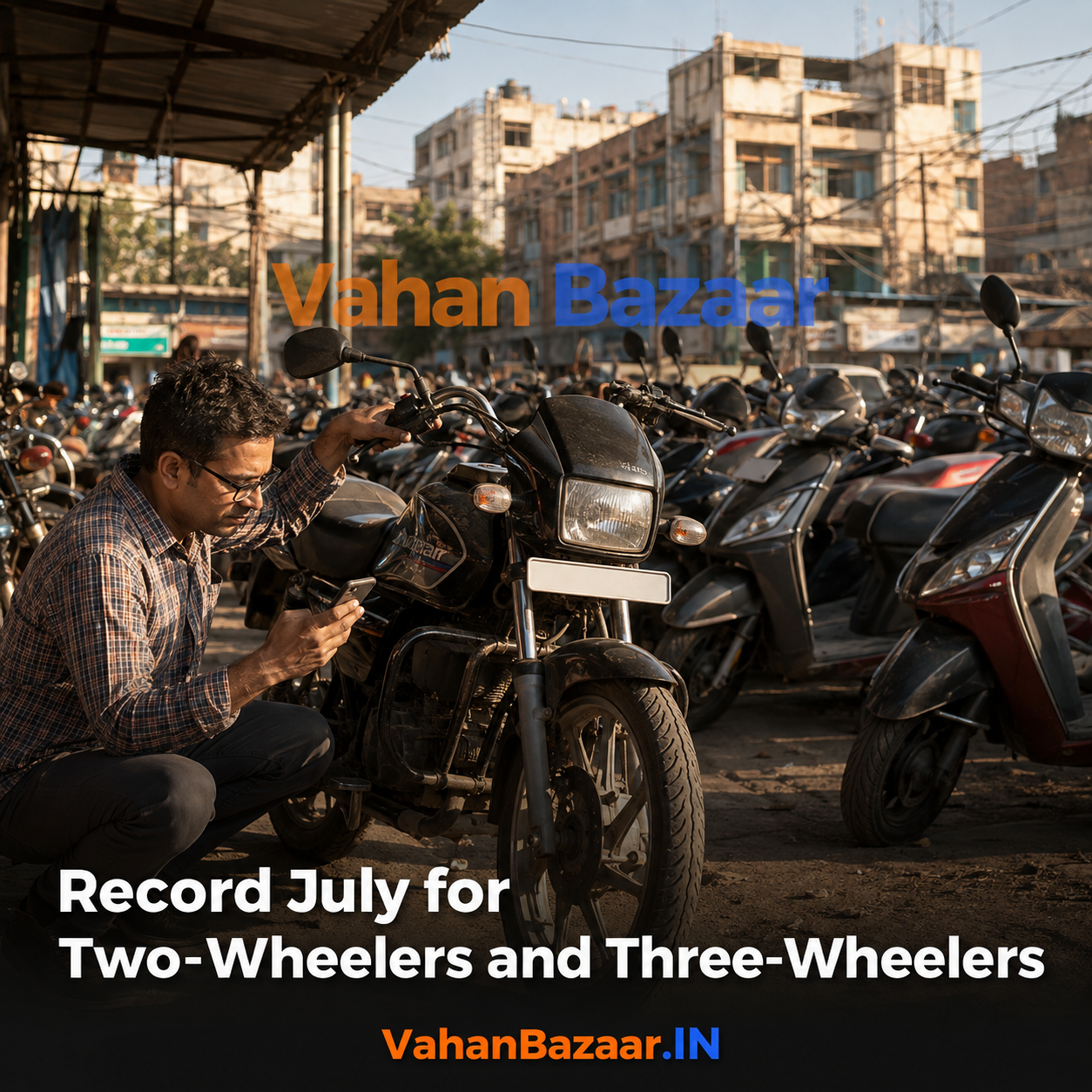
India's automobile industry has just posted its strongest July on record, and the coverage has, predictably, been about cars. That is understandable. Cars are the visible part of the industry and the part that carries the headline growth rate. But the segment that actually moves India recorded numbers of its own last month, and those numbers have a consequence that almost nobody has written about.
Figures released by the Society of Indian Automobile Manufacturers on 13 August 2026 show 19,23,483 two-wheelers sold domestically in July 2026, up 22.6 per cent from 15,69,120 units in July 2025. Three-wheeler domestic sales came in at 92,560 units, up 33.4 per cent from 69,403 units a year earlier. Passenger vehicle domestic sales reached 4,57,810 units, up 34.3 per cent from 3,40,772 units. Overall monthly production across passenger vehicles, three-wheelers, two-wheelers and quadricycles stood at 33,70,958 units.
Rajesh Menon, Director General of SIAM, said India's auto industry had delivered its strongest-ever July sales, with robust double-digit growth across Passenger Vehicles, Three-Wheelers and Two-Wheelers.
The Numbers, Segment by Segment
It is worth laying these out side by side, because the relative scale is easy to lose in percentage terms. Passenger vehicles grew fastest in percentage terms, but two-wheelers moved more than four times as many units in absolute terms, and it is absolute units that determine how many vehicles eventually reach the used market.
| Segment (domestic sales) | July 2025 | July 2026 | Change |
|---|---|---|---|
| Two-wheelers | 15,69,120 | 19,23,483 | +22.6% |
| Three-wheelers | 69,403 | 92,560 | +33.4% |
| Passenger vehicles | 3,40,772 | 4,57,810 | +34.3% |
A note on what these figures are. SIAM reports domestic sales as declared by manufacturers, which is essentially the flow of vehicles from factories into the dealer network. That is a different measure from vehicles actually registered to end customers in the same month, and the two diverge in a stocking month. Retail-side numbers tell a related but separate story, which we covered when the record July retail figures came out. For the purpose of this article the distinction does not change much, because a vehicle dispatched in July is a vehicle that reaches a customer within weeks.
Why Record New Sales Create a Used Supply Wave
The link between a record new-sales month and the used market is not complicated, but it is consistently ignored in coverage of monthly sales data.
Very few two-wheeler purchases in India are somebody's first vehicle. Far more are replacements: a household moving from a ten-year-old commuter motorcycle to a new scooter, a delivery rider upgrading after his earnings improved, a family buying a second two-wheeler because a son or daughter has started college. In each of those cases there is an older vehicle in the picture, and that older vehicle does not disappear. It gets traded in at the dealership, sold privately, or handed down within the family and then sold a year later when it finally becomes uneconomic to keep.
The same logic applies with more force to three-wheelers, because a three-wheeler is a working asset rather than a possession. An operator replacing an ageing auto-rickshaw or a goods three-wheeler is replacing a machine that has to earn, and the replaced vehicle is almost always sold on to someone operating at a lower price point rather than retired. That is how the commercial three-wheeler fleet cascades downward through the market.
Finance reinforces the cycle. Two-wheelers and three-wheelers in India are heavily financed on relatively short tenures, and a buyer whose loan on the previous vehicle has just closed is a buyer in a position to upgrade. A strong new-sales month is therefore partly a signal that a large group of earlier purchases have reached the end of their finance cycle, which is exactly the point at which the older vehicle gets sold.
None of this happens on a fixed timetable, and we are not going to attach a number to it, because no reliable public figure exists for how many used two-wheelers reach the market for every hundred new ones sold. What can be said with confidence is directional: a wave of trade-ins typically follows a strong new-sales month, and July 2026 was the strongest July on record.
What It Means If You Are Buying a Used Two-Wheeler
More supply is, on the face of it, good news for a buyer. More listings, more choice, more room to negotiate on a vehicle that has been sitting unsold for three weeks. That part is real.
The complication is what more supply does to the pace of the transaction. A busy used two-wheeler market is a fast one. Bikes and scooters at popular price points move within days, often within hours in the metros, and buyers who hesitate lose them. That pressure is precisely what causes people to skip the checks that matter, because verifying paperwork feels like the thing that can wait and the vehicle feels like the thing that cannot.
It is the wrong trade, and it is worse on a two-wheeler than on a car. Two-wheeler transactions in India are smaller, less formal and far more likely to be conducted in cash between two individuals with no intermediary, which means there is nobody in the chain whose job it is to notice that the registration record says something different from what the seller said. Our checklist for used bikes and scooters works through the record checks in order.
Looking at a used bike, scooter or auto? Confirm the registered owner, hypothecation position and pending challans before you hand over any money.
What It Means If You Are Buying a Used Three-Wheeler
The three-wheeler buyer is in a different position again, and generally a more exposed one. A used auto-rickshaw or goods three-wheeler is bought to generate income, frequently with borrowed money, and often by somebody making their first purchase of a commercial vehicle. The margin for error is thin: every day the vehicle cannot legally work is a day of lost earnings against an instalment that is already running.
What makes the three-wheeler market harder to read is that the paperwork question is genuinely more complex. A commercially used three-wheeler carries a permit position on top of everything a private vehicle needs, and a permit authorises a particular vehicle for a particular kind of carriage over a defined area. It is not an attribute that simply travels with the vehicle to a new owner. Establishing what the vehicle currently holds, and what your intended use actually requires, belongs before the price conversation rather than after it. Our guide to permit and registration checks on auto-rickshaws and e-rickshaws sets out what to establish, and there is a separate one for used electric goods three-wheelers, which are a growing and less well documented part of this segment.
The Checks That Actually Matter on a Used Two-Wheeler or Three-Wheeler
The record checks below are the ones that decide whether a vehicle can be transferred into your name and used without dispute. They are all readable against the registration number before you meet the seller.
Registration status
The starting point. Confirm that the registration number is live, that the vehicle described in the record matches the vehicle in front of you on make, model and fuel type, and that the registration is not blacklisted, cancelled or suspended. A mismatch between the record and the physical vehicle is the single clearest signal to walk away, and it is the check that takes the least time.
Owner count
The record shows how many registered owners the vehicle has had. On a used two-wheeler this matters for two reasons: it affects resale value when you eventually sell, and a high count on a relatively young vehicle is worth a question. Confirm also that the person selling it to you is the person named as the current registered owner, because a sale by somebody who is not the registered owner needs a different and considerably more careful process.
Hypothecation
This is the one that catches used two-wheeler buyers most often, because two-wheelers are so widely financed. If a hypothecation entry is still active against the vehicle, a financier retains an interest in it, and the transfer of ownership into your name will not complete until that entry is removed with the financier's No Objection Certificate. Sellers do not always mention it, and quite often do not realise it is still showing, because the loan being repaid and the entry being removed from the record are two separate events. Our explainer on two-wheeler hypothecation covers what to do when it appears.
Pending challans
Challans attach to the vehicle, not to the person who was riding it, so unpaid ones become your problem once the vehicle is yours. Two-wheelers accumulate them readily, and on a vehicle that has been used commercially the count can be considerable. Check before you buy and make clearing them the seller's responsibility as a condition of the sale rather than a favour you ask for afterwards, which is far harder once the money has moved. Our guide on checking and clearing challans on a used bike explains the sequence.
Insurance validity
Establish whether a valid policy exists and what it covers, because third-party cover is a legal requirement and riding without it is an offence regardless of who let the policy lapse. Insurance is transferable to the new owner but the transfer has to actually be done within the insurer's timeline, and a policy left in the seller's name is of limited use to you if there is a claim.
Permit, for a three-wheeler
For a three-wheeler intended for commercial use, add the permit position and the fitness certificate to everything above. These are the two items that decide whether the vehicle can legally earn, and a three-wheeler that cannot legally earn is not a cheap vehicle, whatever it cost.
An RC check on VahanBazaar costs Rs. 99 and returns the registered owner and hypothecation position against the registration number. A pending challan check costs Rs. 99. Both together cost Rs. 149 rather than Rs. 198 separately. On a used two-wheeler purchase, that is a rounding error against the price.
What This Means for Used Vehicle Buyers and Sellers
For buyers, the practical response to a rising supply of used two-wheelers and three-wheelers is to separate the two things that a busy market pushes together. Choosing the vehicle is the part that rewards moving quickly, because good examples at fair prices genuinely do go. Verifying the vehicle is the part that does not reward moving quickly, and it also does not take long, which is the point people miss. A record check runs against the registration number, so it can be done from the listing before you travel to see the bike, before you take a test ride, and certainly before any money changes hands. Doing it first does not slow you down. It stops you spending a Saturday on a vehicle with an active loan against it.
For sellers of an ageing two-wheeler or three-wheeler, the reading of these numbers is more direct: your competition is about to increase. The vehicles being replaced by July's record purchases will reach the used market over the coming weeks and months, and every one of them at your price point is a listing a buyer will look at instead of yours. If you were already intending to sell, the case for listing sooner rather than later is straightforward, and it does not depend on any forecast about how large the incoming supply will be.
The second half of that argument is about how you list. In a market with more sellers than usual, the listing that answers a buyer's questions before they ask is the one that gets the enquiry. A verified listing at Rs. 99 cross-verifies the vehicle against the government record and carries a Verified badge that every buyer sees. On average, based on VahanBazaar listings data, verified listings receive around three times more buyer enquiries and typically sell about 40% faster. In a crowded market that matters: an unverified listing is exactly what a cautious buyer skips past.
It is also worth noting where the used market's supply is heading over a longer horizon. The rapid growth of electric two-wheelers is already reshaping what reaches the resale market, a shift we looked at when electric two-wheeler sales crossed a million, and it changes the calculation for anybody holding an older petrol commuter bike. On the four-wheeler side, the same dispatch data showed a reshuffle at the top of the manufacturer table, which will work its way into used car supply on its own schedule.
Check Any Two-Wheeler or Three-Wheeler Before You Pay
Registered owner, hypothecation position and pending challans against any registration number, straight from the VAHAN database. RC check Rs. 99. Add the challan position and take both for Rs. 149 instead of Rs. 198 separately.
List Verified — Rs. 99Frequently Asked Questions
According to SIAM data reported on 13 August 2026, domestic two-wheeler sales reached 19,23,483 units in July 2026, up 22.6 per cent from 15,69,120 units in July 2025. Three-wheeler domestic sales reached 92,560 units, up 33.4 per cent from 69,403 units in July 2025. Passenger vehicle domestic sales were 4,57,810 units, up 34.3 per cent from 3,40,772 units. SIAM described these as the industry's highest-ever July figures across all segments.
Broadly, yes, though not instantly. Most new two-wheeler and three-wheeler purchases in India are replacements or upgrades rather than first vehicles, and the vehicle being replaced usually ends up sold, traded in or handed down rather than scrapped. A wave of trade-ins typically follows a strong new-sales month over the subsequent weeks and months as those older vehicles reach the resale market. VahanBazaar does not publish a forecast of how large that wave will be, because no reliable public figure exists for it.
Confirm the registration status of the vehicle against its registration number, the number of previous owners, whether a hypothecation entry is still active from an unpaid loan, whether pending challans are attached to the vehicle, and whether insurance is valid and transferable. An RC check on VahanBazaar costs Rs. 99 and returns the registered owner and hypothecation position, and a pending challan check costs Rs. 99. Both together cost Rs. 149 rather than Rs. 198 separately.
A three-wheeler used commercially carries a permit position on top of everything a private two-wheeler needs. A permit authorises a particular vehicle for a particular kind of carriage over a defined area, and it does not simply pass to a new owner along with the vehicle. Establish what the vehicle currently holds and what your intended use requires before agreeing a price, alongside the registration status, owner count, hypothecation entry, pending challans and fitness position.
If you were already planning to sell, the case for listing sooner is that competition on the used side tends to increase after a strong new-sales month, as replaced vehicles reach the market. More comparable listings means buyers have more choice and sellers have less pricing room. A verified listing on VahanBazaar costs Rs. 99, cross-verifies the vehicle against the government record and carries a Verified badge.