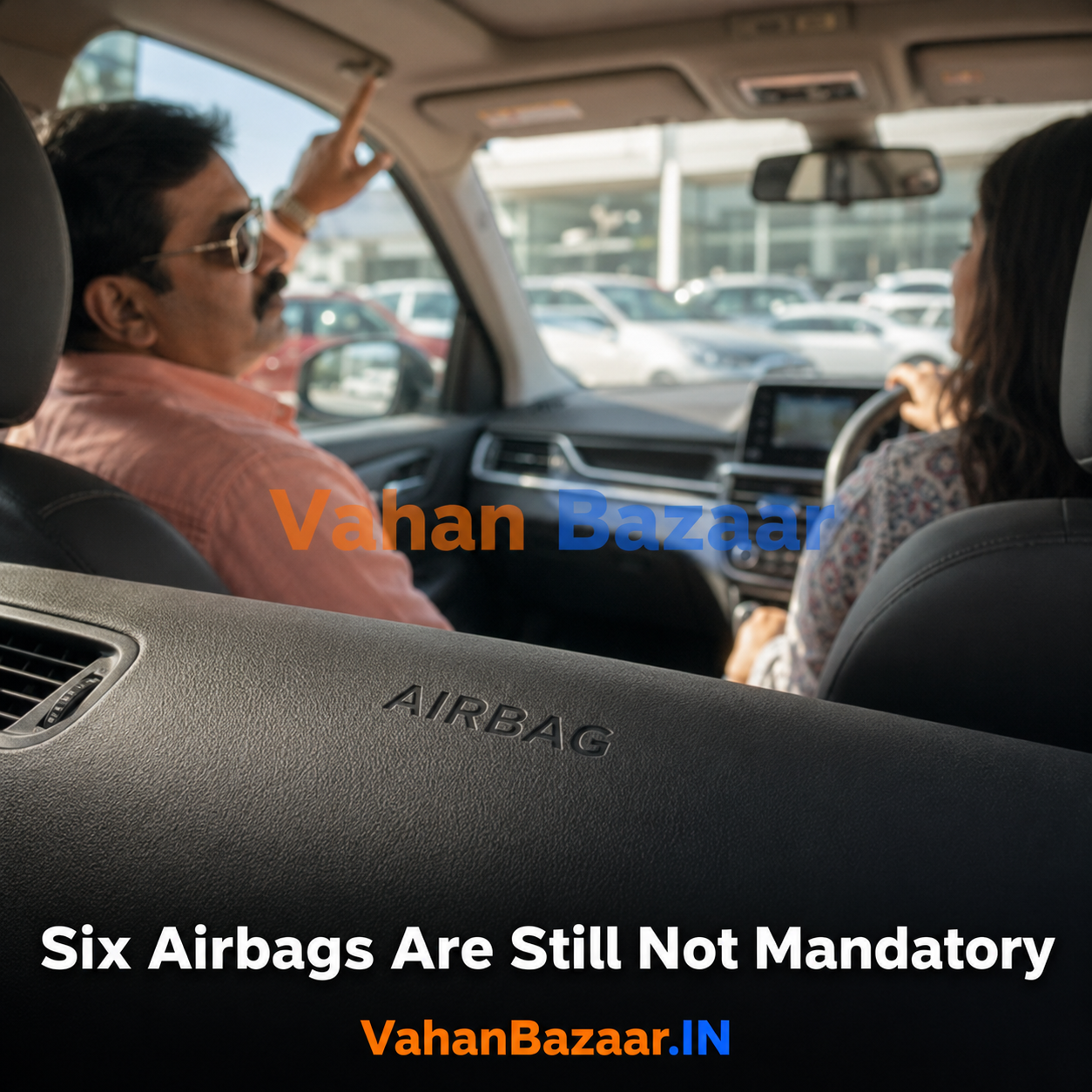
Walk into almost any showroom in India in 2026 and six airbags will be part of the conversation within the first two minutes. Brochures lead with it, salespeople quote it, and buyers have come to treat it as the baseline any modern car simply has. That impression is understandable. It is also not the same thing as a legal requirement, and the difference matters enormously the moment you stop buying new and start buying used.
Here is the position as it stands in August 2026, stated plainly: six airbags are not yet a strict legal mandate in India. The rule has been drafted. It has been scheduled, rescheduled and deferred. It has not been enforced. What has happened instead is that most leading manufacturers, including Maruti Suzuki, Hyundai, Tata and Kia, have moved ahead on their own and made six airbags either standard or widely available across their 2026 model ranges.
That combination — a rule that was never switched on, and an industry that largely adopted the specification anyway, at its own pace and on its own schedule — has produced a used-car market where you genuinely cannot tell from the year on the number plate what safety equipment a car left the factory with. Two cars of the same model, the same year, the same colour, parked next to each other in Pune or Hyderabad, can carry different airbag counts. Not because one is defective, but because they are different variants.
This article is about that gap, the chronology behind it, and the specific checks that close it on one particular car.
Airbag count is a variant fact. Which car and which year you are actually looking at is a record fact — and that is the part you can settle for Rs. 99 before you negotiate.
What the Draft Rule Actually Proposed
The starting point is a draft notification issued on 14 January 2022. It proposed that vehicles in the M1 category — passenger vehicles carrying up to eight people besides the driver, which covers essentially every family hatchback, sedan and SUV sold in India — manufactured after 1 October 2022 be fitted with two side or side-torso airbags and two side-curtain or tube airbags.
Read that carefully, because the phrasing explains the shorthand. The proposal was about adding four airbags to the front pair that cars already carried. Two side or torso bags, typically deploying from the outboard edge of the front seat backrests to protect the chest and abdomen in a side impact. Two curtain or tube bags, deploying downwards from the roof rail along the side glass to protect the heads of occupants in both rows. Front pair plus those four is where the number six comes from.
The intent was never in dispute. What moved, repeatedly, was the date.
The Chronology: A Timeline That Kept Moving
Anyone trying to work out what applies to a given car needs the sequence rather than a single headline. Here it is, dated.
| Date | What happened | Effect on cars on the road |
|---|---|---|
| 14 January 2022 | Draft notification proposes two side or side-torso airbags plus two side-curtain or tube airbags for M1-category vehicles manufactured after 1 October 2022 | Proposal only, not in force |
| 1 October 2022 | The originally proposed effective date for vehicles manufactured from this point | Did not take effect as proposed |
| 1 October 2023 | The requirement is rescheduled to this date | Again did not take effect |
| Subsequently | MoRTH defers the requirement further, with reporting pointing to 2026; a deferral of up to 18 months is reported as under consideration | Timeline unsettled |
| August 2026 | Six airbags remain not a strict legal mandate; most leading manufacturers fit them voluntarily as standard or make them widely available | Common on new cars by choice, not by law |
Two reasons have been cited by the Ministry of Road Transport and Highways for the deferral, and both are worth understanding rather than dismissing. The first is global semiconductor supply-chain constraints, which affected vehicle production worldwide and made a hard cut-off on additional electronic safety systems difficult to plan around. The second is a stated focus on broader vehicle safety standards, including anti-lock braking systems, electronic stability control and crash-test ratings, rather than airbag count considered in isolation. The policy conversation has been an active one at the highest level, with Union Minister Nitin Gadkari publicly addressing the six-airbag question in Parliament.
You will find confident claims online that six airbags became mandatory on one specific date. The record does not support a single settled date, because the timeline has slipped more than once. The dependable statement for a used-car buyer in August 2026 is the one this article makes: repeatedly rescheduled, not currently enforced as a strict mandate, and widely fitted by manufacturers on a voluntary basis. Anything more definite than that is a guess dressed up as a fact.
Why the Same Model and Year Can Have Different Airbag Counts
This is the part that costs people money, and it follows directly from everything above. Because there was no enforced cut-off, each manufacturer decided for itself when to extend six airbags across its range, and — crucially — which variants to extend it to first.
Airbags arrived variant by variant, not year by year
The normal pattern in the Indian market is that a new feature appears at the top of the range and works its way down. A top-spec trim gets it in one model year, the mid-spec trim in the next, the base trim later still — or the manufacturer makes it standard across the range in one move, but from a specific production month rather than from 1 January. Some brands moved early and comprehensively. Others phased it in. Both approaches were entirely legitimate, because no rule compelled either.
The result, four years on, is a used-car pool spanning roughly 2022 to 2026 in which airbag fitment tracks manufacturer, model year and exact variant — three variables — rather than the single variable most buyers actually use, which is the year of manufacture. A buyer who reasons "it is a 2024 car, so it has six airbags" is applying a rule that was never in force, and they can be straightforwardly wrong.
The trims that sit closest together in price are where this bites hardest. Popular nameplates carry long variant ladders with names that differ by a single letter or suffix, and the visual differences between adjacent trims can be limited to a badge, a wheel design or a touchscreen size. Browse enough used Maruti Suzuki Baleno listings, used Hyundai Creta listings, used Tata Nexon listings or used Kia Seltos listings from the same production years and you will see identical-looking cars advertised at different prices for reasons the photographs do not explain. Equipment is frequently one of those reasons.
A brochure describes a model. It does not describe your car.
Sellers, including entirely honest ones, will often produce a brochure or a specification page pulled from a search result to demonstrate what the car has. This is a reasonable thing to do and it is also not proof. A brochure describes what was available on a model in a given year. It does not establish what one particular chassis was built with, because the same brochure covers every variant in the range, and the footnote listing which items are standard on which trim is exactly the part that gets skipped.
The same trap catches buyers on engine and trim claims generally, which is why variant inflation in used-car listings is a persistent problem. A car described as "top model" in an advertisement is describing itself. The documents describe the car.
It is worth being clear about this. A car built with fewer than six airbags is not an unsafe car and it is not a faulty one. Every vehicle sold in India met the safety norms in force at the time it was manufactured. The point of this article is not that older or lower-spec cars should be avoided. It is that you should know precisely what you are buying, so that the price you agree matches the specification you are actually getting rather than the one you assumed.
What a Bharat NCAP Rating Does and Does Not Tell You
Bharat NCAP is India's official New Car Assessment Programme, launched by the Ministry of Road Transport and Highways on 22 August 2023. It has done a great deal to make crash performance a mainstream buying consideration, and star ratings now appear routinely in advertising and in showroom conversations.
For a used-car buyer, one limitation needs stating. A rating is awarded to a tested configuration of a model. It reflects how that particular specification, with that particular equipment, performed in that particular assessment. It is not a certificate attached to every car wearing the same badge for the rest of the model's life.
So a five-star model rating tells you something real and useful about the structure and the safety engineering of that model family. It does not, on its own, prove that the specific used car in front of you — possibly a different variant, possibly a different model year, possibly built before or after a mid-cycle update — carries the same equipment that was tested. Treat the rating as strong context about the model, then confirm the specification of the individual vehicle. If you want the mechanics of how the programme scores cars, our explainer on how Bharat NCAP star ratings actually work covers the assessment structure in detail.
How to Establish the Safety Specification of One Specific Car
Four checks, done together, will settle this on almost any car. None of them takes long, and none of them requires you to trust anybody's recollection.
1. Read the airbag markings in the cabin
Airbag locations are physically labelled, because they have to be — the markings warn service technicians and occupants where pyrotechnic devices are fitted. Look in these places:
- Front airbags: moulded lettering reading SRS AIRBAG or AIRBAG on the steering wheel boss, and a matching moulded panel on the dashboard above the glovebox on the passenger side.
- Side or torso airbags: a small stitched or moulded tag reading AIRBAG on the outboard bolster of the front seat backrests, on the side facing the door. It is usually near shoulder height on the seam.
- Curtain airbags: labels on the pillar trims or along the roof lining edge above the door apertures, running between the A-pillar and the C-pillar. Peel your eyes along the join between the headliner and the trim above the doors; the marking is small and easy to miss.
- The warning lamp: the airbag telltale in the instrument cluster should illuminate briefly when you turn the ignition on and then go out. A lamp that never illuminates, or one that stays on, is a reason to ask questions before anything else.
Markings are strong evidence and they are the quickest read available. They are not conclusive on their own, because seats can be re-trimmed and interior trim can be replaced during repairs, which is a good reason to treat the cabin check as the first step rather than the last.
2. Read the exact variant name on the registration document
The registration document carries the maker's model description, and on most cars that description includes the variant designation. This is the single most useful line on the page for this purpose, because it is the manufacturer's own identification of what the vehicle is, recorded at registration, rather than a description written by whoever is selling it today.
3. Note the month and year of manufacture
Not the model year in the advertisement, and not the registration year — the actual manufacture month and year. Where a manufacturer phased six airbags in from a particular production month, this is the field that decides which side of the change your car falls on. It is also, separately, one of the most common places where a used-car listing and reality part company, which is why the difference between a car's advertised year and its actual registration record is worth checking on every purchase.
4. Confirm the variant against the manufacturer's records for that model year
With the variant name and the manufacture date in hand, confirm what that exact variant carried in that exact model year against the manufacturer's own published specification or through an authorised dealership, which can look up the equipment fitted against the vehicle identification number. This is the step that converts a reasonable inference into a confirmed fact, and it is the only one of the four that gives you an answer you can rely on completely.
Where the Government Record Fits In
Be precise about this, because it is easy to overstate. The VAHAN record does not list airbag count. No government vehicle record in India does. If anybody tells you a registration check will show you how many airbags a car has, they are wrong.
What the record does is answer the question that comes before it. Before you can confirm what a variant was built with, you have to be certain which car and which year you are actually dealing with. That is precisely what a Vahan Verify check establishes: the car's identity, its registration and manufacture timeline, its vehicle age, owner count, RC status, insurance validity, and blacklist and challan flags. An RC check costs Rs. 99, a challan check costs Rs. 99, and both together cost Rs. 149 rather than Rs. 198 separately.
The sequence is what makes it useful. Verify the car's identity and age first, so you have a confirmed baseline. Then check the variant's equipment against that baseline. Doing it the other way round means confirming a specification against a year that might not be the car's real one — which is a lot of effort spent on the wrong vehicle. Our complete guide to checking a used car's RC walks through the individual fields and what each one is good for.
Record first, cabin second, manufacturer confirmation third. Establishing the registration and manufacture timeline before you travel to see a car means the physical inspection is either worth doing properly or not worth doing at all. Buyers who reverse the order end up inspecting seat bolsters on cars whose advertised year turns out to be wrong.
What This Means for Used Car Buyers
The practical takeaway is narrow and specific. Six airbags being widely fitted is genuinely good news for the market, and the used-car pool arriving over the next few years will be better equipped on average than the one before it. But "widely fitted" was achieved by manufacturer choice rather than by an enforced deadline, and choices made at different times by different companies across different variants do not produce a clean line you can draw across a calendar.
So do not price a car on an assumption about its airbag count, and do not let a seller price it on one either. If the advertisement leads with a safety specification, ask which variant and confirm it. If the star rating is quoted, remember it belongs to a tested configuration of the model. If the brochure is produced, ask which trim the footnote applies to. None of this is adversarial — most sellers genuinely believe what they are telling you, because the same "it is a 2024 car" reasoning that misleads buyers misleads owners too.
This matters most on family purchases, where the equipment list is doing real work in the buying decision. Anyone shortlisting from the used family car segment or working through a broader pre-purchase document checklist should treat airbag count as a line item to be verified rather than assumed, alongside the checks they are already making on ownership, insurance and outstanding dues. It also matters on price. Adjacent variants of a popular model are separated by a real price gap when new, and a slice of that gap survives into the used market. Paying a top-variant price for a mid-variant car is a quiet, avoidable loss.
Market depth affects how much room you have to be choosy about this. In deeper markets such as Delhi, Pune and Bengaluru, enough cars of the same model and year are listed at any time that you can hold out for the variant you actually want. In thinner markets there may be two examples in the district, and the honest move there is to know exactly which specification you are getting and negotiate on that basis rather than walk away. Either way, the information is what gives you the position. You can browse listings with the four checks above in mind, and settle the identity question first.
Confirm Which Car You Are Buying, Then Confirm What It Was Built With
A Vahan Verify check pulls the car's record from the VAHAN database against the registration number: registration status, vehicle age, owner count, insurance validity, and blacklist and challan flags. It will not tell you the airbag count, because no government record in India carries that. It will tell you which car and which year you are actually dealing with, which is the baseline you need before checking the variant's equipment. RC check Rs. 99, challan check Rs. 99, or both together for Rs. 149 instead of Rs. 198.
Frequently Asked Questions
No. Six airbags are not yet a strict legal mandate in India. A draft notification issued on 14 January 2022 proposed that M1-category vehicles manufactured after 1 October 2022 be fitted with two side or side-torso airbags and two side-curtain or tube airbags. That date was rescheduled to 1 October 2023, and the Ministry of Road Transport and Highways later deferred it again, with reporting pointing to 2026 and a further deferral of up to 18 months described as under consideration. What has changed in the meantime is voluntary: most leading manufacturers, including Maruti Suzuki, Hyundai, Tata and Kia, have made six airbags either standard or widely available on their 2026 models.
No. Because the rule was never enforced, fitment across the 2022 to 2026 used-car pool depends on the manufacturer, the model year and the exact variant rather than on the year of manufacture. Two cars of the same model and the same year, sitting side by side and looking identical from the outside, can carry different airbag counts because they are different variants. Airbag count has to be verified against the specific vehicle in front of you, not inferred from its age.
Work through four things together. First, look for the airbag markings in the cabin: the moulded lettering on the steering wheel boss and on the dashboard above the glovebox for the front pair, the small stitched tags on the outboard bolsters of the front seat backrests for side or torso airbags, and the labels on the pillar trims or along the roof rails above the door apertures for curtain airbags. Second, read the exact variant name on the registration document. Third, note the month and year of manufacture. Fourth, confirm that variant against the manufacturer's published specification for that model year. Markings are a strong indication, but the variant record is what settles it.
Not by itself. Bharat NCAP is India's official New Car Assessment Programme, launched by the Ministry of Road Transport and Highways on 22 August 2023, and a rating is awarded to a tested configuration of a model. A used car wearing the same badge may be a different variant, from a different model year, with a different equipment list. Treat the star rating as information about the model family and then confirm what your specific vehicle was actually built with.
No. The government vehicle record does not list airbag count. What it does establish is the car's identity and timeline: registration status, registration and manufacture details, vehicle age, owner count, insurance validity, and blacklist and challan flags. That matters because you cannot confirm a variant's equipment until you are certain which car and which year you are actually dealing with. A Vahan Verify RC check on VahanBazaar costs Rs. 99, a challan check costs Rs. 99, and both together cost Rs. 149 instead of Rs. 198 separately.