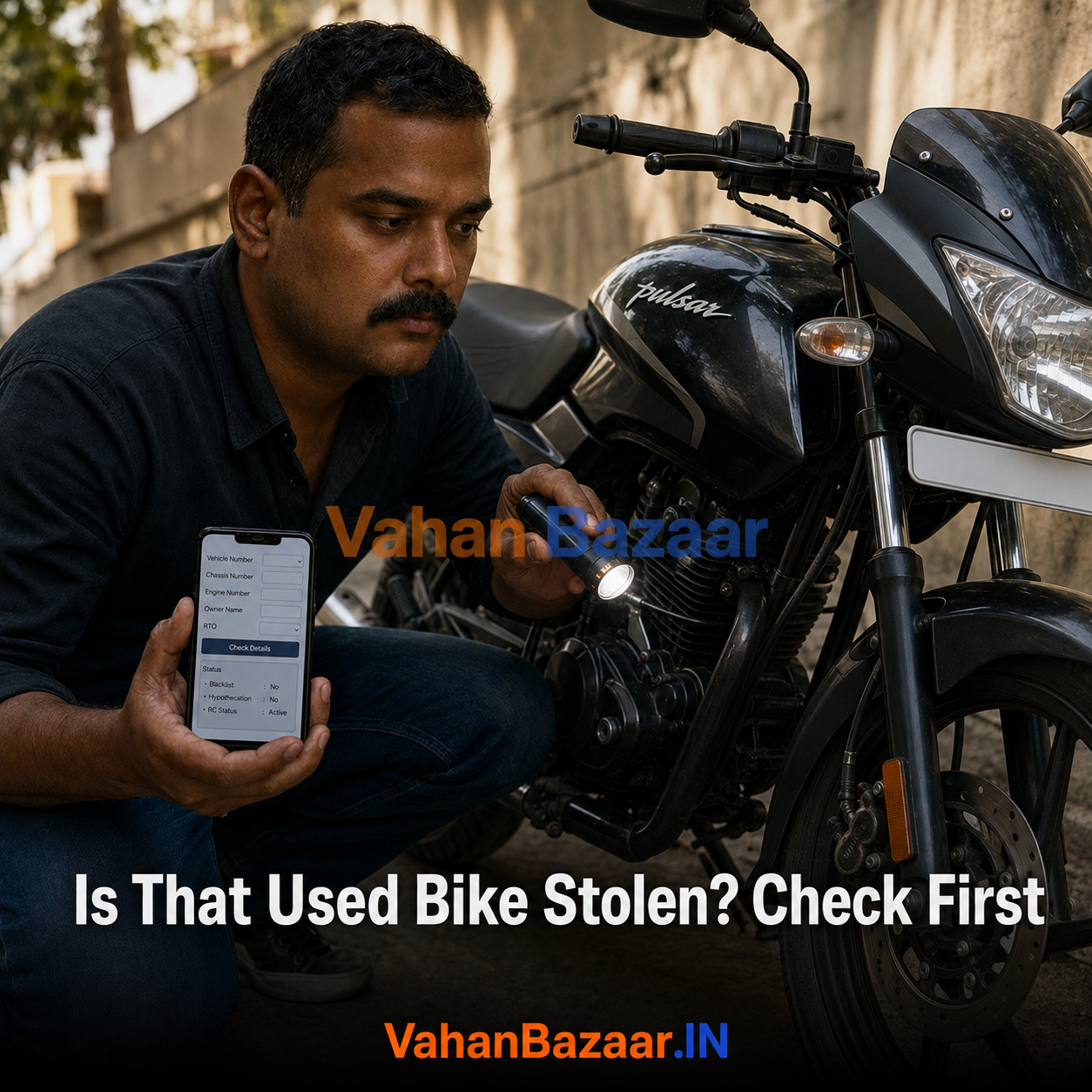
A used car purchase tends to come with a certain amount of ceremony. There is a test drive, an inspection, a conversation about service history, and usually a bank involved somewhere. A used bike purchase frequently comes with none of that. Somebody sees a photograph on a phone, meets a stranger at a fuel pump, rides it around the block, hands over cash, and takes the keys. The whole thing can be done in under an hour.
That speed is not a flaw in how Indians buy two-wheelers. It is the reason the second-hand two-wheeler market works at all, and it puts affordable transport in the hands of people for whom a car is not a realistic option. But the same properties that make the market efficient, low value per unit, high volume, cash settlement and light paperwork, are exactly the properties that make a stolen bike easy to move. A vehicle that can be resold in an hour with no questions asked is a vehicle worth stealing.
And the person who ends up carrying that loss is not the one who took the bike.
Why Two-Wheelers Are Structurally More Exposed Than Cars
The exposure is not about two-wheeler owners being less careful as people. It is about how the economics of the transaction shape the diligence.
When the asset is worth several Lakh, the effort of verifying it is obviously proportionate. Nobody objects to spending an afternoon on paperwork for a purchase of that size. When the asset is worth thirty or forty thousand Rupees, that same afternoon starts to feel disproportionate, and the checks quietly fall away one by one. The inspection becomes a look. The paperwork becomes a photograph of the registration certificate. The transfer becomes something both parties agree to do later, and often never do.
Three consequences follow. First, cash settlement leaves no trail on either side, so there is nothing to point to afterwards. Second, informal sales through acquaintances and neighbourhood intermediaries mean the buyer often has no verifiable identity for the seller, only a phone number that may stop working. Third, and most significantly, a large proportion of used two-wheeler sales are never intimated to the RTO at all, which means the registered owner in the official record can be several transactions behind the person currently riding the bike. Once that gap exists, an additional undocumented handover in the chain is invisible.
A bike that has passed through three owners without a single transfer being filed looks exactly like a bike that has passed through three owners, one of whom did not own it. The record cannot distinguish between the two, and neither can you, because the record has not been updated in either case. What the record can tell you is whether the vehicle itself carries a flag, and that is the question worth Rs. 99.
What the Buyer Loses, Not the Thief
It is worth being plain about the arithmetic of a bad outcome, because it is not symmetrical and people tend to assume it is.
If a bike is identified as stolen after you have bought it, the vehicle goes. It is seized, and it is returned into the process that deals with recovered property. You do not get to keep it while the matter is sorted out, and the fact that you paid for it does not create a claim on it.
The money also goes. It went to a seller you met once, who was paid in cash, whose identity you did not verify, and whose phone number was disconnected the following week. There is nothing to recover and nobody identifiable to recover it from.
And then there is the third part, which people rarely think about in advance: you are the person in possession. Explaining how you came to be riding a stolen vehicle becomes your responsibility, not the seller's, because the seller is not there. Whether that leads anywhere is a matter for the police and the courts on the facts of the individual case, and it is not something anybody should be predicting from an article. But the position itself is uncomfortable and entirely avoidable, and the cost of avoiding it is smaller than a tank of fuel.
The Three-Layer Check
No single check settles this. The record can be clean on a bike whose numbers have been altered. The numbers can match on a bike being sold by someone with no right to sell it. The seller can be entirely genuine and still be sitting on a vehicle with an open lender charge that blocks the transfer. The three layers close each other's gaps, and they should be worked in order because each one is cheaper than the next.
- The record. Ask for the registration number before you travel anywhere, and check it. Registration status, blacklist entries, hypothecation, owner serial number and the date of first registration all come from this one look. It costs Rs. 99 and it is the only layer you can complete without leaving the house.
- The metal. When you see the bike, match the chassis and engine numbers stamped on it against the numbers in the record, character by character, and look at the condition of the stamping itself.
- The person. Confirm the seller is the registered owner, with an identity document that matches the name in the record, met at the registered address rather than at a neutral spot chosen for convenience.
Layer one: the record
A check against a registration number returns the registration status, the date of first registration and therefore the vehicle's true age rather than the age the seller quotes, the make and model, the vehicle class, the registered owner serial number, the insurance validity position, whether a financier still holds a charge over the vehicle, and any blacklist entry.
The blacklist entry is the one that matters most here. Vehicles reported stolen can be flagged in the record, and so can vehicles subject to other enforcement action, which is why a flag is a reason to stop rather than a diagnosis of a specific cause. We have written separately about what a blacklisted entry does to a used vehicle deal, and the logic is identical on a two-wheeler, only the sums are smaller and the checking is rarer.
The hypothecation field matters independently of theft, and it catches far more buyers than theft does. If a financier still holds a charge, the transfer is blocked regardless of what the seller says has been repaid. Most two-wheelers in India are bought on finance, which makes this the single most common reason a bike sale that felt completely straightforward cannot be completed on paper. Our note on a live loan still showing on a used bike's record covers what has to happen before the charge comes off.
The owner serial number and the date of first registration together give you the two facts sellers most often shade. A bike described as a second-hand purchase from a single careful owner should not be showing a fourth owner in the record, and a bike described as three years old should not have first been registered seven years ago.
Check the Bike Before You Pay
Registration status, blacklist flags, hypothecation against a live loan, owner serial number and true age from the date of first registration, pulled from the official record against any registration number. RC check Rs. 99, challan check Rs. 99, or both together for Rs. 149 — against a bike that costs tens of thousands.
Layer two: the metal
The record describes a vehicle. The next question is whether the vehicle in front of you is that vehicle.
The chassis number and the engine number stamped on the bike must match the numbers in the record exactly. Not approximately, not allowing for a character that is hard to read in poor light. Take a photograph, read it in daylight, and compare it character by character. Our guide to matching chassis and engine numbers against the record sets out where these numbers are typically located and how to read a worn stamping without guessing.
Then look at the stamping itself rather than only at what it says. Signs worth a second look include characters that appear to have been re-punched over earlier ones, an area that has been ground flat and re-marked, filler or fresh paint around the frame number when the rest of the frame is weathered, and lettering whose spacing or depth is inconsistent along the sequence. The technique of putting a clean identity onto a vehicle that does not deserve one is not new, and we have covered how a cloned chassis number is constructed and how a mismatch shows itself in more detail.
Layer three: the person
The final layer costs nothing and is the one buyers skip most often, because raising it feels impolite.
The name on the identity document should match the registered owner in the record. If the bike is registered to someone else, there needs to be a documented reason, not a verbal one, and a verbal explanation involving a brother, a cousin or a friend who is travelling is the most common single feature of a sale that goes wrong. Meet at the registered address. A seller with a genuine bike and a genuine address has no reason to refuse, and the refusal itself is the information.
Other seller behaviour worth weighing, none of it conclusive alone but all of it meaningful together: a price noticeably below the band that model and year is trading in, pressure to complete today for a reason that keeps changing, only a photocopy or a phone photograph of the registration certificate rather than the original, and an insistence on cash with no receipt.
What a Photograph of an RC Actually Proves
Almost every informal two-wheeler sale now starts with a photograph of the registration certificate sent over a messaging app. It is treated as the document that settles the matter. It settles almost nothing.
An image can be edited. An image can be a genuine, unedited photograph of a different bike of the same make, model and colour. And even a completely authentic image of the correct certificate tells you only what that card said on the day it was printed, which may be years ago. A blacklist entry added last month, a hypothecation that was never closed, a registration that has since been cancelled, none of these appear on a card printed before they happened. Only the current state of the record shows the current state of the record.
| What the seller shows | What it actually proves | What to check instead |
|---|---|---|
| A photograph of the RC | Nothing about the current record | Take the registration number and pull the record yourself |
| The original RC card in hand | That a card exists, not that the record is clean | Blacklist entry, hypothecation and owner serial in the record |
| A clean, correct-looking number plate | Very little. Plates are the easiest part to replace | Chassis and engine numbers stamped on the frame and engine |
| "The loan is fully paid" | Nothing until the charge is removed from the record | The hypothecation field in the record |
| A recent service bill | That somebody serviced a bike | Registration and chassis number printed on the bill itself |
| An insurance policy copy | That a policy existed on some date | Insurance validity position in the record |
| Meets you at the registered address with matching ID | The strongest single human signal available | Still pair it with the record and the stamped numbers |
Why "I Bought It in Good Faith" Is a Weak Place to Stand
Good faith is not a claim you make. It is a position you have to be able to demonstrate, and demonstrating it requires artefacts.
Consider what the two versions of the same buyer actually have. The first paid in cash, kept no receipt, never saw the seller's identity document, never checked the record, and has a phone number that no longer connects. The second has a dated record check against the registration number taken before payment, a photograph of the seller's identity document, a signed receipt, and Form 29 and Form 30 completed on the day of sale. Both bought the same bike from the same person. Only one of them can show that the question was asked.
How any particular case is treated is a matter for the police and the courts, and nobody should take a general article as advice on their own situation. But the difference between those two files is roughly Rs. 99 and twenty minutes, spent before the money moves rather than after.
If the Check Comes Back With a Blacklist Flag
Keep this simple and unemotional.
Do not confront the seller. You do not know what the flag relates to, the seller may not know either, and a confrontation over a vehicle that may be evidence helps nobody and can put you at risk. There is nothing to gain from the conversation.
Do not pay, and do not pay a token deposit to hold the bike while you look into it. Withdraw from the transaction. A flagged record is not a negotiating position and not a reason to ask for a discount.
Report the registration number to the police and give them what you have, which will typically be the registration number, the record check result, the location where the bike was shown to you, and the phone number you were contacted on. That is all that is being asked of you. What happens next is not your responsibility to determine.
Blacklist entries can arise from more than one kind of enforcement action, so a flag is not by itself a finding about any particular vehicle or person. What it reliably tells you is that the vehicle has an unresolved status in the official record, which means the transfer will not go through cleanly and the reason has not been established. Both of those are sufficient on their own to walk away. Confirm the position with the RTO if you need to understand it.
Do Not Become the Next Seller With an Untransferred Bike
Every stalled ownership chain started with one buyer who meant to file the transfer and did not. Closing the loop on your own purchase is what keeps you out of the same position later, when you want to sell.
Ownership transfer must be intimated within 14 days for a transfer within the same state, and within 45 days where the vehicle has moved under a No Objection Certificate. Form 29 is the seller's Notice of Transfer, submitted in two copies. Form 30 is the application signed by both parties, also in two copies. Get both signed on the day of sale, while the seller is standing in front of you, because chasing a signature afterwards is close to impossible once the money has changed hands.
Transfer fees are broadly in the range of Rs. 300 to Rs. 500 plus the smart-card fee. That is indicative and varies by state, so confirm the current figure and the document list with your RTO. A new registration certificate typically issues in seven to thirty days. If any hypothecation was showing in the record, it has to be cleared before the transfer can complete, not alongside it.
What This Means for Buyers
Work in the order the cost suggests. Ask for the registration number before you agree to meet, and check the record. Rs. 99 spent at that point either removes the vehicle from your list before you have spent a Sunday travelling to see it, or it tells you the record is clean and the rest of the visit is worth making. Against a used two-wheeler costing tens of thousands of Rupees, the check is a rounding error on the purchase price. RC check Rs. 99, challan check Rs. 99, both together Rs. 149.
When you see the bike, do the metal. Photograph the chassis and engine numbers, read them in daylight, compare them character by character, and look at the stamping for signs of re-punching, grinding, filler or fresh paint. Then do the person: identity document matching the registered owner, met at the registered address.
If any of the three layers does not resolve, do not negotiate the price down to compensate for it. A discount does not fix a record flag, and it does not fix a number that has been re-stamped. There will be another bike. Our checklist for reading a used bike or scooter's record before buying covers the field-level detail, and it is worth also clearing pending challans, since those follow the vehicle rather than the previous rider.
What This Means for Sellers
If you are selling an honest bike, the state of this segment is working against you and you did nothing to deserve it.
Every buyer who has read anything about used two-wheelers now approaches your listing from a position of suspicion. They are not being unreasonable. They have no cheap way to distinguish your bike from the one that should not be for sale, so they price the uncertainty into what they offer you, and they hesitate, and some of them simply do not reply.
The answer is to remove the question before it is asked. A verified listing at Rs. 99 cross-checks the vehicle against the official record and carries a Verified badge, so the registration position is settled on the listing page rather than argued about over a call with a stranger. On average, based on VahanBazaar listings data, verified listings draw about three times the buyer enquiries and sell around 40 percent faster than unverified ones. Rs. 99 is. In a segment where every buyer starts from doubt, being the one listing that has already answered the question is the whole advantage.
The Short Version
Used two-wheelers move fast, cheap and informally, and that combination is what makes a stolen bike easy to resell. The loss lands on the buyer: the vehicle on seizure, the money already handed over in cash, and the position of having to account for possession.
Three layers settle it. The record gives you registration status, blacklist entries, hypothecation, owner serial number and true age for Rs. 99. The metal gives you a chassis and engine number match and the condition of the stamping. The person gives you an identity document that matches the registered owner, met at the registered address.
A photograph of a registration certificate gives you none of that. If a blacklist flag comes back, do not confront the seller, do not pay, and report the registration number to the police. And once you have bought cleanly, file the transfer: 14 days within the state, 45 days under an NOC, Form 29 and Form 30 signed on the day.
Frequently Asked Questions
Start with the registration record. A check against the registration number returns the registration status, the date of first registration and therefore the true age, the make, model and vehicle class, the owner serial number, the insurance validity position, whether a financier still holds a charge, and any blacklist entry. A blacklist entry is the flag that matters most, because vehicles reported stolen or subject to other enforcement action can be flagged in the record. Then match the chassis and engine numbers stamped on the bike against the numbers in the record, and confirm the seller is the registered owner. A record check costs Rs. 99.
It means the vehicle has been flagged in the official record. Vehicles reported stolen can be flagged this way, and so can vehicles subject to other enforcement action, so a blacklist entry is not by itself proof of any single cause. What it does mean, without ambiguity, is that the vehicle carries an unresolved status in the record and should not be bought until that status is understood. Treat it as a full stop rather than a point to negotiate over. Do not pay, and report the registration number to the police.
Do not rely on it. Good faith is not something you assert, it is something you have to be able to demonstrate, and a cash payment with no receipt, no identity check and no record check is a weak position from which to demonstrate anything. Whether a particular purchase attracts any consequence is a matter for the police and the courts on the facts of that case, and anyone in that situation should approach the police and confirm the vehicle position with the RTO. The practical point is that a Rs. 99 record check taken before payment costs almost nothing and creates the evidence that the question was asked.
No. A photograph can be edited, it can be a picture of a different bike of the same make and model, and even a genuine unaltered image tells you only what the card said on the day it was printed. It says nothing about the current status of the record, which is where a blacklist entry, a live hypothecation or a cancelled registration would appear. Ask for the registration number, check it against the record yourself, and treat the photograph as a starting point rather than as evidence.
Ownership transfer must be intimated within 14 days for a transfer within the same state, and within 45 days where the vehicle has moved under a No Objection Certificate. Form 29 is the seller's Notice of Transfer and is submitted in two copies, and Form 30 is the application signed by both parties, also in two copies. Transfer fees are broadly in the range of Rs. 300 to Rs. 500 plus the smart-card fee, which is indicative and varies by state, and a new registration certificate typically issues in seven to thirty days. Confirm the current fee and document list with your RTO.