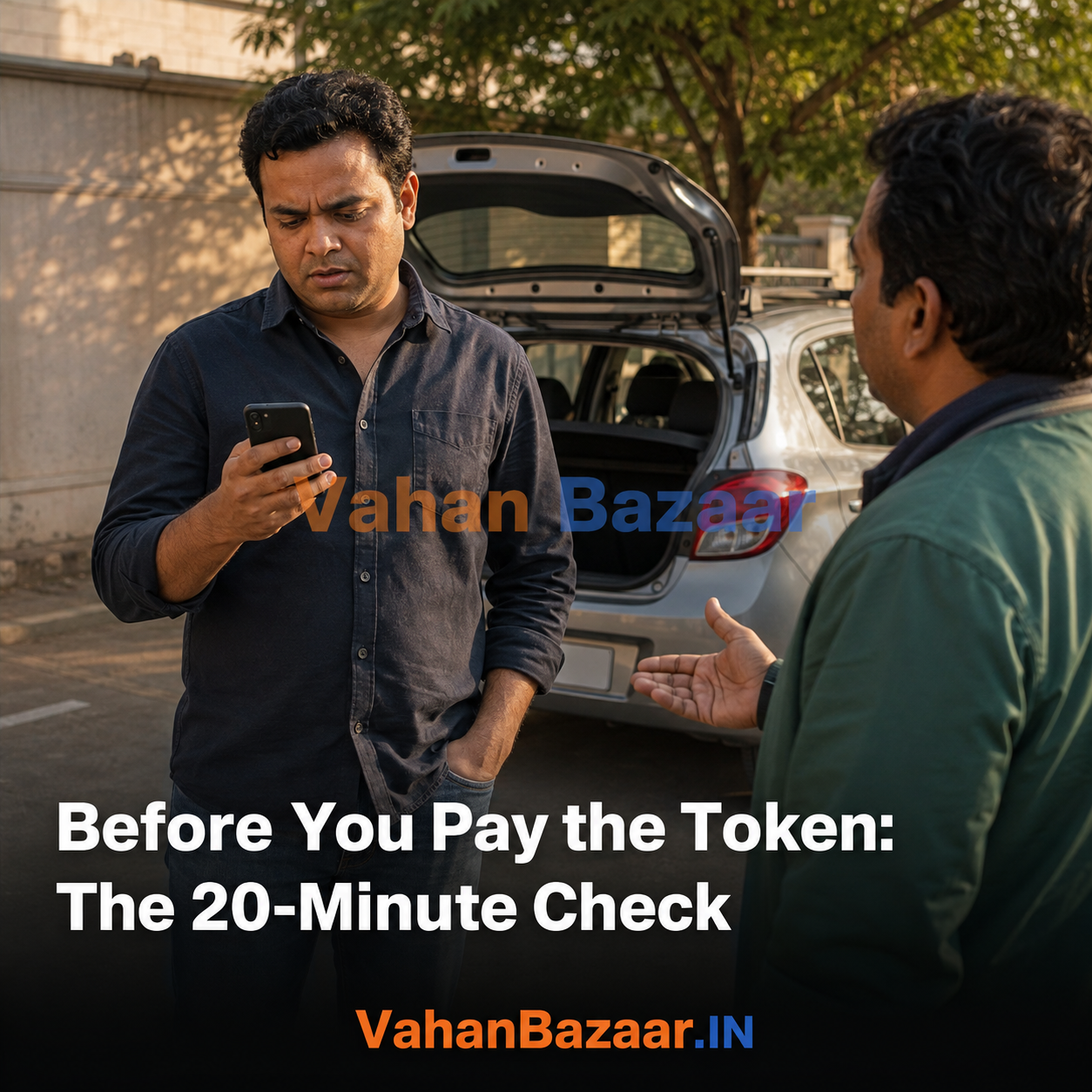
Almost every used car purchase in India has one moment that decides how the rest of it goes, and it is not the test drive. It is the twenty minutes between agreeing a price and handing over the token.
The scene is the same in Delhi, Pune, Coimbatore or Ranchi. You have inspected the car. You have taken it around the block. You have negotiated, and the number has landed somewhere you both accept. The seller then says the sentence everyone says: there is another party coming this evening, so give me something today to hold it. Somewhere between Rs 5,000 and Rs 25,000, cash or UPI, in the next twenty minutes.
What makes this moment different from every other step is that it is the last one where you still hold all the leverage and the last one where new information is still free to act on. Before the token, walking away costs you nothing but an afternoon. After the token, walking away costs you the token, and every subsequent conversation is coloured by the fact that you are already in.
India's used car market is estimated at around USD 41.74 billion in 2026, and the great majority of those transactions still happen exactly like this: two people, a driveway, a phone. That is not a problem in itself. It becomes a problem only when the buyer treats the token as a formality rather than as the actual point of commitment.
Standing in the driveway right now? Enter the registration number and get the car's official record back before you pay — RC check Rs 99, challan check Rs 99, both for Rs 149.
What You Can Still Verify in Twenty Minutes
Here is the useful fact about that twenty-minute window: you do not need the car, the keys, the service history or the seller's cooperation to use it. You need one thing, and it is already painted on the number plate.
The registration number is the key to the official VAHAN record, which is the government's own account of the vehicle. It does not care what the seller says. It does not soften anything to close a deal. And it answers, in minutes, the questions that decide whether this car can legally become yours at all.
The fields that matter before a token
Not everything in the record is urgent at this moment. Fuel type and engine capacity can wait. These six cannot:
- Registration status. The single most important line. You are looking for ACTIVE. Anything else — suspended, cancelled, or a blacklist marker — changes the transaction from a purchase into a problem.
- Owner serial number. The record states which owner the current seller is. If he told you he is the second owner and the record says fourth, you have not found a paperwork error. You have found out what kind of seller you are dealing with, twenty minutes before paying him.
- Hypothecation. If a lender's interest is still recorded against the vehicle, the loan is not closed in the eyes of the system, and the registration certificate is effectively spoken for. The seller cannot hand you a clean transfer while that entry stands.
- Insurance validity. Both a legal requirement and a negotiating lever. An expired policy is not a deal-breaker, but you should know about it before you price the deal, not after.
- Pending challans. Challans in India attach to the registration number, not to whoever was driving. That makes them the seller's history and your future.
- Vehicle age and registration date. Cross-check against the year the seller quoted. Cars aged three to seven years account for roughly 47% of India's used car market, which is precisely the band where a one-year overstatement is both tempting and easy.
On VahanBazaar you can pull that record yourself from wherever you are standing. An RC check costs Rs 99, a challan check costs Rs 99, and both together cost Rs 149 rather than Rs 198 bought separately. You type the registration number; the record comes back in minutes. There is no queue, no counter and no appointment, which is the entire reason it fits inside the window you actually have.
Why the Token Is the Point of No Return
Buyers routinely underestimate the token because of its size. Rs 20,000 against a Rs 6 Lakh car feels like a rounding error. Legally and practically, it is nothing of the sort.
Start with what the token usually is not. It is usually not documented. In most private sales there is no written agreement, no receipt beyond a UPI confirmation screen, and nothing anywhere that states what the money was for or what happens if the deal collapses. A payment app screenshot proves that money moved between two accounts. It does not prove what it was for.
Then consider the route to getting it back. A purchase from a registered dealer sits inside the consumer-protection framework, and a buyer with a grievance has a forum to go to. A private individual selling his own car is generally not a trader in that sense, so that route is normally closed. What is left is a civil recovery suit — which, on a token of Rs 10,000 to Rs 25,000, will usually cost more in legal fees, filing and time than the amount being chased. Most people do the arithmetic and simply absorb the loss. Sellers who make a habit of this know that.
Seller-side and buyer-side fraud in India's used car market rose roughly 40% in FY2026, with recurring patterns including advance payment manipulation and forged bank documents. In May 2026, Delhi Police arrested an individual who had systematically defrauded private car sellers using exactly those two techniques. And in April 2026, a used car trader in Bilaspur, Himachal Pradesh sold a stolen SUV for Rs 14 Lakh on a fake registration certificate carrying incorrect chassis and engine numbers — a document that looked convincing in the hand and collapsed the moment it was matched against the official record.
None of this means private sales are unsafe. Most of them are completely straightforward, and the private route is still where the best prices in the market live. It means only that the protection has to sit before the payment, because there is very little available afterwards.
Six Flags That Should Stop the Payment Entirely
Some findings are negotiating points. Others should end the transaction where it stands. The difference matters, because a seller who senses hesitation will offer to "adjust the price" for problems that cannot be adjusted away.
| What the record shows | What it actually means | Your move |
|---|---|---|
| Registration status not ACTIVE | Suspended or cancelled registration cannot be transferred to you in its current state | Do not pay. This is not a discount conversation |
| Blacklist or theft marker | The registration number carries a flag placed by an authority; the car may not be the seller's to sell | Do not pay. Walk away and do not negotiate |
| Active hypothecation | A lender's interest is still recorded; the loan is not closed and the RC is not free to move | No token until the termination is completed and reflected in the record |
| Owner serial higher than claimed | The seller misrepresented the car's history in the one place it is independently checkable | Do not pay. Assume the service history is equally optimistic |
| Pending challans on the number | Unpaid e-challans can stall or block the transfer of ownership application at the RTO | Pause. Seller clears them first, or the amount comes off the price in writing |
| Insurance expired or near expiry | Legal exposure from day one and an immediate cost you had not budgeted | Proceed, but price it in and note it on the receipt |
The challan row deserves a moment of its own, because it is the newest of these and the least understood. Under the tightened 2026 challan procedure, an RTO can reject a transfer of ownership application when unpaid e-challans are showing against the vehicle's registration number. The buyer typically discovers this weeks after paying, standing at a counter with the car already parked outside his own house but registered in someone else's name. At that point the seller has the money and the buyer has the problem, and the cheapest exit is usually to pay the seller's old fines himself. We have covered the mechanics of that in detail in Pending Challans Can Block Your RC Transfer.
Hypothecation works on a similar delay. A seller will often say the loan was "closed years ago", and he may genuinely believe it — closing a loan and terminating the hypothecation entry on the RC are two separate acts, and plenty of borrowers only ever do the first. The consequence lands on the buyer. Our piece on the hypothecation trap in used car deals sets out how that entry gets removed and how long it takes, which is exactly the information you want before agreeing to a completion date.
If You Do Proceed: What the Receipt Must Say
Suppose the record comes back clean. Status ACTIVE, owner serial matching, no hypothecation, insurance valid, no challans. Good — now pay the token properly rather than casually.
A token receipt does not need a lawyer or stamp paper. It needs to exist, and it needs to contain enough detail that neither party can later claim a different understanding. Write it on plain paper, photograph it, and keep the original.
- The vehicle registration number. The receipt must identify one specific car, not "a Swift". This is the single most commonly omitted line.
- The agreed total price. The full figure, in words and in numerals, so the number cannot drift upward later.
- The token amount paid today and the mode of payment, with the UPI reference number if applicable.
- The balance still due — stated explicitly, not left to arithmetic.
- The date by which the balance is paid and the transfer application is filed. Section 50 of the Motor Vehicles Act 1988 gives the seller 14 days to report a same-state transfer and 45 days for an inter-state one, while the buyer must apply for the change of registration within 30 days. Name a date inside those limits.
- What happens to the token if either side withdraws. One line is enough. Its absence is what turns a dispute into a stalemate.
- Both signatures, both phone numbers, and the date. Photograph the seller's identity document alongside the registration certificate and confirm the name receiving your money is the name on the RC, or that he holds documented authority from that person.
That list takes about five minutes to write out on a phone note and copy onto paper. It is the difference between a token you can argue about and a token you can only mourn.
The Arithmetic: Rs 149 Against a Rs 25,000 Token
Set the two numbers next to each other, because this is the whole argument.
On one side, Rs 149 for the bundled RC and challan check, paid before the token, from where you are standing. On the other, a Rs 25,000 token on a car whose transfer application the RTO will not accept — because there are unpaid challans on the number, or because a lender's interest is still recorded, or because the registration is not ACTIVE at all.
In the second case you do not lose Rs 25,000 cleanly. You lose it slowly. First come the weeks of the seller saying he will sort it out. Then the trips to the RTO. Then the realisation that the practical choice is to pay the seller's dues yourself or to give up the car and the money. Meanwhile the car is either sitting at your house registered to someone else — leaving you exposed on anything that happens on the road — or still with the seller while you wait.
The ratio is roughly three hundred to one, and that is only against the token. Against the full purchase price of a Rs 6 Lakh car, the check costs about one hundredth of one per cent of the transaction. There is no other line item in a used car purchase with that shape.
Everything above works in the driveway, but it works even better the night before. If you run the registration number when the seller first shares it, you arrive at the inspection already knowing the owner count, the registration status and the hypothecation position. You inspect a car you have already cleared on paper, and you negotiate knowing exactly which of the seller's claims survived contact with the government's own record.
What This Means for Used Car Buyers
The practical sequence is short enough to remember while standing in a driveway.
One: ask for the registration number early. Not at the token stage — at the first phone call. A private seller with nothing to hide gives it without hesitation, because it is visible to anyone who walks past the car. Reluctance to share the number is itself the first data point you get.
Two: run the check before the money, not after. Whether you do it the night before or in the twenty minutes before the token, the ordering is what matters. A Rs 99 RC check, or the Rs 149 bundle with challans included, returns registration status, owner serial number, insurance validity, hypothecation and blacklist flags, and pending challans against the registration number.
Three: treat the six red flags as absolute. Status not ACTIVE, a blacklist or theft marker, an active hypothecation, and an owner serial higher than claimed are all stop signs, not discounts. Challans and expired insurance are negotiable, but only in writing and only before the token.
Four: write the receipt. Registration number, total price, token amount, balance, completion date, withdrawal terms, both signatures. Five minutes.
Five: keep a shortlist alive. The pressure in that driveway comes almost entirely from having only one car in play. If you have two or three others you would be content with — from the listings, or a city search across used cars in Delhi, Pune or Bengaluru — the seller's evening deadline stops being frightening. If you are working through a shortlist, new signups get five free contact credits, and the Starter plan at Rs 199 for five contacts or Pro at Rs 399 for fifteen both run for ninety days, so nothing expires while you take your time.
The token is the moment the transaction stops being reversible. Everything before it is research; everything after it is commitment. Spending Rs 149 on the last side of that line where information is still cheap is not caution. It is just paying attention to which side of the line you are standing on.
Check the Car Before the Token Leaves Your Hand
Type the registration number, get the official VAHAN record back in minutes: registration status, owner serial number, insurance validity, hypothecation and blacklist flags, and pending challans. RC check Rs 99, challan check Rs 99, or both together for Rs 149 instead of Rs 198 separately. New signups also get five free contact credits to reach sellers.
See Contact PlansFrequently Asked Questions
Before the money leaves your hand, run the registration number against the official VAHAN record and confirm five things: that the registration status is ACTIVE and carries no blacklist marker, that the owner serial number matches what the seller told you, that no hypothecation is still recorded against the vehicle, that the insurance is valid on the date you are paying, and that there are no pending challans on the registration number. On VahanBazaar an RC check costs Rs 99 and a challan check costs Rs 99, or both together for Rs 149 instead of Rs 198 separately, at vahanbazaar.in/buyer-tools/vahan-verify.
In practice it is very difficult. A token paid in cash or by UPI to a private individual usually has no written contract behind it, and a private person selling their own car is generally not treated as a trader, so the consumer-forum route that covers a dealer purchase is normally not available. What remains is a civil recovery suit, which on a token of Rs 10,000 to Rs 25,000 will typically cost more in legal fees and time than the amount in dispute. The practical protection is not recovery after the fact; it is checking the vehicle record and taking a signed receipt before you pay.
Yes. Under the tightened 2026 challan procedure, an RTO can reject a transfer of ownership application when unpaid e-challans are showing against the vehicle's registration number, because challans in India attach to the registration number rather than to the driver. Buyers usually discover this weeks after paying, when the transfer application stalls at the counter. Because the car is by then in your possession but not in your name, the pressure to simply pay the seller's old fines falls on you. Check the challan list against the registration number before the token, not after.
At minimum: the vehicle registration number, the agreed total sale price, the token amount paid, the balance still due, the date by which the balance will be paid and the RC transfer application will be filed, what happens to the token if either side withdraws, and the signature of both parties with their phone numbers. Take a photograph of the seller's identity document alongside the registration certificate so that the name receiving your money matches the name on the RC. A handwritten receipt on plain paper with these details is far stronger than a UPI screenshot alone.
Under Section 50 of the Motor Vehicles Act 1988, the seller must report the transfer to the registering authority within 14 days for a sale within the same state and within 45 days where the vehicle moves to another state, while the buyer must apply for the change of registration within 30 days. Those are statutory deadlines, not estimates, which is why the token receipt should name a specific date for filing the transfer. A car whose record shows an active hypothecation or unpaid challans cannot move cleanly through that window at all.