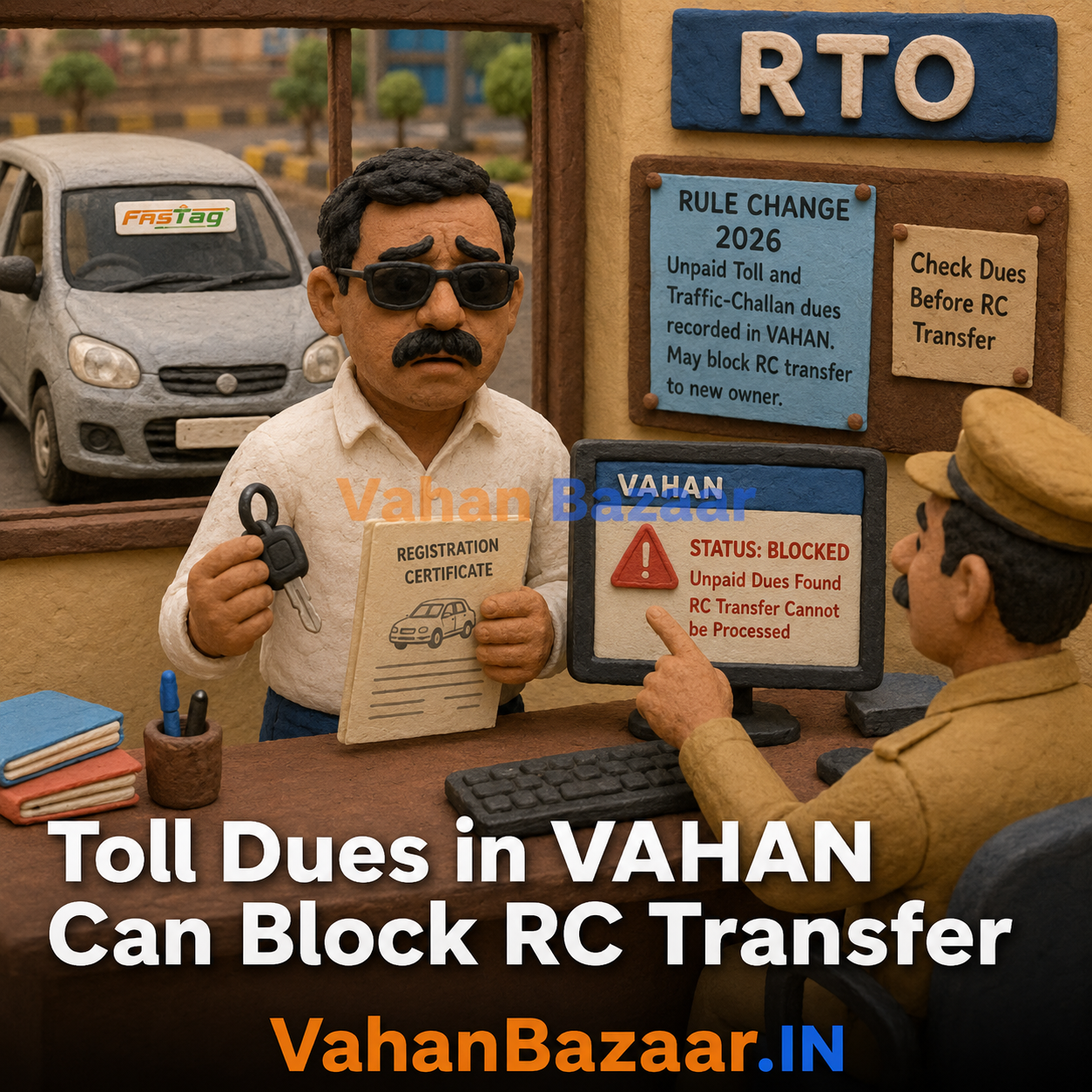
For years, the unpaid toll and the unpaid challan were treated as someone else's loose ends. You bought a used car, the dues stayed in the seller's name in some informal sense, and you got on with the transfer. That assumption has just become dangerous. Under the Central Motor Vehicles (Second Amendment) Rules, 2026, a No Objection Certificate for ownership transfer or inter-state registration will not be granted if there are unpaid National Highway user fees recorded against the vehicle's FASTag. The dues no longer follow a person. They follow the car, and they can stop the car changing hands.
This is a quiet but significant shift in how a used car moves from one owner to the next. India launched a structured e-notice system in 2026 to recover unpaid toll fees, and the mechanism has teeth. If a user fee stays unpaid for more than 15 days with no pending representation, the dues are recorded in the VAHAN system, after which vehicle-related services can be restricted until the outstanding toll is cleared. Clearing those dues is also a precondition for renewal or issuance of the Certificate of Fitness, and pending dues can block national permits for commercial vehicles. The net effect, as far as a buyer is concerned, is blunt: toll compliance is now a prerequisite for any ownership transfer or sale.
The buyer angle is the part most people miss. If you buy a used car that has recorded toll or challan dues against it, the NOC and the RC transfer into your name can be blocked until those dues are cleared. And once you have paid the seller and driven away, you are the one who needs the clean transfer, so you are the one chasing the clearance. The good news is that the dues, the registration status, and any blacklist flag all sit in the government VAHAN record, and they are readable from the registration number before you part with a rupee. A Rs 99 Vahan Verify check surfaces exactly that.
The Central Motor Vehicles (Second Amendment) Rules, 2026 tie the No Objection Certificate to cleared toll dues. Once an unpaid National Highway user fee crosses 15 days with no pending representation, the dues are recorded in VAHAN and vehicle services can be restricted until the toll is settled. Because the dues are attached to the vehicle and not the person, a used-car buyer who skips the record check can inherit a block on a car they have already paid for. Reading the official record first is the single cheapest way to keep that risk on the seller's side of the table.
How the New Toll-Dues Mechanism Works
Barrier-free, FASTag-based and increasingly camera-based tolling has changed how National Highway user fees are charged. You no longer always stop at a plaza and hand over cash; the fee is debited from a FASTag, or, when that fails, it becomes a recorded due against the vehicle. The 2026 framework formalises what happens when those fees go unpaid. A structured e-notice is issued. If the user fee remains unpaid for more than 15 days and there is no pending representation against it, the amount is recorded in the VAHAN system as a due tied to that registration number.
From the moment a due is recorded in VAHAN, the consequences cascade through the services a vehicle owner relies on. The system can restrict vehicle-related services until the outstanding toll is cleared. Crucially for anyone buying or selling, the No Objection Certificate needed for an ownership transfer or an inter-state registration will not be granted while those dues are outstanding. The same logic extends to the Certificate of Fitness, whose renewal or issuance is conditioned on cleared dues, and to national permits for commercial vehicles, which pending dues can block. This is the same direction of travel we describe in our piece on how barrier-free tolls can flag a used car: the plaza barrier is gone, but the digital one is firmer.
Why this is a registration problem, not just a toll problem
It is tempting to file unpaid tolls under "minor money owed" and assume they can be settled at leisure. The amendment removes that comfort. By tying the NOC and the Certificate of Fitness to cleared dues, the rules convert a small unpaid amount into a hard stop on the paperwork that makes a car saleable and transferable. A car with recorded dues is not a car with a bill to pay; it is a car that, for the moment, cannot lawfully and cleanly change owner. For a buyer who has already paid, that distinction is the difference between an errand and a trap.
The safe sequence is: check the car's official VAHAN record, confirm there are no recorded dues, no blacklist flag and a clean registration status, and only then pay and begin the transfer. The unsafe sequence is the common one: agree the price, pay the seller, and discover at the RTO that the NOC is blocked because of dues you never knew about. The rules did not change which sequence is sensible; they raised the cost of getting it wrong.
What a Recorded Toll or Challan Due Actually Blocks
It helps to be precise about what is and is not stopped when dues are recorded in VAHAN, because the practical effect is broader than "you owe toll money." The table below maps the recorded due to the service it touches and what that means for a buyer mid-transfer.
| Service or document | Clean record (proceeds) | Recorded dues (blocked or held) |
|---|---|---|
| No Objection Certificate (NOC) | Granted for transfer or inter-state move | Not granted while toll dues are outstanding |
| Ownership transfer (RC into your name) | Proceeds on a clean record | Held up until the dues are cleared |
| Inter-state re-registration | Allowed once NOC is issued | Stalled with the NOC |
| Certificate of Fitness | Renewed or issued normally | Conditioned on cleared dues first |
| National permit (commercial) | Available on a clean vehicle | Pending dues can block it |
| Other vehicle-related services | Available | Can be restricted until toll is cleared |
None of these blocks announce themselves on the car. A Mumbai buyer looking at a clean-bodied hatchback, or a Delhi buyer eyeing an SUV that drives perfectly, has no way of seeing a recorded toll due by walking around the vehicle. It lives in the government VAHAN record, attached to the registration number, and it is readable from that number alone. That is precisely why the record check belongs at the start of the purchase, not after the RTO turns you away.
The Three Flags That Most Often Stall a Transfer
Beyond toll dues specifically, a handful of record-level problems recur in transfers that get stuck. Each is invisible to inspection and plainly visible in the record.
Under the 2026 amendment, unpaid National Highway user fees that cross the 15-day mark with no pending representation are recorded in VAHAN, and the NOC for transfer or inter-state registration will not be granted until they are cleared. If you buy the car first, the clearance becomes your job. This is the central reason to read the record before you pay, and it sits alongside the wider e-challan picture we cover in our explainer on the Rs 39,000 Cr e-challan pileup that hits buyers.
India is sitting on an enormous pile of unpaid e-challans recorded against vehicles, and a stack of them can complicate a clean transfer just as toll dues do. When a challan is recorded against the registration, it follows the car, and a buyer who settles up after the sale rarely recovers the money from the seller. Our piece on cross-state e-challan buyer liability in 2026 walks through how these dues cross state lines and land on the new owner.
A vehicle can carry a blacklist flag or a registration status that is anything other than clean and active, often for reasons unrelated to toll, such as tax non-payment or a legal matter. A flagged registration is a hard stop for a transfer and you will not see it by looking at the car. Our guide on how to check if a used car is blacklisted shows exactly where this appears in the record and what it means for the sale.
Where the Block Bites in a Typical Purchase
The danger of a recorded due is not the amount; it is the timing. By the time most buyers find out, the money has already moved. Mapping a typical used-car purchase against where toll or challan dues strike makes the risk concrete.
| Stage | What the buyer has done | Where recorded dues bite |
|---|---|---|
| Shortlisted the car | Time, travel, a test drive | Cheapest point to check the record and walk away |
| Agreed a price | A verbal or written commitment | Still recoverable, but pressure to close builds |
| Paid the seller | Often several Lakh handed over | Now the dues are effectively your problem |
| Filed for NOC and transfer | Form 28, 29, 30 and RTO visit | NOC blocked; transfer held until dues cleared |
The buyer who pulls the record at the shortlist stage spends Rs 99 and learns, in about two minutes, whether the car carries recorded dues, a blacklist flag, or an unusual registration status. The buyer who skips that step can hand over several Lakh, reach the RTO with Forms 28, 29 and 30 in hand, and be told the NOC cannot be granted until dues they never agreed to are cleared. Against a purchase of that size and the time lost untangling a seller who has already banked the money, the record check is a rounding error that defuses the entire problem.
Do not assume unpaid tolls or challans are the seller's problem to settle later. Once the dues are recorded in VAHAN, they are attached to the vehicle, and the NOC, the Certificate of Fitness and the transfer all depend on them being cleared. Pay first and you inherit the block along with the car. Lead with the car's official record, confirm it is clean, and you keep any dues firmly on the seller's side until they are sorted.
Check the Record Before You Pay
Every block described above is readable in advance, from one place, using nothing but the registration number. You do not need the seller's cooperation, an RTO appointment, or a toll-plaza receipt to do it. You can do it the moment you shortlist a car.
A Vahan Verify check for Rs 99 pulls the car's official record straight from the government VAHAN database and shows you the registration status, owner count, vehicle age, insurance validity, and any blacklist or challan flags. Read that before you pay, and a recorded-dues or flagged-status problem surfaces while walking away still costs you nothing. If the record is clean, you proceed with confidence and a transfer that should sail through. If it is not, you have saved yourself the far worse position of chasing a seller for a clearance after the money has gone. It is the same record an RTO will look at; you are simply reading it first. For the wider re-registration picture when a car crosses state lines, our guide on how to buy a used car from another state in 2026 sets out the NOC and Form sequence end to end.
A Rs 99 record check confirms the car's official status: registration status, owner count, vehicle age, insurance validity, and any blacklist or challan flags. It tells you whether the car is likely to transfer cleanly into your name. It does not by itself settle dues, and it does not measure the car's physical condition. Use the record check as the cheap first filter that keeps toll and challan blocks off your plate, then layer a condition assessment on top once a car passes.
What This Means for Used Car Buyers
The headline is a small administrative change with an outsized consequence: by tying the No Objection Certificate to cleared toll dues, the Central Motor Vehicles (Second Amendment) Rules, 2026 have made toll compliance a prerequisite for selling or transferring a used car. The buyers who get caught out will not be the careless ones; they will be the ones who trusted that a clean-looking car meant a clean record, and who paid before they checked.
So flip the order. Before you fall for a car, before you agree a price, and certainly before you hand over several Lakh, pull the car's registration record and confirm there are no recorded toll or challan dues, no blacklist flag, and a clean registration status. Read it against what you now know the rules can block, the NOC, the transfer, the inter-state registration, the Certificate of Fitness, and you turn a purchase from a gamble on a stranger's toll discipline into a decision you control. The official record is the same one the RTO checks; the only question is whether you read it before or after your money moves. The cheapest, highest-leverage step in the whole purchase is the Rs 99 record check that happens first. And because a clean RC is not the same as a printed copy of one, our note on DigiLocker RC versus a VAHAN check explains why a document on a phone does not tell you whether the live record is blocked.
Check for Toll and Challan Blocks Before You Pay
For Rs 99, Vahan Verify pulls a car's official record from the government VAHAN database and shows the registration status, owner count, vehicle age, insurance validity, and any blacklist or challan flags. Confirm the car will transfer cleanly into your name before you commit a rupee.
Want a fuller read on a car once its record is clean? AI Vahan Inspection for Rs 249 reads the car's photos and its official record together, so you get the verified history and an assessment of the visible condition side by side. For toll and challan risk, the Rs 99 Vahan Verify is the right first move to confirm the car can change owner cleanly; step up to the inspection once a car clears that gate and you are serious about it.
Frequently Asked Questions
Yes. The Central Motor Vehicles (Second Amendment) Rules, 2026 provide that a No Objection Certificate for ownership transfer or inter-state registration will not be granted if there are unpaid National Highway user fees recorded against the vehicle's FASTag. If the toll stays unpaid for more than 15 days with no pending representation, the dues are recorded in the VAHAN system and vehicle-related services can be restricted until the outstanding amount is cleared. For a buyer that means the transfer of the car into your name can be held up until the toll is settled.
The dues are recorded against the vehicle in the VAHAN system, not against a person, so they follow the car. The NOC and RC transfer can be blocked until they are cleared. In practice, once you have paid the seller and taken the car, you are the one who needs the clean transfer, which means you are the one chasing the clearance. That is why the safe order is to read the car's official record before you pay, while a dues or flag problem is still the seller's problem and you can still walk away.
India launched a structured e-notice system in 2026 to recover unpaid toll fees. If a National Highway user fee stays unpaid for more than 15 days with no pending representation, the dues are recorded in the VAHAN system, after which vehicle-related services can be restricted until the outstanding toll is cleared. Clearing the dues is also a precondition for renewal or issuance of the Certificate of Fitness, and pending dues can block national permits for commercial vehicles.
Pull the car's official record from the government VAHAN database using only its registration number. For Rs 99, a Vahan Verify check returns the registration status, owner count, vehicle age, insurance validity, and any blacklist or challan flags. Because dues, registration status and any block flag sit in the government VAHAN record, reading that record before you pay surfaces a problem while you can still walk away, rather than after the money has changed hands and you are stuck chasing the clearance.
The amendment ties the No Objection Certificate to cleared toll dues for ownership transfer as well as inter-state registration, so it bites on transfers generally, not just sales across state lines. It is most visible when a car moves from one state to another because an NOC and re-registration are involved, but the principle is the same: toll compliance is now a prerequisite for an ownership change. Clearing dues is also linked to the Certificate of Fitness, and pending dues can block national permits for commercial vehicles.