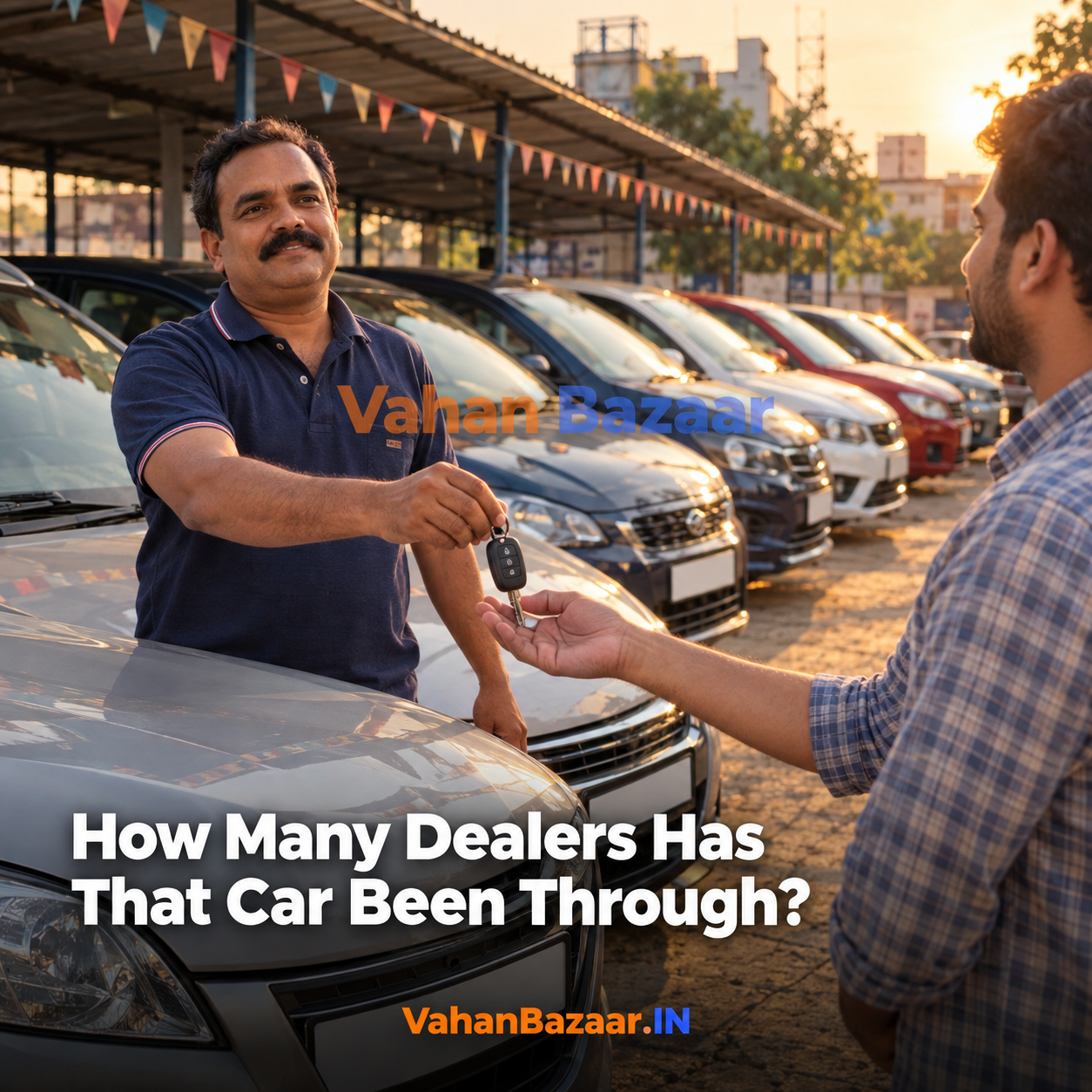
There is a question almost nobody asks when they go to look at a used car, and it is the one that explains the most about what is standing in front of them. How many hands has this car been through since it left the driveway of the person whose name is on the registration certificate?
The listing will not tell you. The photographs will not tell you. The seller very often cannot tell you, because the seller is not the person who drove it and may be two or three steps removed from anyone who did. And yet the answer changes what the car is worth, what you can find out about it, and how much of the seller's description you can reasonably rely on.
A draft notification issued by the Ministry of Road Transport and Highways on 21 July 2026, proposing amendments to the Central Motor Vehicles Rules, 1989, would begin to close that gap. Among other things it proposes a new form, Form 29CA, whose entire job would be to record that one authorised dealer has handed a vehicle over to another. Before anything else is said about it, the important qualification: this is a draft. It is a proposal published for objections and suggestions, and it is not in force.
Everything described here as Form 29CA, as a cap on dealer-to-dealer moves, or as a six-month holding limit is proposed, not current law. A draft notification can be amended, delayed or dropped entirely, and the final text can differ from the draft. Nothing in this article is a description of what applies to a car you are looking at this week. The section on what you can check today is the part that is actually actionable now.
The Gap the Draft Is Trying to Close
India already has an authorised used vehicle dealer framework. A dealer who wants to trade in used vehicles applies for an authorisation certificate, and when a registered owner hands a vehicle over to such a dealer, the handover is notified to the registering authority through Form 29C, filed on the portal, with an acknowledgement number generated automatically. From that point the dealer, not the seller, carries responsibility for the vehicle until ownership is transferred to an eventual buyer.
That structure handles the first step and the last step. The owner hands the car to a dealer, and eventually a buyer takes ownership using Form 30, the report of transfer of ownership, with Form 29 serving as the notice of transfer. Our explainer on Form 29 and Form 30 and the 14-day rule covers how that end of the process works for an ordinary private sale.
What sits between the first step and the last step is where the record currently goes quiet. A vehicle that a dealer cannot move can be passed to another dealer. That second dealer can pass it on again. It can come back to where it started. None of those movements produces a change of registered ownership, which means none of them leaves a mark that a buyer can later read. The car simply reappears in a new listing, in a new city sometimes, described in fresh language, with nothing to indicate how long it has been going round.
What the Draft Actually Proposes
The draft addresses that middle stretch directly. Form 29CA would record that one authorised dealer has handed a vehicle over to another authorised dealer. It would be filed by the dealer currently holding the vehicle, every time the vehicle moves between authorised dealers, and also when the vehicle is sent back to the original dealer. It would be filed electronically on the portal, and the portal would generate an acknowledgement number automatically on submission.
Alongside the form, the draft proposes limits on the movement itself. It proposes a cap on how many times a vehicle can move between authorised dealers before ownership must actually be transferred using Form 30, and published summaries of the draft read that cap as two moves. It also proposes that a vehicle should not remain in a dealer's possession beyond six months from the date the owner filed Form 29C without ownership being transferred. Separately, the draft proposes that ownership cannot be transferred where the registration certificate, the insurance or the pollution under control certificate is invalid.
| Stage of a used car's journey | Position today | What the draft proposes |
|---|---|---|
| Owner hands the vehicle to an authorised dealer | Notified through Form 29C on the portal, acknowledgement number generated | Unchanged in substance, and it becomes the start date for the proposed holding clock |
| Dealer passes the vehicle to another dealer | No separate form records this movement | Form 29CA filed electronically by the dealer holding the vehicle, acknowledgement generated automatically |
| Vehicle sent back to the original dealer | Not separately recorded | Also to be recorded through Form 29CA |
| Number of dealer-to-dealer moves | Not capped | A cap proposed before ownership must move via Form 30, read in published summaries as two |
| How long a dealer may hold the vehicle | No specific outer limit tied to the handover | Six months from the Form 29C date without ownership transfer |
| Ownership transfer to the final buyer | Form 30 report of transfer, with Form 29 as the notice of transfer | Blocked where the RC, insurance or PUC is invalid |
Read as a whole, the proposal is less about paperwork and more about time. A vehicle that cannot be endlessly rotated between lots, and cannot be held indefinitely without the ownership question being settled, is a vehicle whose history stays legible. That legibility is the part a buyer would eventually benefit from, and it is the reason a draft about dealer forms is worth reading as a buyer rather than skipping as trade news.
What a Long Dealer Chain Signals to a Buyer
Set the draft aside for a moment. Whether or not Form 29CA is ever notified, the underlying situation it describes is real, and it is worth understanding on its own terms, because you will meet it long before any rule changes.
A car that has been passed along carries three practical problems, and none of them is fraud.
First, it is a car other buyers have already looked at. Stock that moves between dealers is usually stock that did not sell where it was. People walked up to it, opened the bonnet, took a test drive, and decided against it. You do not know what they saw. It may have been nothing more than the colour or the asking price. It may have been something a torch found in a wheel arch. The point is that you are not the first person to evaluate this car, you are the latest, and the ones before you said no. Our note on how long dealer stock is sitting covers why ageing inventory changes the economics on the dealer's side as well.
Second, the service history thins out with every handover. The person who knows whether the timing belt was changed, whether the car sat through a flood season, whether it was driven hard or gently, is the registered owner. Each step away from that person is a step away from the answers. By the third handover, nobody in the chain is describing the car from experience. They are describing it from a previous seller's description, which was itself a description of a description.
Third, the person selling you the car is very often not its registered owner. That is not by itself improper, and it is entirely normal for dealer stock. But it changes what you must do before paying, because you are now transacting with somebody who holds the vehicle rather than somebody whose name is on the record. Our piece on checking whether the seller is the real owner sets out how to establish that properly.
None of this means a car that has been through several dealers is a bad car. Stock moves for ordinary commercial reasons: a lot has too many of one model, a car is better suited to another city's market, a dealer needs floor space before the festive season. The correct response to a long chain is not to walk away. It is to stop treating the seller's account as your source of information, and to establish the facts from the record and from a physical inspection instead.
What You Can Check Today, Draft or No Draft
Here is the practical part, and it does not depend on anything being notified.
The VAHAN record shows the registered owner and the registered owner serial number. Those two fields settle, independently of anything the seller says, whether the person selling you the car is its registered owner and how many recorded ownership transfers the vehicle has been through. The registration number is visible in almost every listing photograph, so you can establish both before you make contact, let alone before you travel.
Be precise about what the owner count does and does not tell you. It counts recorded ownership transfers. A vehicle can move between dealers as stock without each of those moves producing a fresh ownership entry, which is exactly the gap the draft is aimed at. So a car can honestly be a two-owner car and still have spent the last year moving between lots. Read the owner count as one fact and the dealer chain as a separate one. Our explainer on how many owners a used car has had goes through what that number moves in price terms.
| What you are told | How reliable is it? | What the record settles |
|---|---|---|
| "It is a single-owner car" | A claim, freely made | Registered owner serial number returns the recorded count |
| "I am selling it for the owner" | Common and often true, but unverified | Registered owner name, which you can then match against written authority |
| "It only came in last week" | Unverifiable today | Not shown directly; this is the gap Form 29CA is proposed to fill |
| "Papers are all clear" | A summary, not evidence | Registration status, insurance validity, fitness validity and blacklist flags |
| "The loan was closed long back" | Very often stated, rarely checked | Hypothecation, which if still live will block the transfer into your name |
| "It is a 2022 model" | Model year and registration year often differ | Date of first registration and month and year of manufacture |
The left column is a conversation. The right column is a record. When they disagree, the record is not the thing you argue with.
Find Out Who the Registered Owner Actually Is
Registered owner and owner serial number, registration status, date of first registration and month and year of manufacture, vehicle class, fuel type, hypothecation held by a lender, insurance validity, fitness validity and blacklist flags — pulled from the VAHAN database against any registration number in about two minutes. RC check Rs. 99, challan check Rs. 99, or both together for Rs. 149.
What This Means for Used Car Buyers
Four things follow, and they are all small.
Run the record check before you go anywhere. Read the registration number off the listing photograph and check it. Rs. 99, about two minutes, no contact with the seller required. You will know the registered owner's name, the owner count, the registration status, whether a lender still holds a charge, and whether the insurance and fitness are live, before you have spent a Sunday on the road.
Ask the dealer-chain question out loud, and listen to how it is answered. How long has this car been on your lot, and where did it come from before that? Today there is no record you can check that against, which is precisely why the answer is informative. A dealer who gives you a straight answer with a date is telling you something. A dealer who cannot or will not is also telling you something.
If the seller is not the registered owner, get the authority in writing before any money moves. Do not accept a verbal assurance and do not pay a token amount on the strength of one. And never sign a blank transfer form to speed things along, a trap we covered in detail in why you should never sign a blank Form 29 or 30. The same discipline applies to advance payments, which is the subject of our checks before you pay the token.
Treat a car that has clearly been sitting as a car that needs a harder inspection, not a cheaper price. Months of standing still is its own kind of wear: tyres flat-spot, batteries discharge, brake discs surface-rust, rubber perishes, fluids sit. A discount does not fix any of that. A thorough physical inspection tells you whether it needs fixing. If the car in question is a demonstrator rather than an ordinary trade-in, our piece on what the RC will not tell you about ex-demo cars covers a related blind spot.
What This Means for Sellers
There is a second reading of the same draft, and it belongs to the person handing the car over rather than the one buying it.
If you give your car to a dealer to sell on your behalf, the length of the chain that follows is no longer under your control, and neither is the timeline. The proposed six-month limit exists because that timeline can stretch. Until something like it is notified, the way to keep control of the transaction is to keep the car in your own name and sell it directly to the person who is going to drive it.
That route has become considerably easier to do properly. A verified listing at Rs. 99 cross-checks your car against the official record and carries a Verified badge, so the registration status, true age and owner count are shown on the listing as facts rather than argued over on a phone call. You stay the registered owner until the buyer takes the transfer, you know exactly who the car went to, and there is no chain to explain. Rs. 99 is.
Put the rest in the description rather than waiting to be asked: current insurance validity, whether any loan has been closed and the hypothecation removed on the record, and a plain statement of how many owners the car has had. Every one of those closes a door a cautious buyer would otherwise use as a reason to hold back or to knock the price down.
The Short Version
MoRTH issued a draft notification on 21 July 2026 proposing amendments to the Central Motor Vehicles Rules, 1989. It proposes a new Form 29CA to record a handover from one authorised dealer to another, filed electronically on the portal by the dealer holding the vehicle, with an acknowledgement number generated automatically, and used every time the vehicle moves between authorised dealers including when it goes back to the original dealer. It proposes a cap on the number of such moves before ownership must transfer via Form 30, and a six-month limit on how long a dealer may hold the vehicle after the owner's Form 29C without ownership being transferred. It also proposes that ownership cannot be transferred where the RC, insurance or PUC is invalid.
None of that is in force. It is a draft, and drafts change.
What is available to you today is the part that matters most anyway. The VAHAN record carries the registered owner and the registered owner serial number, which is the fastest way to find out whether the person selling you the car is actually its registered owner and how many recorded hands it has passed through. Rs. 99, the registration number from the listing photograph, about two minutes. Do that before you travel, not after you have paid.
Frequently Asked Questions
No. Form 29CA is a new form proposed in a draft notification issued by the Ministry of Road Transport and Highways on 21 July 2026, which proposes amendments to the Central Motor Vehicles Rules, 1989. A draft notification is a proposal published for objections and suggestions, not a rule you can rely on. Nothing in it takes effect unless and until it is finalised and notified, and the text can change between the draft and the final version. Treat every description of Form 29CA in this article, including the proposed six-month holding limit and the proposed cap on dealer-to-dealer moves, as a description of what has been proposed and not of what applies to a car you are looking at today.
Under the draft, Form 29CA would record that one authorised dealer has handed a vehicle over to another authorised dealer. It would be filed by the dealer currently holding the vehicle, and it would be used every time the vehicle moves between authorised dealers, including when the vehicle is sent back to the original dealer. The draft proposes that it be filed electronically on the portal, with an acknowledgement number generated automatically once it is submitted. In effect it would create a dated, numbered trail of dealer-to-dealer handovers where at present there is no separate form recording that movement at all.
Because a car that has been passed along is usually a car that other buyers have already inspected and declined. Each handover also puts more distance between you and the person who actually drove the vehicle, which is where the service history and the honest account of how the car was used live. A long chain does not prove that anything is wrong. It does tell you that the seller in front of you cannot answer the questions that matter most, and that you will have to establish the facts from the record and from a physical inspection rather than from the seller's description.
Run a record check on the registration number, which is visible in almost every listing photograph and needs no cooperation from the seller. Our Rs. 99 RC check returns the registered owner along with the registered owner serial number, the registration status, the date of first registration and month and year of manufacture, the vehicle class, the fuel type, any hypothecation held by a lender, the insurance validity, the fitness validity and any blacklist flag. If the name that comes back is not the person selling you the car, that is not automatically a problem, but it is a question that has to be answered in writing before money moves. The challan check is Rs. 99 and both together are Rs. 149.
Not necessarily, and that is exactly the gap the draft is aimed at. The registered owner serial number counts recorded ownership transfers. A vehicle can pass through the hands of several dealers as stock without each of those moves producing a fresh ownership entry, which is why a car can be honestly described as a two-owner car and still have spent a year moving between lots. Read the owner count as one fact and the length of the dealer chain as a separate one, and do not assume that a low owner count means the car came to you directly from the person who drove it.