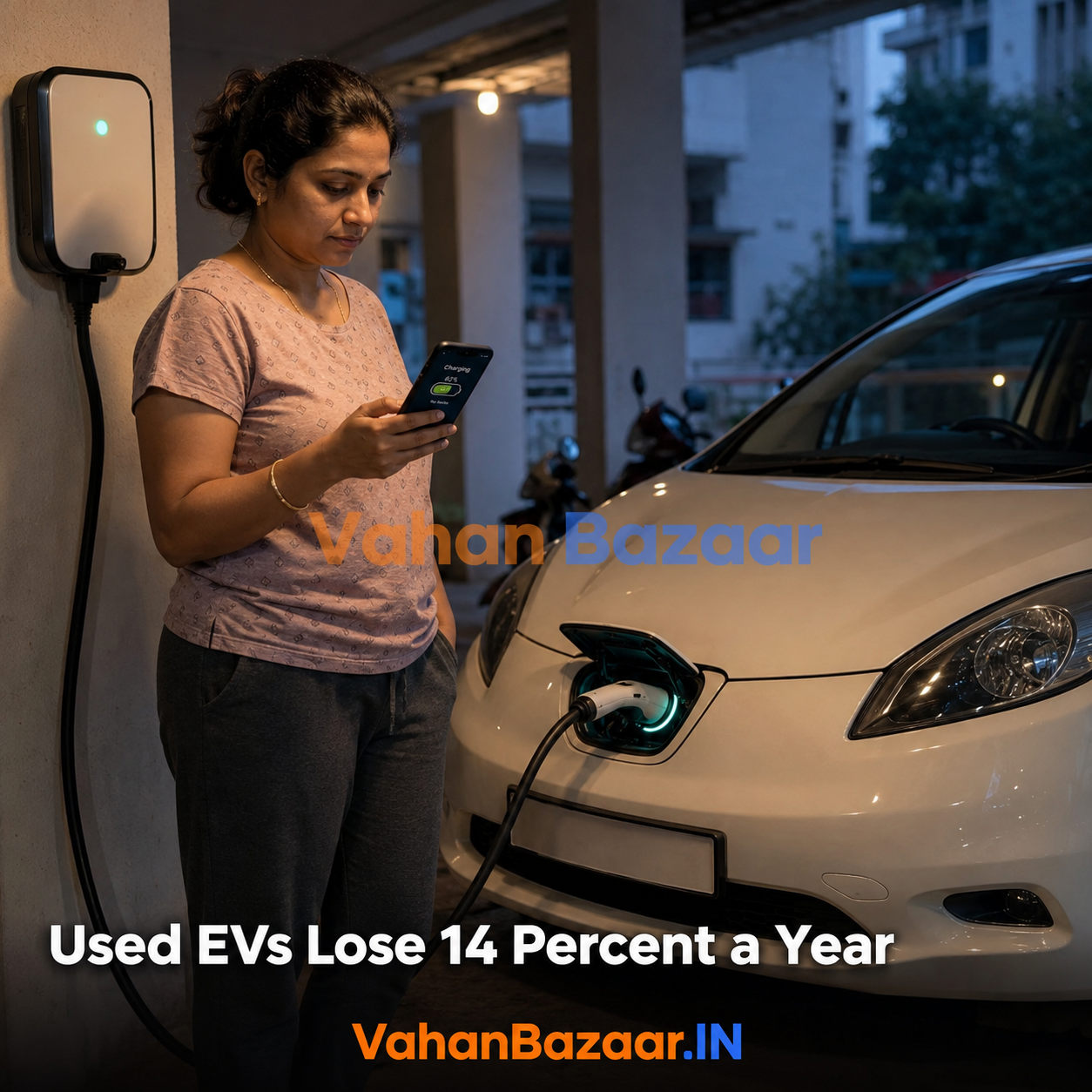
The used electric vehicle market in India has spent five years being a theory. It is now becoming an actual market, and the first proper look at the numbers is not flattering.
Analysis of used EV listings — more than 2,900 of them across 23 models — puts average depreciation at roughly 14 percent a year. That is a listings-derived figure from a young and thin market rather than an audited industry dataset, and it should be read as indicative. But the shape it describes is consistent with what everyone in the trade has been saying quietly: electric cars in India are losing value faster than their petrol equivalents, and the first year is where most of the damage happens.
The Shape Matters More Than the Average
A single annual percentage is a poor way to describe what actually happens to an electric car's value, because the curve is front-loaded in a way the petrol curve is not.
Reported figures put the first year at 15 to 25 percent for an EV against 10 to 15 percent for a comparable petrol car. After that, the EV curve settles to roughly 8 to 12 percent a year — which is not dramatically worse than petrol, and in some cases is better.
For an owner, that changes the decision completely. If you are still inside the first year, you are standing on the steepest part of the slope and selling crystallises the worst of it. If you are two or three years in, the expensive part has already happened to you, and what remains is a more ordinary rate of decline.
| Ownership stage | What the curve is doing | The reasonable move |
|---|---|---|
| Year 1 | Steepest decline, reported at 15-25%. | Hold unless you have to sell. You are paying for the newest part of the curve. |
| Years 2-3 | Flattening toward 8-12% a year. | The strongest window to sell. Curve has flattened, supply has not yet swelled. |
| Years 4+ | Steady decline, but battery questions sharpen. | Sell on evidence. Buyers discount hard for anything they cannot verify. |
Why the Battery Sits at the Centre of It
The battery pack can account for up to 40 percent of an electric car's cost, and it ages on a different schedule from the rest of the vehicle. State of health, the number of charge cycles it has been through, and its thermal history all determine how much range is left — and therefore what the car is worth.
Here is the structural problem. A petrol car's wear is legible. There is an odometer with a number on it, a service book, a compression test if you really want one. Everyone in the transaction broadly agrees on what those things mean.
An EV battery has none of that. India has no mandatory battery health testing framework for used electric vehicles, and the Ministry of Road Transport and Highways has not notified used-EV certification rules under the Central Motor Vehicle Rules. There is no universally accepted standard for measuring or certifying state of health for resale. Which means the most valuable single component in the car is also the one nobody can agree how to value.
The buyer assumes the worst and prices accordingly. That is not pessimism, it is rational behaviour under uncertainty — if the downside is a battery replacement running into lakhs and there is no way to rule it out, the only protection is to pay less. A large part of the 14 percent is not physical wear at all. It is the cost of an information gap.
The Models That Are Not Following the Average
The same listings analysis reports some models depreciating far more slowly than the average — the MG Windsor EV at around 2.2 percent a year and the BYD Seal at around 4.7 percent, against a market average near 14 percent.
Two cautions belong with those numbers, and they are important. They come from a single listings-based analysis rather than an audited industry source. And models that are new to the market or sell in small numbers can show flattering figures simply because there are very few used examples to price against — a thin market is a forgiving one, right up until it is not.
What the spread does tell you reliably is that depreciation is not a property of electric cars in general. It is a property of specific nameplates, and it tracks demand, charging convenience, running costs and how confident buyers feel about long-term support. Owners of models with strong used demand have considerably more room than the headline average suggests. Owners of models that never built a following have less.
The Supply Wave Nobody Has Priced In
There is a timing element to all of this that existing owners should take seriously.
The first mainstream cohort of Indian EVs — the cars bought between 2020 and 2023, when electric ownership stopped being an experiment and started being a normal purchase for urban families — is reaching the secondary market from 2026 onward. Those cars are hitting three, four and five years old, which is exactly when Indian owners typically change vehicles.
More supply into a market that still has no agreed way of valuing the most expensive component is not a comfortable combination. It means more listings competing for the same cautious buyers, and it means the buyer's ability to walk away improves. Residual values from here will increasingly be shaped by battery health, software support and whatever certification standards eventually emerge — and until those standards exist, by how much evidence an individual seller can put in front of an individual buyer. Our piece on the used-EV wave traces where that supply is coming from.
What This Means for EV Sellers
The instinct when facing a depreciating asset is to hold on and hope. For a used EV in India in 2026, that instinct is mostly wrong, because the two forces working against you — supply increasing and the technology moving on — both get worse with time, while the one working for you, the flattening curve, has already delivered most of its benefit by year three.
If you are past the first year and a sale is anywhere in your plans, the case for moving sooner is stronger than the case for waiting.
And when you do, compete on evidence rather than on price. The discount a buyer demands from an EV seller is largely a discount for uncertainty, which means every piece of verifiable information you can put in front of them is worth real money. Charging history, service records, any battery health report your manufacturer's app or service centre can produce, and a registration record that has been cross-checked rather than asserted. A verified listing on VahanBazaar costs Rs. 49 and cross-checks the car against the VAHAN database, confirming registration date, owner count, RC status and insurance validity so that the buyer's remaining questions are about the battery alone — and those you can answer directly. On average, based on VahanBazaar listings data, verified listings draw around three times more buyer enquiries and sell roughly 40 percent faster.
What This Means for Used EV Buyers
A market with structurally weak residuals is a good market to buy into, and the arithmetic is genuinely attractive: someone else has absorbed the steep first year, and you get a car with very low running costs for a fraction of its original price.
The risk is concentrated in one component, so concentrate your diligence there. Ask for the battery state of health reading from the manufacturer's app or a service centre, ask how the car was routinely charged and whether fast charging was the norm, and be direct about the fact that no certification standard exists — a seller who engages honestly with that question is telling you something useful, and one who deflects is telling you something too.
Everything outside the battery is an ordinary used-car check and should not be skipped just because the car is electric. Confirm the registration date and the vehicle's real age, the owner count, the RC status, whether a loan is still hypothecated against it, and whether there are challan or blacklist flags. A Vahan Verify check costs Rs. 49, with RC and challan checks together at Rs. 79. It will not tell you anything about the battery — nothing available in India today will, with certainty — but it settles every other question before you commit.
Frequently Asked Questions
Analysis of used electric vehicle listings in India points to an average of roughly 14 percent a year, drawn from a sample of more than 2,900 listings across 23 models. The shape matters more than the average. The first year is reported at 15 to 25 percent against 10 to 15 percent for a comparable petrol car, after which the curve settles to around 8 to 12 percent a year. That means an owner past the first year has already taken the steepest part of the hit. These are listing-derived figures from a market that is still young, so treat them as indicative rather than precise.
Three reasons compound. New EV prices have been falling as competition intensifies and tax treatment favours them, which drags used values down behind them. Range and charging technology are improving quickly, so a three-year-old EV can feel a generation behind in a way a three-year-old petrol car does not. And the battery, which can account for up to 40 percent of the vehicle's cost, has no agreed method of valuation on the used market, so buyers price the uncertainty by discounting.
Not at present. India has no mandatory battery health testing framework for used electric vehicles, and the Ministry of Road Transport and Highways has not notified used-EV certification rules under the Central Motor Vehicle Rules. Unlike an odometer reading, which at least has a number on the dashboard, battery state of health has no universally accepted standard for resale in India. This is the single largest structural reason used EV pricing is inconsistent, and it is a gap that only regulation or a widely trusted private standard can close.
Reported figures from used-listing analysis put the MG Windsor EV at around 2.2 percent a year and the BYD Seal at around 4.7 percent, both far below the roughly 14 percent average. Two cautions apply. These come from a single listings-based analysis rather than an audited industry dataset, and models with small sample sizes or short time in the market can show flattering numbers simply because there are few used examples to price against. Treat them as a directional signal about which nameplates are holding demand, not as a guarantee.
It depends almost entirely on where you are on the curve. If you are still inside the first year, you are in the steepest part and selling crystallises the worst of it, so unless you need to move, holding is usually better. If you are past two or three years, the annual rate has flattened, but supply is about to increase as the 2020 to 2023 cohort reaches the used market, which erodes pricing power over time. For most owners in that position the argument favours selling sooner rather than later, and competing on evidence rather than on price.