When you look at a used petrol or diesel car, almost everything that determines its value is either visible or verifiable. The odometer gives you kilometres. The service book gives you maintenance history. The registration record gives you age and owner count. You can hear the engine, feel the clutch, look at the tyres, read the paint. None of it is perfect, but a careful buyer can build a reasonably honest picture of what they are paying for, and the market has spent decades learning how to price the gaps.
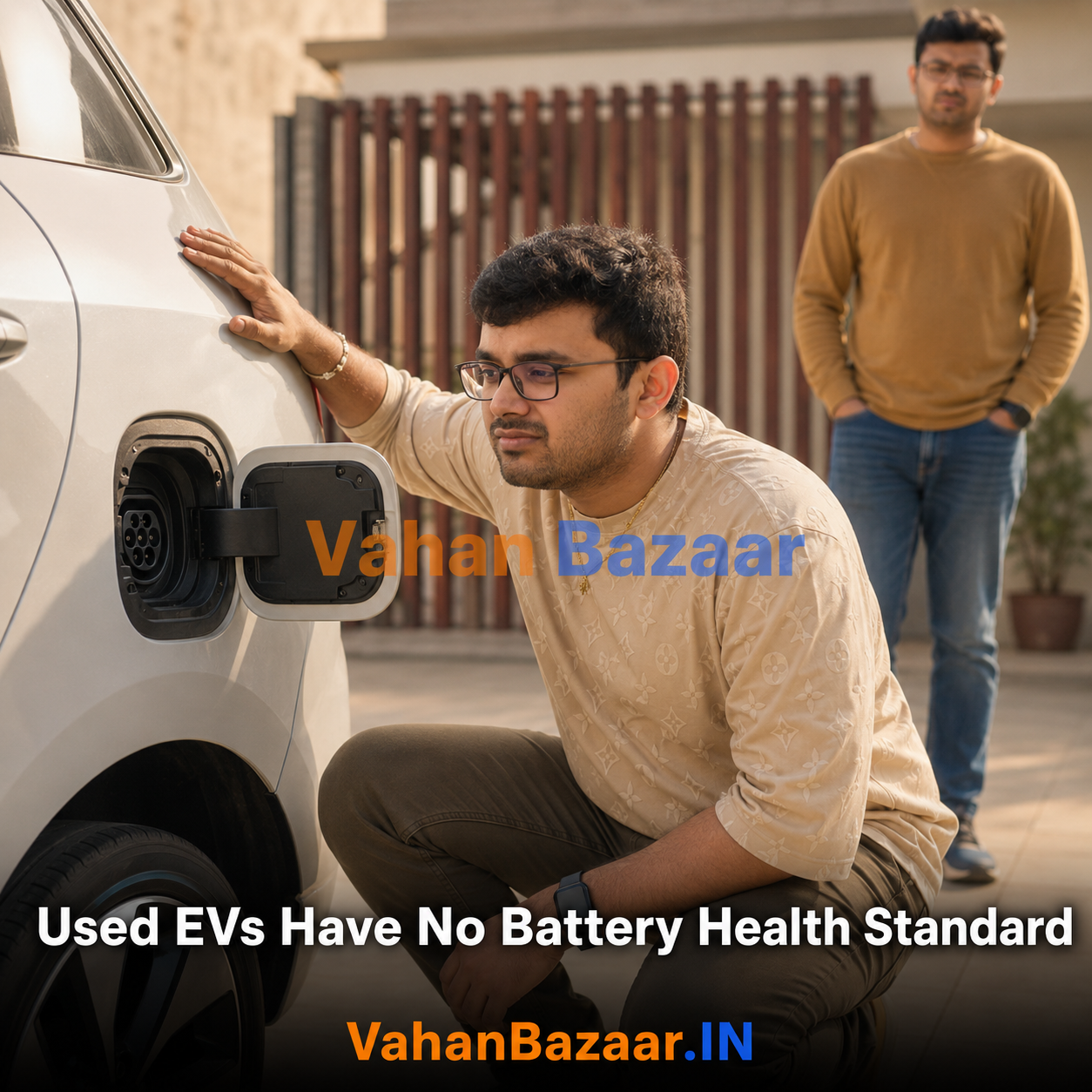
A used electric car is a different problem. Most of the same checks still apply, and they still matter. But the component that carries the largest share of the car's value is a sealed pack under the floor that a buyer cannot see, cannot hear and cannot meaningfully inspect on a Sunday morning test drive. And as Business Standard set out in its piece on the second-hand test facing India's used electric cars, there is no universally accepted standard yet in India to measure or certify electric vehicle battery health for resale.
That is worth stating plainly and then stating fairly. It is a genuine information gap. It is also an evolving area — the technology to read pack condition exists, the industry is actively working towards common ground, and standards will settle. They simply have not settled yet. In the meantime, a used EV buyer in India is being asked to put a price on something nobody can hand them a recognised certificate for.
This article is about what that actually means in rupees, and about the parts of a used electric car that are verifiable today.
The battery record is not public. The registration record is. Rs. 99 gets you age, owner count, RC status, insurance validity and flags before you negotiate.
What Battery Health Actually Means
The phrase gets used loosely, so it helps to break it into the three things that genuinely determine how much life is left in a pack. All three matter, and they interact.
State of Health
State of Health, almost always written as SoH, is the headline number. It expresses how much usable capacity a pack still holds compared with when it left the factory. A pack at full health delivers the range the car was sold with. A pack that has lost capacity delivers less, and the loss is permanent — this is chemistry, not a setting that can be reset. SoH is the closest thing an EV has to a compression test on a petrol engine, except that reading it properly requires access to the vehicle's own battery management data rather than a look under the bonnet.
Charge cycles
A charge cycle is one full equivalent discharge and recharge of the pack. Two cars with identical odometer readings can have lived very different electrical lives. A car driven 60 kilometres a day and topped up every evening has accumulated a different cycle count from one driven 300 kilometres twice a week. Fast charging in particular is convenient and entirely legitimate, but a pack that has spent much of its life on high-power chargers has been treated differently from one that mostly sipped from a home wall box overnight. Kilometres alone will not tell you which car you are standing in front of.
Thermal history
This is the one that deserves extra attention in India specifically. Heat is the single largest environmental stressor on a lithium-ion pack, and a car that has spent five summers parked in the open in Delhi, Ahmedabad or Nagpur has had a materially different thermal life from one garaged in Bengaluru or Pune. Add stop-start traffic, which keeps a pack working without much cooling airflow, and monsoon-season humidity, and Indian operating conditions genuinely shape how a battery ages. Thermal management systems handle a great deal of this. They do not erase it.
SoH, charge cycles and thermal history are not independent boxes to tick. Together they determine remaining range, and remaining range is what a second buyer is actually paying for. A used EV's price is, in large part, a bet on those three things. Right now, in India, that bet is being placed without a standard scorecard.
Why the Battery Is the Whole Valuation Question
On a petrol car, no single component carries a decisive share of the value. A clutch, a gearbox, a turbocharger — each is a real expense if it fails, but none of them is the car. On an electric car, the battery accounts for up to 40 percent of the vehicle's cost. That single figure changes the nature of the used purchase entirely.
If nearly two-fifths of what you are paying for sits in one sealed unit whose condition cannot be certified, then battery health is not a line item on an inspection checklist. It is the valuation. Everything else — paint, tyres, upholstery, infotainment — is rounding error by comparison. This is why the absence of a standard matters more for EVs than an equivalent gap would matter on a petrol car. The unknown is not at the edges of the price. It is most of the price.
It is also why residual values for EVs are expected to be shaped by a different set of variables going forward: battery health, software support and certification standards, rather than the familiar trio of kilometres, service history and owner count that governs the internal combustion market.
What Used EV Depreciation Actually Looks Like
Here is where the fair version of the story matters, because the "EVs collapse in value" line gets repeated more confidently than the data supports.
An analysis of over 2,980 real used EV listings across 23 models puts average annual depreciation across Indian EVs at approximately 14 percent per year. That is a real number from real listings, not a projection. The shape of the curve is front-loaded in the familiar way: mass-market EVs can depreciate about 20 to 30 percent of original value within the first 12 months, then a further 8 to 12 percent each year in years 2 to 5, depending on model, brand demand and battery condition.
| Segment | Typical pattern | Position at three years |
|---|---|---|
| Mass-market EVs, established brands, metro markets | About 20 to 30 percent in year one, then 8 to 12 percent a year | Around 70 to 75 percent of value retained |
| Indian EVs, all models, blended | Approximately 14 percent average annual depreciation | Varies widely by model and battery condition |
| Many premium and luxury EVs | Steeper curve, thinner second-hand demand | Around 40 to 60 percent depreciation over the same period |
Retaining 70 to 75 percent of value at three years is a respectable outcome by any standard, and it is not the profile of a category the market has rejected. A buyer looking at a three-year-old mass-market EV in a metro is not looking at a write-off. They are looking at a normal used car with one abnormal unknown.
The premium end tells a different story, and the reason is instructive. Steeper 40 to 60 percent depreciation on many premium and luxury EVs is not primarily a battery problem — it reflects thinner second-hand demand, higher replacement exposure, and buyers in that bracket who are more likely to want the newest software and the newest range figures. The spread between the two rows above is a demand story as much as a chemistry story.
Under GST 2.0, EVs attract 5 percent GST with no compensation cess. Combined with lower per-kilometre energy costs and fewer serviceable mechanical parts, the ownership economics that made EVs attractive new still apply to the second owner. The question this article raises is about pricing the purchase correctly, not about whether the category is worth buying into.
The First Real Used EV Wave Is Arriving Now
Until recently this was a theoretical discussion, because there were not enough used EVs on the market for it to matter. That is changing. The first mainstream EV cohorts, the cars registered between 2020 and 2023, start entering the secondary market from 2026 onwards. These are the vehicles whose second owners will be the first large group of Indians to face the battery-pricing question in volume.
The supply behind them keeps building. Total registered EV sales across all categories in July 2026 were 3,27,557, up from 3,10,107 in June 2026, on Vahan data reported by EVreporter. EV penetration in the four-wheeler passenger car and cab segment stood at 7.9 percent in July 2026. Every one of those registrations is a used EV two, three or four years from now.
You can already see the shape of it in listings. Popular electric variants of familiar nameplates dominate what comes to market first, which is why buyers browsing used Tata Nexon listings or used Tata Tiago listings increasingly find electric versions sitting alongside petrol ones at prices that look similar on the surface and are not remotely comparable underneath. The same is starting to happen across the wider Tata used car range, the Mahindra range and with used Hyundai Creta listings as electrified variants filter through.
What You Can Verify Today
Here is the constructive half. The battery may be opaque, but a great deal about a used electric car is not, and the verifiable facts are more useful for an EV than most buyers realise.
Age and owner count are the best available proxies
Nobody can hand you a certified SoH figure today. What you can establish is how long the pack has been in service and how many different people have been charging it. Those are not the same thing as battery health, and it would be dishonest to pretend otherwise — but they are the strongest proxies available, and they are free of the seller's opinion.
Age tells you how many summers the pack has sat through and how much calendar ageing has accumulated, which happens whether the car is driven or not. Owner count tells you how many charging regimes it has lived under. A car that has passed through three owners in five years has had three different sets of charging habits, three different parking situations, three different attitudes to fast charging and state-of-charge discipline. That is a materially different history from a single-owner car of the same age and the same odometer reading, and it is knowable in under a minute.
The registration date is what the warranty runs from
Battery warranties are the strongest financial protection a used EV buyer has, and they are almost always counted from the original date of registration, not from the date you buy the car. A seller's recollection of when the car was registered is not good enough to price a warranty against. The registration record is. Getting this right changes how much remaining cover you are buying, and remaining cover is worth real money on a component that represents up to 40 percent of the vehicle's cost.
What the record does not contain
Be clear about the limits. A Vahan Verify check pulls the car's VAHAN and RTO record: owner count, registration status, insurance validity, blacklist and challan flags, and vehicle age. An RC check costs Rs. 99, a challan check costs Rs. 99, and both together cost Rs. 149 rather than Rs. 198 separately.
It does not contain battery State of Health. No government record in India does, yet. Anybody suggesting otherwise is selling you something. What the record establishes is the registration date the warranty runs from, and the ownership history that tells you how many hands and how many charging habits the pack has been through. On an electric car, those two facts are doing more work than they do on a petrol one.
A Practical Pre-Purchase Sequence
Order matters here, because each step tells you whether the next one is worth taking.
- Pull the government record first. Before you travel to see the car, before you negotiate, and before you get attached to it. Establish age, owner count, RC status, insurance validity and any flags. If the seller said single owner and the record says three, you have learnt something about the car and about the seller.
- Ask for charging history and battery service records. Any battery service, module replacement or pack replacement should be documented. Ask directly whether the car was charged mostly at home or mostly on fast chargers, and where it was parked. A seller who has this information and shares it readily is telling you something; so is one who has none of it.
- Check remaining battery warranty against the original registration date. Not against the seller's memory, and not against the year printed in the listing headline. Work out exactly how much cover transfers to you and under what conditions.
- Take an extended test drive and note the state of charge at start and end. Not a ten-minute loop. Drive it long enough for the numbers to mean something, record the percentage and indicated range when you start and when you finish, and compare the energy consumed against the distance actually covered. This is not a laboratory SoH measurement and it should not be presented as one, but a car that visibly falls short of what its charge level promised is telling you to look harder.
- Establish the record before you commit. A Vahan Verify check at Rs. 99 gives you the registration date the battery warranty runs from, plus owner count and status, rather than an impression formed in a stranger's driveway.
The first is treating a used EV like a used petrol car and negotiating purely on kilometres and year. The second is the opposite error — assuming the battery must be degraded and refusing the category outright. Both price the car wrongly. The correct posture is to establish every verifiable fact, treat age and owner count as the proxies they are, and pay for the range you can demonstrate rather than the range printed in the original brochure.
What This Means for Used Car Buyers
The practical position for a buyer in 2026 is this. Used EVs are a reasonable purchase, and mass-market models from established brands retaining around 70 to 75 percent of value at three years in metros is evidence of that rather than against it. Running costs remain low and GST at 5 percent with no compensation cess under GST 2.0 keeps the arithmetic sensible. The category is not the problem.
The problem is narrower and quite specific: you are being asked to price an unknown that represents up to 40 percent of what you are paying. Nobody can currently remove that unknown for you with a certificate. What you can do is shrink the surrounding uncertainty to nothing, so the only thing you are guessing about is the one thing nobody can yet certify. Age, owner count, registration date, insurance validity, blacklist and challan flags — every one of those is establishable for Rs. 99 before you make an offer, and on an electric car they carry more weight than they do on a petrol one because they are the closest available read on how the pack has been treated.
Geography matters too. Metro markets, where mass-market EVs hold 70 to 75 percent at three years, have deeper charging infrastructure and deeper buyer pools, which is why used EV listings in Delhi, Bengaluru and Pune behave differently from smaller markets where a second buyer may be harder to find. If you expect to resell within three or four years, the depth of your local market is part of the price you should be paying today. Buyers weighing an electric SUV against a petrol one will also find the comparison worth making against the established used SUV field, where the resale mechanics are better understood.
For sellers, the mirror image applies, and it is an opportunity rather than a burden. If you are listing an electric car, you are asking a buyer to trust you on the most expensive component in the vehicle. The sellers who transact fastest are the ones who make everything else unarguable — a listing whose registration details have been cross-checked against the VAHAN database, plus whatever charging and battery service documentation you actually hold. You cannot hand a buyer a battery certificate that does not exist yet. You can remove every other reason for them to hesitate, and in a market where buyers are nervous about one thing, removing the other five is what closes the deal.
The standard will come. Battery health certification is exactly the kind of thing that gets solved once enough vehicles hit the second-hand market to make solving it worthwhile, and the 2020 to 2023 cohorts arriving from 2026 onwards are what creates that pressure. Until it lands, the buyer's job is to be precise about what is known and honest about what is not — and to make sure that the list of unknowns is exactly one item long. You can browse listings with that framework in mind.
Establish Everything the Battery Cannot Tell You
Owner count, vehicle age, RC status, insurance validity, blacklist and challan flags, straight from the VAHAN database against the registration number. It will not give you battery State of Health, because no record in India does yet. It will give you the registration date your warranty runs from and the ownership history the pack has lived through. RC check Rs. 99, challan check Rs. 99, or both together for Rs. 149 instead of Rs. 198.
Buying and selling in the same month? List your current car RC-verified for Rs. 99.
Frequently Asked Questions
Not yet. As of 2026 there is no universally accepted standard in India to measure or certify an electric vehicle's battery health for resale. This is an evolving area and the industry is working towards it, but a buyer today cannot ask for a single recognised certificate the way they might ask for a service record on a petrol car. What a buyer can do is establish the verifiable facts around the battery: the registration date the warranty runs from, the vehicle's age, the owner count, and any battery service or replacement records the seller holds.
State of Health, usually written as SoH, is a measure of how much usable capacity a battery pack retains compared with when it was new. Together with the number of charge cycles the pack has been through and its thermal history, SoH determines how much range the car can still deliver. Because the battery accounts for up to 40 percent of an electric car's cost, a pack that has degraded meaningfully takes a large share of the vehicle's value with it. That is why battery condition, rather than kilometres alone, is becoming the central question in used EV valuation.
Analysis of over 2,980 real used EV listings across 23 models puts average annual depreciation across Indian EVs at approximately 14 percent per year. Mass-market EVs can lose about 20 to 30 percent of original value within the first 12 months, then a further 8 to 12 percent each year in years 2 to 5, depending on model, brand demand and battery condition. Mass-market EVs from established brands can retain around 70 to 75 percent of value at three years in metros, while many premium and luxury EVs see steeper 40 to 60 percent depreciation over the same period.
No. No government record in India carries battery State of Health today. What the VAHAN record does carry is the registration date, the vehicle's age, the owner count, RC status, insurance validity, and blacklist and challan flags. Those matter for an EV in a specific way: the registration date is what a battery warranty period is counted from, and the owner count tells you how many different charging habits the pack has lived through. A Vahan Verify RC check on VahanBazaar costs Rs. 99, a challan check costs Rs. 99, and both together cost Rs. 149 instead of Rs. 198.
No. Mass-market EVs from established brands holding around 70 to 75 percent of value at three years in metros is a respectable outcome, running costs remain low, and EVs attract 5 percent GST with no compensation cess under GST 2.0. The honest caution is different: because there is no settled battery certification standard yet, a used EV buyer is being asked to price a component they cannot directly inspect. The sensible response is to establish everything that is verifiable, use age and owner count as proxies for how the pack has been treated, and check the remaining battery warranty against the original registration date before agreeing a price.