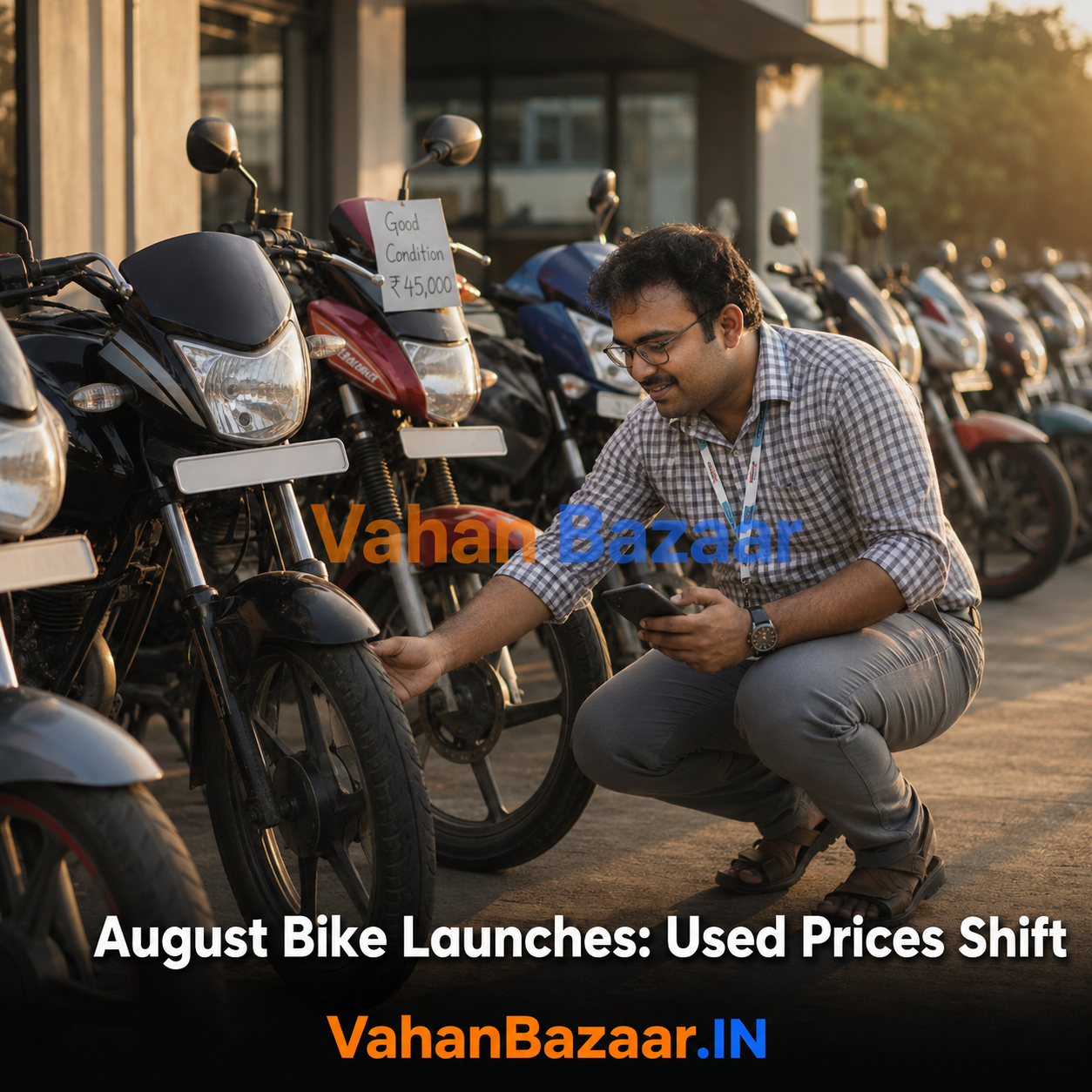
Three two-wheelers land in India inside one week. The Yamaha R2 is due on 27 August, the Ather EL scooter on 29 August, and Honda has already pulled the covers off the 2026 CB350 family. Individually, each is a product story. Together, in the same seven days, they are something more useful to anyone shopping second-hand: a supply event.
Because the interesting thing about a launch wave is never the new bike. It is what happens to the outgoing one. Every rider who moves up releases a machine into the used market, and they tend to do it in the same few weeks. Prices on the previous generation soften, listings multiply, and the buyer who was patient suddenly has choice. That is genuinely good news. It is also the exact moment when the basic record checks get skipped, because a discount creates urgency and urgency is where used two-wheeler purchases go wrong.
A used bike at a good price feels like a decision that has already been made. The seller knows it. The listing is priced to move, there is a queue of interested buyers, and the pressure is to pay a token today. Nothing in that sequence gives you a moment to establish whether the machine is financed, blacklisted, carrying challans, or three years from the end of its registration life. Those four facts do not appear on the bike. They appear on the record.
What Is Actually Landing, and When
Worth being precise here, because two of the three had not launched at the time of writing and the prices circulating are estimates rather than announced figures.
| Model | Date | Reported price expectation | What it displaces |
|---|---|---|---|
| Yamaha R2 | 27 August 2026 | Around Rs. 2 Lakh, estimates vary | Sits above the R15 V4 in the range |
| Ather EL | 29 August 2026 | Reported Rs. 1.15–1.40 Lakh | Family scooter, separate from the 450 range |
| Honda CB350 (2026) | Unveiled, on sale shortly | Reported around Rs. 2 Lakh | Supersedes the outgoing CB350 series |
On the Yamaha, pre-bookings have been open at a reported Rs. 10,000, adjusted against the final price at purchase. The machine is positioned above the R15 V4, which is the detail that matters for the used market: R15 owners are the obvious upgrade pool, and R15s are among the most heavily traded sportbikes in the country.
The Ather EL is the more consequential of the three for ordinary buyers, because it is aimed at the family scooter buyer rather than the enthusiast — a larger floorboard, a longer seat, and a claimed range reported at over 150 km on the higher variants. That is a different customer from the 450 range, and a customer who very often already owns a petrol scooter they intend to replace.
Honda's 2026 CB350, CB350RS and CB350C carry over the familiar 348.36cc air-cooled single making a reported 20.7 bhp and 29.4 Nm, with a five-speed gearbox and an assist-and-slipper clutch. A carried-over engine is worth noting for a used buyer, because it means the outgoing bikes are not made mechanically obsolete by the update — they are made cheaper by it.
Two of these three models had not launched when this was written, and reported price expectations for the Yamaha in particular ranged from a little under Rs. 2 Lakh to around Rs. 2.50 Lakh depending on the outlet. Treat every figure above as an indication of the bracket rather than a quote. Confirm the actual ex-showroom and on-road price with the manufacturer or a dealer before you build a budget around it.
Why a Launch Wave Moves Used Prices
The mechanism is simple and it repeats every time. A new model arrives. Existing owners of the outgoing model, who have been waiting for it, sell. Dealers discount remaining stock of the old bike, which drags the used price of the same bike down with it, because nobody pays 90% of a new-bike price for a two-year-old example. Within roughly a quarter, the outgoing generation is measurably cheaper on the used market than it was the month before the launch.
What makes this August unusual is volume. Indian two-wheeler registrations reached 18.18 Lakh units in July 2026, up about 28% year on year from 14.19 Lakh in July 2025, according to figures published by JATO Dynamics. A market running that hot produces a large upgrade pool, and a large upgrade pool produces a large second-hand wave behind it. We looked at the same dynamic when record July two-wheeler and three-wheeler sales pointed to a used wave, and the launch calendar now adds a trigger to the supply.
For a buyer, that is a real opportunity and it should be treated as one. The caution is narrow and specific: a wider choice of cheap bikes also means a wider choice of bikes being offloaded for reasons the listing does not mention.
The Checks That Matter More on a Bike Than a Car
Used two-wheeler buying gets treated as a smaller version of used car buying. It is not. Some risks are materially larger on a bike, and the sums involved make people less willing to spend anything on due diligence — which is precisely backwards, because the check costs the same either way while the deal moves faster.
Whether a loan is still open on it
Two-wheelers are financed at very high rates in India, frequently on small-ticket consumer loans that the rider has half-forgotten. If a financier still holds a charge against the machine, the registration cannot transfer into your name until that charge is removed, regardless of what the seller has actually repaid. The seller is usually not lying. They paid the loan off and assumed the record updated itself. It does not. Our guide to checking whether there is still a loan on a scooter covers what the entry looks like and how it gets cleared.
Challans attached to the machine
Unpaid challans follow the vehicle, not the person who earned them, and on two-wheelers they accumulate quietly — camera-issued tickets for helmets, signals and lane discipline that the rider never saw. They surface when you attempt the transfer. Checking and clearing a used bike's challans before money moves is a five-minute job that saves a stalled transfer later.
Insurance status and the no-claim bonus
A lapsed policy on a used two-wheeler is common and it costs you twice: once in the gap in cover, and once in the no-claim bonus you cannot inherit. It is worth understanding how insurance and NCB actually transfer on a used bike before you agree a price that assumes they do. The rules on how long new two-wheelers must carry third-party cover have also moved recently, which we covered when new bikes were required to carry six years of insurance.
How much registration life is left
This is the one that catches enthusiasts buying older machines. A two-wheeler's initial registration runs 15 years, after which re-registration and a fitness assessment are required, with costs and state green tax on top. A seven-year-old bike at a tempting price has around eight years of straightforward life left. A thirteen-year-old one has two. Our note on what to do when a bike turns 15 sets out the sequence and what it costs.
Check the Bike Before You Pay the Token
Registration date and true age, registration status, owner serial number, whether a financier still holds a charge, and blacklist flags — pulled from the official record against any registration number, in about a minute. RC check Rs. 99, challan check Rs. 99, or both together for Rs. 149.
What This Means for Used Two-Wheeler Buyers
Three practical positions, depending on what you are shopping for.
If you want the outgoing model cheap
This is the strongest case in the wave, and the CB350 is the clearest example of it: a carried-over engine means the pre-update bikes are not technically superseded, only commercially superseded. You are buying the same mechanical package at a lower price. Do the record check anyway, and do it before you agree the number rather than after — an open hypothecation or a stack of challans is a legitimate reason to renegotiate, and it only works as leverage while you still have money in your pocket.
If you are buying a used R15 or similar as the R2 lands
Expect more listings and softer asking prices over the coming months. Expect also that a proportion of those listings will be enthusiast-owned bikes that have been ridden hard, and a proportion will have modifications that were never endorsed on the registration record. An unendorsed modification is the owner's problem until it becomes yours at transfer. Establish the registration date, the owner serial number and the status before you fall for a colour.
If you are replacing a petrol scooter with a used one
The Ather EL's arrival at the family end of the market will, over time, push more used petrol scooters into circulation, and those are the machines most likely to be sold informally without paperwork discipline. A scooter bought from a neighbour with a handshake and no transfer is a scooter whose challans and liability remain, on the record, attached to somebody else — until they are attached to you. Our full checklist for checking a used bike or scooter's record before buying is the place to start, and the transfer process itself is now considerably less painful than its reputation.
One group deserves a separate mention. Riders buying a used two-wheeler to earn on — delivery and gig work — are buying a tool, not a toy, and the checks that matter shift accordingly, towards running costs, service history and whether the machine can survive the duty cycle. We set those out separately in our checks for gig riders buying a used delivery bike.
What This Means for Sellers
If you own the outgoing version of any of these three and you have been thinking about selling, the timing argument points in one direction: earlier is better than later. Not because your bike is about to become worthless — it is not — but because you are about to be one of many. The first sellers into a supply wave meet buyers who still have limited choice. The ones who list three months later are competing against everyone who moved first.
What actually separates a bike that sells from one that sits, at the same price, is whether the buyer can satisfy themselves quickly. Clear your challans before you advertise. Confirm the hypothecation has genuinely been removed from the record if your loan has closed, rather than assuming it lapsed when you made the last payment — this is the single most common cause of a two-wheeler sale collapsing at the transfer stage. Have the insurance position straight and be accurate about the no-claim bonus.
Then let the buyer see it. A verified listing at Rs. 99 cross-checks the vehicle against the official record and carries a Verified badge, which answers the buyer's first reasonable question before they have to ask it. On average, based on VahanBazaar listings data, verified listings draw around three times more buyer enquiries and typically sell about 40% faster than unverified ones. In a market that is about to get crowded, being the listing that has already answered the obvious question is worth more than being the cheapest one.
The Short Version
Three notable two-wheelers arrive inside one week: the Yamaha R2 on 27 August, the Ather EL on 29 August, and the updated Honda CB350 family. Prices reported ahead of launch are estimates, not announcements, and the Yamaha's in particular varies by outlet.
For used buyers the meaningful consequence is supply. A market that registered 18.18 Lakh two-wheelers in July, up about 28% year on year, produces a large upgrade pool, and launches give that pool a reason to move. More choice and softer prices are coming.
The four things that decide whether a cheap used bike is actually cheap — an open loan, unpaid challans, lapsed insurance, and how many years of registration life remain — are not visible on the machine and are not in the listing. They are on the record, and pulling it costs Rs. 99 against a purchase you will live with for years.
Frequently Asked Questions
The Yamaha R2 is scheduled for 27 August 2026 and the Ather EL for 29 August 2026. Honda has already unveiled the 2026 CB350, CB350RS and CB350C. Prices circulating ahead of launch are estimates rather than announced figures, and the reported expectation for the Yamaha in particular varies noticeably between outlets, from a little under Rs. 2 Lakh to around Rs. 2.50 Lakh. Confirm the actual ex-showroom and on-road price with the manufacturer or a dealer before budgeting against it.
They tend to, through supply rather than through any change to the older machine. When a new model arrives, existing owners of the outgoing version who were waiting for it sell, and dealers discount remaining old stock, which pulls used asking prices down with it. The effect usually shows over roughly a quarter rather than overnight. It is most pronounced where the upgrade pool is large, which is why a launch calendar landing on top of a market that registered 18.18 Lakh two-wheelers in July matters more than a single launch would on its own.
Four things decide whether a cheap bike is actually cheap, and none are visible on the machine. Whether a financier still holds a charge against it, because an open hypothecation blocks the transfer regardless of what the seller has repaid. Whether unpaid challans are attached to the vehicle, since those follow the machine rather than the rider. Whether the insurance is live and what happens to the no-claim bonus. And how many years of registration life remain, given that initial registration runs 15 years. All four sit on the registration record. On VahanBazaar an RC check costs Rs. 99, a challan check Rs. 99, or both together Rs. 149.
The update carries over the same 348.36cc air-cooled single, reported at 20.7 bhp and 29.4 Nm with a five-speed gearbox and an assist-and-slipper clutch. That matters to a used buyer, because it means the earlier bikes are commercially superseded rather than mechanically superseded. You are looking at broadly the same mechanical package at a lower price, which is a reasonable position to buy from. The record check still applies, and an open loan or a stack of challans is a legitimate reason to renegotiate while you still have leverage.
It does, though not because your machine loses its value overnight. A launch wave brings a lot of similar bikes to market at roughly the same time, so early sellers meet buyers who still have limited choice while later sellers compete against everyone who moved first. Beyond timing, the practical work is clearing outstanding challans, confirming the hypothecation has actually been removed from the record if your loan has closed, and being accurate about the insurance and no-claim bonus position. Those are the things that decide whether a sale completes or stalls at transfer.