Bharat NCAP has had a busy few weeks. The 2026 Maruti Suzuki Brezza has come through with 5 stars for both adult and child occupant protection, scoring 30.41 out of 32 for adults and 43 out of 49 for children. The Nissan Tekton, the latest model to be crash-tested by the programme, has taken a full 5-star rating on 30.49 out of 32 and 45 out of 49.
Those are strong results and they deserve the coverage they are getting. But there is a second story sitting quietly underneath them, and it is the one that actually affects most people reading car news in India, because most people reading car news in India are shopping second-hand.
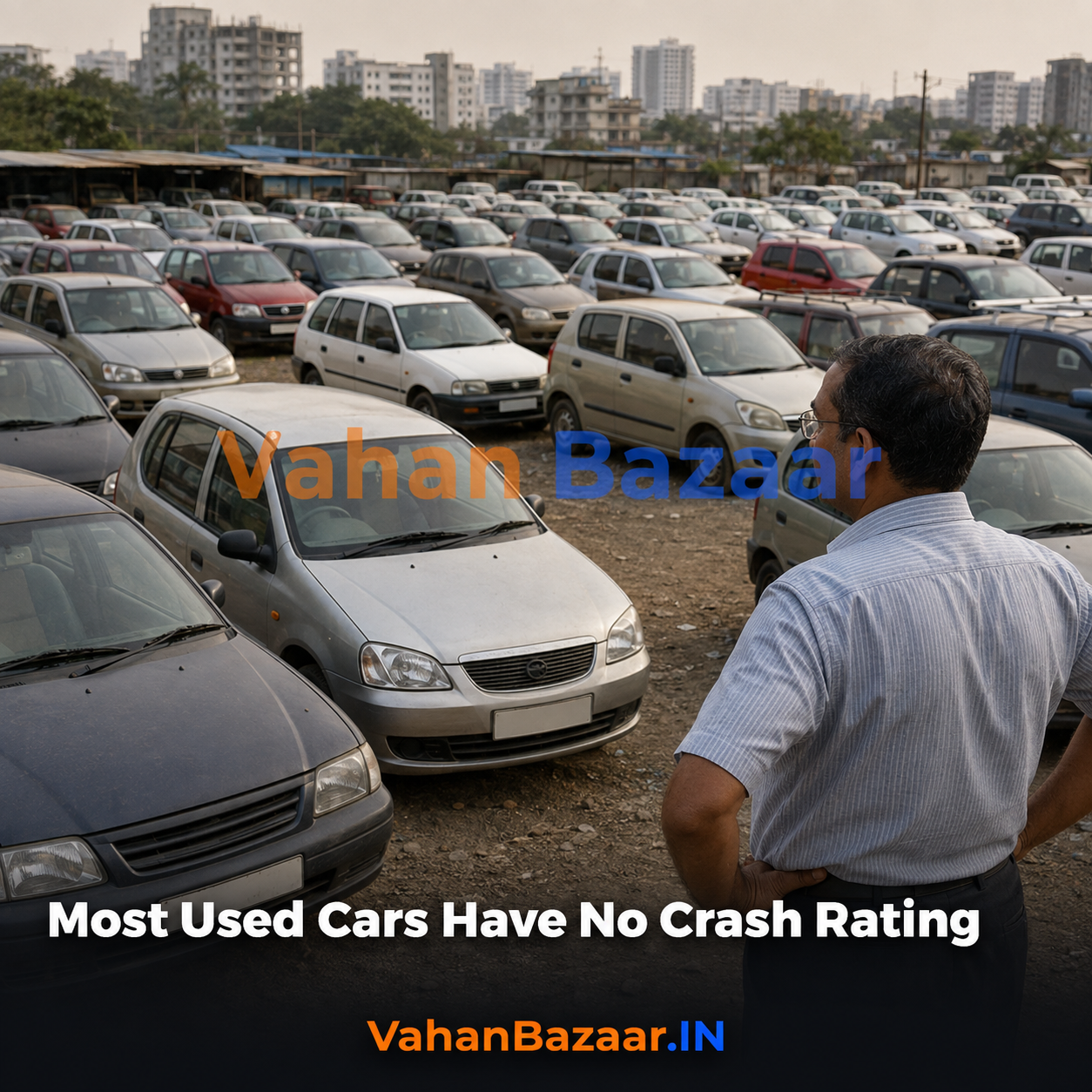
Bharat NCAP was introduced by the central government in 2023, and it has tested 31 vehicles since inception, primarily SUVs. Set that against a used market that spans roughly two decades of hatchbacks, sedans, MPVs and SUVs, sold across thousands of variant permutations. The arithmetic is not close. The overwhelming majority of cars a used buyer will ever look at have no Bharat NCAP rating at all.
Which leads to the question this article is actually about. Not "which star rating applies" — but "what do you do when there is no star rating, and how do you assess a car without one?"
No star rating on the car you are looking at? The registration record still tells you plenty — and it costs Rs 99 to read before you negotiate.
What the Latest Round Actually Published
Start with the news itself, because it sets the scale. Here are the most recent published results alongside the current leaders.
| Vehicle | Adult occupant protection | Child occupant protection | Overall |
|---|---|---|---|
| 2026 Maruti Suzuki Brezza | 30.41 out of 32 | 43 out of 49 | 5 stars, both categories |
| Nissan Tekton | 30.49 out of 32 | 45 out of 49 | Full 5-star rating |
| Mahindra XEV 9e | 32 out of 32 | 45 out of 49 | Leads the rankings |
| Tata Harrier EV | 32 out of 32 | 45 out of 49 | Leads the rankings |
The Nissan Tekton is the newest entry on that list, and at the top sit the Mahindra XEV 9e and the Tata Harrier EV, both recording a maximum 32 out of 32 for adult occupant protection alongside 45 out of 49 for children. The Brezza and the Tekton are separated by eight hundredths of a point on the adult score. That is what a maturing programme looks like: a cluster of strong performers, with margins too fine to be a buying criterion on their own.
It is worth saying clearly that this is a good programme doing valuable work. In three years it has changed what Indian buyers ask for in a showroom, and manufacturers have responded. Crash performance is now part of the mainstream conversation in a way it simply was not before 2023.
The Coverage Gap Nobody Puts a Number On
Now the part that gets left out of the headlines. Thirty-one vehicles is a meaningful body of work for a programme three years old. It is also a very small slice of what is parked on Indian roads and listed for sale on any given day.
The programme is young, and it skews to SUVs
Two structural facts drive the gap. First, timing: a car sold new in 2016 or 2019 could not have been tested by a programme introduced in 2023. Whole model generations came and went before the first assessment took place. Second, mix: the tested set is primarily SUVs. Some of the highest-volume shapes in the Indian used market — the small hatchback, the compact sedan, the seven-seat MPV that does school runs in every city — are far less represented.
So the buyer most likely to find a rating for the exact car they want is the buyer shopping a recent, popular SUV. The buyer shopping a five-year-old hatchback in Chennai or a family MPV in Hyderabad is very likely to find nothing at all, and there is no failing on the car's part in that.
Variant permutations multiply the gap
Even where a model has been tested, the used market does not sell models. It sells individual cars, each one a particular variant from a particular year with a particular equipment list. A single popular nameplate can run to a dozen trims across petrol, diesel and CNG, refreshed across several model years. Multiply that across every nameplate on sale over two decades and you are into thousands of distinct configurations. A published list of 31 tested vehicles was never going to map cleanly onto that.
The narrower question of which model year a given star belongs to is a real one, and we have covered it separately in our explainer on why a rating attaches to one model year rather than to the nameplate. For the purposes of this article, the point is simpler and broader: for most used cars, there is no rating to attach to anything.
Unrated Is Not Unsafe. Say It Out Loud.
This is the spine of the whole piece, so let us be blunt about it. If a car has no Bharat NCAP star rating, it has not failed anything. It has not been marked down. It has not been assessed and found wanting. It has simply never been through the assessment.
What an absent rating actually means
An absent rating is an absence of data. That is the whole of it. Every vehicle sold new in India met the safety standards in force at the time it was manufactured — that is a legal requirement, not a matter of opinion. A car built in 2018 complied with 2018 norms; a car built in 2024 complied with 2024 norms. None of that changes because a voluntary assessment programme launched in 2023 and has not yet got round to that particular model.
The honest statement about an untested car is therefore narrow and precise: its crash performance has not been independently published. That is different from a statement about how it would perform. No conclusion of the second kind can be drawn from a fact of the first kind.
Why "no stars" and "bad stars" get confused
The confusion is understandable. Star ratings are designed to be scannable, and a scannable scale invites the brain to fill in a blank with a zero. But the scale has no zero for untested cars — they are not on the scale at all. Treating a blank as a low score is a reasoning error, and it is one that unfairly devalues a very large number of perfectly sound cars that continue to serve families across the country.
It cuts the other way too, and this matters if you are selling. An owner with an unrated but well-maintained car should not accept a discount framed around a rating the model never had the opportunity to earn. The correct response to "it has no rating" is "no model of its generation does, and here is the documentation on this specific car".
"This model has a published Bharat NCAP result" and "this model has no published Bharat NCAP result" are both accurate and both useful. Anything that converts the second into a judgement about how a car would behave in a crash is a guess wearing the clothes of a fact. What a buyer is entitled to insist on is knowing which of the two applies — and then assessing the individual car on evidence that does exist.
What You Can Actually Verify Instead
This is the practical payoff. Remove the star rating from the equation and you are not left with nothing. You are left with a set of checks that are, in several ways, more specific to the car in front of you than a model-level rating ever was — because a rating describes a tested example, while these describe this example.
1. The registration record
The government vehicle record is the factual base layer under any used purchase. It carries the registration date, the maker's model and variant description, the fuel type and the vehicle age, alongside owner count, registration status, insurance validity and blacklist and challan flags.
Each of those does real work. The maker's description identifies what the manufacturer says the vehicle is, which is the starting point for confirming its equipment. Fuel type catches retrofits and mismatches. Owner count is one of the most commonly stretched claims in a listing, which is why the difference between an advertisement and the owner number on the record is worth reading for yourself. Vehicle age drives insurance, resale and re-registration maths. One note in passing: the registration date is not the manufacture date, and a car built late in one year can be registered early in the next — the explainer linked above covers that in detail.
A Vahan Verify check reads that record from the VAHAN database against the registration number. An RC check costs Rs 99, a challan check costs Rs 99, and both together cost Rs 149 rather than Rs 198 separately. Our breakdown of the seven RC fields that decide a used-car deal goes field by field through what each line is good for.
2. The variant's actual airbag count
Safety equipment is the part buyers most often assume and least often confirm. The key fact here is that six airbags are not retrospectively mandatory across all older cars. There was no national switch that flipped on a date, so airbag count on a used car varies by variant and by model year rather than following the year on the number plate.
The practical consequence is that two cars of the same model and the same year, parked side by side and identical from ten feet away, can carry different airbag counts because they are different variants. So confirm rather than assume. The markings in the cabin are the quickest read — moulded lettering on the steering wheel boss and the dashboard for the front pair, small tags on the outboard bolsters of the front seat backrests for side or torso airbags, and labels on the pillar trims above the door apertures for curtain airbags. Then hold that against the variant on the record and the manufacturer's published specification for that model year. Our guide to how airbags actually work and when they deploy is useful context if this is unfamiliar ground.
3. The individual car's condition and history
A crash rating describes a car as it left the factory. A used car has lived a life since then, and that life is often the bigger variable. Structural repair history, the quality of any accident work, tyre condition, brake condition and outstanding manufacturer recalls all affect the actual vehicle in ways no star rating can capture. Checking for open recalls you would otherwise inherit is a free, five-minute task that most buyers skip entirely.
This is also why a clean record alone is not the finish line. As we have argued before, a clean RC is not enough on its own — the documents and the physical inspection answer different questions, and you want both. A structured pre-purchase checklist keeps the two from collapsing into each other.
What This Means for Used Car Buyers
Reframe how you use star ratings and the whole problem gets easier.
If the exact model and generation you are considering has a published Bharat NCAP result, take it seriously — it is real, independently produced information, and it is worth paying something for. If it does not, do not treat that as a mark against the car and do not let anyone price it as one. Move instead to the evidence that exists for the specific vehicle.
In sequence, on any used car:
- Establish the facts from the record first. Registration date, the maker's model and variant description, fuel type, vehicle age, owner count, registration status, insurance validity, and blacklist and challan flags.
- Confirm the variant's safety equipment. Start with airbag count, checked against the variant rather than the model name, because fitment varies by variant and model year.
- Inspect the individual car. Structural and repair history, tyres, brakes and open recalls — the things that describe this vehicle rather than a factory-fresh one.
- Use any published rating as context, not as a substitute. It tells you about a tested car. The three steps above tell you about yours.
Market depth changes how much room you have to be selective. In deeper pools such as Delhi and Pune, enough examples of a popular model are listed at any moment that you can hold out for the exact variant and condition you want. In thinner markets the realistic move is to know precisely what you are getting and negotiate on that basis. Either way, you can browse listings with these checks in mind rather than waiting for a star rating that, for most cars, is never going to arrive.
The programme itself is continuing to evolve its assessment, and coverage will widen over time as more models go through. That is welcome. But it will always run behind a used market that is decades deep, which means the skill of assessing an unrated car on its own documented merits is not a stopgap. It is a permanent part of buying well in India.
No Star Rating? The Record Still Tells You a Great Deal
A Vahan Verify check reads the car's VAHAN and RTO record against the registration number: owner count, registration status, insurance validity, blacklist and challan flags, and vehicle age. It does not publish a crash-test score, because no government record does. What it gives you is verified fact about the specific car in front of you — which is exactly what you need when no star rating exists for it. RC check Rs 99, challan check Rs 99, or both for Rs 149 instead of Rs 198 separately.
Frequently Asked Questions
Bharat NCAP was introduced by the central government in 2023 and has tested 31 vehicles since inception, primarily SUVs. The most recent results include the 2026 Maruti Suzuki Brezza at 5 stars with 30.41 out of 32 for adult occupant protection and 43 out of 49 for child occupant protection, and the Nissan Tekton at 5 stars with 30.49 out of 32 and 45 out of 49.
Because of arithmetic rather than anything else. The programme began in 2023 and has assessed 31 vehicles, weighted towards SUVs. The used market spans roughly two decades of hatchbacks, sedans, MPVs and SUVs across thousands of variant permutations. Most of those cars were built and sold before the programme existed, or were simply never submitted to it, so no published star result exists for them.
No. Unrated is not unsafe. A car with no published star result has not failed anything and has not been marked down. It has simply never been through the assessment, usually because it predates the programme. Every vehicle sold new in India met the safety standards in force at the time it was manufactured. The absence of a published test is an absence of data, not a negative verdict.
Three things carry real weight. First, the registration record: registration date, the maker's model and variant description, fuel type, vehicle age, owner count, registration status, insurance validity and blacklist or challan flags. Second, the variant's actual safety equipment, starting with airbag count, confirmed against the specific variant rather than the model name. Third, the physical and documentary condition of the car, including structural repair history and any open recalls. Together these tell you far more about the individual vehicle than a model-level star rating would.
No. Six airbags are not retrospectively mandatory across all older cars, so airbag count on a used car varies by variant and by model year rather than following one national cut-off. Two cars of the same model and the same year can carry different airbag counts because they are different variants. Airbag count has to be confirmed against the specific vehicle and its variant, not assumed from its age.