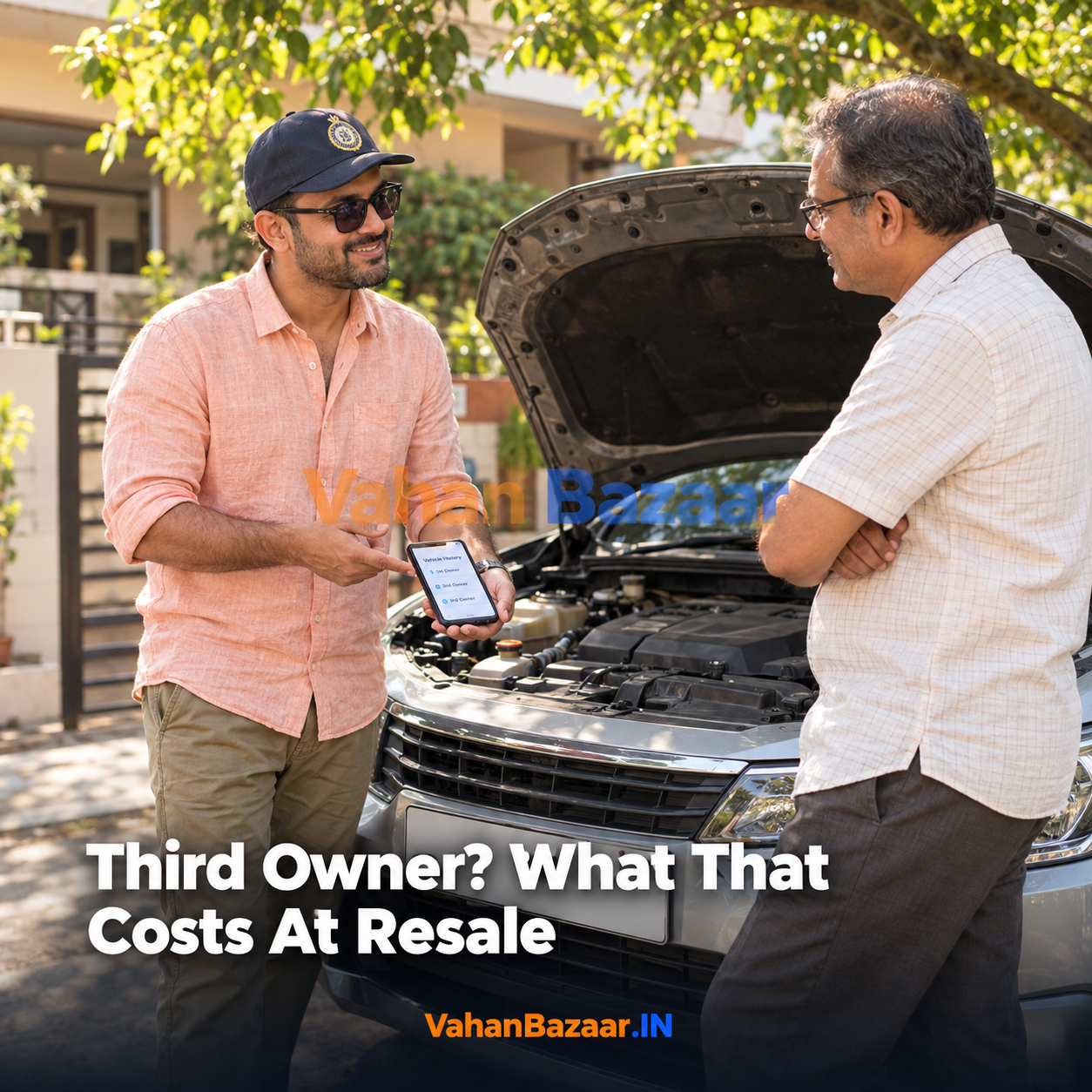
Watch any used car negotiation in India and you will hear the same exchange. The buyer says the car has had too many owners. The seller says it has been looked after. Both are talking about the same field on the same registration certificate, and neither has converted it into a number. So the conversation goes nowhere and the price ends up wherever the more stubborn person wanted it.
This is odd, because the owner count is not a matter of opinion. The registered owner serial number sits in the official record against the registration number. It is one of the only things in the whole transaction that is neither a judgement call nor a promise. Kilometres can be tampered with. Condition is subjective. Service records can be incomplete. The owner serial is a fact, and facts are what negotiations are supposed to run on.
We have written before about what the owner count means and why it changes the price. This article is the next step: what that number is worth in rupees, how to spend it at the table, and, just as importantly, when to leave it alone.
The Baseline Nobody Sets Before Arguing
Before owner count enters the conversation at all, most of the price movement has already happened. Indian passenger cars typically lose something in the region of 15 to 20 percent of their value in the first year, reaching roughly 45 to 55 percent cumulative depreciation by year five, with brand, model, kilometres, city and condition shifting where a given car sits inside that band. Several Indian valuation and insurance guides describe the curve in almost identical terms, so this part is well established.
That matters because it sets the order of operations. Age and kilometres decide roughly what the car is worth. Owner count is an adjustment on top of that number, not a replacement for it. A buyer who opens with the owner count before agreeing on a fair base price for the age and kilometre load has skipped a step, and a seller who hears the owner count raised first will usually treat the whole conversation as an attack rather than a valuation.
Get the base right first. Establish the year of first registration from the record rather than from the model year the seller quotes, because the registration date and not the model year is what actually sets the price, and a car built in one calendar year and registered in the next is worth less than the badge suggests. Agree the kilometre reading. Then, and only then, bring up how many hands it has passed through.
What the Owner Count Genuinely Signals
The reason the market pays for a low owner count is not sentiment. It is information density.
A single-owner car has one maintenance philosophy, one driving style, one set of habits about servicing intervals and one person who can answer questions about it. Everything that happened to that car happened under one regime, and if that regime was careful, the whole history is careful. Each additional owner adds a gap in the story: a stretch of the car's life where nobody present can tell you how it was driven, whether the service was done on time, or what the noise from the rear suspension was diagnosed as.
That is what the discount is buying, and it explains why the size of the discount is not fixed. If the gaps are filled, the discount shrinks. A third-owner car with a continuous stamped service book across all three owners has far less missing information than a second-owner car with no records at all, and it should not be priced as though it has more.
What the owner count does not signal is mechanical condition, accident history or odometer honesty. Those are separate questions with separate answers. A car can have one owner and a rolled-back odometer, or one owner and an undisclosed structural repair, and neither will show up in the ownership field. If you want those, you look for them specifically, which is why the wider checks on hidden accident claim history and on odometer fraud in Indian used cars exist as separate exercises.
What the Discount Looks Like in Rupees
Here is where we have to be careful, because this is the part everyone wants a clean number for and the sources do not give one.
The best-corroborated figure is the single-owner premium. Indian valuation guides commonly describe a single-owner, well-maintained car as priced roughly 5 to 15 percent above a comparable multi-owner car, and some express the same idea in rupees, putting a single-owner, fully-serviced example in a popular colour at something like Rs. 50,000 to Rs. 1 Lakh above an otherwise equivalent car. Those two framings are consistent with each other on a mid-market car and they show up across more than one guide.
The step between one owner and the next is thinner ground. One Indian valuation guide puts the decrement at roughly 5 to 8 percent per additional owner for a car in the 3 to 7 year age bracket, and describes it as steepest on premium and luxury models, where the first-owner story carries most weight, and shallowest on entry-level hatchbacks, where kilometres and condition already dominate. That is a single source rather than a consensus, so treat it as an indicative range and lean on the lower end when you are planning.
| Owner serial in the record | Indicative price impact vs a comparable first-owner car | What to actually do with it |
|---|---|---|
| First owner | The benchmark. Commonly carries a premium of roughly 5 to 15 percent over comparable multi-owner cars | Do not pay the premium on the claim alone. Confirm the serial is genuinely 1 before you accept a first-owner price |
| Second owner | One step down. Commonly quoted at around 5 to 8 percent below a comparable first-owner car | The most negotiable position in the market. Ask for the discount and offer to close quickly in exchange |
| Third owner | Two steps down, so broadly in the region of 10 to 16 percent, though the steps usually flatten rather than compounding cleanly | Ask for the full step, then hand part of it back if the service records are continuous. That trade is what closes deals |
| Fourth owner and beyond | The count stops being the main lever. The discount widens but is no longer predictable from the number alone | Stop pricing off the count and start pricing off condition, records and the holding pattern. Inspect harder, not just cheaper |
These are indicative ranges drawn from Indian valuation guides, and sources disagree on the size of the per-owner step. They are not a guarantee of what any individual car will fetch, and we make no claim to know what your car is worth. A well-kept third-owner car in a segment with strong demand can sell above a neglected second-owner car of the same age and model. Use the ranges to decide what is reasonable to ask for, not to decide what a car must be worth.
Put those percentages onto a real asking price and the argument suddenly has weight. On a car advertised at Rs. 6 Lakh, a single step of 5 to 8 percent is roughly Rs. 30,000 to Rs. 48,000. Two steps, on the same indicative arithmetic, is somewhere around Rs. 60,000 to Rs. 96,000. Those are not trivial sums to argue over, and they are considerably more than the cost of establishing the number in the first place.
How to Argue It at the Table
Most buyers waste the owner count by using it as a complaint. Used properly it is a specific, defensible, unemotional request. Three things make the difference.
Establish the number before you discuss price
The sequence matters more than anything else here. If you raise the owner count after the seller has quoted a price, you are asking them to come down from a position they have already committed to, and people defend positions. If the number is already on the table when the price is first discussed, it simply becomes one of the inputs.
The registration number is visible in almost every listing photograph, so you can settle this before you make contact. Understating the owner count is one of the easiest things a seller can do, because it costs nothing to say and is almost never challenged, which is exactly the problem our piece on second-owner claims that do not survive the record was written about. Arriving with the number already confirmed changes the entire tone of the meeting, and it does so without any accusation being made.
Price the gap, do not just name it
"It is a third-owner car" is a statement. "It is a third owner, and on this segment that usually sits a little under a comparable first-owner car, so I am at this figure" is an offer. The second version gives the seller something to respond to and gives you somewhere to concede from.
Be specific about what the discount is compensating for, because that is what makes it arguable in good faith: you are pricing missing information, not insulting the car. Say so. Sellers who understand that they are being asked to price a gap will often close the gap instead, by producing service records, the previous owner's contact, or the insurance history that shows the car was continuously covered.
Separate the count from the condition
This is the discipline most buyers miss, and it costs them credibility. If the car also needs tyres, has a slipping clutch or is running on a lapsed insurance policy, those are separate line items with their own prices. Rolling everything into one large demand invites the seller to dismiss the whole thing as haggling.
Keep the owner-count adjustment clean and small enough to be obviously reasonable, and take the condition items separately with quotes attached. Two modest, well-evidenced requests land far better than one big one. And settle the record checks before you part with any money at all, because there is no leverage left after the token amount changes hands, as our guide to the checks worth doing before you pay a token sets out.
Settle the Owner Count Before You Talk Price
The registered owner serial number, registration status, true age and date of first registration, month and year of manufacture, vehicle class, fuel type, hypothecation held by a lender, insurance validity, fitness validity and any blacklist flag — pulled from the VAHAN database against any registration number in about two minutes. RC check Rs. 99, challan check Rs. 99, or both together for Rs. 149 instead of Rs. 198.
When a High Owner Count Is Genuinely Fine
Now the other half, which buyers ignore and sellers never get credit for.
A high owner count on a car that has been held for long stretches is not a warning. It is arithmetic. A twelve-year-old car that has had three owners has averaged four years per owner, which is an entirely normal ownership span in India and tells you nothing except that the car is old. The count is high because the car has been around a long time, not because anything went wrong.
There are several situations where a third or fourth owner is simply the correct place for the car to be, and where refusing to look at it costs the buyer a good deal:
- Long holding periods. Three owners across ten or twelve years is a car that people kept, which is a mild positive signal, not a negative one.
- Continuous service records. If the book is stamped through every ownership, the information gaps the discount is meant to cover largely do not exist. Pay for the car, not for the field.
- Family transfers. A transfer within a family, or a transfer made purely because someone shifted cities and re-registered, adds a number to the record without adding a genuine change of driver.
- Older, cheaper cars generally. On a car well past its fifth year, kilometre load, structural condition and how much life is left in the paperwork matter far more than whether the serial reads 2 or 3.
The useful frame is this: the count tells you how many gaps there could be in the story, and the records tell you how many there actually are. When the records are complete, the count has already been answered and should not be charged for twice.
When It Is a Real Warning: The Pattern, Not the Number
The genuine red flag is not a high count. It is a short average holding period.
A car that has passed through three or four hands in two or three years is a car that several people, each of whom had the chance to live with it, chose to move on quickly. That pattern is worth far more suspicion than two owners over eight years, and buyer guidance in India and abroad converges on the same point: rapid successive transfers are a stronger signal than the raw number of transfers. Something has usually been discovered and passed on rather than fixed, or the car has been bought and flipped by a chain of intermediaries who never had any intention of keeping it.
Ask each of these plainly: how long did you own it, why are you selling, and who did you buy it from. On a normal car those answers are boring and consistent. On a rapidly flipped car they get vague, the previous owner becomes uncontactable, and the seller turns out not to be the registered owner at all. A high count paired with a short span and an evasive account of the last two years is not a price negotiation. It is a reason to look at something else.
Be clear about what a record check does and does not settle here. It settles the count, the date of first registration and therefore the total ownership span, which gives you an average holding period. It does not hand you a dated transfer-by-transfer history, so the actual timeline has to be reconstructed from the registration certificate, the insurance policy history and the service book. Our field-by-field walkthrough of what the VAHAN record actually shows sets out exactly where that boundary sits, because overstating what a check returns helps nobody.
What This Means for Used Car Buyers and Sellers
Buyers, confirm the number before you build a position on it. Every rupee of leverage the owner count gives you depends on the number being right, and a claim from a seller is not the number. The registered owner serial sits in the official record, the registration number is usually visible in the listing photograph, and Rs. 99 settles it before you have spent a Sunday driving across the city. On a Rs. 6 Lakh car, that is Rs. 99 spent to make an argument worth tens of thousands.
Buyers, price the gap, then let the seller close it. Ask for the step, explain that it reflects missing history rather than a judgement on the car, and be visibly willing to reduce the ask if the records turn up. That is a conversation a reasonable seller can win, which is precisely why it works better than a flat demand.
Buyers, read the span and not just the count. Divide the total years since first registration by the number of owners. If the answer is comfortably over two years, the count is mostly noise. If it is under a year, stop negotiating and start investigating.
Sellers, do not concede the discount by default. If you are the third owner of a car you have kept for five years and serviced properly, the discount a buyer opens with is aimed at an average car, not yours. Answer it with evidence: the stamped book, the insurance continuity, the fact that you held the car for years rather than months. Each of those closes a gap the discount was meant to cover.
Sellers, put the number on the listing yourself. Withholding the owner count guarantees that every buyer assumes the worst and prices accordingly. A verified listing at Rs. 99 cross-checks the car against the official record and carries a Verified badge, so the owner count, registration status and true age appear as confirmed facts rather than as claims a buyer has to test. Rs. 99 is. It will not turn a fourth-owner car into a first-owner one, but it does stop the conversation starting from suspicion, and on a used car sale that is most of the battle.
The Short Version
The owner count is a price input, not a verdict. Indian valuation guides commonly put a single-owner, well-kept car at roughly 5 to 15 percent above a comparable multi-owner car, and one guide puts the step down at around 5 to 8 percent per additional owner on a car aged 3 to 7 years, steepest on premium models and shallowest on hatchbacks. Sources vary on that step, none of it is a guarantee for any individual car, and all of it sits on top of the 45 to 55 percent a typical Indian car has already lost by year five.
Used well, the number is worth real money: on a Rs. 6 Lakh car, one step is roughly Rs. 30,000 to Rs. 48,000 and two steps is roughly Rs. 60,000 to Rs. 96,000 on the same indicative arithmetic. Used badly, it is a complaint that hardens the seller and moves the price nowhere.
And the count on its own is the wrong thing to be frightened of. Three owners across twelve years with a full service book is an ordinary car at a discount. Three owners across two years is a car being passed along. The record gives you the number for Rs. 99. What you do with it is the actual skill.
Frequently Asked Questions
Treat this as a market observation and not as a guarantee about any individual car. Indian valuation guides commonly put a single-owner, well-maintained car at roughly 5 to 15 percent above a comparable multi-owner car. On the step between one owner and the next, sources are thinner and they vary: one Indian valuation guide puts the decrement at roughly 5 to 8 percent per additional owner for a car in the 3 to 7 year age bracket, and describes the effect as steepest on premium models and shallowest on entry-level hatchbacks. Taking two steps down from a first-owner benchmark, that points at something in the region of 10 to 16 percent for a third-owner car, though in practice the steps flatten rather than compounding cleanly. The honest position is that the owner count sets the direction and a rough size, while condition, kilometres, service records and paperwork decide the final figure.
No, and treating it that way is how buyers talk themselves out of good cars. A third-owner car that has been held for several years at a time, has a continuous service record, sensible kilometres for its age and a clean registration status is a perfectly ordinary purchase, and the owner count is doing you a favour by lowering the asking price on a car that is mechanically fine. The count is a pricing input, not a verdict on condition. What genuinely deserves suspicion is not a high number by itself but a short average holding period, because a car that has passed through three or four hands in two or three years is being moved on quickly by people who had the chance to live with it.
A seller's statement is a claim, not evidence, and understating the owner count is one of the easiest things to do in a used car conversation because it costs nothing to say and is rarely challenged. The registered owner serial number sits in the official VAHAN record against the registration number, which is not a field the seller controls. Our RC check is Rs. 99 and returns the registered owner serial number along with registration status, true age and date of first registration, month and year of manufacture, vehicle class, fuel type, hypothecation held by a lender, insurance validity, fitness validity and any blacklist flag. The challan check is Rs. 99 and both together are Rs. 149 rather than Rs. 198 separately.
Not as a dated transfer-by-transfer history, and it is worth being clear about that rather than overselling what a record check does. What the record settles is the count itself and the date of first registration, which together give you the total ownership span and an average holding period across all the owners so far. To reconstruct the actual timeline you have to work with the seller: the registration certificate, the insurance policy history and the service book between them usually show when the car changed hands and how long each owner kept it. If a seller is unwilling to show any of that on a car with a high owner count, the unwillingness is itself the answer.