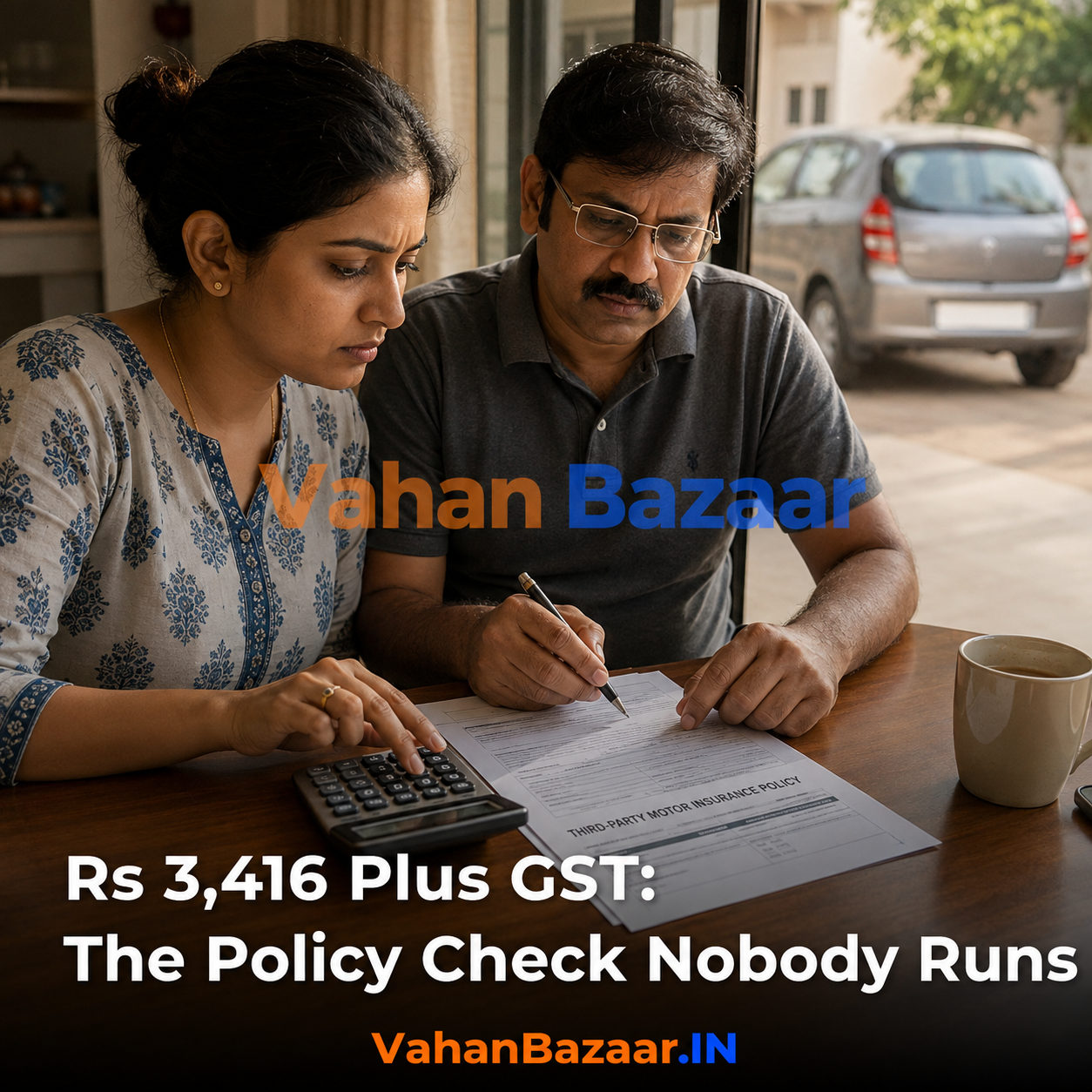
Almost every used car buying checklist in India contains the line "check the insurance". It is one of the least useful instructions ever written, because it does not tell you what you are checking for, or what it costs you if the answer is bad.
So here is the same instruction with a rupee figure attached. Third-party motor cover is the only component of a motor policy that is legally compulsory in India, and it is the only one where the price is not set by the insurer at all. The Insurance Regulatory and Development Authority of India fixes it centrally, by engine capacity, and every general insurer in the country must charge the same notified number. For the engine band that covers the bulk of India's used car parc — the Swift, Baleno, i20, City, Creta, Seltos and Brezza class of car — that number is currently Rs 3,416 a year, before tax.
Add the 18 per cent GST that sits on top and the cash actually leaving your account is closer to Rs 4,031. That is what it costs to make the car you just bought road-legal if the seller's policy has expired. Not an estimate, not a quote you can negotiate down — a fixed statutory number that follows the engine under the bonnet.
Insurance validity and the policy expiry date sit in the car's VAHAN record. One lookup on the registration number tells you whether cover is live — Rs 99.
One Price, Every Insurer: How Third-Party Cover Is Actually Priced
Motor insurance in India is two products stapled together. The own-damage section, which pays for repairs to your own car, is priced competitively — insurers compete on it, discount it, bundle add-ons into it, and it is worth shopping around. The third-party section, which pays compensation to someone else you injure or whose property you damage, is not competitive at all. IRDAI is the statutory regulator for motor insurance in India and it revises and fixes third-party premiums annually, based on engine capacity for petrol and diesel vehicles and on electric motor capacity for EVs.
The practical consequence for a buyer is that the third-party line item is identical no matter which insurer you approach. There is no better deal hiding somewhere. If a used car's cover has lapsed, you are not negotiating a price — you are looking at a bill that is already written.
| Engine capacity | Notified annual premium | With 18% GST | Typical cars in this band |
|---|---|---|---|
| Up to 1000cc | Rs 2,094 | About Rs 2,471 | Alto 800, Alto K10, S-Presso, entry hatchbacks |
| 1001cc to 1500cc | Rs 3,416 | About Rs 4,031 | Swift, Baleno, i20, Dzire, Amaze, City, Creta 1.5, Seltos 1.5, Brezza |
| Above 1500cc | Rs 7,897 | About Rs 9,318 | Larger SUVs and diesels — Scorpio, Fortuner-class vehicles |
Two things jump out of that table. The first is the size of the step between bands. Moving from a sub-1000cc hatchback to an ordinary 1.2-litre or 1.5-litre car adds over Rs 1,300 a year in compulsory premium before tax, and moving above 1500cc more than doubles it again. The second is that the middle row is where India actually shops. Hatchbacks alone account for roughly 46 per cent of used car volume, and cars aged three to seven years make up around 47 per cent of the market — which is precisely the population of 1.2-litre petrol hatchbacks and 1.5-litre compact SUVs sitting in that middle band.
IRDAI's notified schedule carries a concession on third-party premium for private electric vehicles and a smaller one for hybrids, applied to the equivalent motor-capacity band. It is one of the few running-cost advantages of a used EV that does not depend on how you drive, but it does not change the transfer rules below — an electric car's policy still has to be endorsed into your name.
How the 1001-1500cc Band Got Here
The middle band did not arrive at Rs 3,416 gradually. Its defining move was a single revision. With effect from 1 April 2017, IRDAI notified a 41 per cent increase on private vehicles between 1 litre and 1.5 litre engine capacity, taking the premium to Rs 3,132 from Rs 2,237. In the same revision the regulator left the sub-1 litre band untouched at Rs 2,055 — a deliberate decision to load the increase onto the mid-size segment rather than the smallest cars.
The band has moved again since, and the rate now in force in the notified table is Rs 3,416. Put the whole sequence together and the compulsory premium on the most common engine size in Indian motoring has risen by more than 50 per cent from its pre-2017 level.
| Period | 1001-1500cc notified premium | What happened |
|---|---|---|
| Before April 2017 | Rs 2,237 | The base from which the big revision was measured |
| From 1 April 2017 | Rs 3,132 | IRDAI notifies a 41 per cent increase on this band; sub-1 litre held at Rs 2,055 |
| Currently notified | Rs 3,416 | The rate in force today, and stable for several years without a fresh revision |
That last row matters for anyone buying a car this year. The current table has been unusually static, and the Ministry of Road Transport and Highways and IRDAI have been publicly discussing a further increase for some time. Nothing is notified until it is notified, so treat Rs 3,416 plus GST as today's number and nothing more. But if you are pricing a used car on the assumption that the compulsory insurance line will stay where it is forever, that is an assumption and not a fact.
Why This Lands on the Used Car Buyer, Not the Seller
Here is the part most buyers get wrong, and it costs them at exactly the wrong moment.
Third-party cover follows the car. Own damage and No Claim Bonus do not.
Under Section 157 of the Motor Vehicles Act, 1988, when ownership of an insured vehicle is transferred, the certificate of insurance and the policy described in it are deemed to have been transferred in favour of the new owner with effect from the date of transfer. That deeming provision is why a car does not become instantly uninsured for third-party purposes the moment it changes hands. The compulsory cover attaches to the vehicle.
The own-damage section behaves completely differently. It is a contract about your property, and until the insurer has been told who now owns that property and has endorsed the policy accordingly, the own-damage cover is sitting in someone else's name. If you crash the car in week three of ownership and the policy still names the seller, you are asking an insurer to pay a stranger's claim on a contract it was never told had changed hands. That is a claim the insurer is entitled to decline, and routinely does.
The No Claim Bonus is a third category again. It is a reward for the person's claim-free record, not the vehicle's. It does not travel to you with the car. The seller can carry their accumulated bonus across to their next vehicle; you start from zero on your own-damage premium regardless of how spotless the car's history is. Buyers frequently discover this only when they get their first renewal quote and it is far higher than the number the seller quoted them.
The fourteen-day window
Section 157 also puts a clock on it. The transferee must apply to the insurer within fourteen days from the date of transfer, in the prescribed form, to have the transfer recorded in the certificate of insurance and the policy, and the insurer must then make those changes. Fourteen days is not long, and it runs from the transfer — not from whenever the RC transfer paperwork finally clears at the RTO.
The two clocks are not the same clock. RC transfer at the RTO has its own timeline and its own paperwork; the insurance endorsement is a separate application to a separate organisation with a fourteen-day window of its own. Buyers who assume the RTO transfer automatically updates the policy end up with a car registered in their name and insured in someone else's.
Start the insurance endorsement on day one, not after the registration comes through. It costs you nothing to be early.
What a Lapsed Policy Actually Costs at the Moment of Purchase
Now put the arithmetic together for the realistic bad case: you are looking at a well-kept 1.2-litre hatchback or a 1.5-litre compact SUV, the seller says the insurance "just needs renewing", and you find out afterwards that it lapsed four months ago.
- Compulsory third-party premium: Rs 3,416. Statutory, identical at every insurer, non-negotiable.
- 18 per cent GST on top: about Rs 615, taking the third-party component alone to roughly Rs 4,031.
- Own-damage cover, if you want it: extra, and quoted at zero No Claim Bonus. The seller's discount does not come with the car, so the own-damage line is priced as if you have never held a policy.
- An inspection before cover restarts. When a policy has lapsed, insurers typically require the vehicle to be inspected before fresh own-damage cover is issued. That is a delay, and a delay is a car you cannot legally drive.
- Legal exposure in the meantime. Driving without valid third-party cover is an offence under Section 196 of the Motor Vehicles Act, 1988, quite apart from the personal liability you carry if something happens.
None of this makes the car a bad car. A lapsed policy tells you something about the seller's diligence, not necessarily about the engine. What it does mean is that the price on the windscreen is not the price of the transaction. Roughly Rs 4,031 of compulsory cost, plus an own-damage premium quoted without any bonus, plus an inspection delay, are all facts you are entitled to know before you agree a number — because every one of them is a legitimate reason to reprice the deal.
The wider context is that this is not a rare situation. Around 56 per cent of India's registered vehicles are running uninsured, according to Parliamentary Standing Committee figures cited by the Supreme Court — about 16.54 crore out of 30.48 crore. On those odds, "check the insurance" is not a formality on a checklist. It is closer to a coin toss.
How to Check Before You Buy, Not After
The good news is that this is one of the easiest things about a used car to verify, because you do not need the seller's cooperation to do it. Insurance validity and the policy expiry date are recorded in the vehicle's VAHAN record alongside the registration details. One lookup on the registration number tells you whether cover is live and the date it lapses — and it tells you before you have handed over a token amount, arranged a test drive, or had any conversation you would find awkward to walk back from.
On VahanBazaar, an RC check costs Rs 99 and a challan check costs Rs 99, or both together for Rs 149 instead of Rs 198 bought separately. The RC record returns the insurance validity and expiry date, the owner serial number, registration status, fuel type, vehicle age, fitness validity, and hypothecation and blacklist flags. The challan side tells you whether there are unpaid penalties riding on the vehicle, which is a separate problem that also becomes yours on transfer.
Set Rs 99 against the number this article opened with. The compulsory insurance alone on a lapsed 1.5-litre car is about Rs 4,031 — roughly eighty times the cost of finding out in advance. And that is before the own-damage premium you will be quoted at zero bonus, and before whatever the car itself costs.
A photograph of an insurance certificate on a phone screen proves very little. It proves a policy existed on the day it was photographed. It does not prove the policy is current, that it was not cancelled, that the premium was paid, or that the vehicle described on it is the vehicle in front of you. The record against the registration number is the version that does not depend on anyone's goodwill.
What This Means for Used Car Buyers and Sellers
For buyers, the sequence is short and it does not have an optional step in it.
Before you pay anything — before the token amount, before the advance, before you say yes on a phone call — run the registration number and read the insurance validity date. If cover is live, note the expiry and factor the renewal into your first-year running costs, using the band table above. If cover has lapsed, you now have a specific figure, and a specific negotiating position: the compulsory component alone is Rs 3,416 plus GST, and the own-damage cover will be quoted to you without the seller's accumulated bonus.
The moment the sale is agreed, start two separate clocks. One is the RC transfer at the RTO. The other is the insurance endorsement, which has its own fourteen-day window under Section 157 and its own application to the insurer. Do not let the second wait on the first.
And use the band as a filter while you are still shortlisting. If you are choosing between a sub-1000cc hatchback and a 1.2-litre one, the compulsory premium difference is over Rs 1,300 a year before tax, every year you own it. That is a genuine running-cost input when you are comparing options among used hatchbacks or working to a budget on used cars under Rs 5 Lakh. It works the other way too: a used Creta or a used Seltos in 1.5-litre form sits in the middle band, while a larger diesel SUV lands in the top one at Rs 7,897 before tax. Buyers browsing used cars in Delhi or Bengaluru, where multi-year policies and lapsed cover are both common, feel this difference immediately.
Contacting sellers is straightforward: new signups get five free contact credits, which is enough to work through a first shortlist. If you are comparing seriously across cities, the Starter plan is Rs 199 for five contacts and the Pro plan Rs 399 for fifteen, both valid for ninety days.
For sellers, the same facts run in reverse and they are worth acting on. A live policy with time left on it is a genuine selling point, because it removes a real cost from the buyer's side of the table — and because the buyer can confirm it independently in seconds, it is a claim you get full credit for. Letting cover lapse while the car sits on the market does the opposite: it hands every buyer a Rs 4,031 argument for knocking your price down. If you are listing your car, keep the policy current until the day it goes, and be ready with the expiry date when you are asked.
Rs 99 Before Rs 4,031
Insurance validity, expiry date, owner serial number, registration status, fitness, hypothecation and blacklist flags — all of it sits in the car's VAHAN record against the registration number. Pull it before you pay a rupee. RC check Rs 99, challan check Rs 99, or both together for Rs 149 instead of Rs 198 separately. New signups also get five free contact credits to reach sellers.
See Contact PlansFrequently Asked Questions
IRDAI's notified third-party rate table for private cars sets the annual premium at Rs 2,094 for engines up to 1000cc, Rs 3,416 for 1001cc to 1500cc, and Rs 7,897 for above 1500cc. These figures exclude GST. At 18 per cent GST, the actual cash outflow works out to roughly Rs 2,471, Rs 4,031 and Rs 9,318 respectively. Because IRDAI fixes third-party rates centrally, the same number applies at every general insurer, so there is nothing to shop around for on this component.
Yes, but that specific 41 per cent jump was the FY2017-18 revision, not a fresh one. IRDAI raised the 1 litre to 1.5 litre private car band to Rs 3,132 from Rs 2,237 with effect from 1 April 2017, while leaving the sub-1 litre band unchanged at Rs 2,055 that year. The band has since moved again and the current notified rate is Rs 3,416, so the cumulative rise on the most common engine size in India's used car parc is over 50 per cent from the pre-2017 level. The present table has been stable for several years, and MoRTH and IRDAI have been publicly discussing a further increase.
Only partly. Under Section 157 of the Motor Vehicles Act, 1988, the certificate of insurance and the policy are deemed transferred to the new owner from the date of transfer, so the compulsory third-party cover follows the vehicle. But the transferee must apply to the insurer within fourteen days of the transfer to have the policy formally endorsed into their name. The own-damage portion and the No Claim Bonus do not pass to the buyer by default, and an own-damage claim made while the policy still names the previous owner is a claim the insurer can decline.
Insurance validity and the policy expiry date sit in the vehicle's VAHAN record alongside the registration details, so one lookup on the registration number tells you whether cover is live and when it lapses. On VahanBazaar an RC check costs Rs 99 and a challan check costs Rs 99, or both together for Rs 149 instead of Rs 198 bought separately, at vahanbazaar.in/buyer-tools/vahan-verify. Do it before you pay a token amount, not after.
For a typical 1001-1500cc car, the compulsory third-party component alone is Rs 3,416 plus 18 per cent GST, so about Rs 4,031 before any own-damage cover is added. You also start on a zero No Claim Bonus, because the discount belongs to the previous owner and not to the vehicle, and any own-damage premium is quoted without the discount the seller had built up. On top of that, driving the car home uninsured is itself an offence under Section 196 of the Motor Vehicles Act, 1988. None of this is a reason to walk away from the car, but all of it is a reason to reprice it.