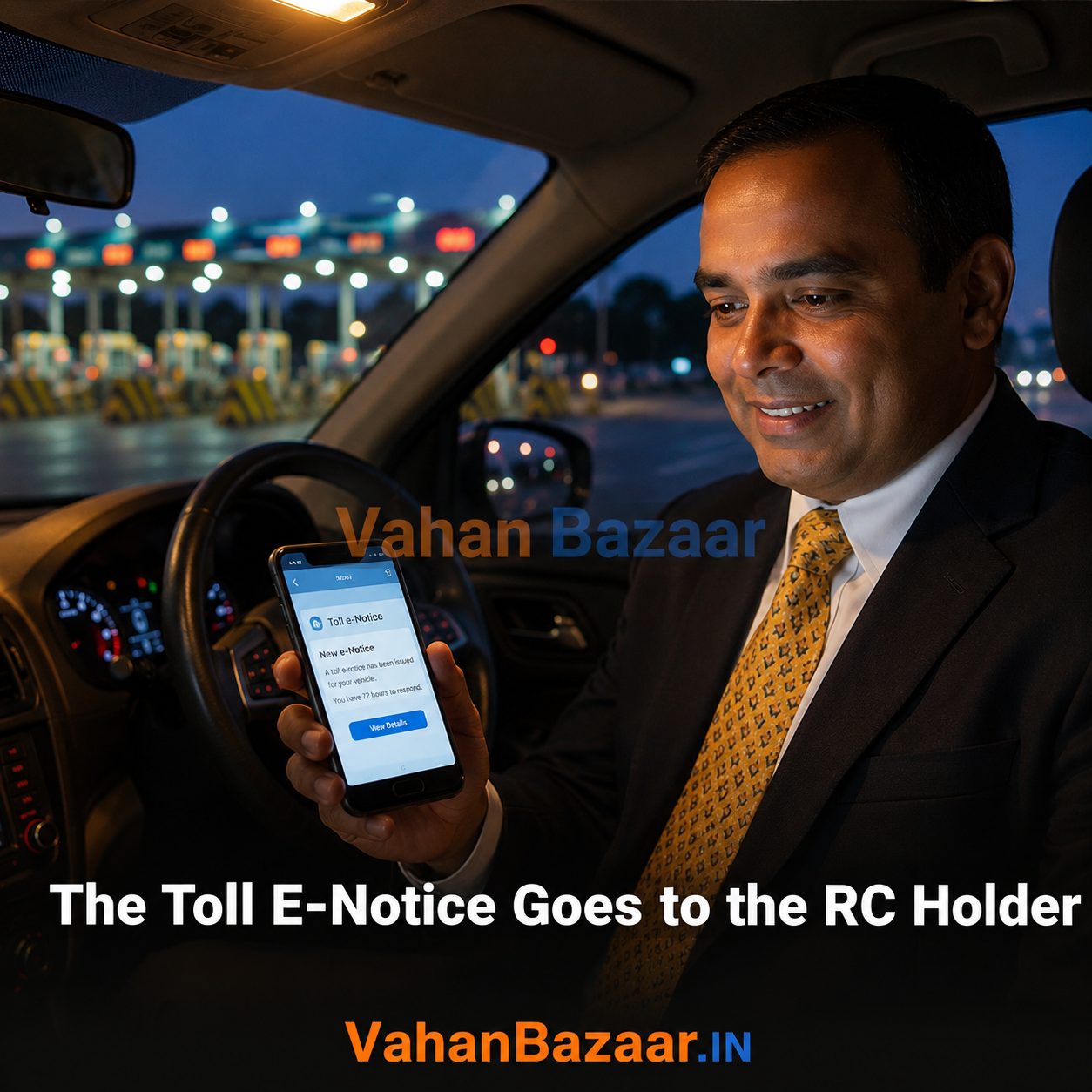
A toll passage used to be an event that closed at the barrier. Money changed hands, or an account was debited, and nothing about it survived the moment. Under the Central Motor Vehicles (Second Amendment) Rules, 2026, that is no longer the shape of it. The National Electronic Toll Collection system is integrated with the VAHAN database, which allows vehicles to be identified and unpaid dues to be enforced against them, and it allows a notice to be raised about a passage after the vehicle has long since driven on.
We have already written about the far end of that chain, where dues left unpaid begin to freeze a vehicle's fitness position and stall an RC transfer that the buyer thought was routine. This piece is about the near end, and about a question that is rarely asked in advance. When the notice is issued, who receives it? The rules answer that plainly. On a used car, the answer is frequently the wrong person.
What the Amendment Actually Does
Strip the change back to its mechanics and there are five moving parts, each of which matters to somebody buying or selling a second-hand vehicle.
- Identification. The National Electronic Toll Collection system is integrated with the VAHAN database, enabling the identification of vehicles and the enforcement of unpaid dues against them.
- Service. Electronic notices are issued to registered vehicle owners, specifying the vehicle details, the date and location of the passage, and the amount payable.
- Channel. Those e-notices are served through SMS, email, mobile-based applications or other electronic means.
- Representation. An aggrieved vehicle owner or driver may submit a representation through the designated portal within 72 hours of issuance of the e-notice.
- Consequence. Clearance of unpaid toll dues is mandatory for the issuance of a No Objection Certificate and for inter-state transfer of a vehicle, and a Certificate of Fitness cannot be renewed or issued while an unpaid user fee is pending.
The National Highways Fee Rules were also amended in 2026 to strengthen toll compliance and digital enforcement, so the two sets of rules are pulling in the same direction. The design is coherent and, read as a system, entirely sensible. A vehicle can be identified, its owner can be told, the owner can object within a defined period, and if nothing is paid the vehicle's own paperwork is where the consequence lands.
The word doing the heavy lifting in all of that is registered. Not current owner. Not possessor. Not driver. Registered.
The 72-Hour Window and Who Is Standing In It
There is a small asymmetry buried in the rules that is worth reading twice. The e-notice is issued to the registered vehicle owner. The representation may be submitted by an aggrieved vehicle owner or driver. So the right to object is drawn more widely than the duty to inform.
That sounds generous, and in a household where the owner and the driver eat dinner at the same table, it is. The driver disputes the passage, the owner forwards the message, the representation goes in. The mechanism works exactly as intended.
It works less well the moment those two people are strangers to each other. A driver has standing to file a representation but no notice; an owner has the notice but nothing to say about a journey they did not make. Neither of them, on their own, holds both halves of the thing.
Then there is the clock. Seventy-two hours is a short period by the standards of Indian vehicle administration, and the rules run it from issuance of the e-notice, not from the point at which somebody actually reads it. An SMS arrives among a dozen other SMSs. An email lands in a promotions tab. An app notification is dismissed with a thumb on the way to something else. None of that stops the clock.
The 72-hour period does not announce itself when it closes. There is no second notice saying the moment has passed, and nothing visibly changes on the day it expires. The consequence appears months later, at an RTO counter, when a No Objection Certificate or a fitness certificate does not come through. By then the dispute is not a dispute any more. It is simply a dues entry attached to a vehicle.
Exactly what remains available once the window has closed is not something to guess at. Portals are operated differently across states, and the practical position on a specific vehicle depends on the administration handling it. Ask the RTO. That is a far better use of an afternoon than reasoning from first principles about what ought to be possible.
The Transfer Gap Is Where This Bites
Now put the mechanism against how used cars actually change hands in India, which is where a tidy rule meets an untidy market.
Why the gap exists at all
A very large number of used vehicles are driven for weeks, and often for months, between the day the money is paid and the day the RC transfer is recorded. Sometimes the delay is administrative. Sometimes an NOC is required because the vehicle is moving between states and the process takes what it takes. Sometimes the buyer simply drives the car, is perfectly happy with it, and does not treat the paperwork as urgent because nothing appears to be going wrong. Our note on what an inter-state purchase actually involves sets out why that particular gap tends to be the longest of all.
Whatever the reason, during that gap there is a car being driven daily by one person while the RC carries the name of another. That was always a slightly awkward arrangement. Under an electronic notice regime addressed to the registered owner, it becomes a specific and identifiable failure mode.
The evidence and the addressee are in different hands
Consider a car bought in Pune and driven back to Hyderabad, or one sold in Delhi and now running daily on the Jaipur road. A passage is recorded. An e-notice is issued. It goes to the registered owner, who is the seller, who no longer has the car, was not on that highway, and has no way of knowing whether the passage is right or wrong.
The buyer, meanwhile, was driving. The buyer knows where the car was that day, whether the account had balance, whether the vehicle was even on that stretch of road. The buyer holds every piece of evidence that a representation would need. The buyer also has standing to file one as the driver. What the buyer does not have is the notice.
So the two halves sit apart. The seller may forward the message, out of decency or out of self-interest. The seller may also not open it at all, having mentally closed the file on a car sold three months ago. Nobody has to behave badly for the 72 hours to run out. Indifference is enough.
And when it runs out, the consequence does not attach to the person who ignored the SMS. It attaches to the vehicle, which by then is very likely the buyer's problem, arising from a period in which the buyer was never the addressee. This is the same structural trap we described when unpaid toll account dues began stalling RC transfers, and it is worth noticing that barrier-free tolling makes it quieter still, because a passage recorded without a stop gives nobody at the roadside a reason to raise a question at the time.
What an Unpaid User Fee Blocks
The consequences are specific, and they are all consequences that land on the asset rather than on a person. That is the whole point of the design, and it is also why the used car market feels it more sharply than anybody else.
| What is blocked | What the rules provide | Where it lands on a used car |
|---|---|---|
| NOC for transfer of ownership | Will not be granted until any unpaid user fee is cleared | The transfer stops. The buyer has paid for the car and cannot get their name onto the record |
| NOC for transfer from one State to another | Will not be granted until any unpaid user fee is cleared | An inter-state purchase cannot proceed to re-registration in the destination state |
| Certificate of Fitness, issue and renewal | Cannot be renewed or issued while unpaid user fee is pending | Bites hardest on commercial vehicles, where fitness gates the ability to earn at all |
Read that column of blocks together and a pattern emerges. Every one of them is a moment at which a vehicle needs the state to say yes, and every one of them is a moment that arrives long after the passage that caused the problem. The dues do not stop you driving. They stop you completing. Our tip on how unpaid toll now blocks NOC and fitness work goes through what to do when you are already inside one of these blocks, and the equivalent problem on the commercial side, where pending dues freeze permit and fitness renewals on a working vehicle, is the same mechanism with the earning capacity of a business attached to it.
How a specific block is lifted, what proof of clearance an RTO wants to see, and how quickly a cleared dues entry is reflected in the record are all matters of state administration and of how the designated portal is operated. Nothing in this article replaces asking the RTO handling your vehicle. Treat what follows as the position to plan around, and treat the RTO's answer as the one that decides.
If You Are Buying
The buyer's exposure is straightforward once you see it. You inherit an asset whose record may already carry dues from a period you had no visibility into, and you may then spend a further period driving a car whose notices are being addressed to somebody else.
Before the token money
Check the dues position against the registration number before any money moves, not after. This is the same discipline we set out in our piece on the checks that belong before the advance rather than after it, and toll dues have now joined the list of things that belong on that side of the payment. A dues entry discovered before you pay is a negotiating point and, if it is large enough, a reason to walk. The same entry discovered after you pay is your problem to clear.
What you are buying with that check is not a clearance certificate. It is evidence. It tells you the registration status, the owner serial, whether a financier still holds a charge, whether there is a blacklist entry, and what the pending dues position looks like on that vehicle. Where something appears, the next step is the RTO, with the registration number in hand.
Check the Dues Position Before the Money Moves
Registration status and owner serial, hypothecation against a lender, blacklist flags and pending dues — pulled from the VAHAN database against any registration number, in seconds. RC check Rs. 99, challan check Rs. 99, or both together for Rs. 149.
After you take delivery
Complete the transfer without delay. That is the entire remedy, and it is unglamorous enough that most buyers postpone it. Until the RC carries your name, every e-notice generated by your driving is being issued to somebody else, and the 72-hour representation window is opening and closing in a mailbox you cannot see.
While the gap is open, keep the seller reachable and say plainly why. A seller who understands that a forwarded SMS protects them as much as it protects you is far more likely to forward it. Agree it at handover, in writing, alongside the rest of the paperwork. It costs nothing and it is the only bridge across the gap that exists.
If the vehicle is on a toll-heavy route, understand its account arrangements as part of the handover rather than as an afterthought. A car running the Mumbai or Ahmedabad corridors daily generates passages at a rate that a city car does not, and the shift towards annual pass products on the highway network means the arrangements attached to a used car are no longer uniform from one vehicle to the next.
If You Are Selling
The seller's exposure runs the other way, and it is genuinely uncomfortable once stated. Until the transfer completes, you are the registered owner. You are therefore the addressee for e-notices generated by a vehicle you no longer possess and by driving you did not do.
Those notices reach you by SMS, email, a mobile-based application or other electronic means. They will arrive at a point when the car has stopped occupying any part of your attention, which is precisely why they get missed. And the aggrieved-party clock is running whether or not you have read anything.
The practical position for a seller has three parts. Complete the transfer promptly, and treat it as your task rather than the buyer's favour to you. Keep every message relating to that registration number until the record shows the new owner, because during the gap you are the only person receiving them. And if something arrives that you know nothing about, forward it to the buyer the same day, because the buyer holds the facts and the window is measured in hours.
There is also a commercial argument for getting the record clean before you list at all. A buyer who runs a check and finds a pending dues entry does not stop to work out whether it is a genuine liability or an administrative artefact. They discount, or they move on. A verified listing at Rs. 99 cross-checks the vehicle against the official record and carries a Verified badge, which puts the registration position on the listing instead of into an argument on a phone call. On average, based on VahanBazaar listings data, verified listings draw about three times the buyer enquiries and sell around 40 percent faster than unverified ones. Rs. 99 is.
What This Means for Used Car Buyers and Sellers
What has changed is not really the money. Toll amounts are toll amounts, and on most private cars they are not the kind of figure that decides a purchase. What has changed is that a dispute now has a defined shape, a defined channel and a defined 72-hour period, and that the person the process is addressed to is fixed by the RC rather than by who was behind the wheel.
That is a fair system for a vehicle with one settled owner. It is a system with a visible seam for a vehicle that has changed hands and not yet changed records, because during the seam the addressee and the witness are two different people, and neither of them alone can complete a representation properly.
Both sides close the seam the same way, which is the useful thing about this. Know the dues position before money moves, and complete the transfer without delay afterwards. A buyer who does the first has not inherited a problem. A pair who do the second have shut the window in which a new one can be created unseen. Everything else in this article is a description of what happens when neither is done, and none of it is expensive to avoid.
If you are buying across a state line, from Bengaluru into Hyderabad or from Delhi into Jaipur, treat both steps as non-negotiable rather than as good practice. Clearance of unpaid toll dues is mandatory for inter-state transfer, so the dues position is not a detail you can settle later. It is on the critical path to the vehicle becoming legally yours in the state you intend to keep it.
The Short Version
Under the Central Motor Vehicles (Second Amendment) Rules, 2026, the National Electronic Toll Collection system is integrated with the VAHAN database, allowing vehicles to be identified and unpaid dues to be enforced. Electronic notices are issued to registered vehicle owners, specifying vehicle details, the date and location of the passage and the amount payable, and are served by SMS, email, mobile-based applications or other electronic means.
An aggrieved vehicle owner or driver may submit a representation through the designated portal within 72 hours of issuance. On a used car in the gap between sale and transfer, the notice goes to the seller while the evidence sits with the buyer, and the window can close without either of them having done anything wrong.
What follows is attached to the vehicle, not to the person. A No Objection Certificate for transfer of ownership, or for transfer from one State to another, will not be granted until any unpaid user fee is cleared, and a Certificate of Fitness cannot be issued or renewed while an unpaid user fee is pending. The National Highways Fee Rules were amended in 2026 in the same direction.
Buyers: establish the dues position for Rs. 99 before the token money, then complete the transfer without delay. Sellers: you remain the addressee until the record changes, so complete the transfer and forward anything that arrives in the meantime. And where the practical answer turns on how a portal is run or how a state administers the process, confirm it with the RTO rather than assuming.
Frequently Asked Questions
The rules provide for electronic notices to be issued to registered vehicle owners. That is the name on the RC, which until the transfer is recorded is still the seller. It is not the person who was driving and it is not necessarily the person who now has the car. If you have bought a used vehicle and the transfer has not completed, notices generated by your driving are being addressed to somebody else.
An aggrieved vehicle owner or driver may submit a representation through the designated portal within 72 hours of issuance of the e-notice. That is a short period, and it runs from issuance rather than from the moment anybody happens to read the message. If it passes without a representation being filed, the practical effect is that the dispute has not been raised. What options remain after that depends on how the portal is operated and on the state administration concerned, so ask the RTO rather than assume.
Clearance of unpaid toll dues is mandatory for the issuance of a No Objection Certificate. An NOC for transfer of ownership, or for transfer of a vehicle from one State to another, will not be granted until any unpaid user fee is cleared. A Certificate of Fitness also cannot be issued or renewed while an unpaid user fee is pending. The dues attach to the vehicle record, so a buyer can inherit a block created before they were ever the registered owner.
If the RC still carries your name, you are still the registered owner and therefore still the addressee for e-notices on that vehicle, including notices generated by somebody else driving it. The notices reach you by SMS, email, a mobile-based application or other electronic means, so they are easy to overlook once you have mentally moved on from the car. The remedy is to complete the transfer promptly and to keep every message about that registration number until the record shows the new owner.
Run a record check against the registration number before any money moves. An RC check costs Rs. 99 and a challan check costs Rs. 99, or both together for Rs. 149, and they establish the registration status, the owner serial, whether a financier still holds a charge, any blacklist entry and the pending dues position on the vehicle. A record check is evidence about the vehicle, not a clearance certificate, so where a dues entry appears, confirm what has to be settled with the RTO before you commit.