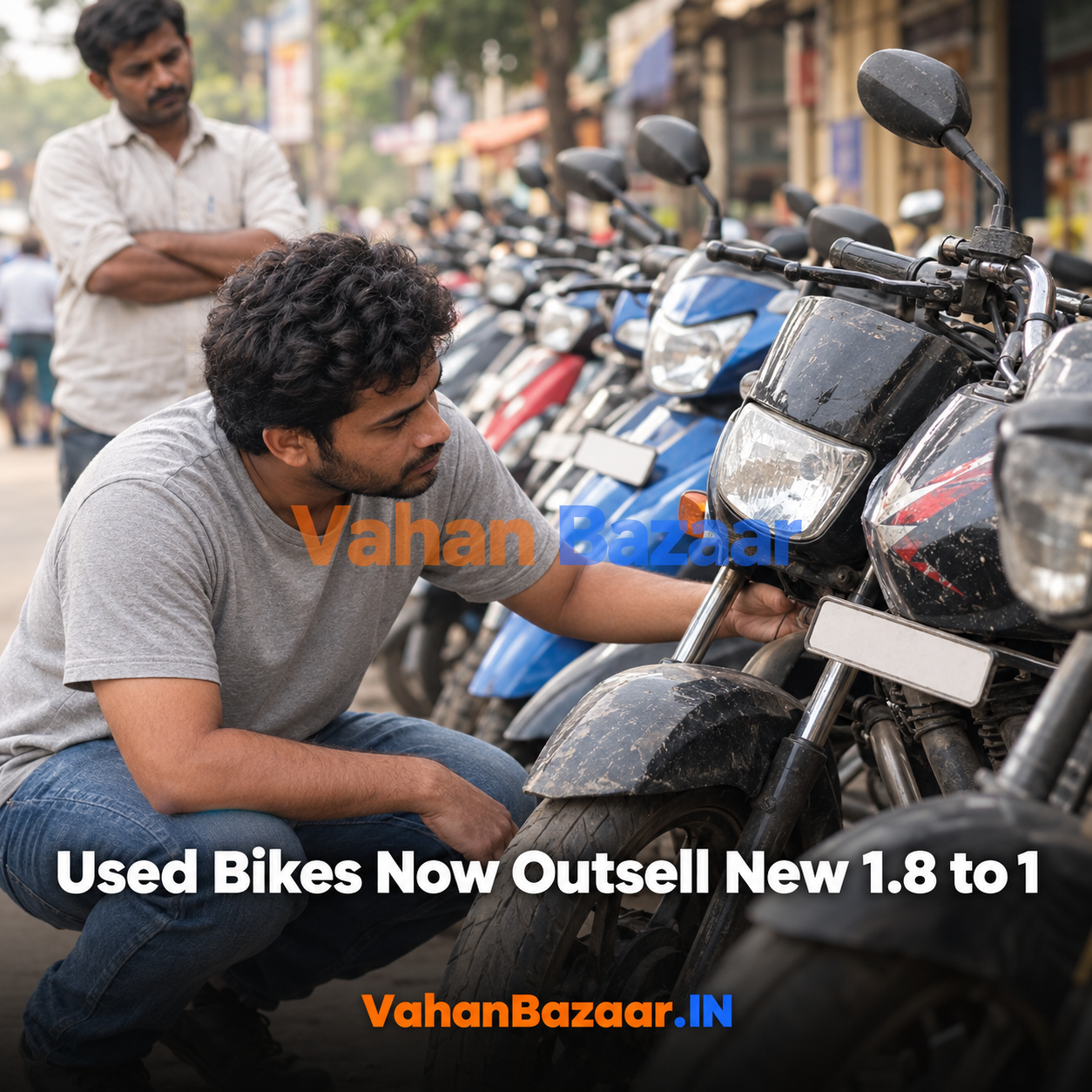
Somewhere in the last couple of years, without an announcement and without a press conference, India's two-wheeler market quietly inverted. In 2026, used two-wheeler sales exceed new two-wheeler sales by a ratio of roughly 1.8 to 1, according to industry data. For every new motorcycle or scooter that rolls out of a showroom, close to two used ones change hands somewhere else.
That is not a niche any more. It is the larger half of the market. India's used two-wheeler market crossed Rs. 50,000 crore in 2025, and research houses put its growth at a compound annual rate of about 12.5 percent through the end of FY2028, with volumes expected to reach around 55.8 million units by 2027. Those are estimates from market research rather than official registration counts, and the precise numbers vary by source, but the direction has not been seriously disputed by anyone for some time.
Now put the second number next to the first, because that is where the story actually is. Industry estimates place the unorganised sector at up to around 99 percent of that market by revenue, leaving the organised sector at roughly 1 percent. A market the size of a small industry, growing at double digits, is being transacted almost entirely between individuals, neighbourhood dealers, local mechanics and brokers.
An Inversion With No Institutions Behind It
Markets usually build institutions as they grow. Volumes rise, money follows, intermediaries appear, standards form, and eventually a buyer walking into the market finds a floor beneath them: someone has inspected the thing, someone stands behind it, someone keeps a record. That is roughly the arc the used car market in India has been travelling for a decade.
The used two-wheeler market has done the first half of that and almost none of the second. It has the volume. It has the money. It does not have the institutions, and the ratio of organised to unorganised participation suggests it is not about to acquire them quickly. We flagged the demand side of this when record new bike sales pointed to a used wave arriving behind them, and again when July's record two-wheeler numbers made the coming supply of resale stock obvious. What neither of those pieces could say is that the supply would arrive into a market with essentially no infrastructure to describe it.
The reason is not mysterious and it is not anybody's fault. It is arithmetic. A used bike is simply too cheap a transaction to support the cost of an organised channel around it. A commuter motorcycle changing hands for Rs. 45,000 cannot absorb an inspection, a refurbishment, a warranty, a showroom's overhead and a margin, and still land at a price a buyer wants to pay. A used car at ten times that price can. So the organised sector goes where the unit economics work, and the used two-wheeler market keeps running on cash, trust and word of mouth.
The 1.8 to 1 ratio, the Rs. 50,000 crore market size, the roughly 12.5 percent growth rate, the 55.8 million unit projection for 2027 and the 99 percent unorganised share all come from published market research on the India used two-wheeler sector. They are analyst estimates, not government registration statistics, and different houses put the boundaries in slightly different places. We have used them as directional rather than exact, and nothing in this article depends on any single figure being precise to the decimal.
What an Informal Market Structurally Cannot Produce
It is worth being clear about what "unorganised" does and does not mean, because the word gets used as a slur when it should be used as a description. It does not mean the sellers are dishonest. The overwhelming majority of people selling a used scooter in India are ordinary owners who looked after the machine, want a fair price and will tell you the truth about it if you ask.
What it means is that an informal channel cannot produce the artefacts that an organised one produces, however honest the individual seller happens to be. There is no inspection report, because nobody is paid to inspect. There is no certification, because there is no certifier. There is no warranty, because there is no entity to honour it. There is no digital service record, because nothing centralised was ever recording the service.
The organised 1 percent is, to its credit, moving in the right direction on exactly these points. Digital service records and engine health certificates are becoming standard on organised platforms, and that genuinely does improve transparency. The problem is scope. Those improvements cover roughly one transaction in a hundred. The other ninety-nine are still a conversation, a photograph and a handshake.
Which brings the argument to its actual conclusion, and it is a structural one rather than a moral one. The bigger and more informal a market gets, the more the public vehicle record becomes the only neutral source of truth about a specific machine. Not because it is comprehensive, and not because it replaces judgement. Because in a market with no other institution, it is the only party in the transaction with no stake in the outcome.
Who Can Hand a Buyer What
Set the three sources side by side and the shape of the gap becomes concrete. The first column is what a buyer actually wants to know before parting with money. The rest is who can supply it.
| What the buyer wants | Organised dealer (~1% of the market) | Private or local seller (~99%) | The public VAHAN record |
|---|---|---|---|
| Written inspection report | Usually provided | Almost never exists | Not held. The record is not an inspection |
| Certification or resale warranty | Often offered | Not available | Not held |
| Digital service history | Increasingly standard | Depends entirely on the individual | Not held |
| True age and date of first registration | Shown | The seller's word | Settled, independently |
| Month and year of manufacture | Shown | The seller's word | Settled, independently |
| Number of previous owners | Shown | The seller's word | Settled by the owner serial number |
| Live loan against the bike | Cleared before sale | Frequently unknown to both sides | Settled by the hypothecation entry |
| Blacklist or stolen-vehicle flag | Screened | Not screened at all | Settled by the blacklist entry |
| Registration status and vehicle class | Verified | The seller's word | Settled, independently |
| Insurance and fitness validity | Checked | The seller's word | Validity dates shown, cover type not shown |
| True odometer reading | Partly, via service history | Not verifiable | No odometer field in the record |
| Accident and repair history | Sometimes disclosed | Rarely disclosed | Not held |
Read the last two rows honestly, because they matter as much as the rest. Odometer tampering and undisclosed accident history are repeatedly cited as the main things deterring cautious buyers from the used two-wheeler market, and the record does not fix either of them. It has no odometer field and no accident field. Anyone telling a buyer that a record check is a complete answer is overselling it.
But read the middle block too, because that is the part nobody else in a private sale can supply. Age, manufacture date, owner count, loan status, blacklist, registration status, class, insurance and fitness are all things the seller will happily tell you, and all things you currently have no way to confirm. In a market where 99 percent of transactions come with no report of any kind, converting nine verbal claims into nine verified facts is not a small move.
Of everything in that table, the hypothecation entry is the one that turns a bad deal into an impossible one. If a lender's charge is still live on the record, ownership cannot transfer to you until it is cleared, no matter how sincerely the seller believes the loan is closed. On a two-wheeler this is common precisely because so many are bought on small loans and so few sellers think to close the entry after the last instalment. Our explainer on spotting a live loan on a used bike's RC covers why the entry outlives the repayment so routinely.
The Asymmetry Between Car Buyers and Bike Buyers
Here is the comparison that makes the point sharpest. A used car buyer in India in 2026, even one buying privately, usually encounters some documentation. Perhaps a service book. Perhaps an inspection sheet. Perhaps a dealer's paperwork, a finance closure letter, a folder of receipts. Not always reliable, and often more theatre than substance, but it exists and it sets an expectation.
A used bike buyer often gets a photograph on a messaging app and a phone number. That is the whole information set. No report, no history, no third party, no folder. The buyer is asked to make a five-figure decision on the strength of a stranger's description and a walk around the machine on a Sunday morning.
That asymmetry is the real story behind the 1.8 to 1 ratio. The segment of India's vehicle market that has grown into the larger half is also the segment where buyers are given the least to work with. And it compounds: the more transactions happen with no verifiable information, the more every buyer discounts every seller, and the harder it becomes for an honest owner with a genuinely good bike to prove it.
The correction available today is not an institution. It is a habit. A buyer who runs the public record on the registration number before doing anything else has, in about the time it takes to type a plate, closed most of the gap between what a bike buyer gets and what a car buyer gets. Our detailed walkthrough of running a VAHAN record check on a used bike or scooter covers the mechanics field by field.
This is worth stating plainly because a lot of buyers assume otherwise and never try. Our record check is not a car-only tool. A motorcycle or scooter is a registered motor vehicle like any other, so it sits in the same national database with the same fields against its registration number. Same input, same output, same price. RC check Rs. 99, challan check Rs. 99, both together Rs. 149.
What the Record Actually Returns on a Bike
Concretely, against a two-wheeler registration number, the record returns the date of first registration and therefore the true age, the month and year of manufacture, the registration status, the vehicle class, the registered owner serial number, the fuel type, any hypothecation charge still held by a lender, the insurance validity dates, the fitness validity where applicable, and any blacklist entry.
Four of those are worth dwelling on because they are the ones most often misstated in a private two-wheeler sale, rarely with any intent to deceive:
- True age. Sellers describe a bike by the year they bought it, which is frequently not the year it was first registered, and almost never the month and year it was manufactured. On a machine that will face fitness and re-registration rules at fifteen years, the difference of a year or two is money.
- Owner serial number. "Second owner" is the most repeated phrase in used two-wheeler listings and one of the least verified. The record settles it, and the answer moves the price.
- Hypothecation. Small two-wheeler loans get repaid and the charge stays on the record, so the seller believes the bike is clear and the record disagrees. Until it is cleared, the transfer cannot complete.
- Blacklist entry. A hard stop rather than a negotiating position. The reasoning behind our piece on checking whether a used bike is stolen applies to every machine in this market, and in a 99 percent informal channel there is no one else doing that screening for you.
The same logic extends to the electric side of the market, where the resale cohort is only now forming, though there the record leaves a bigger gap because it holds nothing at all about the battery. We worked through that specific case in our piece on India's first used e-scooter wave.
Check the Bike Before You Travel to See It
True age and date of first registration, month and year of manufacture, registration status and vehicle class, registered owner serial number, fuel type, hypothecation against a lender, insurance and fitness validity, and blacklist flags — pulled from the VAHAN database against any registration number. Motorcycles, scooters and cars alike. RC check Rs. 99, challan check Rs. 99, or both together for Rs. 149.
What This Means for Used Two-Wheeler Buyers
The practical instruction that falls out of all this is short. Assume nobody has checked the bike before you, because in ninety-nine cases out of a hundred nobody has. That is not cynicism about the seller. It is an accurate description of a market where the checking function has never been institutionalised.
So do the record check first, before the phone call, before the visit, before any negotiation. It needs only the registration number, which is stamped on the plate and legible in most listing photographs, so it requires nothing from the seller and does not even require you to have spoken to them. It returns in seconds. And it is the single step most likely to end a conversation early: a live lender's charge, a blacklist entry, a registration status that contradicts the listing, an owner count higher than claimed, or an age two years off the description.
Then spend your in-person time on the things the record genuinely cannot cover, which is where the remaining risk sits. Odometer plausibility measured against the general condition of the machine, chain and sprocket wear, tyre and brake condition, frame and fork alignment, and any sign of accident repair. Ask for service receipts and read them for the mileages written on them. In an unorganised market these are your inspection report, because there is no other one.
Add the challan check when the bike has spent its life in a city with heavy enforcement, since unpaid challans follow the vehicle and land on whoever holds the registration next. And when the deal is agreed, complete the transfer properly rather than trusting a signed form and an assurance, because a transfer that is never completed leaves the previous owner's name on the record and every future liability pointed at them. Our guide to RC transfer for a used bike in 2026 sets out the current process.
What This Means for Sellers
If you are selling a bike or scooter into this market, the 99 percent figure is working directly against you, and it has nothing to do with your machine. Buyers cannot tell your well-kept, single-owner, loan-free scooter from the tired one two listings down, so they price both for the risk of the worse one. You are absorbing a discount created entirely by vehicles you have never seen.
The way out of that discount is to arrive with the answers already given. A seller who can show a clean record, a clear hypothecation position, a matching owner count and a genuine registration date has removed most of what the buyer was going to hold money back for. On the used-car side, a verified listing at Rs. 99 cross-checks the vehicle against the official record and carries a Verified badge, so age, ownership count and registration position are settled on the listing itself rather than argued about over a phone call. Rs. 99 is.
Whatever you are selling and wherever you are listing it, the principle holds: in a market with no institutional trust, verifiable specifics are the only thing that separates your listing from the average. Vague ones read like every other listing, and get priced like every other listing.
The Short Version
India now sells about 1.8 used two-wheelers for every new one, and the used market has crossed Rs. 50,000 crore while growing at roughly 12.5 percent a year, heading towards an estimated 55.8 million units by 2027. That growth has not been accompanied by institutions. Around 99 percent of the market by revenue is unorganised, which means no inspection report, no certification, no warranty and no service record on the overwhelming majority of transactions.
The organised 1 percent is genuinely improving, with digital service records and health certificates becoming standard there. It covers one transaction in a hundred. For the rest, the public VAHAN record is the only party in the deal with no stake in the outcome, and therefore the only neutral source of truth about a specific machine.
It does not do everything. It holds no odometer field and no accident history, and those are exactly the two problems most often cited as deterring careful buyers. What it does settle is age, manufacture date, owner count, registration status, vehicle class, fuel type, live loan, insurance and fitness validity, and blacklist flags — nine things that are otherwise nothing more than a stranger's assurance.
It costs Rs. 99, it needs only the registration number, it returns in seconds, and it works on two-wheelers exactly as it works on cars. In a market this large and this informal, that is the cheapest institution a buyer will ever have access to.
Frequently Asked Questions
Yes. In 2026 used two-wheeler sales in India exceed new two-wheeler sales by a ratio of roughly 1.8 to 1, so for every new bike or scooter leaving a showroom, close to two used ones change hands. The used two-wheeler market crossed Rs. 50,000 crore in 2025, and industry research projects a compound annual growth rate of about 12.5 percent through the end of FY2028, with volumes expected to reach around 55.8 million units by 2027. These are research-house estimates rather than official registration counts, so treat the exact figures as indicative. The direction, however, is not in dispute: resale is now the larger half of India's two-wheeler economy, not a sideshow to it.
Industry estimates put the unorganised sector at up to around 99 percent of India's used two-wheeler market by revenue, leaving the organised sector at roughly 1 percent. In practice that means the overwhelming majority of used bikes are sold by individual owners, neighbourhood mechanics, small local dealers and brokers rather than by a company with a process behind it. Those sellers are not doing anything wrong, and many are entirely straight. But an informal channel structurally cannot produce the things an organised one produces: a written inspection report, a certification, a warranty, a digital service history or an audited ownership trail. The transaction rests on trust and on whatever the buyer can independently verify.
It works on two-wheelers exactly as it works on cars. This is genuinely under-communicated and a lot of buyers assume otherwise. A motorcycle or scooter is a registered motor vehicle like any other, so it sits in the same national database with the same fields against its registration number. Our RC check is Rs. 99, the challan check is Rs. 99, and both together are Rs. 149. All you need is the registration number, which is stamped on the plate and legible in most listing photographs, so the check needs no cooperation from the seller and can be run before you make contact at all.
It tells you the same things the seller would tell you, except that it is not the seller telling you. The record holds the date of first registration and therefore the true age, the month and year of manufacture, the registration status, the vehicle class, the registered owner serial number, the fuel type, any hypothecation charge still held by a lender, the insurance validity dates, the fitness validity where applicable and any blacklist entry. On a private two-wheeler sale every one of those is otherwise a verbal claim. The record turns them into facts you can check in seconds, and it does so without needing the seller to agree, cooperate or even know you have looked.
Mostly economics. A used car is a large enough transaction to support an organised channel around it, so a car buyer usually encounters at least some documentation, whether that is an inspection sheet, a service book or a dealer's paperwork. A used bike often sells for a fraction of that, which leaves far less room for anyone to build a process around the sale, and the organised share of the used two-wheeler market has stayed at roughly 1 percent as a result. The practical consequence is that a bike buyer frequently gets a photograph, a price and a phone number. Nothing about that makes the bike worse. It simply means the burden of verification sits with the buyer, and the public record is the cheapest place to discharge it.