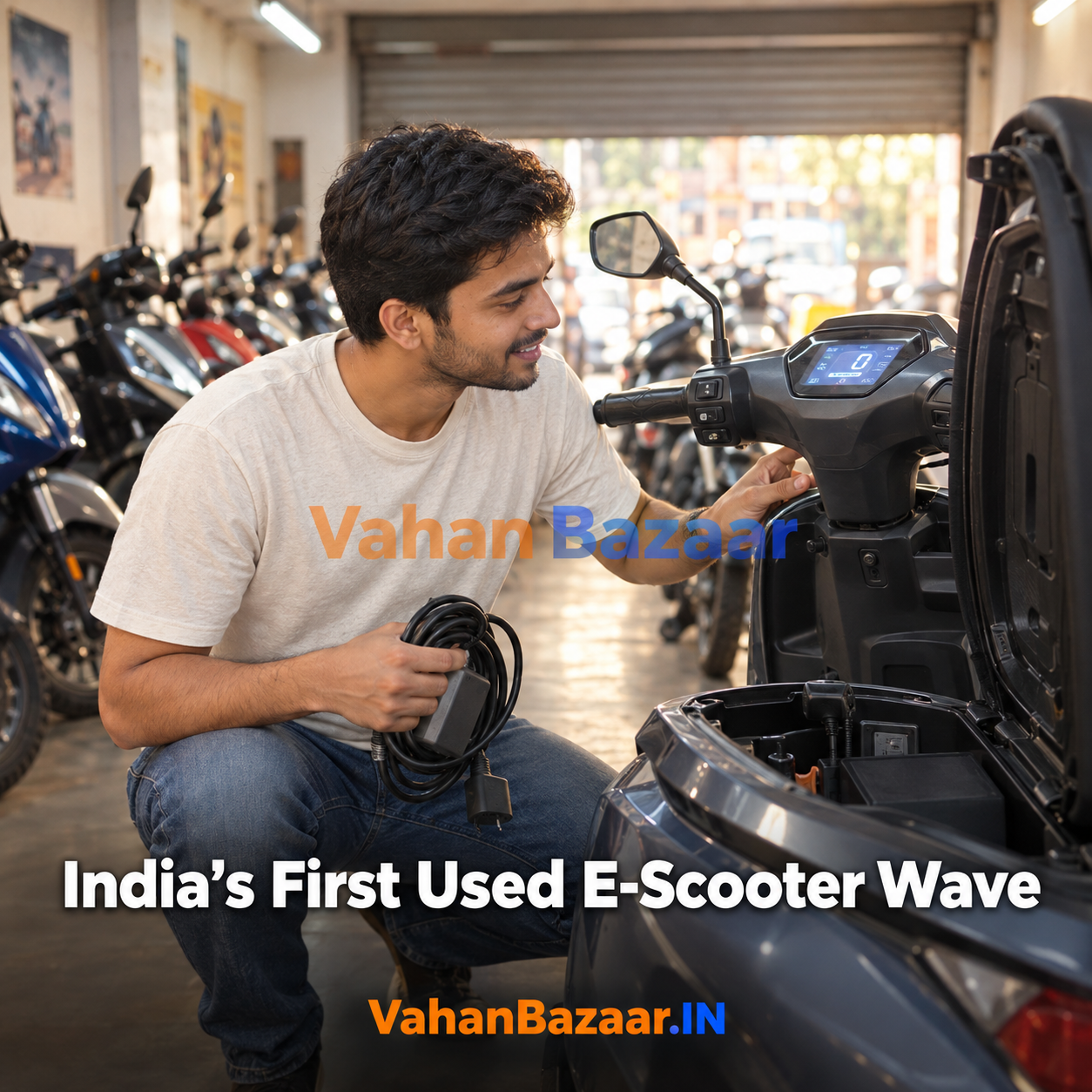
Two facts have been sitting next to each other for a while without most buyers putting them together. The first is that India's electric two-wheeler segment has scaled quickly: industry data puts its FY2026 growth at 21.81 percent, taking it past 14 lakh units, and our earlier report on the moment electric two-wheelers crossed one million in 2026 traced how fast that curve steepened. The second is much older and much more boring: Indians typically keep a two-wheeler for three to five years before selling it on.
Put the two together and the conclusion writes itself. The first large cohort of electric scooters bought during India's EV boom is now reaching resale age, and a genuine second-hand e-scooter market is forming for the first time. Not a handful of early adopters offloading experiments. A real, liquid supply of used electric two-wheelers, with real listings, real price expectations and a growing number of first-time used-EV buyers walking towards them.
Those buyers are arriving with habits learned on petrol bikes. Most of those habits transfer perfectly well. One of them does not transfer at all, and it happens to be the one attached to the most expensive part of the machine.
What the Record Still Does Exactly as Before
Start with the reassuring half, because it is genuinely reassuring and buyers talk themselves out of it far too easily. An electric scooter is a registered motor vehicle like any other. It is not a gadget, it is not an appliance and it is not outside the system. It carries a registration number, it sits in the same national database, and its record holds exactly the same fields as the record for a petrol scooter parked next to it.
That means the date of first registration, the month and year of manufacture, the registration status, the vehicle class, the registered owner serial number, the fuel type, whether a lender still holds a hypothecation charge, the insurance validity dates, the fitness validity where applicable, and any blacklist entry. Everything our guide to what a used bike's RC hides covers applies here without a single amendment.
Every reason to run that check on a used petrol bike therefore applies unchanged to a used electric one:
- A live lender's charge blocks the transfer. If the hypothecation entry is still sitting on the record, ownership cannot pass to you until it is cleared, no matter how genuinely the seller believes the loan is closed. Our piece on spotting a live loan on a used bike's RC explains why this entry outlives the repayment so often.
- A blacklist entry stops the deal. It is a hard stop, not a negotiating point, and the reason behind it has to be understood before anything else happens. The logic in our explainer on checking whether a used bike is stolen is identical for an electric machine, and a stolen scooter is a stolen scooter whatever powers it.
- The registered owner serial number moves the price. A third-owner scooter is not worth what a first-owner scooter is worth, and the record is the only place a buyer can verify that claim independently.
- The date of first registration settles the true age, which on an electric two-wheeler matters more than usual, because age is also the crudest available proxy for how long the pack has been ageing.
There is one field that does slightly more work here than it does on a petrol bike. The fuel type field will read as electric, which gives you a clean cross-check against the seller's description and against the paperwork they are showing you. It is a small thing, but it costs nothing and it confirms that the machine in the listing and the machine in the record are the same category of vehicle.
This is worth saying plainly because a surprising number of readers assume otherwise. Our record check works on two-wheelers exactly as it works on cars, and that includes electric scooters. Same database, same fields, same registration-number input, same price. RC check Rs. 99, challan check Rs. 99, both together Rs. 149.
What the Record Cannot Do, and Why It Is Different Here
Now the part that actually changes. The single biggest component of an electric scooter's value is its battery, and there is no battery field in the record. None. Not a degraded one, not an approximate one, not one hidden behind an extra fee. The record was designed to describe a vehicle's legal and financial identity, and a battery's condition is neither.
It goes further than a missing field. As of 2026, India has no universally accepted standard for measuring or certifying an EV battery's state of health for resale. So there is no separate certificate you can go and ask for either, the way you might ask for an emissions document on a petrol vehicle. Charge cycles, thermal history and state of health together determine remaining range, and remaining range determines most of what the machine is actually worth to you. None of it is recorded anywhere a buyer can pull.
The consequence is uncomfortable and buyers need to sit with it: a used electric scooter with a perfect record can still have a substantially degraded pack. The record is not wrong and it is not incomplete by anyone's mistake. It simply never claimed to describe the battery.
That produces the asymmetry at the heart of this article. On a used e-scooter, the record settles a larger share of the legal questions and a smaller share of the value question than it does on a petrol bike. Larger, because an electric scooter has fewer of the mechanical unknowns a petrol engine carries, so the legal fields cover proportionally more of what is left. Smaller, because on a petrol bike the engine's condition is at least partly readable by ear, by exhaust and by service history, while on an electric one the equivalent question is locked inside a sealed pack.
Which does not make the record check less useful. It makes it necessary and cheap, and it makes what you do afterwards different. The record check plus battery-specific diligence you carry out yourself is the complete method. Either half alone leaves you exposed.
Used Petrol Scooter vs Used Electric Scooter
Set them side by side and the division becomes obvious. The left-hand column is the question, and the two right-hand columns show how much of it the record can close on each type of machine.
| The question | Used petrol scooter | Used electric scooter |
|---|---|---|
| True age and date of first registration | Settled by the record | Settled by the record, identically |
| Number of previous owners | Settled by the owner serial number | Settled by the owner serial number, identically |
| Live loan or lender's charge | Settled by the hypothecation entry | Settled by the hypothecation entry, identically |
| Blacklist or stolen-vehicle flag | Settled by the blacklist entry | Settled by the blacklist entry, identically |
| Registration status and vehicle class | Settled by the record | Settled by the record, identically |
| Fuel type matches the description | Rarely in dispute | Useful cross-check, reads as electric |
| Insurance and fitness validity | Dates shown, cover type not shown | Dates shown, cover type not shown |
| Condition of the most expensive component | Engine: partly readable by service history, sound and inspection | Battery: no field in the record, and no accepted Indian standard for certifying it |
| Remaining usable range | Fuel-tank arithmetic, effectively a non-question | Not recorded anywhere a buyer can pull |
| Warranty position on the costliest part | Not in the record, usually low-stakes | Not in the record, and frequently the highest-value question in the deal |
Read the bottom three rows across and you have the whole argument in one glance. Everything above them is a tie. Everything below them is where a petrol-bike buying habit walks a used-EV buyer into a gap.
The Battery Questions the Record Cannot Answer
None of what follows is a guarantee, and nobody should present it as one. It is sensible practice: the set of questions that a buyer with no certificate to lean on can still ask, in person, and that a straight seller will be able to answer without hesitating. Treat evasiveness on any of them as information in itself.
1. The invoice, the warranty terms and whether they transfer
Ask for the original purchase invoice, then ask for the written battery warranty terms, the period remaining on them, and whether the warranty is transferable to a second owner. This is often the single highest-value question in the entire transaction. Warranty terms vary: some follow the vehicle, some follow the original purchaser, and some transfer only if a formal process is completed at the point of sale. A verbal assurance from a seller is not a warranty. The document is.
Work out what is left in months or kilometres, whichever the terms are written in, and price the scooter with that number in front of you. A machine with real, transferable warranty cover remaining is a materially different proposition from an identical-looking one without it.
2. Fixed pack, or swappable and subscription-based
Establish early whether the scooter uses a fixed battery pack or a swappable or subscription arrangement, because the answer changes what you are actually buying. A battery the seller does not own is not a battery you are buying. Under a subscription or swap model the pack may belong to the network operator, with ongoing charges attached and terms of its own, and the resale conversation has to account for that separately from the price of the scooter.
This is not a warning against those models. They exist for good reasons and they suit plenty of riders. It is a warning against quietly assuming that the price on the listing buys you the whole machine when part of it may be rented.
3. A real full-charge range figure, honestly compared
Ask the seller what the scooter genuinely does on a full charge in their normal riding, and compare that with the original claimed range for the model. Do the comparison with your eyes open: the original figure was a test figure, produced under standardised conditions, and no machine on Indian roads with an Indian rider and Indian traffic was ever going to match it exactly. A gap does not by itself prove degradation.
What the comparison gives you is a shape. A used scooter delivering close to what similar-age machines deliver is unremarkable. One delivering far less than its peers is telling you to slow down and ask more questions, and it is a legitimate basis to negotiate on. Ask on what kind of riding the figure was measured, too, since load, terrain and speed all move it.
4. Service history, and any record of a pack replacement
Ask for service records and specifically for any history of battery pack service or replacement. A documented replacement is not automatically bad news, and can genuinely be the opposite if it was done under warranty and recently. What matters is knowing about it, and knowing what warranty position the replacement pack carries, which is not necessarily the same as the original one.
A pack replacement outside warranty is a large fraction of the machine's value. That single sentence is why this line of questioning deserves more of your attention than anything else on a used electric scooter, and why a buyer who skips it is gambling with the biggest number in the deal.
5. The charger, present and original
Check that the charger is present, that it is the original one supplied with the scooter, and that it works. It is a small item next to the pack itself, but a missing or substituted charger is an avoidable cost and an avoidable risk, and it is the kind of thing that gets forgotten in the excitement of a handover and remembered a week later.
Every question above is a question you can ask over a phone call or a message before you spend a Sunday travelling to see a scooter. Warranty terms, transferability, fixed versus swappable, real range, service history, charger. A seller who cannot answer any of them, or who will not put the invoice in front of you, has saved you a journey. Pair that call with the Rs. 99 record check on the registration number and you have filtered most of what can be filtered remotely.
Run the Record First, on Two-Wheelers Exactly as on Cars
Date of first registration and true age, month and year of manufacture, registration status and vehicle class, registered owner serial number, fuel type, hypothecation against a lender, insurance and fitness validity, and blacklist flags — pulled from the VAHAN database against any registration number, electric scooter or petrol bike or car. RC check Rs. 99, challan check Rs. 99, or both together for Rs. 149.
The Subsidy and Ownership Wrinkle
There is one more layer that has no petrol-bike equivalent. Some electric two-wheelers on Indian roads were bought with government purchase incentives, and incentive schemes are written around the original purchase rather than around the vehicle's whole life.
Where a scheme attaches conditions to the original buyer, a second-hand purchaser is not the beneficiary, and the resale terms can therefore differ from those on an ordinary bike. That is a general statement and it has to stay general, because schemes differ from one another and their terms change. The practical instruction is simple: do not assume in either direction. Establish which scheme, if any, the scooter was bought under, read what that scheme actually says, and confirm whether any transfer conditions apply to a resale.
The broader shape of this question, and what the end of purchase support does to the arithmetic buyers were doing, is something we worked through in our piece on what the end of e-scooter subsidies does to the used-car maths. The important point for a used buyer is narrower: an incentive on the original purchase does not travel with the machine by default, and a price that looks like a bargain because the first owner's cost was subsidised is not the same as a bargain for you.
Whatever the scheme says, the mechanical parts of the handover do not change. Make sure the RC transfer is completed properly and the hypothecation position on the record is clean, because those are the things that actually block a change of ownership in practice, and no incentive question overrides them.
The Order to Do Things In
Sequencing matters here for the same reason it matters on any used vehicle: the checks differ enormously in what they cost, what they need from the seller, and how decisively they can end a conversation. Do the cheapest and most decisive one first.
First, run the Rs. 99 record check. It needs only the registration number, which is visible on the scooter and legible in most listing photographs, so it needs nothing at all from the seller and can be done before you make contact. It returns in seconds. And it is the step most likely to produce a hard stop: a live hypothecation, a blacklist entry, a registration status that is not what the listing said, an owner count higher than claimed, or an age years off the description. Every one of those ends the conversation before you have travelled anywhere.
Second, do the battery questions in person or at least before travelling. Invoice, warranty terms and transferability, fixed or swappable, real full-charge range against the claimed figure, service history and any pack replacement, charger present and original. This is the part no database is going to do for you, and it is where the money is.
Third, do a physical inspection. Ride it if the seller allows it. Look at tyres, brakes, suspension, the charging port and the general condition of the machine the way you would on any two-wheeler. Electric drivetrains remove some of the mechanical unknowns, but a scooter is still a scooter and the parts that wear still wear.
If you are new to used EVs entirely, our first-time used EV buyer guide walks through the broader mindset shift, most of which applies to two-wheelers as directly as it does to cars.
What This Means for Buyers
The mental adjustment is small and specific. On a used petrol bike, the record answers the legal questions and your ears, the service book and a mechanic answer the value question. On a used electric scooter, the record answers the legal questions slightly more completely, and answers the value question not at all, so the paperwork the seller holds does more work than usual.
That means the invoice and the warranty document are not a formality to be collected at handover. They are the closest thing to a battery record that exists, and they should be seen early, read properly and priced into the offer. A seller who produces them without being chased is telling you something good. A seller who keeps promising to find them is telling you something else.
Do not let any of that talk you out of the record check. It remains the fastest way to kill a bad deal, it costs Rs. 99, it works on two-wheelers exactly as it does on cars, and it is the only step in this entire process that requires nothing from the seller at all. Insurance validity in particular is worth reading on an electric machine as carefully as on any other, and the changing rules we covered when new two-wheelers were required to carry six years of insurance have made that field more informative than it used to be.
What This Means for Sellers
If you are selling an electric scooter into this new market, you are selling into buyer uncertainty that has nothing to do with your machine. Buyers cannot tell your well-kept scooter with warranty left on the pack from someone else's tired one, so they discount both. You pay for the ambiguity created by scooters you have never seen.
The way out is to close the questions before they are asked. A seller with the purchase invoice, clear battery warranty paperwork and a clean record can prove all of it up front, which is exactly the position no anxious used-EV buyer expects to find and exactly the one that ends the discounting. A verified listing at Rs. 99 cross-checks the vehicle against the official record and carries a Verified badge, so age, ownership count and registration position are settled on the listing rather than argued about on a call. On average, based on VahanBazaar listings data, verified listings draw about three times the buyer enquiries and sell around 40 percent faster. Rs. 99 is.
Then put the battery paperwork in the listing description rather than waiting to be asked for it. Warranty period remaining, whether it transfers, the charger being original and included, and an honest real-world range figure. Every one of those removes a reason for a buyer to hold something back, and on an electric two-wheeler in 2026 they are the difference between a fair price and a nervous one.
The Short Version
India's EV two-wheeler segment grew 21.81 percent in FY2026 and crossed 14 lakh units, and Indians typically keep a two-wheeler three to five years. The first big cohort of used electric scooters is therefore arriving in the resale market now.
The record does everything it always did. Date of first registration, month and year of manufacture, registration status, vehicle class, registered owner serial number, fuel type reading as electric, hypothecation, insurance validity, fitness validity where applicable, blacklist entry. A live lender's charge still blocks the transfer, a blacklist entry still stops the deal, owner count still moves the price, and a stolen machine is still a stolen machine.
The record does nothing at all about the battery. There is no battery field, and as of 2026 no universally accepted Indian standard for measuring or certifying state of health for resale. Charge cycles, thermal history and state of health drive remaining range and therefore most of the value, and none of it is recorded anywhere a buyer can pull. A perfect record is compatible with a substantially degraded pack.
So run the Rs. 99 record check first, because it is cheapest, needs only the registration number and disqualifies fastest. Then ask the battery questions in person: invoice, warranty terms and transferability, fixed or swappable pack, real range against claimed range, service history and any pack replacement, charger present and original. Then inspect the machine physically. Confirm any incentive-scheme terms rather than assuming them, and make sure the RC transfer and hypothecation position are clean regardless.
Frequently Asked Questions
No. There is no battery field in the record at all. The record holds the date of first registration, the month and year of manufacture, the registration status, the vehicle class, the registered owner serial number, the fuel type, any hypothecation charge held by a lender, the insurance validity dates, the fitness validity where applicable and any blacklist entry. Battery state of health, charge cycles and thermal history appear nowhere in it. As of 2026 India also has no universally accepted standard for measuring or certifying an EV battery's state of health for resale, so there is no separate certificate you can ask for either. A used electric scooter with a perfectly clean record can still have a substantially degraded pack.
It works on two-wheelers exactly as it works on cars, and that includes electric scooters. An electric scooter is a registered motor vehicle like any other, so it sits in the same database with the same fields. Our RC check is Rs. 99, the challan check is Rs. 99, and both together are Rs. 149. All you need is the registration number, which is visible on the scooter and legible in most listing photographs, so the check costs you nothing but a few seconds and needs no cooperation from the seller.
Start with the purchase invoice, then the battery warranty terms, the remaining warranty period and whether that warranty transfers to a second owner. That is usually the single highest-value question you can ask. Next, establish whether the scooter uses a fixed pack or a swappable or subscription arrangement, because a battery the seller does not own is not a battery you are buying. Then ask for a realistic full-charge range figure and compare it against the original claimed range, remembering the original figure was a test figure rather than a promise. Finally, ask for service history, any record of a pack replacement, and confirm the original charger is present.
It depends entirely on the manufacturer's warranty terms, which is exactly why it needs to be asked rather than assumed. Some warranties follow the vehicle, some follow the original purchaser, and some transfer only if a formal process is completed at the time of sale. Ask to see the written warranty terms alongside the purchase invoice rather than accepting a verbal assurance, and confirm the remaining period in months or kilometres. A pack replacement outside warranty is a large fraction of the machine's value, so a transferable warranty with real time left on it is worth a great deal, and the absence of one is worth negotiating over.
They can. Some electric two-wheelers were bought with government purchase incentives, and where a scheme attaches conditions to the original buyer, a second-hand purchaser is not the beneficiary. Resale terms can therefore differ from those on an ordinary petrol bike. Do not assume either way: confirm the specific scheme the scooter was bought under, read its terms, and check whether any transfer conditions apply. Separately, and regardless of what the scheme says, make sure the RC transfer is completed properly and the hypothecation position is clean, because those are the things that block a change of ownership in practice.