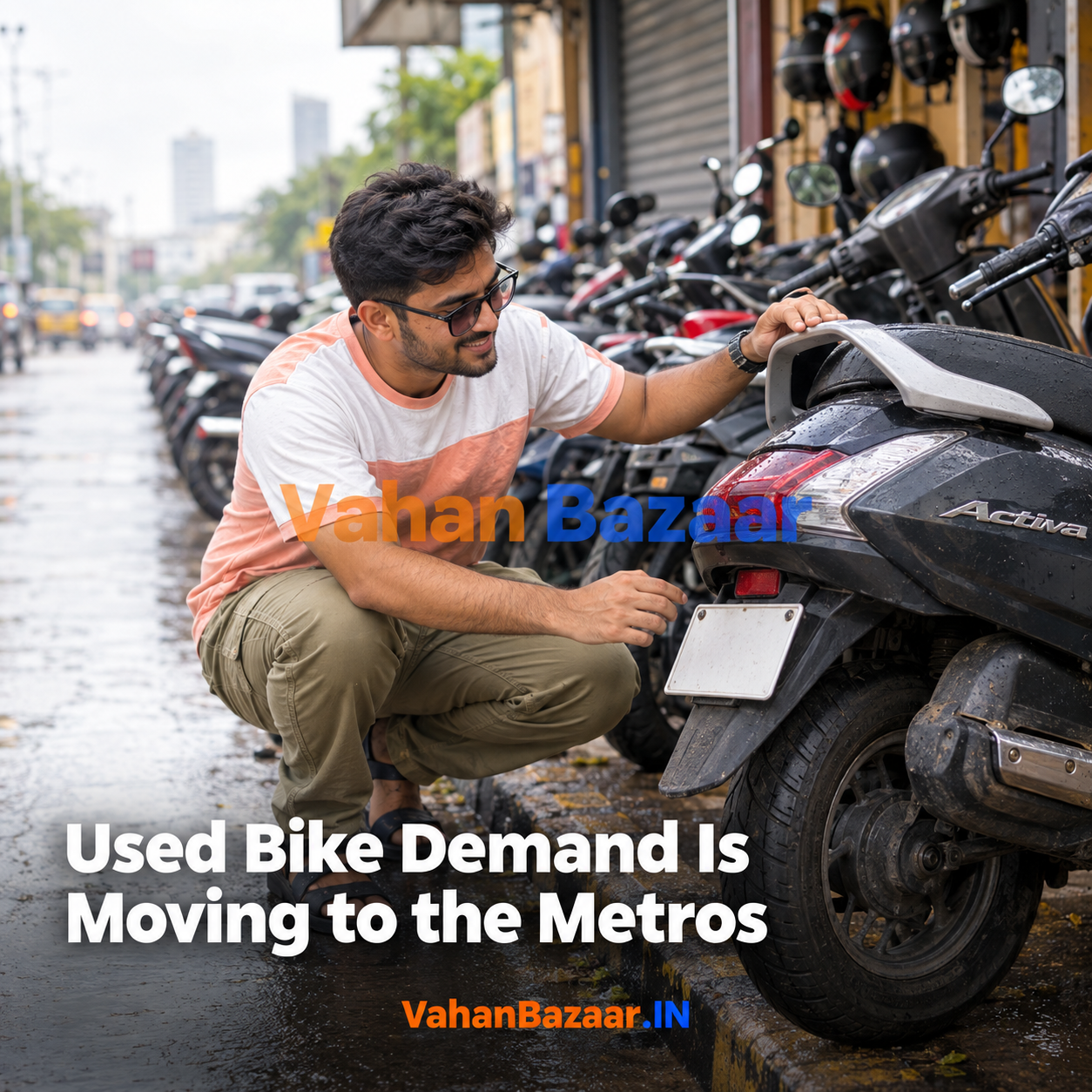
A used car buyer in India will typically spend two or three weeks on the purchase. They will see four cars, take two of them to a mechanic, argue about the paperwork, and hand over money only after somebody has looked at the registration certificate properly. A used bike buyer will often do the whole thing between a Saturday morning message and a Sunday afternoon handshake.
That difference is not carelessness. It is arithmetic. When the purchase is Rs. 45,000 rather than Rs. 4.5 Lakh, the effort a buyer is willing to spend scales down with the price. The problem is that the risks do not scale down with it. On a two-wheeler, several of them scale up.
What Happened in Last Year's Festive Window
The most recent published read on how metro two-wheeler demand behaves ahead of the festive season comes from the local-search platform Justdial, which compared search activity from September to mid-October 2025 against a mid-July to August 2025 baseline. Across India, two-wheeler searches on the platform rose 306 per cent between those two windows.
The city table is the interesting part, because the demand did not rise evenly. Mumbai led at 174 per cent, followed by Delhi at 161 per cent, Pune at 150 per cent, Chennai at 143 per cent, Hyderabad at 129 per cent and Bengaluru at 116 per cent. Four-wheeler searches moved too, but less sharply, at 193 per cent nationally.
These figures are from the September to mid-October 2025 festive window and were published towards the end of October 2025. They are not 2026 measurements, and we are not presenting them as such. Two further caveats matter. The platform counted two-wheeler searches broadly rather than pre-owned listings alone, and a large part of the movement was driven by the GST revision that cut the rate on entry-level two-wheelers from 28 per cent to 18 per cent in September 2025, which pulled attention towards new bikes as well as used ones. What the data is genuinely good for is the shape of the thing: metro demand for two-wheelers concentrates hard in the eight weeks before Diwali, and Mumbai and Delhi sit at the top of that curve. On 10 September 2026 the festive season has not started. Ganesh Chaturthi falls on 14 September, Navratri runs 11 to 19 October, Dussehra is on 20 October and Diwali on 8 November. This is a plan-ahead article, not a report on a rush already under way.
The Structural Fact Underneath the Spike
Strip out the festive noise and one thing stays true all year. India moves more second-hand two-wheelers than new ones. New registrations reached 2.02 crore units in calendar 2025 on the VAHAN portal, up roughly 7 per cent on the 1.89 crore recorded in 2024. The used market sits on top of that base and is estimated by market-research houses at around Rs. 50,000 Crore, expanding at roughly 8 to 10 per cent a year.
Unit estimates for the used side vary enormously, from under a crore a year at the conservative end to well over three crore at the optimistic one. That spread is not sloppy research. It is the single most important fact about this market: the overwhelming majority of used two-wheeler trade in India is unorganised, and unorganised trade does not generate the paper trail that would let anyone count it. Small neighbourhood dealers, mechanics who buy and resell on the side, roadside sellers, and above all direct person-to-person sales between people who met on a classifieds app on Tuesday and shook hands on Thursday.
In used cars, an organised layer of dealers has grown up over the last decade, and with it a set of habits: documented handovers, transfer applications actually filed, some standard of disclosure. Used two-wheelers never got that layer. The discipline that the used car market spent ten years acquiring simply does not exist on the bike side, and the vehicles turn over faster.
Fast-Moving Stock Is the Least-Checked Stock
Here is the part that catches buyers out during a demand spike. When a market gets hot, the good listings do not sit around. A well-priced scooter in Andheri or a two-year-old commuter motorcycle in Rohini will have six enquiries within a day and will be gone within two.
That speed does two things at once. It removes the buyer's time to check, and it removes the seller's incentive to tolerate being checked. A seller with one interested party will happily wait while you look at the papers. A seller with six will tell you the next person is on their way, and in a hot week that is often true rather than a negotiating tactic.
A bike that sells in forty-eight hours does not get a two-week inspection. So the fastest-moving stock, which is to say the most desirable stock, is systematically the least verified stock in the market. That is exactly backwards from how it ought to work, and it is why the only check worth relying on in a hot market is one you can complete in about two minutes from your phone, before you have even travelled to see the bike.
Why a Used Bike's Record Deserves More Scrutiny, Not Less
The instinct that a smaller purchase needs a smaller amount of due diligence is the most expensive instinct in this market. Five specific reasons a two-wheeler's record is more likely to hold a nasty surprise than a car's, not less.
1. The amount is small enough to rationalise away
"It is only Rs. 40,000" is the sentence that precedes most used bike regrets. But Rs. 40,000 is real money to the person spending it, and the failure modes do not cost you a proportion of the purchase, they cost you all of it. A bike you cannot transfer into your name is a bike you cannot lawfully resell, which means the loss is total rather than partial. We have set out the full list of what a bike's registration record can hide in our piece on why a used bike's RC hides more than a car's.
2. Two-wheelers are the most-stolen vehicle class in India
This is not a soft claim. National Crime Records Bureau figures for 2021 recorded 2,09,960 motorcycles and scooters reported stolen, out of 2,42,158 vehicles of all kinds. That is close to nine in every ten stolen vehicles being a two-wheeler, and only a minority were recovered. Bikes are easier to take, easier to move and easier to sell on than cars, and the resale ends up somewhere in exactly the unorganised, cash-and-handshake segment described above.
The practical consequence is that a blacklist flag on the record genuinely matters when you are buying a bike, in a way that it only occasionally does when you are buying a car. It is the one check that separates a bargain from a police station.
3. Small loans are frequently left open on the record
A two-wheeler loan is small, short and usually finished early. What happens next is the problem. Once the borrower has paid the final instalment, they get on with their life. Very few of them go back to the lender for a no-objection certificate and then to the RTO to have the hypothecation entry removed from the registration record.
So the loan is closed in the bank's books and still live in the government record, sometimes years later. And a live hypothecation entry blocks the transfer. The seller is not lying to you when they say the loan is paid off; they simply do not know the record still says otherwise. This is common enough on two-wheelers that we wrote a separate explainer on checking a used bike's RC for a live loan before you commit.
4. The person selling is often not the registered owner
Because so little of the trade is documented, plenty of bikes change hands two or three times without a single transfer application being filed. Each buyer intends to sort it out, each one discovers it is a small hassle, and each one sells the bike on before getting round to it.
The result is a bike being sold by someone whose name does not appear anywhere in the official record, and who may have no realistic way of producing the person whose name does. That person is the only one who can sign the transfer application. If they cannot be produced, you have bought a bike you can ride but cannot own, while somebody who has never met you keeps receiving its challans. Reading the owner name and owner serial number off the record before you pay turns this from a discovery into a question.
5. Long-tenure insurance has changed what travels with the bike
Insurance on newer two-wheelers now runs for years rather than one season, which changes the calculation on a resale. The Supreme Court had already required five years of third-party cover on new two-wheelers at first registration back in 2018, and in August 2026 it directed that the period be extended to six years, on the reasoning that too many vehicles on Indian roads still carry no cover at all. Our report on what six years of mandatory cover means for used bike buyers goes through the detail.
For a buyer, the point is simply that the insurance validity date on the record is now a meaningful piece of information rather than a formality. A three-year-old bike may still carry years of cover, or the previous owner may have let a lapsed policy run on unaddressed. Reading the date is the difference.
What This Means for Used Two-Wheeler Buyers
The response to a concentrating market is not to move faster than everybody else. It is to do the one part of the process that can be done before you move at all.
Pull the record from the registration number, before you travel. A registration number is visible in almost every listing photograph and in most WhatsApp messages sellers send. That is all the input needed. Our Rs. 99 record check returns the owner name and the owner serial number, so you know whether this is a first, second or third owner and whether the name matches the person messaging you. Note honestly that the government source masks the owner name in some states, in which case only the first name comes back, and we show you exactly what the source gives us rather than filling in a guess.
The same report returns the registration status and any blacklist flag, the date of first registration and the month and year of manufacture, which together settle the bike's true age regardless of what the listing claims, the make, model and variant, the fuel type, the insurance company and validity date, the fitness validity, and the financer name where a loan is still recorded against the vehicle.
What it does not return is service history, accident history, a full insurance claim history, odometer readings or a valuation. Those are different questions, answered by a mechanic and by your own judgement. The record check answers the legal and identity questions, which are the ones that can cost you the entire purchase price.
Run the challan check in the same pass if you are buying in a metro. Pending challans are a separate Rs. 99 check, or Rs. 149 for both together rather than Rs. 198 bought separately. Camera enforcement in the big cities has made accumulated two-wheeler challans far more common than they used to be, and they attach to the vehicle rather than to the person who was riding it.
Then do the transfer properly, and do it quickly. Most of the misery in this market traces back to a transfer that everybody meant to file and nobody did. Our step-by-step guide to transferring the RC on a used bike in 2026 walks through the current process.
Roughly a third of the buyers paying for a record check on VahanBazaar are checking a two-wheeler, a truck or a three-wheeler rather than a car. That is our own observation from our own usage, not a market statistic, and we mention it only because it runs against the assumption that record checks are a used car concern. The people buying the cheapest vehicles are, on our numbers, among the most likely to check them.
Rs. 99 Against a Rs. 40,000 Purchase
Rs. 99 on a Rs. 40,000 bike is about one-eighth of one per cent of the price. On a Rs. 80,000 bike it is about one-sixteenth of one per cent. It is less than the fuel most buyers burn getting to and from the viewings. Owner name and owner number, registration status, blacklist flag, registration and manufacture dates, insurance validity and the financer name if a loan is still live — from the VAHAN database, against any registration number, in about two minutes. RC check Rs. 99, challan check Rs. 99, or both for Rs. 149 instead of Rs. 198.
The Short Version
India's used two-wheeler market is large, growing and almost entirely unorganised. Market-research estimates put it at around Rs. 50,000 Crore, growing at roughly 8 to 10 per cent a year, sitting on top of a new-vehicle base of 2.02 crore registrations in calendar 2025. Because so little of the used trade is documented, unit estimates vary by a factor of three, which tells you more about the state of the paperwork than any single number could.
Demand concentrates in the metros ahead of the festive season. In the September to mid-October 2025 festive window, two-wheeler searches on one national local-search platform rose 306 per cent against the mid-July to August 2025 baseline, with Mumbai leading the city table at 174 per cent, Delhi at 161 per cent and Chennai at 143 per cent. Those are 2025 figures, published in October 2025, covering two-wheeler searches broadly rather than used listings alone, and they were helped along by a GST cut on entry-level two-wheelers. Treat them as the shape of the season rather than a forecast.
The consequence for a buyer is straightforward. Hot stock moves in days, and stock that moves in days does not get inspected. Meanwhile a used bike's record carries risks a car's usually does not: two-wheelers are by a wide margin the most-stolen vehicle class, small bike loans are routinely left live on the record after being repaid, and a large share of bikes are being sold by someone who is not the registered owner.
So do the cheap step first. Read the registration number off the listing photograph, pull the record, check the owner name and owner number, the registration status, the blacklist flag, the insurance validity and whether a financer is still named. Rs. 99, about two minutes, before you travel and long before any token amount changes hands. On a Rs. 40,000 purchase it is the cheapest thing you will do all week.
Frequently Asked Questions
No, and we would rather say so plainly than let the impression stand. The percentages quoted here come from local-search platform Justdial and cover the period from September to mid-October 2025, measured against a mid-July to August 2025 baseline. They were published towards the end of October 2025. The figures describe two-wheeler searches broadly rather than pre-owned listings alone, and part of the movement was driven by the GST revision that cut the rate on entry-level two-wheelers from 28 per cent to 18 per cent in September 2025. We use them here as the most recent published read on how metro two-wheeler demand behaves in a festive run-up, not as a 2026 measurement. On 10 September 2026 the festive season has not begun. Ganesh Chaturthi falls on 14 September 2026, Navratri runs from 11 to 19 October, Dussehra falls on 20 October and Diwali on 8 November.
Because the price is small enough that most buyers talk themselves out of checking, and because the underlying paperwork is weaker. Roughly all of India's used two-wheeler trade sits outside the organised sector, which means small dealers, roadside sellers and direct person-to-person sales with no standard documentation. Two-wheelers are also the vehicle class most often stolen. National Crime Records Bureau data for 2021 recorded 2,09,960 motorcycles and scooters reported stolen out of 2,42,158 vehicles in total, which is close to nine in every ten. On top of that, small bike loans are frequently left open on the record after the borrower has finished paying, and a live hypothecation entry blocks a transfer until the lender issues a no-objection certificate. A Rs. 99 record check surfaces all three of those in one view.
It returns the owner name and the owner serial number, telling you whether you are dealing with the first, second or third registered owner. Note that the government source masks the owner name in some states, in which case only the first name is returned, and we show exactly what the source gives us rather than filling in a guess. It also returns the registration status, any blacklist flag, the date of first registration and the month and year of manufacture, the make, model and variant, the fuel type, insurance company and validity, fitness validity, and the financer name where a loan is still recorded against the vehicle. Pending challans are a separate Rs. 99 check, or Rs. 149 for both together instead of Rs. 198 bought separately. It does not return service history, accident history, a full insurance claim history, odometer readings or a resale valuation.
It is the single most common problem in the used two-wheeler trade and it deserves a direct answer before any money moves. Many bikes change hands several times without a single transfer being filed, so the person holding the keys is often not the registered owner, and sometimes not even known to the registered owner. Whoever is named on the record is the person who must sign the transfer application, so if that person cannot be produced, the transfer cannot be completed and the bike stays in a stranger's name while you ride it and carry the liability. Pull the record before you pay, read the owner name and owner serial number off it, and match them to the person in front of you. If they do not match, that is a conversation to have before the token amount, not after.
The arithmetic answers this better than any argument. Rs. 99 on a Rs. 40,000 bike is about one-eighth of one per cent of the purchase price. On a Rs. 80,000 bike it is about one-sixteenth of one per cent. It is less than most buyers spend on fuel getting to and from the two or three viewings they will do before choosing. Against that, a blacklist flag, a live hypothecation entry or a mismatched owner name can cost you the entire amount, because a bike you cannot transfer is a bike you cannot lawfully resell. The instinct to skip the check because the sum is small has the logic exactly backwards. The smaller the purchase, the larger Rs. 99 looks and the smaller it actually is.