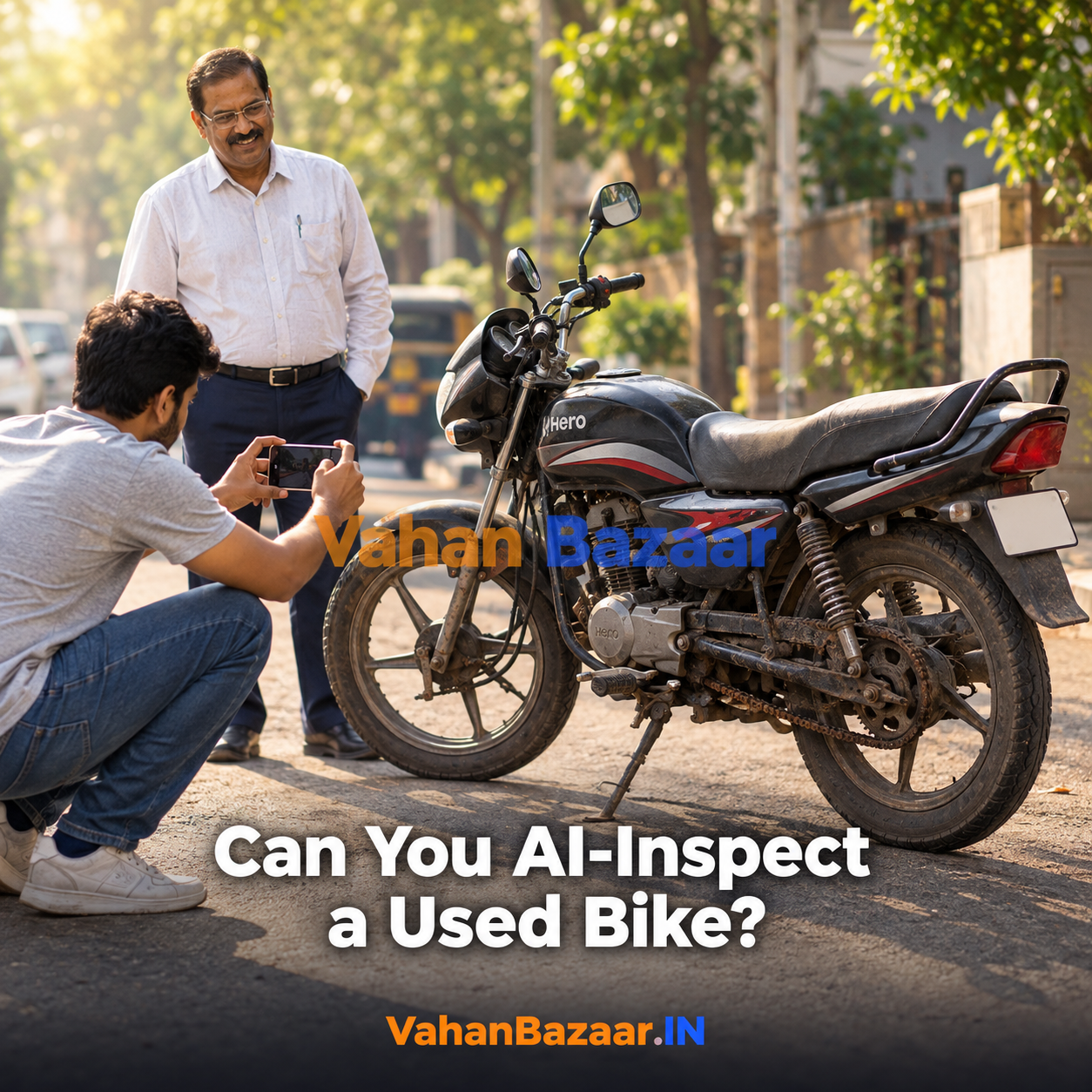
The question arrives in our inbox several times a week, usually phrased almost identically. "I am buying a used Activa. Can I run your AI inspection on it?"
No. Not today, and not for a two-wheeler. The AI Vahan Inspection is built for cars, it does not support motorcycles and scooters, and we are not going to dress that up. There is a version of this article that hedges, uses the word "currently" a lot and leaves you hopeful. This is not that article, because a hopeful answer would waste your afternoon and you are buying a bike this weekend.
What follows is the useful part: which of the checks actually carries the risk on a used two-wheeler, which of them you can buy for Rs. 49, and how to do by hand, in about ten minutes, the physical inspection that the car report automates.
Why the Photo Set Does Not Describe a Motorcycle
The reason is mechanical rather than philosophical. The Rs. 249 report is assembled from eight required photographs of a car, each taken from a defined angle: front, passenger side, rear, driver side, engine bay, trunk, odometer and front cabin interior. On top of those it accepts up to four optional tyre close-ups, one per wheel.
Every one of those angles exists for a reason. The four walkaround shots are there so that the analysis can compare panel to panel and catch paint mismatch, which is the most reliable tell-tale of accident repair on a car. The trunk and the cabin interior carry their own evidence of water ingress, of a hard life, of a rear-end repair that the outside no longer shows. The odometer photograph is cross-checked against the registration year.
A motorcycle has no trunk. It has no front cabin interior. It has two wheels, not four. And it has no panels in the car sense at all, so panel-to-panel paint comparison, which is the single most valuable thing the walkaround angles do, has nothing to compare. Point a car analysis at a set of bike photographs and you would get a report that reads confidently and means nothing. A confident report that means nothing is considerably worse than no report, because you would act on it.
The Rs. 249 AI Vahan Inspection is a car product. It requires the eight car photographs listed above and does not support two-wheelers. Nothing on this page should be read as a hint that this will change. We have no roadmap to share and we are not going to invent one to keep you reading. What we can tell you is which of our tools does work on your bike, and that is the rest of this article.
It is worth adding, for the car buyers reading this, that even on a car the AI report is a records-plus-photographs analysis rather than a physical mechanical inspection. It cannot replace a workshop check or an ECU scan, and we have written separately about when a photo analysis is enough and when you need a workshop inspection. That distinction matters here too, because it points at what a bike buyer actually needs.
On a Used Bike, the Record Is the Part That Carries the Risk
Here is the thing that gets lost in the question. On a used car, the physical condition and the paperwork both carry serious money. A car with a repaired chassis and a car with a live loan are each a problem worth several Lakh. On a used two-wheeler the physical risk is genuinely smaller, because a bike is simpler, cheaper to repair and easier to look over in ten minutes, while the paperwork risk is just as large as it is on a car and in some ways larger.
A bike you cannot transfer into your own name is a bike you cannot lawfully resell, and that loss is total rather than proportional. It does not matter that you only paid Rs. 45,000 for it. You paid Rs. 45,000 for something you do not own.
The record check that answers those questions is our Rs. 49 Vahan Verify, and unlike the AI inspection it covers cars, bikes and commercial vehicles, because it reads the government record against a registration number rather than analysing photographs. You need nothing but the number on the plate, which is usually visible in the listing photograph before you have even replied to the seller. There is no sign-in; you pay and the report comes back.
What the Rs. 49 Check Returns for a Bike, What It Does Not, and What Is Left to You
This is the table to keep open while you are standing next to the bike. The first column is the question, the second is what the record answers for you, the third is what you have to establish yourself because no records database holds it.
| The question about the bike | Rs. 49 record check | What you must check yourself |
|---|---|---|
| Who legally owns it | Owner name and owner serial number | Match the name to the person selling; ask for identification if it does not |
| Is it stolen or blocked | Blacklist flag, RC status, NOC flags | Nothing. This is the one check you genuinely cannot do standing in a lane |
| Is a loan still live on it | Hypothecation entry and financer name | Ask for the lender's NOC and RTO Form 35 before any money moves |
| How old is it really | Date of first registration, month and year of manufacture | Cross-check against the tyre DOT codes and general wear |
| Is the frame the frame on the papers | Engine number and chassis number as recorded | Find the stamped numbers on the frame and compare character by character |
| Insurance, fitness, road tax, PUC | Company, status and validity dates | Sight the physical documents and confirm they are the same policy |
| Pending challans | Separate Rs. 49 check, or Rs. 79 for both together | Settle who pays them before you agree the price |
| Has it been crashed and repaired | Not returned | Square-on photographs of both sides, headstock welds, paint overspray |
| Is the odometer honest | Not returned | Read it with the engine running; weigh it against chain, sprocket and tyre wear |
| Service history | Not returned | Ask for the service book and call the service centre named in it |
| What it is worth | Not returned | Your own comparison against similar bikes on the listings |
Why the Record Matters More on a Bike, Not Less
The instinct runs the other way. Small purchase, small check. That instinct is the most expensive one in this market, and there are five concrete reasons why.
1. The sum is small enough to rationalise away
"It is only Rs. 40,000" is the sentence that precedes most used bike regrets. Rs. 49 on a Rs. 40,000 purchase is about one-eighth of one per cent of the price, which is less than most buyers spend on fuel travelling to the viewings. The failure modes, though, do not cost you a proportion. They cost you the lot.
2. The trade is overwhelmingly unorganised
India's used two-wheeler market is estimated at around Rs. 50,000 Crore and is growing at roughly 8 to 10 per cent a year, on top of a new-vehicle base of 2.02 crore two-wheelers registered in calendar 2025 on the VAHAN portal, up about 7 per cent on 2024. Almost none of that used trade sits in the organised sector. It is small neighbourhood dealers, mechanics who buy and resell on the side, and above all direct person-to-person sales. Used cars acquired an organised layer over the last decade and with it some documentation habits. Bikes never got that layer, which is a theme we have traced before in our piece on how used bikes now outsell new ones.
3. Two-wheelers are the most-stolen vehicle class in the country
National Crime Records Bureau data for 2021 recorded 2,09,960 motorcycles and scooters reported stolen out of 2,42,158 vehicles reported stolen in total. That is close to nine in every ten. Bikes are easier to take, easier to move and easier to sell on, and they are sold on into exactly the unorganised segment described above. The blacklist flag on the record is therefore doing real work when you are buying a two-wheeler, in a way it only occasionally does on a car. We set out how to read it in our guide to checking whether a used bike is stolen.
4. Small loans are routinely left open on the record
A two-wheeler loan is small and short, and is often cleared early. What almost nobody does afterwards is go back to the lender for a no-objection certificate and then to the RTO to have the hypothecation entry removed. So the loan closes in the bank's books and stays live in the government record, sometimes for years. A live entry blocks the transfer until the lender issues that NOC. Lenders usually issue one within 7 to 21 working days of full repayment, and a bank NOC is typically valid for 90 days from the date of issue, so it has to be used inside that window. Removing the entry needs the NOC plus RTO Form 35. Our explainer on a live loan on a used bike's RC walks through it.
5. The person holding the keys is very often not the registered owner
Because so little of the trade is documented, plenty of bikes change hands two or three times without a single transfer being filed. Each buyer means to sort it out, each finds it a small hassle, and each sells the bike on first. The person on the record is the only one who can sign the transfer application, and if they cannot be produced, you have bought a bike you can ride but cannot own, while a stranger keeps receiving its challans. Reading the owner name and owner serial number before you pay turns that from a discovery into a question. There is more on what a bike's registration record conceals in a used bike's RC hides more than a car's.
The Ten-Minute Inspection You Run Yourself
Now the physical half. What the car report automates, a bike buyer can do by hand, because a motorcycle hides far less than a car does. Almost everything structural is visible without a lift. Six checks, in this order, with your phone.
Photograph both sides square-on, in daylight
Stand at the same distance on each side, phone held at the same height, and take one photograph of each flank straight on. Then put the two pictures side by side on the screen. You are looking for the fork angle to match, the frame tubes to run parallel to the ground in the same way, and the gap between tyre and mudguard to look the same on both. A bike that has been down hard and straightened rarely comes back perfectly symmetrical, and the comparison catches what the eye forgives. This is the manual version of the panel-to-panel comparison the car report does for you.
Look at the chain and the sprockets
The chain and sprockets are the cheapest honesty test on a motorcycle. Hooked or pointed sprocket teeth mean long, hard use. Push and pull the chain at several points around the wheel: if it is tight in one place and loose in another, it has stretched unevenly, which takes time and neglect. A bike that claims low use and shows a worn drivetrain is telling you something the seller is not. On a scooter, look instead at the state of the rear tyre and the drive belt cover for the same reason.
Read the DOT code on both tyres
On the sidewall of every tyre is a four-digit manufacture code: the first two digits are the week, the last two the year. Two tyres from different years is normal on a used bike. Two tyres from a year later than the registration date is normal too. What is worth a question is a bike claiming very low use on tyres that are five or six years old, or a bike claiming heavy recent use on tyres fitted last month, which usually means it was tidied up for sale. Compare what the sidewalls say against the month and year of manufacture in the record you have already pulled.
Read the odometer with the engine running
Turn the ignition on, start the engine, and read the odometer then, not on the ignition alone. On some digital clusters a reading will display on ignition and settle differently once the engine is running, and a genuine cluster behaves consistently. Photograph the number. Then hold that number against the chain, the sprockets, the tyre codes, the wear on the footpegs and the shine on the grips. The record gives you the registration date, so you can work out the implied distance per year yourself; a figure far below what the wear suggests is worth pressing on.
Look at the headstock for welds and overspray
The headstock, where the forks meet the frame, is where a serious front impact shows. Get close with the phone torch and look for weld beads that do not match the factory ones elsewhere on the frame, for grinding marks, for filler, and for paint overspray on the cables, the rubber grommets or the edges of the frame number stamping. Overspray near the headstock on a bike whose seller has not mentioned a respray is the single most informative thing you will see all afternoon.
Match the engine and chassis numbers character by character
This is the check people skip and it is the one that ties everything together. Find the chassis number stamped on the frame, usually on the steering head or the right side of the frame near the headstock, and the engine number stamped on the crankcase. Photograph both. Then compare them against the engine and chassis numbers in the record you pulled for Rs. 49, character by character, out loud if it helps. Look also at the stamping itself: factory stamping is even in depth and spacing, while a re-stamped or filed number is not. A mismatch here is not a paperwork error to sort out later. It is the end of the conversation.
What This Means for Used Bike Buyers
The order of play is the opposite of what most people do. Most buyers travel, look, like the bike, agree a price and only then wonder about the papers, by which point they are emotionally committed and a token amount has usually moved.
Pull the record first, from the listing photograph, before you travel. A registration number is visible in almost every listing image and in most of the photographs sellers send on WhatsApp, and it is the only input the Rs. 49 check needs. If the blacklist flag is set, or a financer is still named, or the owner name does not resemble the person messaging you, you have saved yourself the journey for less than the cost of the fuel.
If you are buying in a metro, run the challan check in the same pass. Pending challans attach to the vehicle rather than to whoever was riding it, and camera enforcement has made accumulated two-wheeler challans far more common than they used to be. It is a separate Rs. 49 check, or Rs. 79 for both together rather than Rs. 98 bought separately. Demand in the big cities concentrates hard ahead of the festive season, which we looked at in our report on metro two-wheeler demand and the checks that are not keeping up, and fast-moving stock is systematically the least-checked stock.
Then, and only then, spend your ten minutes with the phone camera. Both flanks square-on, chain and sprockets, tyre DOT codes, odometer with the engine running, headstock, engine and chassis numbers against the record. If anything in the physical inspection worries you on a bike you otherwise want, take it to a mechanic you chose rather than one the seller recommends. That is the two-wheeler equivalent of the workshop check, and on a bike it is cheap.
The Check That Does Cover Your Bike
Cars, bikes and commercial vehicles, all Rs. 49. Owner name and owner serial number, registration status, blacklist and NOC flags, any live loan and the financer's name, engine and chassis numbers, insurance and fitness validity, road tax and PUC status, the registered RTO and the month and year of manufacture — straight from the VAHAN database against any registration number. No sign-in: pay and the report comes back. RC check Rs. 49, challan check Rs. 49, or both for Rs. 79 instead of Rs. 98.
The Short Version
You cannot AI-inspect a used bike with our Rs. 249 product. It is built around a car's eight photographs, two of which are a trunk and a cabin interior that a motorcycle does not have, and we would rather lose the sale than hand you a report that reads convincingly about a vehicle it was never designed to see.
What you can do is buy the half of the job that carries most of the money. The Rs. 49 record check covers two-wheelers, reads against a registration number you can take off the listing photograph, and returns the owner name and serial number, the blacklist flag, any live hypothecation and the financer's name, the engine and chassis numbers, the true manufacture and registration dates and the insurance position. On a market this size and this unorganised, where even the first wave of used electric scooters is now reaching resale, those are the questions that decide whether you own what you paid for.
The other half is yours, and it takes ten minutes. Two square-on photographs, the chain and sprockets, the tyre DOT codes, the odometer with the engine running, the headstock, and the stamped numbers matched character by character against the record. Do the Rs. 49 part before you travel and the ten-minute part before you pay, and you will have covered, by hand, almost everything a car buyer pays Rs. 249 to have covered for them.
Frequently Asked Questions
No. The AI Vahan Inspection is built for cars and does not support two-wheelers. The report is assembled from eight required photographs of a car: front, passenger side, rear, driver side, engine bay, trunk, odometer and front cabin interior, plus up to four optional tyre close-ups, one per wheel. A motorcycle or scooter has no trunk and no cabin interior, and it has two wheels rather than four, so that photograph set does not describe it. Feeding bike photographs into a car analysis would produce a report that looks confident and means nothing, which is worse than no report at all. We would rather tell you plainly that it is a car product. For a two-wheeler, buy the Rs. 49 record check instead, which does cover bikes, and run the physical checks yourself.
Yes. The Rs. 49 record check covers cars, bikes and commercial vehicles, because it reads the government record against a registration number rather than analysing photographs. For a motorcycle or scooter it returns the owner name and owner serial number, the vehicle identity including make, model, variant and fuel type, the engine and chassis numbers as recorded, the registration status, blacklist and NOC flags, any loan or hypothecation entry along with the financer name, the insurance company and validity, fitness validity, road tax status, the registered RTO location, the date of first registration and the month and year of manufacture. A pending-challan check is a separate Rs. 49, or Rs. 79 for both together instead of Rs. 98 bought separately. No sign-in is needed; you pay and the report comes back.
Six things, in this order. Photograph both sides of the bike square-on in daylight from the same distance, then compare the two images for fork angle and frame alignment. Look at the chain and sprockets, because hooked sprocket teeth and a chain with tight and loose spots tell you how the bike was actually treated. Read the four-digit DOT manufacture code on the sidewall of both tyres, which gives the week and year each was made. Read the odometer with the engine running rather than only on the ignition. Look closely at the headstock, where the forks meet the frame, for weld marks, grinding or paint overspray. Finally, find the stamped engine and chassis numbers on the frame and compare them character by character against the registration record you have already pulled.
A live hypothecation entry blocks the transfer until the lender issues a no-objection certificate, so the sale cannot legally complete in your name while it stands. This is common on two-wheelers because small bike loans are short and are often repaid in full while nobody goes back to have the entry removed. The seller is usually not lying; they simply do not know the record still says otherwise. The fix is the lender's NOC plus RTO Form 35. Lenders usually issue an NOC within 7 to 21 working days of full repayment, and a bank NOC is typically valid for 90 days from the date of issue, so the paperwork has to be used inside that window. The sensible move is to make the seller complete the removal before any token amount changes hands.
Because the government source masks the owner name in some states, and where it does, only a first name is returned. We show exactly what the source gives us and never fill in a guess, so a masked name in the report means a masked name at source rather than a gap in the check. It is still useful. A first name that does not match the person selling you the bike is a question worth asking before money moves, and the owner serial number sitting next to it tells you whether you are dealing with the first, second or fifth registered owner regardless of how the name is displayed.